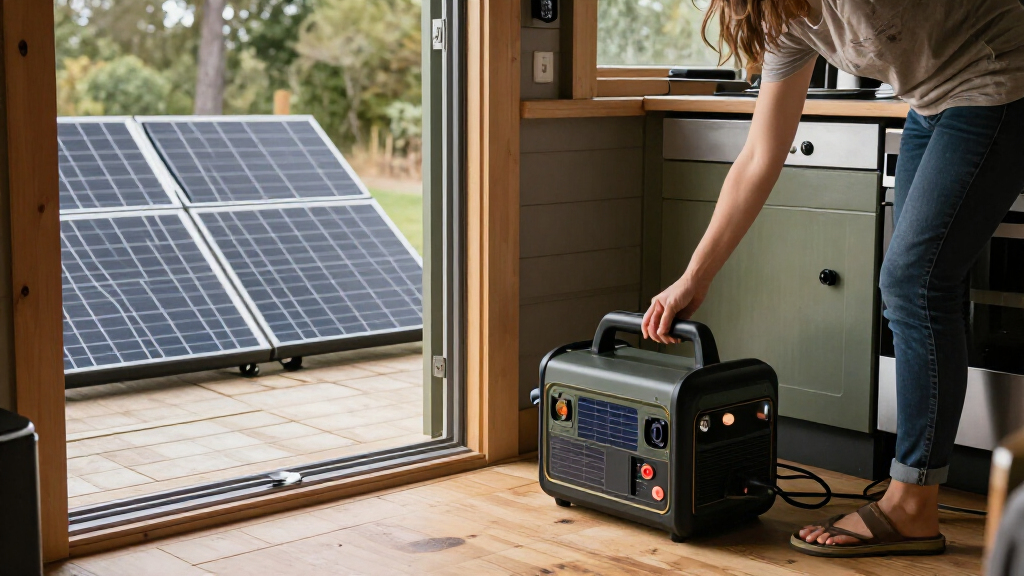

For a tiny home, the best portable solar generator balances usable battery capacity, output for your essential appliances, and a charging setup that fits your available sun and space. I rank the Jackery HomePower 3000 as the best overall because its paired panels and larger capacity suit buyers who want more room for everyday loads. The BLUETTI Elite 200 V2 stands out for buyers who want substantial stored energy, while the DaranEner 600W is a smaller, simpler fit for modest needs. The main tradeoff is between portability and runtime: a compact unit is easier to place but may not cover heavier appliances or long cloudy stretches. Read on for the full comparison, buying criteria, and guidance on matching capacity to your tiny home.

Get compact home essentials delivered free with Prime
- Fast, free delivery on millions of items
- Prime Video, Amazon Music and more included
- Member-only deals all year
Complete the kit


Key Takeaways
The Jackery HomePower 3000 is the balanced pick: it pairs a larger-capacity station with two 200W panels, making it a stronger fit for tiny-home routines than the smaller kits.
The BLUETTI Elite 200 V2 favors stored energy: its 2073.6Wh capacity and two 200W panels make it a standout for buyers who want more reserve than the 768Wh and 1024Wh options provide.
Panel bundles differ as much as batteries: several models include one 200W panel, while the HomePower 3000, Elite 200 V2, Elite 300, and HomePower 3600 Plus bundle two; that affects how much solar input is available, not just the station’s capacity.
Small capacity has a clear use case: the DaranEner‘s 576Wh and 600W output suit lighter loads, but buyers planning to run a fridge or other demanding appliance should check startup power and runtime before choosing it.
More watt-hours do not make a full-home system: portable units can serve selected circuits or essential devices, but sustained heating, cooking, and air-conditioning loads may exceed what these kits can supply.
| Jackery HomePower 3000 Portable Power Station with Two 200W Solar Panels |  | Best Overall for Tiny-Home Backup | Battery capacity: 3,072Wh | Battery chemistry: LiFePO4 | AC output: 3,600W | VIEW LATEST PRICE | See Our Full Breakdown |
| DaranEner 600W 576Wh Portable Power Station with 100W Foldable Solar Panel |  | Best Compact Starter Kit | Battery capacity: 576Wh | Battery chemistry: LiFePO4 | AC output: 600W | VIEW LATEST PRICE | See Our Full Breakdown |
| BLUETTI AC180 Solar Generator with 200W Solar Panel, 1152Wh |  | Best for Fast-Switching Essential Loads | Battery capacity: 1,152Wh | Battery chemistry: LiFePO4 | AC output: 1,800W | VIEW LATEST PRICE | See Our Full Breakdown |
| Anker SOLIX C800X Portable Power Station with 100W Solar Panel, 768Wh |  | Best for Portable Solar Flexibility | Battery capacity: 768Wh | Battery chemistry: LiFePO4 | Peak output: Up to 1,600W | VIEW LATEST PRICE | See Our Full Breakdown |
| BLUETTI Elite 300 Solar Generator Kit with Two 200W Solar Panels |  | Best for Long-Lasting Off-Grid Storage | Battery capacity: 3,014Wh | Battery chemistry: LiFePO4 | Battery cycle life: 6,000+ cycles | VIEW LATEST PRICE | See Our Full Breakdown |
| EBL 2400W Portable Power Station with 200W Solar Panel |  | Best for Many Devices at Once | Battery capacity: 1,843.2Wh | Battery chemistry: LiFePO4 | AC output: 2,400W | VIEW LATEST PRICE | See Our Full Breakdown |
| BLUETTI Elite 100 V2 Solar Generator with 200W Solar Panel, 1024Wh |  | Best for Backup and Compact Power | Battery capacity: 1,024Wh | Power-lifting output: 2,700W | Included solar panel: 200W | VIEW LATEST PRICE | See Our Full Breakdown |
| BLUETTI Elite 200 V2 Solar Generator with Two 200W Solar Panels, 2073.6Wh |  | Best for Solar-Ready Capacity | Battery capacity: 2,073.6Wh | Battery chemistry: LiFePO4 | Continuous AC output: 2,600W | VIEW LATEST PRICE | See Our Full Breakdown |
| Jackery Solar Generator 1000 v2 with 200W Solar Panel |  | Best Compact Pick | Battery capacity: 1,070Wh | Battery type: LFP | AC output: 1,500W | VIEW LATEST PRICE | See Our Full Breakdown |
| Jackery HomePower 3600 Plus Portable Power Station with Two 200W Solar Panels |  | Best for Expandable Home Backup | Battery capacity: 3,584Wh | AC output: 3,600W | Expandable capacity: Up to 21kWh per unit; up to 43kWh with multiple units | VIEW LATEST PRICE | See Our Full Breakdown |
| portable solar generators for tiny home | Battery capacity | Weight | Battery chemistry | AC output |
|---|---|---|---|---|
| Jackery HomePower 3000 Portabl | 3,072Wh | 59.5 pounds | LiFePO4 | 3,600W |
| DaranEner 600W 576Wh Portable | 576Wh | 15.2 pounds | LiFePO4 | 600W |
| BLUETTI AC180 Solar Generator | 1,152Wh | 37.4 pounds | LiFePO4 | 1,800W |
| Anker SOLIX C800X Portable Pow | 768Wh | 24 pounds | LiFePO4 | — |
| BLUETTI Elite 300 Solar Genera | 3,014Wh | — | LiFePO4 | 2,400W |
| EBL 2400W Portable Power Stati | 1,843.2Wh | 55 lb | LiFePO4 | 2,400W |
| BLUETTI Elite 100 V2 Solar Gen | 1,024Wh | — | — | — |
| BLUETTI Elite 200 V2 Solar Gen | 2,073.6Wh | 53.4 lb | LiFePO4 | — |
| Jackery Solar Generator 1000 v | 1,070Wh | 23.8 lb | — | 1,500W |
| Jackery HomePower 3600 Plus Po | 3,584Wh | 77.2 lb | — | 3,600W |
More Details on Our Top Picks
Jackery HomePower 3000 Portable Power Station with Two 200W Solar Panels
For a tiny home that needs to ride through outages, the 3,072Wh capacity, 3,600W AC output, and ≤20ms UPS switching make this the most balanced choice in this group. It can support a broader mix of essential appliances than the smaller DaranEner 600W, while its included two 200W panels give it more solar collection than the single-panel kits here. The tradeoff is portability: at 59.5 pounds, it is better treated as a movable home backup unit than something to carry often. Hybrid AC/DC charging can replenish it in about 1.7 hours, but solar charging with the included panels takes about nine hours to reach 80%. I’d choose it for dependable household coverage, not for the lightest setup.
Pros:- 3,072Wh capacity and 3,600W AC output suit a wider range of household essentials than smaller units.
- UPS switches in 20ms or less to help keep connected devices running during an outage.
- Two included 200W solar panels provide more panel capacity than the single-panel kits in this group.
- LiFePO4 battery is rated for 4,000 cycles to 70% capacity.
Cons:- At 59.5 pounds, it is cumbersome to carry regularly.
- Solar charging takes about nine hours to reach 80% with the included panels.
- The panels and power station may arrive in separate packages.
Best for: Tiny-home residents who want a high-capacity backup for essential appliances, with UPS support and included solar panels.
Not ideal for: Buyers who need to move their power station frequently or prioritize easy one-person carrying; it weighs 59.5 pounds.
- Battery capacity:3,072Wh
- Battery chemistry:LiFePO4
- AC output:3,600W
- Surge output:7,200W
- UPS switching time:≤20ms
- Included solar panels:2 × 200W
- Weight:59.5 pounds
- Solar recharge:Up to 80% in about 9 hours with included panels
Our verdict“Choose the HomePower 3000 if outage coverage and substantial solar capacity matter more than keeping your tiny-home power system lightweight.”
DaranEner 600W 576Wh Portable Power Station with 100W Foldable Solar Panel
The DaranEner is the easiest entry point here for a tiny-home resident who mainly needs to charge electronics and cover a few low-wattage essentials. Its 15.2-pound frame and included 100W foldable panel are far easier to fit into a compact space than the Jackery HomePower 3000, but the smaller battery and 600W AC limit sharply narrow what it can run. A 100W USB-C output is useful for fast-charging compatible devices, while the built-in UPS adds a backup option for small electronics. I would not treat its 576Wh capacity as whole-home storage: it is better as a portable supplemental unit or a first solar setup. Compared with the Anker SOLIX C800X, it is lighter, but offers less capacity and AC output.
Pros:- At 15.2 pounds, it is easier to move and store than the larger home-backup units.
- Includes a 100W foldable solar panel for a ready-to-use small-scale solar setup.
- Two 100W USB-C ports support compatible device charging.
- LiFePO4 battery is rated for more than 3,500 charge cycles.
Cons:- 600W AC output rules out many high-wattage appliances.
- The included panel is limited to 100W, so solar replenishment is modest.
- 576Wh capacity offers limited runtime for multiple household loads.
Best for: Tiny-home owners seeking a lightweight supplemental station for phones, laptops, lights, and other modest loads, with a panel included.
Not ideal for: Buyers who want to run high-wattage appliances or store enough power for extended outages; its 576Wh capacity and 600W AC output are limited.
- Battery capacity:576Wh
- Battery chemistry:LiFePO4
- AC output:600W
- Peak surge:1,200W
- Included solar panel:100W foldable monocrystalline
- USB-C output:100W per port
- Weight:15.2 pounds
- AC charging time:About 1.1 hours
Our verdict“Pick the DaranEner as a compact solar companion for electronics and light loads, not as the main power source for a tiny home.”
BLUETTI AC180 Solar Generator with 200W Solar Panel, 1152Wh
The AC180 fills the middle ground between compact stations and the roughly 3kWh systems in this roundup. Its 1,152Wh battery and 1,800W AC output can cover more than the DaranEner 600W, while staying substantially lighter than the Jackery HomePower 3000 at 37.4 pounds. For a tiny home, the ≤10ms UPS transfer is its clearest distinction: it is a strong fit for sensitive connected essentials that need quick backup switching. AC charging can reach a full charge in about an hour, whereas solar charging ranges from 4.8 to 9.6 hours and the included panel ships separately. I’d favor it for moderate loads and quick AC replenishment; buyers needing longer runtime should step up to the BLUETTI Elite 300.
Pros:- 1,800W AC output supports more substantial loads than the DaranEner 600W.
- UPS transfer time of 10ms or less suits connected essentials that need rapid backup switching.
- AC charging can fully recharge the station in about one hour.
- Five-year warranty and LiFePO4 battery rated for more than 3,000 cycles.
Cons:- Its 1,152Wh capacity provides much less stored energy than the BLUETTI Elite 300 or Jackery HomePower 3000.
- The included 200W solar panel ships separately.
- Solar recharge can take as long as 9.6 hours.
Best for: Tiny-home residents who need UPS backup for sensitive essentials and want more output than a compact starter station can provide.
Not ideal for: Buyers who need multi-day energy storage for several appliances or want the included solar panel delivered with the station in one package.
- Battery capacity:1,152Wh
- Battery chemistry:LiFePO4
- AC output:1,800W
- Peak output:2,700W
- UPS transfer time:≤10ms
- Included solar panel:200W; ships separately
- Weight:37.4 pounds
- AC charging:Up to 1,440W; full charge in about 1 hour
Our verdict“Choose the AC180 for fast UPS response and midrange output, but move to a larger-capacity model if extended tiny-home runtime is the priority.”
Anker SOLIX C800X Portable Power Station with 100W Solar Panel, 768Wh
The SOLIX C800X suits tiny-home owners who want a station they can move between indoor backup and outdoor solar use without jumping to a heavy home-power unit. Its 768Wh capacity is a step above the DaranEner 600W, and its 1,200W rated output with SurgePad support up to 1,600W gives it more appliance flexibility. The included IP67 water-resistant 100W panel is useful when the array must be set up outside, while solar input can reach 300W if you add compatible panel capacity. Still, at 24 pounds it is heavier than the DaranEner, and 768Wh remains a modest reserve beside the BLUETTI AC180. The built-in lights add convenience, but this is a portable utility station, not a long-duration household battery.
Pros:- 1,200W rated output and up to 1,600W SurgePad support handle more loads than the DaranEner 600W.
- Included 100W solar panel has an IP67 water-resistance rating.
- Solar input supports up to 300W for a larger compatible panel setup.
- Built-in lights offer practical illumination without drawing on separate equipment.
Cons:- 768Wh capacity is limited for running several tiny-home appliances over an extended outage.
- At 24 pounds, it is heavier than the DaranEner compact option.
- The included solar panel is rated at 100W, below the 200W panels bundled with some alternatives.
Best for: Tiny-home owners who want a movable station for modest backup loads and outdoor solar charging, with room to add solar input.
Not ideal for: Buyers who need high stored capacity for long outages or a lightweight unit for frequent carrying; it weighs 24 pounds and stores 768Wh.
- Battery capacity:768Wh
- Battery chemistry:LiFePO4
- Peak output:Up to 1,600W
- Included solar panel:100W PS100X
- Maximum solar input:300W
- Solar panel water resistance:IP67
- Weight:24 pounds
Our verdict“Choose the SOLIX C800X if outdoor-ready solar flexibility and stronger output than a starter station matter more than long runtime or low weight.”
BLUETTI Elite 300 Solar Generator Kit with Two 200W Solar Panels
The Elite 300 is the high-capacity choice for tiny homes that value stored energy and long battery life over maximum AC output. Its 3,014Wh LiFePO4 battery and stated 6,000+ cycle life make it a stronger fit for recurring off-grid use than the mid-capacity BLUETTI AC180. Two 200W panels are included, and the TT-30 outlet plus 12V/30A DC port make the kit especially useful for tiny homes that also connect to RV-style equipment. The main compromise is output: at 2,400W, it is below the Jackery HomePower 3000’s 3,600W, so some higher-demand combinations may favor the Jackery. Solar charging is listed at about 7–15 hours, and the panels ship separately, which can complicate setup timing.
Pros:- 3,014Wh capacity provides far more stored energy than the BLUETTI AC180.
- LiFePO4 battery is rated for more than 6,000 cycles.
- Two included 200W solar panels offer a 400W combined panel rating.
- TT-30 RV outlet and 12V/30A DC port support RV-style equipment.
Cons:- 2,400W AC output is lower than the Jackery HomePower 3000’s 3,600W.
- Solar recharge is listed at about 7–15 hours, a broad range that makes planning less precise.
- The solar panels ship separately from the power station.
Best for: Off-grid tiny-home residents who prioritize substantial stored energy, frequent cycling, and RV-compatible connections.
Not ideal for: Buyers who need the highest AC output in this group or want a faster, clearly specified solar recharge window.
- Battery capacity:3,014Wh
- Battery chemistry:LiFePO4
- Battery cycle life:6,000+ cycles
- AC output:2,400W
- Surge power:4,800W
- Included solar panels:2 × 200W
- RV outlet:TT-30
- Solar charging time:About 7–15 hours with included panels
Our verdict“Choose the Elite 300 for high-capacity, frequently cycled off-grid use and RV-ready ports, but select the Jackery HomePower 3000 if higher AC output matters more.”
EBL 2400W Portable Power Station with 200W Solar Panel
I’d put the EBL on the shortlist for a tiny home where several appliances and personal devices may need power at the same time. Its 1,843.2Wh LiFePO4 battery and 2,400W output offer more headroom than the smaller BLUETTI Elite 100 V2, while 12 total outputs make it easier to connect a mixed collection of gear. AC, solar, and combined charging also give you options when sunlight is unreliable. The tradeoff is a 55-pound body that’s awkward to move around a compact living space, and the included 200W panel may need 6–14 hours for a full recharge. The BLUETTI Elite 200 V2 comes with two 200W panels and a larger battery, so it’s a stronger fit for faster solar replenishment; the EBL makes more sense when outlet variety matters more.
Pros:- 1,843.2Wh LiFePO4 battery paired with 2,400W output
- 12 total outlets and charging points for a broad mix of devices
- Can recharge by AC, solar, or combined AC and solar
- Includes a 200W monocrystalline solar panel
Cons:- The included 200W panel may take 6–14 hours to fully recharge the station
- At 55 pounds, it is cumbersome to reposition in a small home
- The solar panel may arrive separately from the power station
Best for: Tiny-home residents who need to run several modest appliances and charge many devices from one station.
Not ideal for: Buyers who need frequent, fast solar refills or a unit that’s easy to carry between rooms; its included panel is 200W and the station weighs 55 pounds.
- Battery capacity:1,843.2Wh
- Battery chemistry:LiFePO4
- AC output:2,400W
- Included solar panel:200W monocrystalline
- Total outputs:12
- USB-C:2 ports, up to 100W PD
- Weight:55 lb
- Solar recharge time:About 6–14 hours with the included 200W panel
Our verdict“Choose the EBL if powering and connecting many devices matters more than easy handling or quick solar recovery.”
BLUETTI Elite 100 V2 Solar Generator with 200W Solar Panel, 1024Wh
For a tiny home that needs a backup for electronics, networking gear, or a few lighter loads, I’d favor the BLUETTI Elite 100 V2 over larger, heavier options. Its 1,024Wh capacity is well below the BLUETTI Elite 200 V2’s 2,073.6Wh, but the smaller reserve can be easier to fit into a tight floor plan. A 10ms UPS switchover helps keep connected equipment running through a brief power interruption, while app control and 30dB silent mode suit indoor use. AC charging takes about 70 minutes, and the battery is rated for over 4,000 cycles to 80% capacity. The clear compromise is limited stored energy for extended appliance use; its 200W solar panel also recharges more slowly than a larger array. I’d skip it if the goal is running high-draw equipment for long stretches.
Pros:- 10ms UPS switchover for connected electronics
- About 70-minute AC recharge time
- 30dB silent mode and Wi-Fi/Bluetooth app connectivity
- LiFePO4 battery rated for over 4,000 cycles to 80% capacity
Cons:- 1,024Wh capacity is limited for sustained appliance use
- The included 200W panel can take up to seven hours for a full solar recharge
- Fast car charging requires the separately mentioned BLUETTI Charger 1
Best for: Tiny-home residents who want quiet, app-managed backup for a router, computer, lights, and other modest loads.
Not ideal for: Buyers who need to run large appliances for extended periods or want more stored energy for cloudy days; its capacity is 1,024Wh.
- Battery capacity:1,024Wh
- Power-lifting output:2,700W
- Included solar panel:200W
- Maximum solar input:1,000W
- AC recharge time:About 70 minutes
- UPS switchover:10ms
Our verdict“Pick the Elite 100 V2 for quiet, responsive backup of smaller loads, not for long-duration whole-home power.”
BLUETTI Elite 200 V2 Solar Generator with Two 200W Solar Panels, 2073.6Wh
The Elite 200 V2 is my pick for tiny-home owners who want substantial battery capacity and a more capable solar kit in one package. Its 2,073.6Wh battery and 2,600W continuous output provide more room for appliance loads than the BLUETTI Elite 100 V2, while the two included 200W panels give it a better starting point for replenishing that larger reserve. Power-lifting mode reaches 3,900W, though that figure is not the same as continuous output. The LiFePO4 battery is rated for over 6,000 cycles, and charging can draw from solar, AC, a car, a lead-acid battery, or a generator. The limitation is portability: at 53.4 pounds, it’s heavy to shift in a compact home, and it offers four power outlets. The Jackery HomePower 3600 Plus stores substantially more energy, but is heavier still.
Pros:- 2,073.6Wh LiFePO4 battery for a larger stored-energy reserve
- 2,600W continuous AC output with 3,900W power-lifting mode
- Includes two 200W solar panels
- Rated for over 6,000 battery cycles
Cons:- 53.4-pound weight makes it difficult to move frequently
- Four power outlets may limit simultaneous AC connections
- Solar panels may ship separately from the power station
Best for: Tiny-home residents who want a high-capacity station, meaningful AC output, and two 200W panels for regular solar charging.
Not ideal for: Buyers who need a lightweight station or many separate AC outlets; this unit weighs 53.4 pounds and lists four power outlets.
- Battery capacity:2,073.6Wh
- Battery chemistry:LiFePO4
- Continuous AC output:2,600W
- Power-lifting output:3,900W
- Included solar panels:2 × 200W
- Power outlets:4
- Weight:53.4 lb
- Charging sources:Solar, AC, car, lead-acid battery, and generator
Our verdict“Choose the Elite 200 V2 for a strong balance of battery capacity, output, and included solar, if you can accommodate its weight.”
Jackery Solar Generator 1000 v2 with 200W Solar Panel
In a tiny home, a power station’s footprint and handling can matter as much as its capacity. The Jackery Solar Generator 1000 v2 weighs 23.8 pounds, making it far easier to lift or tuck away than the 53.4-pound BLUETTI Elite 200 V2. Its 1,070Wh LFP battery and 1,500W AC output suit smaller appliances, lighting, and device charging, while the included 200W panel offers a way to recharge away from the grid. App-controlled charging modes add useful control, though the fastest one-hour charging mode requires enabling emergency charging in the app. Capacity is the main compromise: it holds roughly half the energy of the Elite 200 V2, so longer appliance runs will require careful load choices. I’d choose this Jackery for a mobile, space-conscious setup, not as the main source for heavy daily loads.
Pros:- 23.8-pound weight is easier to handle than the larger-capacity stations here
- 1,070Wh LFP battery with 1,500W AC output
- Includes a 200W solar panel
- App-controlled charging modes and 100W USB-C output
Cons:- Lower capacity than the BLUETTI Elite 200 V2 limits longer appliance runs
- One-hour charging requires emergency charging to be enabled in the app
- Generator and solar panel may ship separately
Best for: Tiny-home residents who need a liftable backup for lights, electronics, and selected small appliances, and value easy storage.
Not ideal for: Buyers who want extended runtimes for larger appliances or a large buffer for several cloudy days; its 1,070Wh capacity is modest beside the Elite 200 V2.
- Battery capacity:1,070Wh
- Battery type:LFP
- AC output:1,500W
- Surge peak:3,000W
- Included solar panel:200W
- Weight:23.8 lb
- Ports:3 AC, 2 USB-C, 1 USB-A, and 1 DC car port
- Battery lifespan:Over 70% capacity after 4,000 charge cycles
Our verdict“Pick the Jackery 1000 v2 when low weight and easy storage matter more than long runtimes or high-capacity backup.”
Jackery HomePower 3600 Plus Portable Power Station with Two 200W Solar Panels
For a tiny home that needs more than a portable battery for occasional outages, the HomePower 3600 Plus offers the largest capacity in this group: 3,584Wh, with expansion options listed up to 21kWh per unit and up to 43kWh with multiple units. Its 3,600W output and 120V/240V support when units are connected in parallel give it a different job from the compact Jackery Solar Generator 1000 v2, which is much easier to lift but stores far less energy. The wheeled design and telescopic handle help with rolling it into place, though 77.2 pounds is still a serious lift. Multiple charging routes, including hybrid AC and DC, offer flexibility, but the size and expansion focus may be excessive for a small home with modest backup needs. Solar panels may also arrive separately.
Pros:- 3,584Wh capacity and 3,600W AC output
- Expandable capacity up to 21kWh per unit or 43kWh with multiple units
- Supports AC, solar, gas-generator, and hybrid charging
- Wheels and a telescopic handle aid repositioning
Cons:- 77.2-pound weight makes lifting and stair transport difficult
- Large capacity and expansion options may be excessive for a small backup setup
- Power station and solar panels may arrive in separate packages
Best for: Tiny-home owners planning substantial outage backup or future capacity expansion, with enough room to park a large wheeled unit.
Not ideal for: Residents with limited storage, frequent stair moves, or only modest backup loads; it weighs 77.2 pounds and may be more capacity than they need.
- Battery capacity:3,584Wh
- AC output:3,600W
- Expandable capacity:Up to 21kWh per unit; up to 43kWh with multiple units
- Voltage:120V; 240V in parallel
- Included solar panels:2 × 200W
- Charging time:2 hours hybrid AC and DC; 2.5 hours AC or gas generator; 4 hours solar
- Weight:77.2 lb
- Battery cycle life:6,000 cycles
Our verdict“Choose the HomePower 3600 Plus for expandable, high-output backup if its size and weight fit your tiny-home layout.”

How We Picked
I ranked these ten kits for tiny-home use, not for camping convenience alone. I compared listed battery capacity and output against likely household needs, including how a unit might handle everyday electronics, refrigeration, and brief higher-power demands. I also considered the included solar-panel wattage, since a kit’s charging potential affects how useful it can be away from grid power. Bundle size matters, but it does not replace checking real appliance draw or local sunlight.
The ranking favors options that offer a practical balance of stored energy, output, and bundled solar input for a small home’s essential loads. Larger-capacity models rank ahead when their additional reserve makes a meaningful difference, while compact and lower-capacity choices remain useful for lighter needs or tighter space. I also accounted for the tradeoff between a more capable system and the added space, weight, and setup effort that can come with it. These products are portable power stations with solar panels, not automatic substitutes for a professionally designed, whole-home electrical system.
Factors to Consider When Choosing Portable Solar Generators For Tiny Homes
Before choosing a kit, I would start with the appliances you actually expect it to run and the time you need them powered. Capacity, output, and solar recharge are separate limits, so a large battery alone does not settle the question. These factors help narrow the field without assuming that every tiny home has the same loads or sunlight.
Match Battery Capacity to Your Essential Loads
List the devices you need during an outage or off-grid day, then estimate their wattage and hours of use. A battery’s watt-hour rating is stored energy, not a promise that every appliance can run for a full day; conversion losses and changing loads reduce the usable amount. A 576Wh option can suit charging electronics and selected low-draw devices, while larger-capacity models provide more reserve for refrigeration and longer use. Avoid adding every appliance’s rated wattage as if it runs continuously, but do not assume a fridge draws its label rating only once. Track actual energy use over a normal day if possible, then size the battery around the loads you cannot comfortably give up.
Check Running and Startup Output Separately
The station’s output rating limits which appliances it can power at once, while some motors briefly demand extra power when starting. Refrigerators, pumps, and tools can have startup surges that exceed their ordinary running draw. Compare both the appliance’s running watts and its starting requirement with the power station’s specifications before buying. A larger battery does not fix an output limit, and a high wattage rating does not mean the battery will run a load for long. For a tiny home, separate essential circuits from occasional high-draw appliances rather than assuming one portable unit can support everything together.
Plan Solar Charging Around Real Conditions
Panel wattage describes rated input under favorable conditions, not a guaranteed daily energy yield. Roof orientation, shade, season, panel angle, and cloudy weather all affect how much power reaches the station. A bundled 400W array can offer more potential input than a single 100W or 200W panel, but it also needs more clear space and careful placement. Check the station’s supported solar input and connector requirements before adding panels; buying more panel capacity than the unit can accept may not speed charging. If your home has regular shade or short winter days, plan for lower production and keep a backup charging method in mind.
Account for Space, Weight, and Daily Handling
A portable power station still has to fit somewhere accessible, with room for safe operation and cable routing. In a tiny home, the footprint of the unit and the area needed to position its solar panels can matter as much as its battery size. Larger systems can reduce the need to ration power, but they are generally less convenient to move and store than compact choices. Think through whether you will carry the station outdoors to charge, move it between rooms, or leave it in a fixed location. Do not choose a small unit only because it looks easier to handle if its limited capacity would force frequent charging or restrict essential use.
Decide Whether You Need Portable Backup or Home Integration
Portable solar generators are best treated as flexible power sources for selected devices or loads, not as a direct replacement for a home’s electrical service. Connecting a station to household wiring can require compatible equipment and a qualified electrician; never backfeed a home circuit through an ordinary outlet. Buyers who want automatic backup, larger loads, or integration with rooftop solar should check whether a portable kit supports the needed connection method, and compare it with a purpose-built home battery system. For renters or owners who want movable backup for a fridge, lights, and communications, a standalone station may be simpler. The right choice depends on whether portability or whole-home operation matters more.
Pay for Capacity You Can Use, Not a Bigger Number
Moving up to a larger station makes sense when its added capacity or output solves a specific gap in your load plan. If your routine is mostly lights, phones, and a laptop, paying for a very large battery can add bulk without improving daily comfort. On the other hand, stretching a small station across refrigeration, pumps, and several devices may leave too little reserve for poor solar days. Compare the complete kit, including panel count and wattage, rather than judging the power station alone. I would also check the product’s warranty, battery chemistry, charging limits, and service support before treating a larger specification as better long-term value.
Frequently Asked Questions
Can one of these portable solar generators power an entire tiny home?
Usually, a portable station is better suited to selected essential loads than every circuit in a tiny home. Refrigeration, lights, internet equipment, and device charging may be manageable when their combined draw fits the unit’s output and stored energy. Electric heat, air conditioning, water heating, and cooking can consume power quickly or exceed the station’s output. Make a load list and check both running and startup watts before expecting whole-home coverage. If you need automatic backup or sustained power for several large appliances, compare these kits with a professionally designed home storage system.
How much battery capacity should I choose for a tiny home?
There is no reliable capacity target without knowing which appliances you will run and for how long. Estimate daily energy use in watt-hours for essential devices, then add a reserve for conversion losses, changing conditions, and cloudy weather. The 576Wh DaranEner is aimed at lighter needs, while the 1024Wh and 2073.6Wh BLUETTI options provide progressively more stored energy. Do not use battery capacity as a stand-in for output: a station can have enough watt-hours but still be unable to start a high-draw appliance. If possible, measure a typical day’s consumption before selecting a size.
Are two 200W solar panels enough to recharge a station each day?
Two 200W panels provide a higher rated input than a single panel, but they do not guarantee a full recharge every day. Actual solar collection changes with weather, season, shade, panel angle, and the station’s own charging limits. A larger battery can take longer to refill than a smaller one even when both receive the same sunlight. Compare the station’s maximum solar input with the panel bundle, then estimate production using your location’s typical sun conditions. If your energy use is close to your daily solar harvest, you may need lower consumption, more compatible panels, or another charging source.
Can these stations run a refrigerator overnight?
Potentially, but the answer depends on the refrigerator’s actual energy use, its startup surge, and the station’s usable capacity and output. A fridge cycles on and off, so multiplying its running watts by every hour can overstate use, while relying on the label alone can understate it. Check the refrigerator’s energy consumption or measure it with a suitable meter, then compare that figure with the station’s watt-hours. Leave capacity for other essential devices and account for cloudy-day recharging. A compact station may manage a low-draw fridge for a limited period, but a larger battery offers more reserve.
Should I choose a larger battery or more solar panels?
Choose a larger battery when you need more stored energy for nights, cloudy periods, or longer stretches without charging. Choose more panel capacity when the station supports it and your main problem is replacing the energy you use during the day. These upgrades address different limits, so one cannot always substitute for the other. A big battery with too little solar input can remain depleted, while a large panel array cannot power loads after sunset without enough stored energy. Start with your daily consumption and local solar conditions, then check the station’s maximum solar input before adding panels.
Conclusion
For the broadest mix of tiny-home essentials and bundled solar input, I recommend the Jackery HomePower 3000 as best overall. The DaranEner 600W is the value-minded choice for modest loads and buyers who do not need a large reserve, while the BLUETTI Elite 200 V2 is my premium pick for those prioritizing substantially more stored energy. Beginners with light needs can start with the straightforward, smaller-scale Jackery Solar Generator 1000 v2, provided its capacity matches their appliance list. For buyers focused on a compact setup, compare the lower-capacity DaranEner and the Anker SOLIX C800X; for greater capacity and a two-panel bundle, consider the Jackery HomePower 3600 Plus or BLUETTI Elite 300. Before choosing any of them, confirm appliance startup needs, expected daily energy use, and whether the station can accept the solar input you plan to provide.
Veterans Day Picks

Shark Matrix Plus 2-in-1 Robot Vacuum and Mop with 60-Day Self-Emptying Base
As an affiliate, we earn on qualifying purchases.