The best tiny house propane heater overall in this roundup is the Mr. Heater 10,000 BTU Blue Flame Vent-Free Heater, which pairs thermostat control with steady convection-style heat. The ProCom 10,000 BTU Blue Flame Heater is a close alternative for buyers who want a similar fixed-style setup, while the Mr. Heater 9,000 BTU Portable Buddy suits people who value portability. The main tradeoff is between a heater designed for a more settled installation and a portable radiant model that can be moved but may be less suited to unattended, continuous heating. Tiny homes also call for careful attention to ventilation, clearances, and manufacturer-approved indoor use. Read on for the full breakdown and guidance on matching a heater to your layout.
Key Takeaways
- Blue-flame heaters lead for steady room heating: The Mr. Heater and ProCom 10,000 BTU blue-flame models are the clearest fits for buyers who want thermostat-controlled convection heat rather than a portable spot heater.
- Portable Buddy models prioritize mobility: The 9,000 BTU Buddy and Buddy Midnight are more adaptable around a small home, while their radiant output is better suited to direct warmth than even whole-room heating.
- Two product names do not mean two distinct heating approaches: The standard and Midnight versions of the Buddy and Little Buddy lines share the same core portable radiant use case, so buyers should compare the specific configuration and instructions.
- Cabinet heaters trade compact storage for higher output: The Avenger and VEVOR offer more output settings, but their larger format makes placement and clearance planning more demanding in a tiny interior.
- Indoor suitability cannot be inferred from BTU or a safety feature: Product labeling, ventilation requirements, and the manual matter more than output alone, especially when comparing indoor-oriented vent-free models with an outdoor cabinet heater.
| Mr. Heater 10,000 BTU Blue Flame Propane Vent Free Heater |  | Best for Fixed Small-Room Heating | Heat output: 10,000 BTU | Heating coverage: 250 sq. ft. in specs; description states up to 300 sq. ft. | Fuel: Propane | VIEW LATEST PRICE | See Our Full Breakdown |
| ProCom Heating Liquid Propane Ventless Infrared Plaque Heater with Base Feet – 10,000 BTU, Thermostat Control |  | Best for Thermostat-Controlled Radiant Heat | Heat output: 10,000 BTU | Heating area: Up to 500 sq. ft. (stated) | Fuel: Liquid propane | VIEW LATEST PRICE | See Our Full Breakdown |
| Mr. Heater Little Buddy Midnight Series Portable Radiant Propane Heater |  | Best Compact Spot Heater | Heat output: 3,800 BTU | Heating coverage: Up to 95 sq. ft. | Fuel: Propane | VIEW LATEST PRICE | See Our Full Breakdown |
| Avenger Portable Outdoor Propane Cabinet Heater – 18,000 BTU Radiant Gas Heater with Safety Shut-Off |  | Best for Outdoor Living Areas | Heat settings: 6,000 / 12,000 / 18,000 BTU | Maximum heat output: 18,000 BTU | Coverage area: Up to 450 sq. ft. (stated) | VIEW LATEST PRICE | See Our Full Breakdown |
| Mr. Heater 9,000 BTU Portable Buddy Radiant Propane Heater |  | Best Portable Indoor/Outdoor Option | Heat output: Up to 9,000 BTU | Heating coverage: Up to 225 sq. ft. (stated) | Heating method: Radiant | VIEW LATEST PRICE | See Our Full Breakdown |
| Mr. Heater 9,000 BTU Portable Buddy Midnight Series Radiant Propane Heater |  | Best Portable Heater for a Small Tiny House | Heat output: 9,000 BTU | Listed coverage: Up to 225 sq. ft. | Fuel: Propane | VIEW LATEST PRICE | See Our Full Breakdown |
| ProCom Liquid Propane Ventless Ice House Heater – 10,000 BTU, Thermostat Control |  | Best for Thermostat Control in a Ventilated Outbuilding | Heat output: 10,000 BTU | Listed coverage: Up to 300 sq. ft. | Fuel: Propane | VIEW LATEST PRICE | See Our Full Breakdown |
| VEVOR Propane Heater, 6000 to 18000 BTU Cabinet Heater with 3 Modes, Tip-over Protection, for Indoor/Outdoor Use |  | Best High-Output Portable Option | Heat output: 6,000 to 18,000 BTU | Listed coverage: Up to 450 sq. ft. | Fuel: Propane | VIEW LATEST PRICE | See Our Full Breakdown |
| Mr. Heater Little Buddy Portable Radiant Propane Heater | 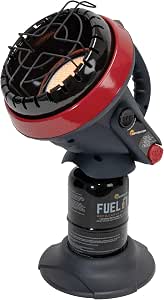 | Best for Personal Spot Heat | Heat output: 3,800 BTU | Listed coverage: Up to 95 sq. ft. | Fuel: Propane | VIEW LATEST PRICE | See Our Full Breakdown |
| ProCom Heating Liquid Propane Ventless Blue Flame Heater with Base Feet – 10,000 BTU, Thermostat Control |  | Best Fixed Indoor Supplement | Heat output: 10,000 BTU | Listed coverage: Up to 500 sq. ft. | Fuel: Propane | VIEW LATEST PRICE | See Our Full Breakdown |
| tiny house propane heater | Fuel | Heat output | Heating method | Safety features |
|---|---|---|---|---|
| Mr. Heater 10,000 BTU Blue Fla | Propane | 10,000 BTU | Blue-flame convection | Oxygen-depletion sensor and low-oxygen shut-off |
| ProCom Heating Liquid Propane | Liquid propane | 10,000 BTU | Radiant infrared plaque | — |
| Mr. Heater Little Buddy Midnig | Propane | 3,800 BTU | Radiant | Oxygen-depletion sensor and tip-over shut-off |
| Avenger Portable Outdoor Propa | Propane | — | — | Tip-over shut-off and oxygen-depletion sensor |
| Mr. Heater 9,000 BTU Portable | Propane | Up to 9,000 BTU | Radiant | — |
| Mr. Heater 9,000 BTU Portable | Propane | 9,000 BTU | Radiant | Low-oxygen shutoff and tip-over protection |
| ProCom Liquid Propane Ventless | Propane | 10,000 BTU | Radiant | Oxygen depletion sensor and automatic shutoff |
| VEVOR Propane Heater | Propane | 6,000 to 18,000 BTU | Radiant | Tip-over and flameout protection |
| Mr. Heater Little Buddy Portab | Propane | 3,800 BTU | Radiant | Tip-over shutoff and low-oxygen shutoff |
| ProCom Heating Liquid Propane | Propane | 10,000 BTU | Forced air | Oxygen depletion sensor and overheat protection |
More Details on Our Top Picks
Mr. Heater 10,000 BTU Blue Flame Propane Vent Free Heater
For a tiny house with a dedicated spot for supplemental heat, this Mr. Heater makes more sense than the portable Buddy models: its 10,000 BTU blue-flame convection output is intended for a small room, and it can be wall-mounted or used freestanding. Piezo ignition keeps startup simple, while the oxygen-depletion sensor adds a safety shut-off feature. The supplied coverage figures differ—300 square feet in the description and 250 square feet in the specs—so I would treat it as a room heater, not a promise to heat an entire tiny house. Unlike the thermostat-controlled ProCom infrared model, this listing does not specify thermostat control. It also burns propane indoors without a vent, so it is a poor fit for buyers seeking a vented appliance or a heater to run without careful attention to the manufacturer’s ventilation and safety requirements.
Pros:- 10,000 BTU output is suited to supplemental heat in a small room.
- Wall-mount and freestanding options give placement flexibility.
- Piezo ignition avoids a separate electrical power source.
- Includes an oxygen-depletion sensor and low-oxygen shut-off.
Cons:- Listed coverage conflicts between 250 and 300 square feet, making exact sizing uncertain.
- Propane-only operation requires an appropriate fuel supply.
- Vent-free indoor use calls for careful adherence to ventilation and safety instructions.
Best for: Tiny-house owners who want a wall-mountable supplemental heater for one small room and have a suitable propane setup.
Not ideal for: Buyers who need whole-home heat, thermostat control, or a vented heater, or who cannot meet the appliance’s indoor safety and ventilation requirements.
- Heat output:10,000 BTU
- Heating coverage:250 sq. ft. in specs; description states up to 300 sq. ft.
- Fuel:Propane
- Heating method:Blue-flame convection
- Mounting:Wall-mounted or freestanding
- Safety features:Oxygen-depletion sensor and low-oxygen shut-off
- Dimensions:11.42 × 15.35 × 21.57 in.
- Weight:13.4 lb.
Our verdict“Choose this for fixed, supplemental heat in one small room; skip it if you need thermostat control or whole-house coverage.”
ProCom Heating Liquid Propane Ventless Infrared Plaque Heater with Base Feet – 10,000 BTU, Thermostat Control
The ProCom’s main advantage over the Mr. Heater blue-flame model is thermostat control: it gives buyers a way to regulate room warmth rather than relying on a fixed output description. Its 10,000 BTU radiant plaque sends heat toward nearby people and surfaces, which can suit a compact living area where occupants stay in one zone. It can stand on base feet or mount on a wall, and it does not require electricity, a practical distinction during outages. The stated coverage reaches 500 square feet, but actual comfort depends on the space and conditions, so I would not size it as guaranteed whole-house heat. Compared with the portable Mr. Heater Buddy, it is a more stationary room-heating choice, not a take-along heater. It remains propane-fueled and ventless, with no remote or digital display listed.
Pros:- Thermostat control offers more regulation than the Mr. Heater blue-flame model’s listed controls.
- Radiant heat can warm occupants and nearby surfaces directly.
- Wall-mount or base-feet placement suits different small-room layouts.
- Operates without electricity, including during power outages.
Cons:- Requires propane fuel and a suitable supply.
- No remote control or digital display is listed.
- Ventless indoor operation requires careful attention to the product’s safety and ventilation instructions.
Best for: Tiny-house residents who want a stationary radiant heater with thermostat control and a no-electricity operating option.
Not ideal for: Buyers who need a portable heater, remote controls, or a vented appliance, or who cannot accommodate indoor ventless-heater safety requirements.
- Heat output:10,000 BTU
- Heating area:Up to 500 sq. ft. (stated)
- Fuel:Liquid propane
- Heating method:Radiant infrared plaque
- Controls:Thermostat control
- Mounting:Wall or floor with base feet
- Power:Gas-powered; no electricity required
- Overheat protection:Yes
Our verdict“Pick this when thermostat-regulated radiant heat matters more than portability or digital controls.”
Mr. Heater Little Buddy Midnight Series Portable Radiant Propane Heater
At 3,800 BTU and a stated 95-square-foot coverage area, the Little Buddy is the lineup’s clearest choice for targeted warmth rather than heating a tiny house’s main living area. Its compact, floor-standing format and lack of an electrical requirement make it easier to move than either 10,000 BTU wall-mountable room heater. The tip-over shut-off and oxygen-depletion sensor are useful protections, but they do not change the product’s listed limits: it is suited to camping and small zones, and it uses 1 lb. propane tanks that may need frequent replacement. Compared with the 9,000 BTU Portable Buddy, this model gives up substantial output and coverage for a smaller-scale role. The supplied description says indoor and outdoor use, but also flags restrictions in Canada and Massachusetts; buyers should check local rules and product instructions before indoor use.
Pros:- Compact 3,800 BTU output suits targeted heating in a small area.
- Portable floor-standing design is easier to reposition than wall-mounted heaters.
- Tip-over shut-off and oxygen-depletion sensor are included.
- Runs without electricity.
Cons:- 95-square-foot stated coverage is limited for most tiny-house living areas.
- Uses 1 lb. propane tanks, which can require frequent replacement.
- Indoor use is not approved in Canada or Massachusetts, according to the supplied product data.
Best for: Tiny-house owners seeking portable, low-output radiant warmth for a small occupied zone or outdoor use.
Not ideal for: Anyone trying to heat a main room, wanting longer runs from a larger fuel supply, or living where indoor use is not approved.
- Heat output:3,800 BTU
- Heating coverage:Up to 95 sq. ft.
- Fuel:Propane
- Heating method:Radiant
- Mounting:Floor-standing
- Safety features:Oxygen-depletion sensor and tip-over shut-off
- Recommended uses:Camping and tent use
- Warranty:3-year limited
Our verdict“Choose the Little Buddy for portable spot heat, not as the primary heater for a tiny house.”
Avenger Portable Outdoor Propane Cabinet Heater – 18,000 BTU Radiant Gas Heater with Safety Shut-Off
This Avenger is the strongest option here for warming an outdoor area, with three heat settings from 6,000 to 18,000 BTU and casters for moving it around a patio or work area. That flexibility gives it a different role from the indoor-oriented Mr. Heater blue-flame and ProCom plaque heaters, but the distinction is firm: its listed use is outdoors only, so it should not be treated as a tiny-house interior heater. A standard 20 lb. propane tank supports the stated runtime of up to 72 hours on low, though runtime varies by setting and conditions. Tip-over shut-off, an oxygen-depletion sensor, and push-and-turn piezo ignition are included. The steel cabinet and mobility add convenience, but its larger fuel-tank requirement makes it less suitable for buyers prioritizing a compact indoor setup.
Pros:- Three heat settings allow adjustment from 6,000 to 18,000 BTU.
- Casters make the cabinet easier to move across an outdoor area.
- Tip-over shut-off and oxygen-depletion sensor are included.
- Stated runtime is up to 72 hours on low with a standard 20 lb. tank.
Cons:- Outdoor-only use rules it out for heating a tiny-house interior.
- Requires a standard 20 lb. propane tank.
- At 8.35 kg, it is heavier than the portable Buddy-style heaters.
Best for: Tiny-house owners who need adjustable radiant warmth for an outdoor patio, porch, or work area.
Not ideal for: Anyone shopping for an interior tiny-house heater, or buyers who need a unit that runs from small disposable propane bottles.
- Heat settings:6,000 / 12,000 / 18,000 BTU
- Maximum heat output:18,000 BTU
- Coverage area:Up to 450 sq. ft. (stated)
- Fuel:Propane
- Runtime:Up to 72 hours on low
- Tank:Standard 20 lb. propane tank
- Safety features:Tip-over shut-off and oxygen-depletion sensor
- Dimensions and weight:15 × 10 × 22 in.; 8.35 kg
- Usage:Outdoor only
Our verdict“Buy this for adjustable outdoor warmth near a tiny house, not for indoor heating.”
Mr. Heater 9,000 BTU Portable Buddy Radiant Propane Heater
The Portable Buddy offers a middle ground between the 3,800 BTU Little Buddy and fixed 10,000 BTU room heaters: up to 9,000 BTU, two heat settings, and a portable body weighing 7.1 pounds. That makes it useful when a tiny-house owner wants one heater for occasional outdoor warmth and limited indoor supplemental use, subject to the product’s instructions and local requirements. Its radiant output is aimed at warming people and nearby surfaces, rather than providing the wall-mounted room-heating setup of the Mr. Heater blue-flame model. The main compromise is fuel endurance: the supplied data says a 1 lb. bottle lasts about three hours on high, so regular use can mean frequent bottle changes. The listed 225-square-foot coverage is also a guide, not a guarantee that it will heat an entire tiny house evenly.
Pros:- Portable 7.1 lb. design is easier to move than the fixed 10,000 BTU heaters.
- Two settings provide a choice of heat output.
- Oxygen-depletion sensor and tip-over switch are listed safety features.
- Suitable for indoor and outdoor use according to the supplied product data.
Cons:- A 1 lb. propane bottle lasts about three hours on high, according to the supplied data.
- Stated 225-square-foot coverage may not provide even heat throughout a tiny house.
- Propane bottles require replenishment for continued operation.
Best for: Tiny-house owners who want a portable heater for occasional spot warmth indoors or outdoors and can manage small propane bottles.
Not ideal for: Buyers seeking continuous primary heat, long runtime between refills, or fixed wall-mounted room heating.
- Heat output:Up to 9,000 BTU
- Heating coverage:Up to 225 sq. ft. (stated)
- Heating method:Radiant
- Fuel:Propane
- Heat settings:2
- Weight:7.1 lb.
- Dimensions:7.7 × 13.4 × 15 in.
- Warranty:1-year limited
Our verdict“Choose the Portable Buddy for flexible, occasional spot heating; look elsewhere for steady whole-room heat or longer runs.”
Mr. Heater 9,000 BTU Portable Buddy Midnight Series Radiant Propane Heater
For a tiny-house owner who needs movable spot heat rather than a permanent room heater, the Portable Buddy Midnight Series offers a useful middle ground: it reaches 9,000 BTU and is rated for spaces up to 225 sq. ft., yet weighs 7.1 pounds. Its two heat settings let me adjust output, unlike the smaller Little Buddy, which has no adjustable setting. The tradeoff is that it still relies on propane and may need extra accessories for longer runtimes, so it is less convenient as a fixed daily heat source than the ProCom 10,000 BTU ventless blue flame heater. Although the description lists indoor use, approval varies by location, and this model is not approved for indoor use in Canada or Massachusetts. I would treat it as supplemental heat and check local rules before use.
Pros:- Up to 9,000 BTU with two heat settings for adjustable spot heating
- 7.1-pound weight makes it easier to move than the 15-pound ProCom Ice House Heater
- Radiant heat suits direct, nearby warming
- Includes low-oxygen shutoff and tip-over protection
Cons:- 225 sq. ft. coverage may not warm a larger or poorly insulated tiny house evenly
- Propane supply and possible added accessories complicate extended runtime
- Indoor use is not approved in Canada or Massachusetts
Best for: Tiny-house owners who want a lightweight, movable heater for occasional supplemental warmth in a small space, garage, or outdoor area.
Not ideal for: People seeking a fixed primary heater for a larger tiny house, or residents in Canada or Massachusetts who need an indoor-approved option.
- Heat output:9,000 BTU
- Listed coverage:Up to 225 sq. ft.
- Fuel:Propane
- Heat settings:2
- Heating method:Radiant
- Weight:7.1 pounds
- Dimensions:8.39″ D x 13.39″ W x 15.16″ H
- Safety features:Low-oxygen shutoff and tip-over protection
Our verdict“Choose this Buddy for portable supplemental heat in a compact tiny house, but not as a universal fixed heating solution.”
ProCom Liquid Propane Ventless Ice House Heater – 10,000 BTU, Thermostat Control
The ProCom Ice House Heater pairs 10,000 BTU output with thermostat control, making it a better fit than the Mr. Heater Little Buddy when a small outbuilding needs steadier heat rather than a brief burst aimed at one person. Its listed coverage reaches 300 sq. ft., and the included 10-foot hose and regulator simplify connecting the propane supply. That convenience does not make it a straightforward choice for every tiny house: the product is designed primarily for outdoor or well-ventilated spaces, and its ventless operation calls for careful attention to the setting and local requirements. At 15 pounds, it is also less appealing to move around than the 7.1-pound Portable Buddy. I would choose it for a ventilated hunting shack or similar space, not as an automatic indoor living-area heater.
Pros:- Thermostat control supports steadier heat than the single-setting Little Buddy
- Listed coverage of up to 300 sq. ft.
- Includes a 10-foot hose and regulator for setup
- Oxygen depletion sensor and automatic shutoff are listed safety features
Cons:- Designed primarily for outdoor or well-ventilated spaces, limiting its fit for enclosed living areas
- At 15 pounds, it is heavier than the Portable Buddy Midnight Series
- Propane is the only listed fuel source
Best for: Owners of a ventilated ice house, hunting shack, or outbuilding who want thermostat-controlled propane heat and an included hose and regulator.
Not ideal for: Tiny-house residents looking for a clearly suited primary heater for an enclosed living area, or anyone who prioritizes low weight and frequent portability.
- Heat output:10,000 BTU
- Listed coverage:Up to 300 sq. ft.
- Fuel:Propane
- Heating method:Radiant
- Control:Thermostat
- Weight:15 pounds
- Dimensions:7″ D x 14″ W x 19″ H
- Included components:Heater, 10-foot hose, and regulator
- Safety features:Oxygen depletion sensor and automatic shutoff
Our verdict“Pick this ProCom for a ventilated shack where thermostat control and the included hose matter more than compact portability.”
VEVOR Propane Heater, 6000 to 18000 BTU Cabinet Heater with 3 Modes, Tip-over Protection, for Indoor/Outdoor Use
When a tiny house also needs heat for a garage, patio, or other larger semi-open area, the VEVOR cabinet heater offers the broadest output range in this batch: three settings span 6,000 to 18,000 BTU, with listed coverage up to 450 sq. ft. That makes it more adaptable than the Mr. Heater Portable Buddy Midnight Series, whose 9,000 BTU ceiling and 225 sq. ft. rating suit smaller zones. The difference comes with a practical cost in space and setup: this unit stands 23.03 inches tall, weighs 13.5 pounds, and needs a propane tank. Rolling wheels help with repositioning, but they do not make it a compact heater. Its description favors outdoor or semi-outdoor use, so I would not treat its indoor-use listing as a substitute for checking safety guidance and local rules.
Pros:- Three settings cover a wide 6,000-to-18,000-BTU output range
- Listed coverage reaches 450 sq. ft., more than the Portable Buddy Midnight Series
- Rolling wheels make repositioning easier
- Tip-over and flameout protection are listed
Cons:- Cabinet dimensions and 13.5-pound weight take more room than compact radiant models
- Requires a separate propane tank setup
- Designed mainly for outdoor or semi-outdoor use, so indoor suitability needs careful checking
Best for: Tiny-house owners who need adjustable, higher-output heat for a garage, patio, or semi-open area and can accommodate a cabinet-style unit.
Not ideal for: People with very limited floor space, those wanting a lightweight heater for frequent carrying, or anyone needing a primary heater specifically suited to an enclosed living area.
- Heat output:6,000 to 18,000 BTU
- Listed coverage:Up to 450 sq. ft.
- Fuel:Propane
- Heating method:Radiant
- Heat settings:3
- Weight:13.5 pounds
- Dimensions:17.48″ D x 14.96″ W x 23.03″ H
- Safety features:Tip-over and flameout protection
Our verdict“Choose the VEVOR when adjustable high output for a larger semi-open zone matters more than a compact footprint or enclosed-room suitability.”
Mr. Heater Little Buddy Portable Radiant Propane Heater
The Little Buddy is the smallest, lowest-output choice here: 3,800 BTU, a 95 sq. ft. listed coverage area, and a 5.6-pound weight. That combination suits a tiny-house occupant who wants portable warmth near a desk or sleeping area, rather than an appliance meant to heat the whole home. Compared with the Portable Buddy Midnight Series, it is lighter and simpler to start thanks to one-button ignition, but it gives up both heat output and adjustable settings. Its reliance on a 1-pound propane cylinder also makes it less suited to long stretches of routine heating. Tip-over and low-oxygen shutoffs add useful protections, but the compact size does not remove the need to follow the product’s safety instructions and local rules for indoor use.
Pros:- At 5.6 pounds, it is lighter than the Portable Buddy Midnight Series
- One-button ignition simplifies startup
- Compact size suits personal spot heating and limited storage
- Includes tip-over and low-oxygen shutoffs
Cons:- 95 sq. ft. coverage and 3,800 BTU are limited for whole-room heating
- No adjustable heat settings
- Requires connection to a 1-pound propane cylinder
Best for: A solo tiny-house resident or camper who needs lightweight, close-range supplemental heat for a small zone and values simple ignition.
Not ideal for: Households needing to warm a full tiny house, buyers who want adjustable heat, or anyone who does not want to manage 1-pound propane cylinders.
- Heat output:3,800 BTU
- Listed coverage:Up to 95 sq. ft.
- Fuel:Propane
- Heating method:Radiant
- Ignition:One-button ignition
- Weight:5.6 pounds
- Dimensions:8.35″ D x 10.31″ W x 10.04″ H
- Safety features:Tip-over shutoff and low-oxygen shutoff
Our verdict“Buy the Little Buddy for lightweight personal warmth in a small zone, not for heating an entire tiny house.”
ProCom Heating Liquid Propane Ventless Blue Flame Heater with Base Feet – 10,000 BTU, Thermostat Control
For a tiny house where a heater will stay in one place, this ProCom blue flame model is more home-oriented than the portable Buddy heaters: it offers thermostat control, base feet, and wall-mount hardware, with listed coverage up to 500 sq. ft. The same 10,000 BTU output as the ProCom Ice House Heater is paired here with a larger stated area, making this the stronger listed fit for a broader indoor zone. It also runs without electricity, which can help during an outage. The tradeoff is its ventless propane design; that may not suit every indoor environment, and the listing’s coverage figure does not guarantee even warmth throughout a tiny house. Unlike the portable models, this is not the pick for frequent relocation or outdoor use. Check local requirements and the product’s safety guidance before choosing it for a living space.
Pros:- Thermostat control supports more consistent indoor heat than the Little Buddy’s fixed output
- Listed coverage reaches up to 500 sq. ft.
- Can be placed on base feet or mounted using included hardware
- Does not require electricity to operate
Cons:- Ventless operation may not suit every indoor environment or local requirements
- Propane supply must be managed separately
- Indoor-only design is less versatile than the Portable Buddy Midnight Series
Best for: Tiny-house owners seeking a stationary, thermostat-controlled propane supplement with wall-mount or floor-placement options and no dependence on electricity.
Not ideal for: People who need a portable or outdoor heater, or residents whose indoor space is not suited to ventless propane operation.
- Heat output:10,000 BTU
- Listed coverage:Up to 500 sq. ft.
- Fuel:Propane
- Heating method:Forced air
- Control:Thermostat
- Placement:Floor placement with base feet or wall mounting
- Dimensions:6.38″ D x 17″ W x 23″ H
- Weight:7.21 kg
- Safety features:Oxygen depletion sensor and overheat protection
Our verdict“Choose this ProCom for stationary supplemental heat when its ventless design is suitable for your tiny house and local rules.”
How We Picked
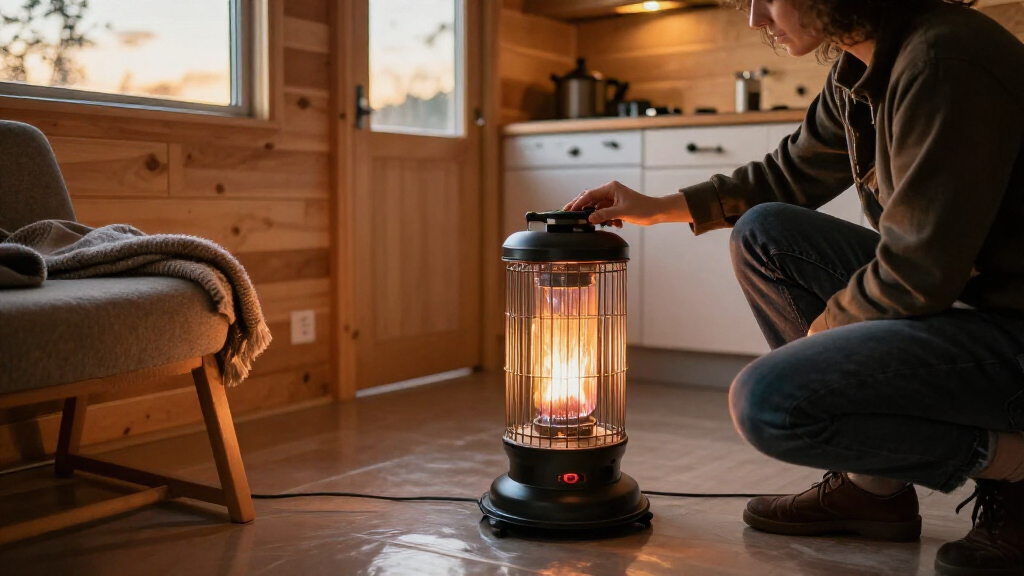
I ranked these tiny house propane heaters by how well their heating style, controls, and form factor fit compact living—not by output alone. I gave more weight to thermostat control and a clear indoor-oriented design for buyers seeking regular room heat, while portability mattered more for occasional or movable warmth. I also compared the practical costs of each format: floor space, ease of placement, range of heat settings, and the need to follow product-specific ventilation and clearance instructions.
That logic puts the Mr. Heater blue-flame model first as the strongest balance of room-heating intent and thermostat control. The ProCom blue-flame option follows as a comparable fixed-style alternative, while the portable Buddy models rank higher for mobility than for whole-home coverage. The Avenger and VEVOR cabinet heaters offer more output, but their size and indoor-use caveats make them less universal for a tiny house. I treat similar models as separate choices only where their listed configuration or intended use may affect a buyer’s decision.
| tiny house propane heater | Fuel | Heating method | Listed coverage |
|---|---|---|---|
| Mr. Heater 10,000 BTU Blue Fla | Propane | Blue-flame convection | — |
| ProCom Heating Liquid Propane | Liquid propane | Radiant infrared plaque | — |
| Mr. Heater Little Buddy Midnig | Propane | Radiant | — |
| Avenger Portable Outdoor Propa | Propane | — | — |
| Mr. Heater 9,000 BTU Portable | Propane | Radiant | — |
| Mr. Heater 9,000 BTU Portable | Propane | Radiant | Up to 225 sq. ft. |
| ProCom Liquid Propane Ventless | Propane | Radiant | Up to 300 sq. ft. |
| VEVOR Propane Heater | Propane | Radiant | Up to 450 sq. ft. |
| Mr. Heater Little Buddy Portab | Propane | Radiant | Up to 95 sq. ft. |
| ProCom Heating Liquid Propane | Propane | Forced air | Up to 500 sq. ft. |
Factors to Consider When Choosing Tiny House Propane Heaters
A tiny house changes the heater decision: floor area, air volume, fuel storage, and the location of sleeping and cooking areas all shape what works. Before choosing by BTU rating, I would settle how the heater will be used, where it can sit, and what the manufacturer permits for indoor operation.
Match heat style to how you occupy the space
Radiant heat warms people and nearby surfaces, so it can make sense when you spend time in one zone or want a portable source of warmth. Blue-flame models heat the surrounding air by convection, a better match when the goal is a more even-feeling room temperature. Neither style automatically heats every corner of a tiny home equally; lofts, partitions, and drafts can create temperature differences. A common mistake is choosing a heater based only on the highest BTU figure and expecting it to solve poor heat distribution. Think about where you sit, sleep, and work, then decide whether direct warmth or broader air heating fits your routine. A fan or other circulation method may help with stratification, but only use one if it is compatible with the heater setup and does not violate the manual’s clearance rules.
Treat indoor-use instructions as a purchase requirement
“Vent-free” does not mean ventilation-free or suitable for every room. Propane combustion affects indoor air and moisture, and a small, tightly sealed home has less room for error than a larger space. Read the exact manual for approved locations, required ventilation, clearances, and any restrictions on sleeping areas or unattended operation. Do not assume an outdoor cabinet heater is safe inside because it has a tip-over or shut-off feature; safety mechanisms do not change its approved use. If the product’s indoor status or instructions are unclear, choose a different model or ask the manufacturer before buying. A carbon monoxide alarm is a sensible layer of protection, but it does not replace correct installation and ventilation practices.
Size for the real room, not the whole-house headline
BTU output is only one part of sizing; insulation, ceiling height, window area, air leakage, and outside temperatures affect how much heat a tiny house needs. A high-output cabinet heater may be excessive for a well-insulated small room, while a modest portable unit may struggle in a drafty space or during a cold snap. Look for a model with settings or thermostat control that can respond to changing conditions rather than relying on a single maximum-output figure. Avoid treating a seller’s coverage estimate as a guarantee, since room shape and insulation vary. If your home has a loft, measure the full heated volume and consider where warm air will collect. For a permanent primary heat source, compare the heater’s permitted operating pattern with your climate and daily use before relying on it alone.
Plan clearances and fuel placement before choosing the format
Small footprints make placement harder, not easier: a heater can occupy little floor area yet require open space around it. Portable Buddy-style units are easier to move, but they still need a stable location away from bedding, curtains, walkways, and stored items. Cabinet heaters take more room and may restrict furniture layouts, so measure both the heater and its required clearances before purchase. Decide where the propane cylinder will go and follow the model’s connection and storage instructions; do not improvise a hose or cylinder arrangement. A floor plan sketch can expose conflicts around doors, exits, and cooking areas before the heater arrives. If the only possible location violates the manual, the model is the wrong fit for that home.
Choose controls for your heating routine
Thermostat control can reduce constant manual adjustment, especially when a heater is used to maintain a room temperature rather than warm one person briefly. A portable radiant unit may suit short periods of direct heat, but its operation and supervision requirements can make it a poor substitute for a set-and-forget system. Consider whether you need multiple output levels, how easy the controls are to reach, and whether the heater can be operated safely from its planned position. More settings are useful only if they support your routine and do not encourage operation beyond the manual’s limits. Tiny homes often have a long gap between the heater and a safe cylinder location, so confirm the specified fuel arrangement before deciding that portability will simplify use.
Pay more for a better fit, not a bigger number
Extra output is not automatically extra value in a compact home. A buyer who needs steady room heat may gain more from thermostat control and a suitable blue-flame format than from a higher-output cabinet unit with a larger footprint. Conversely, someone seeking movable warmth for an approved setting may prefer a compact portable radiant model over controls they will rarely use. Check what is included, what fuel connections are required, and which maintenance tasks the manual specifies; a low-complexity purchase can still become inconvenient if its setup does not suit your space. Do not pay for several output modes unless you expect to use them. The best value is the heater that meets your actual heating pattern while fitting the permitted location and fuel setup.
Frequently Asked Questions
Can I use a vent-free propane heater as the primary heat source in a tiny house?
That depends on the exact model’s manual, the home’s ventilation, and how the heater is meant to operate. A vent-free label alone does not confirm that a unit is approved for every indoor room or for continuous, unattended use. Tiny homes can accumulate combustion byproducts and moisture more quickly because of their limited air volume. Check the manufacturer’s rules for room size, ventilation, clearances, and sleeping areas before relying on one. If the heater is not expressly suited to your intended use, choose a different heat source or consult a qualified professional.
Is a blue-flame heater or a radiant heater better for a tiny house?
Blue-flame heat is generally the more natural fit for warming room air, while radiant heat is useful when you want direct warmth in a particular spot. The blue-flame models in this roundup also include thermostat control, which can help when maintaining a more consistent room temperature is the goal. Portable radiant Buddy models are easier to reposition, but their strength is localized comfort rather than even heating throughout a divided or lofted home. Insulation and layout can matter as much as the heater style. Choose based on where warmth needs to reach, not on the name of the technology alone.
How much BTU output should I look for in a tiny house propane heater?
There is no single BTU figure that fits every tiny house. Insulation quality, ceiling height, drafts, window area, climate, and whether you are heating one zone or the full interior all affect the demand. The 10,000 BTU models here offer thermostat-controlled options, while the portable Buddy units are listed at 9,000 BTU and the cabinet heaters reach higher output. Those figures help compare products, but they do not guarantee a particular room temperature. Use the manufacturer’s coverage guidance as a starting point and avoid choosing a larger heater than your space and approved use can accommodate.
Can I run a portable Buddy heater while I sleep?
Do not assume that portability or a safety shut-off makes a heater safe to run while sleeping. Follow the exact model’s manual for permitted use, supervision, ventilation, and sleeping-area restrictions. A sleeping person cannot respond quickly to a change in operation, and a compact home has limited air volume. If the instructions prohibit use while unattended or in sleeping areas, follow that direction. For overnight heat, choose a system specifically approved for that use and consider professional advice on the home’s heating and alarm setup.
Should I choose the Avenger or VEVOR cabinet heater over a smaller Buddy model?
Choose a cabinet heater only if its higher output and operating modes fit a space where its larger body and required clearances can be accommodated. The Avenger is described as an outdoor cabinet heater, so its indoor suitability must not be inferred from its safety shut-off. VEVOR lists indoor/outdoor use, but the exact manual still governs placement, ventilation, and operation. A Buddy model is more compact and portable, though it is better suited to localized radiant warmth than broad room heating. For a tiny house, the deciding issue is not simply output; it is whether the chosen unit is approved for the intended location and can be placed safely.
Conclusion
Best overall: I would start with the Mr. Heater 10,000 BTU Blue Flame Vent-Free Heater for buyers who want thermostat-controlled room heat in an approved setup. Best value: the ProCom 10,000 BTU Blue Flame Heater is the closest alternative for shoppers prioritizing a similar heating approach and controls. Best for beginners: the Mr. Heater 9,000 BTU Portable Buddy is a straightforward choice for buyers who value a compact, movable radiant heater and can follow its operating instructions. Best premium-style choice: the VEVOR cabinet heater offers more listed output modes, but only makes sense where its footprint and permitted use fit. Best for specific needs: choose a Little Buddy for a smaller portable radiant format, or the Avenger for an approved outdoor cabinet-heater setup. For every pick, let the manual, ventilation plan, and safe placement decide the final choice—not BTU output alone.