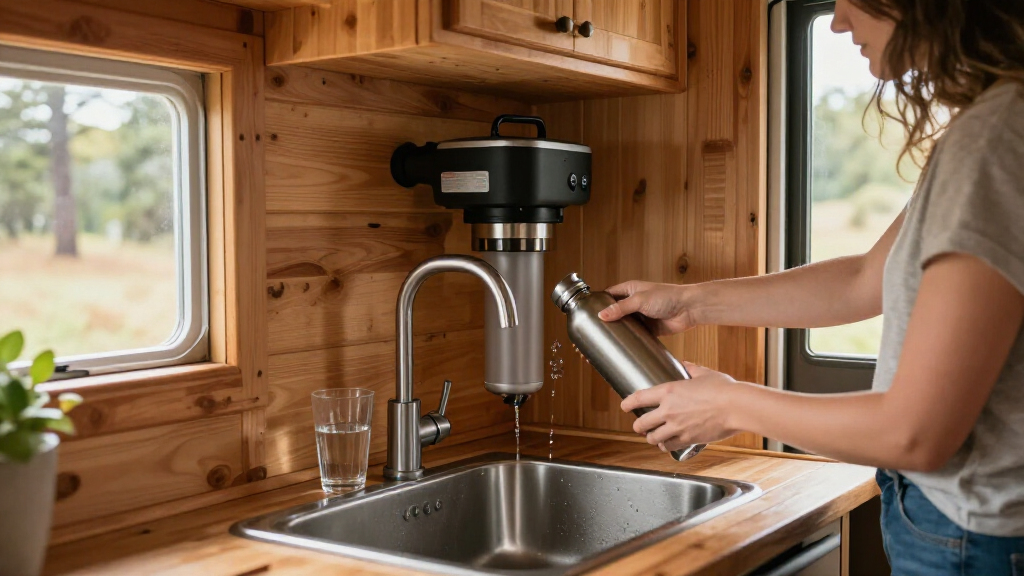

For most tiny homes, I’d start with the Waterdrop G2P600 as the best overall pick: its tankless reverse-osmosis design treats drinking water without taking up room for a storage tank. The Waterdrop 10UA is a simpler choice for buyers who want under-sink filtration without a dedicated RO faucet, while the GE GXWH40L suits homes that need filtration at the incoming water line. The main tradeoff is between compact, targeted treatment and whole-house coverage, with installation space, water source, wastewater, and maintenance all affecting the fit. This roundup compares all 13 systems by those practical constraints, not just their filter stages. Read on for the full breakdown and help matching a system to your tiny home.

Get compact home essentials delivered free with Prime
- Fast, free delivery on millions of items
- Prime Video, Amazon Music and more included
- Member-only deals all year
Key Takeaways
- Under-sink systems are the most space-conscious route for drinking water: the Waterdrop G2P600, G3P600, and G3P800 offer tankless RO, while the 3M Aqua-Pure and Waterdrop 10UA avoid RO complexity.
- Whole-house coverage requires more installation room: the HQUA WF3-01, iSpring WGB21B, GE GXWH40L, and other inlet systems treat water before it reaches taps, but need plumbing access and filter-change clearance.
- Reverse osmosis is not a universal upgrade: it can suit buyers seeking more extensive drinking-water treatment, but adds a dedicated faucet, drain connection, and reject-water considerations.
- Water source changes the shortlist: well-water owners may need testing and targeted treatment; UV models such as the 13 GPM system or Kind E-3000UV address a different need than basic sediment and carbon filtration.
- Capacity and feature counts do not settle the ranking: in a tiny house, usable cabinet space, flow needs, service access, and the ability to replace filters matter as much as stages or rated output.
| HQUA WF3-01 3-Stage Whole House Water Filtration System | 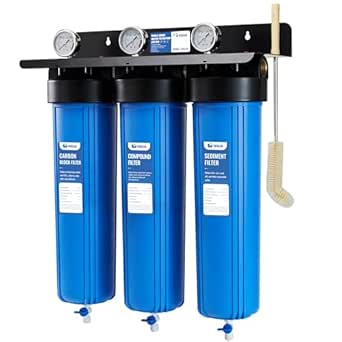 | Best for Whole-Home Multi-Stage Filtration | Filtration stages: 3 | Filter size: 20 × 5.5 inches | Maximum flow rate: 15 gpm | VIEW LATEST PRICE | See Our Full Breakdown |
| Whole House LED UV Water Filter System 13 GPM |  | Best for Microbial Treatment | Manufacturer: Purcooflow | Model: WHF25V | Flow capacity: Up to 13 gpm | VIEW LATEST PRICE | See Our Full Breakdown |
| 3M Aqua-Pure Under-Sink Drinking Water Filtration System with Faucet, 3MDW301-F |  | Best for Certified Drinking-Water Filtration | Filtration method: Dual-stage activated carbon block | Certifications: NSF standards 42, 53, and 401 | Installation: Under sink on cold-water line; dedicated faucet included | VIEW LATEST PRICE | See Our Full Breakdown |
| GE GXWH40L Whole House Water Filtration System |  | Best Compact Whole-House Sediment Prefilter | Purification method: Sedimentation | Maximum flow rate: 4 gpm | Maximum operating temperature: 100 °F | VIEW LATEST PRICE | See Our Full Breakdown |
| Waterdrop G2P600 Tankless Under-Sink Reverse Osmosis Water Filtration System |  | Best for High-Volume RO Drinking Water | Filtration stages: 7 | Purification method: Reverse osmosis | Maximum output: 600 gallons per day | VIEW LATEST PRICE | See Our Full Breakdown |
| Waterdrop G3P800 Tankless Reverse Osmosis Water Filter System, 800 GPD |  | Best High-Capacity RO for a Tiny House | Filtration: 10-stage reverse osmosis | Capacity: Up to 800 gallons per day | Pure-to-drain ratio: 3:1 | VIEW LATEST PRICE | See Our Full Breakdown |
| Waterdrop 10UA Under Sink Water Filter System – NSF/ANSI 42 Certified (1-Year) | 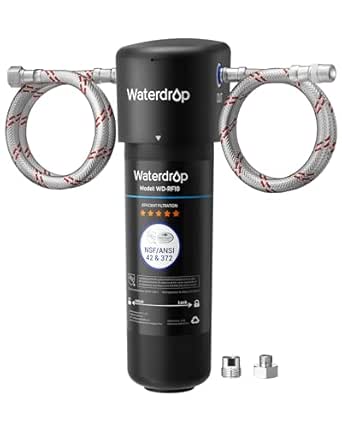 | Best Simple Filter for Municipal Water | Filtration method: Activated carbon | Certifications: NSF/ANSI 42 and 372 | Reduces: PFAS, PFOA/PFOS, and chlorine | VIEW LATEST PRICE | See Our Full Breakdown |
| Purevua PR1-A Countertop Reverse Osmosis Water Filter with UV |  | Best No-Plumbing RO Option | Filtration stages: 6, including RO membrane and UV light | RO membrane: 0.0001 μm | Capacity per cycle: Up to 68 fl oz (2 L) | VIEW LATEST PRICE | See Our Full Breakdown |
| Kind Water Systems E-3000UV Whole House Salt-Free Water Softener & Filter Combo with UV |  | Best Whole-House Treatment for a Fixed Tiny Home | Installation type: Whole house | Treatment: Sediment, carbon block, salt-free softening, and UV | Maximum TDS level: 1,282 ppm | VIEW LATEST PRICE | See Our Full Breakdown |
| 3-Stage Whole House Water Filter System for Well or City Water |  | Best Cartridge Stock-Up for Well or City Water | Filtration stages: 3 | Filter types: PP, GAC, and CTO | Included cartridges: 9 total, or 3 sets | VIEW LATEST PRICE | See Our Full Breakdown |
| Waterdrop G3P600 Tankless Reverse Osmosis Water Filter System with Silver Faucet |  | Best for High-Volume Drinking Water | Filtration: 8-stage reverse osmosis | Certifications: NSF/ANSI 58, 372, and 42; FCC | Capacity: 600 gallons per day | VIEW LATEST PRICE | See Our Full Breakdown |
| iSpring WGB21B Two-Stage Whole House Water Filtration System, 50,000 Gallons | 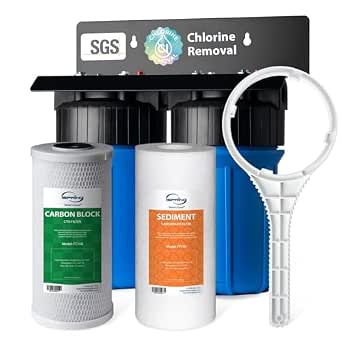 | Best for Whole-Home Taste and Sediment Filtration | Filtration stages: 2 | Sediment filter: 5-micron polypropylene | Carbon filter: CTO carbon block | VIEW LATEST PRICE | See Our Full Breakdown |
| Virego 3-Stage Whole House Water Filter System with 2 Extra Filter Sets |  | Best for Visible Maintenance and Spare Filters | Filtration stages: 3 | Filter types: 0.5-micron PP sediment, GAC activated carbon, CTO carbon block | Maximum flow rate: 15 GPM | VIEW LATEST PRICE | See Our Full Breakdown |
| tiny house water filtration system | Dimensions | Maximum flow rate | Capacity |
|---|---|---|---|
| HQUA WF3-01 3-Stage Whole Hous | 22 × 9.5 × 28 inches | 15 gpm | 100,000 gallons |
| Whole House LED UV Water Filte | 14.17 × 5.51 × 3.54 inches | — | — |
| 3M Aqua-Pure Under-Sink Drinki | 4.75 × 4.75 × 15.79 inches | 0.75 gpm | 1,000 gallons |
| GE GXWH40L Whole House Water F | — | 4 gpm | — |
| Waterdrop G2P600 Tankless Unde | 17.3 × 5.9 × 14 inches | 25 milliliters per second | — |
| Waterdrop G3P800 Tankless Reve | 18.12 × 5.67 × 17.72 in | — | Up to 800 gallons per day |
| Waterdrop 10UA Under Sink Wate | 3.9 × 3.6 × 12.3 in | 2.5 gpm | — |
| Purevua PR1-A Countertop Rever | 14.6 × 7 × 14.2 in | — | — |
| Kind Water Systems E-3000UV Wh | 29 × 23.25 × 29 in | — | 15 gallons |
| 3-Stage Whole House Water Filt | — | 15 gpm | 10,000 gallons |
| Waterdrop G3P600 Tankless Reve | 18.12 × 5.67 × 17.72 in | — | 600 gallons per day |
| iSpring WGB21B Two-Stage Whole | 26 × 19 × 11 in | 15 gpm | Up to 50,000 gallons |
| Virego 3-Stage Whole House Wat | — | 15 GPM | 15 gallons |
More Details on Our Top Picks
HQUA WF3-01 3-Stage Whole House Water Filtration System
For a tiny house where the goal is treating water at the point it enters the plumbing, the HQUA WF3-01 offers more than a sediment-only prefilter: its three stages target sediment, chlorine, odors, and several heavy metals. Compared with the GE GXWH40L, it provides broader filtration and includes pressure gauges and service valves, which help owners monitor and maintain the system. That capability comes with a real space and installation cost: its housings take up room, the unit weighs 44 pounds, and cartridge changes and housing cleaning require hands-on upkeep. The stated 15 gpm flow rate and 100,000-gallon capacity suit a tiny home with enough utility-space clearance, but this is a poor fit for a cramped cabinet or a renter seeking a simple drinking-water filter.
Pros:- Three stages target sediment, chlorine, odors, and multiple heavy metals.
- Pressure gauges and 180-day timers make filter upkeep easier to track.
- Includes servicing valves, a housing brush, and adapters for 3/4-inch or 1-inch NPT fittings.
- 15 gpm maximum flow rate is suited to whole-home use.
Cons:- The 22 × 9.5 × 28-inch footprint and 44-pound weight demand substantial, secure mounting space.
- Cartridges need periodic replacement, and the housings require cleaning.
- Its whole-house installation is more involved than the under-sink 3M Aqua-Pure system.
Best for: Tiny-house owners with a dedicated utility area who want multi-stage treatment for water throughout the plumbing.
Not ideal for: Owners with very limited installation space, or renters who cannot modify plumbing and prefer a small point-of-use filter.
- Filtration stages:3
- Filter size:20 × 5.5 inches
- Maximum flow rate:15 gpm
- Capacity:100,000 gallons
- Dimensions:22 × 9.5 × 28 inches
- Item weight:44 pounds
- Operating temperature:40–125 °F
- Maximum supported TDS:500 ppm
Our verdict“Choose the HQUA if you have utility-room space and want broader whole-house filtration than the GE GXWH40L provides.”
Whole House LED UV Water Filter System 13 GPM
The Purcooflow WHF25V fills a different role from the HQUA WF3-01: it uses UV treatment to reduce microorganisms rather than relying on sediment and carbon stages to address taste, odors, and other contaminants. Its flow-activated, mercury-free LED module can treat water as it moves through a tiny house, with no chemical disinfectant added. At 14.17 × 5.51 × 3.54 inches and 5 pounds, it is easier to fit than the HQUA, though it still needs a compatible 3/4-inch MNPT connection and a power adapter. The system also needs recommended pre-filtration, so it is not a standalone answer for visibly dirty water. Product data cites up to 8,000 LED operating hours but also says the device should be replaced after 5,000 hours; buyers should clarify that service-life discrepancy before relying on the longer figure.
Pros:- Provides whole-house treatment at a stated flow capacity of up to 13 gpm.
- Flow-activated, mercury-free LED UV operation adds no treatment chemicals.
- Compact 5-pound unit is easier to place than the HQUA WF3-01.
- Reported performance specifies up to 99.9999% microorganism reduction.
Cons:- Requires pre-filtration, which adds equipment and installation needs.
- Needs a power adapter, limiting suitability for setups without dependable electricity.
- Product information gives conflicting operating-life guidance: up to 8,000 hours for the LED but replacement after 5,000 hours for the device.
Best for: Tiny-house owners seeking point-of-entry UV microorganism reduction who already have, or plan to add, suitable pre-filtration.
Not ideal for: Off-grid owners without a dependable electrical connection, or buyers seeking a single system that also filters sediment, chlorine, and heavy metals.
- Manufacturer:Purcooflow
- Model:WHF25V
- Flow capacity:Up to 13 gpm
- Dimensions:14.17 × 5.51 × 3.54 inches
- Item weight:5 pounds
- Inlet/outlet connection:3/4-inch MNPT
- LED module life:Up to 8,000 operating hours
- Included components:UV module, power adapter, installation accessories
Our verdict“Pick the Purcooflow for compact, powered UV treatment at the home inlet, but pair it with pre-filtration and verify its service interval.”
3M Aqua-Pure Under-Sink Drinking Water Filtration System with Faucet, 3MDW301-F
When whole-house treatment would use too much of a tiny house’s cabinet or utility space, the 3M Aqua-Pure 3MDW301-F focuses filtration on the kitchen drinking-water tap. Its dual-stage carbon-block system is certified to NSF standards 42, 53, and 401, with listed reductions that include chlorine taste and odor, lead, cysts, VOCs, and microplastics. That gives it a different purpose from the GE GXWH40L, which targets sediment across household plumbing but does not provide the same listed contaminant range. The dedicated faucet and quick-change cartridge with a built-in shut-off simplify day-to-day use and replacement. The tradeoff is coverage: this does not filter shower or laundry water, and its 1,000-gallon capacity means more frequent cartridge changes than a high-capacity whole-house unit.
Pros:- NSF standards 42, 53, and 401 certifications support its stated contaminant-reduction scope.
- Dual-stage carbon-block filtration targets taste, odor, and a range of listed contaminants.
- Includes a dedicated faucet for filtered drinking water.
- Quick-change cartridge has a built-in shut-off valve.
Cons:- Treats water at one dedicated faucet rather than throughout the house.
- The 1,000-gallon cartridge capacity may mean more frequent replacements than whole-house systems.
- Requires under-sink installation on the cold-water line.
Best for: Tiny-house residents who want certified filtration at a dedicated kitchen drinking-water faucet without treating every fixture.
Not ideal for: Owners who want sediment control throughout the home or do not have room and access for under-sink plumbing.
- Filtration method:Dual-stage activated carbon block
- Certifications:NSF standards 42, 53, and 401
- Installation:Under sink on cold-water line; dedicated faucet included
- Capacity:1,000 gallons
- Maximum flow rate:0.75 gpm
- Operating pressure range:25–125 psi
- Dimensions:4.75 × 4.75 × 15.79 inches
- Power:No electricity required
Our verdict“Choose the 3M Aqua-Pure when kitchen drinking-water filtration and listed certifications matter more than whole-house coverage.”
GE GXWH40L Whole House Water Filtration System
The GE GXWH40L makes the most sense when a tiny house needs basic sediment protection without the larger housings and broader treatment of the HQUA WF3-01. It targets sand, scale, dirt, and rust across household plumbing, while a bypass valve lets owners change the filter without shutting off the water supply. Its 15.75 × 9 × 7.75-inch body and 8.2-pound weight are easier to accommodate than the HQUA, but its 4 gpm maximum flow rate is modest for simultaneous high-demand use. This is a prefilter, not a broad contaminant solution: the compatible FXHTC or FXHSC cartridge is sold separately, requires replacement every three months, and the unit only supports horizontal pipe connections. A reminder light helps with upkeep, but it does not remove the recurring filter task.
Pros:- Filters sediment, sand, scale, dirt, and rust throughout the home.
- Bypass valve allows filter changes without shutting off the water supply.
- Smaller and lighter than the HQUA WF3-01 whole-house system.
- Includes a mounting bracket, pressure relief valve, and remote filter reminder light.
Cons:- Compatible FXHTC or FXHSC filter is sold separately.
- Replacement filters are recommended every three months.
- 4 gpm maximum flow and horizontal-only pipe connections limit installation flexibility.
Best for: Tiny-house owners who need a relatively compact whole-house sediment prefilter and can install it on a horizontal pipe run.
Not ideal for: Buyers seeking chlorine, odor, or heavy-metal reduction, higher flow, or a setup that avoids frequent cartridge changes.
- Purification method:Sedimentation
- Maximum flow rate:4 gpm
- Maximum operating temperature:100 °F
- Maximum supported TDS:300 ppm
- Filter life:3 months
- Connections:3/4-inch plumbing
- Installation:Whole house; horizontal pipe connections only
- Compatible filters:FXHTC, FXHSC
Our verdict“Choose the GE GXWH40L for compact, basic sediment protection if its horizontal installation and regular cartridge changes fit your setup.”
Waterdrop G2P600 Tankless Under-Sink Reverse Osmosis Water Filtration System
The Waterdrop G2P600 is the lineup’s drinking-water choice for owners who want reverse osmosis output rather than whole-house treatment. Its seven-stage process and stated output of up to 600 gallons per day suit a tiny house with steady kitchen demand, while the 2:1 pure-to-drain ratio uses less wastewater than systems with a higher reject-water share. Compared with the 3M Aqua-Pure, it offers RO filtration and much higher stated daily production, but it requires electricity and takes more under-sink space at 17.3 × 5.9 × 14 inches. Twist-and-pull filters and life indicators make upkeep more straightforward, though they do not remove the need for replacement cartridges. Its NSF/ANSI 372 certification addresses lead-free materials; it should not be confused with a certification for contaminant-reduction performance.
Pros:- Seven-stage reverse osmosis filtration with stated output up to 600 gallons per day.
- 2:1 pure-to-drain ratio limits wastewater compared with less efficient ratios.
- Twist-and-pull filters allow tool-free replacement.
- Filter-life indicators help track cartridge changes.
Cons:- Requires a corded electrical connection.
- Under-sink installation uses more cabinet space than the 3M Aqua-Pure.
- Treats drinking water at the sink rather than providing whole-house filtration.
- NSF/ANSI 372 certifies lead-free materials, not the system’s contaminant-reduction performance.
Best for: Tiny-house households with a powered kitchen setup that want high-volume reverse-osmosis water from an under-sink system.
Not ideal for: Off-grid owners without a suitable electrical connection, or buyers seeking filtration at every tap rather than a dedicated drinking-water setup.
- Filtration stages:7
- Purification method:Reverse osmosis
- Maximum output:600 gallons per day
- Pure-to-drain ratio:2:1
- Maximum flow rate:25 milliliters per second
- Maximum supported TDS:500 ppm
- Dimensions:17.3 × 5.9 × 14 inches
- Power source:Corded electric
- Certification:NSF/ANSI 372
Our verdict“Choose the G2P600 if you want high-output under-sink RO and have the power and cabinet space it requires.”
Waterdrop G3P800 Tankless Reverse Osmosis Water Filter System, 800 GPD
For a tiny house with a permanent kitchen and frequent drinking-water use, I rank the Waterdrop G3P800 ahead of countertop units because it filters water at the sink and can produce up to 800 gallons per day. Its 3:1 pure-water-to-drain ratio also sends less water to waste than many RO setups, while the tankless body avoids storing a bulky reserve tank beneath the counter. The smart faucet with TDS display adds an at-a-glance check, but this is still a powered, plumbed system—not a fit for an off-grid kitchenette without reliable electricity. Compared with the Waterdrop 10UA, it offers broader RO treatment and lower-TDS output, but costs more space, installation effort, and power dependence in practical terms. Its supported feed-water TDS limit is 500 ppm, so it is not suited to every source.
Pros:- Tankless under-sink layout avoids a separate RO storage tank.
- Up to 800 gallons per day suits frequent use and higher demand.
- 3:1 pure-water-to-drain ratio limits wastewater compared with less efficient RO configurations.
- Smart faucet shows TDS and includes LED lighting.
Cons:- Needs under-sink plumbing and corded electricity, limiting off-grid and portable use.
- Maximum supported feed-water TDS is 500 ppm.
- The 18.12 × 5.67 × 17.72-inch unit still needs a planned under-sink space.
Best for: Tiny-house owners with a fixed kitchen, reliable power, and regular demand for reverse-osmosis drinking water.
Not ideal for: Off-grid residents, renters who cannot modify plumbing, or households whose source water exceeds the 500 ppm supported TDS limit.
- Filtration:10-stage reverse osmosis
- Capacity:Up to 800 gallons per day
- Pure-to-drain ratio:3:1
- Certifications:NSF/ANSI 42, 53, 58, and 372
- Installation:Under sink
- Maximum supported TDS:500 ppm
- Dimensions:18.12 × 5.67 × 17.72 in
- Power:Corded electric
Our verdict“Choose the G3P800 for high-volume RO in a powered, permanently plumbed tiny house; skip it if simplicity or off-grid operation matters more.”
Waterdrop 10UA Under Sink Water Filter System – NSF/ANSI 42 Certified (1-Year)
I’d choose the Waterdrop 10UA when the goal is better-tasting municipal water without adding a tank, power cord, or RO drain line. Its activated-carbon filtration reduces chlorine and listed PFAS and PFOA/PFOS while preserving beneficial minerals, unlike the Waterdrop G3P800, which uses reverse osmosis and takes a more involved under-sink setup. The 10UA’s quick-connect installation and twist-and-lock filter change suit small kitchens where maintenance should stay straightforward; its 2.5 gpm flow also keeps filling a glass or pot from feeling slow. The tradeoff is narrower source-water compatibility: it is specified for cold municipal water, not well water or hot lines. It also does not provide RO-style TDS reduction, so buyers seeking broader dissolved-solids treatment should compare it with the G3P800 instead.
Pros:- Compact 3.9 × 3.6 × 12.3-inch under-sink unit suits tight cabinet layouts.
- Twist-and-lock cartridge design supports quick filter changes.
- Up to 2.5 gpm flow provides water quickly for everyday kitchen tasks.
- Rated for up to 12 months or 11,000 gallons of service.
Cons:- Designed for cold municipal water, not well-water or hot-water use.
- Does not lower TDS like the Waterdrop G3P800 reverse-osmosis system.
- Some installations may need an adapter for its 3/8-inch female thread fittings.
Best for: Tiny-house residents on municipal cold water who want a compact, low-maintenance filter that keeps minerals in the water.
Not ideal for: Well-water users, anyone needing reverse-osmosis or TDS reduction, and kitchens without compatible 3/8-inch faucet fittings or an adapter.
- Filtration method:Activated carbon
- Certifications:NSF/ANSI 42 and 372
- Reduces:PFAS, PFOA/PFOS, and chlorine
- Maximum flow rate:2.5 gpm
- Service life:Up to 12 months or 11,000 gallons
- Maximum supported TDS:700 ppm
- Dimensions:3.9 × 3.6 × 12.3 in
- Replacement filter:WD-RF10
Our verdict“Pick the 10UA for uncomplicated municipal-water filtration and mineral retention, not for well water or RO-level treatment.”
Purevua PR1-A Countertop Reverse Osmosis Water Filter with UV
When drilling or connecting plumbing is not an option, the Purevua PR1-A offers a countertop route to RO filtration with UV treatment. I rank it above the under-sink Waterdrop G3P800 for renters and mobile tiny homes because it needs no plumbing installation and dispenses measured portions into its included glass pitcher. That convenience comes with a smaller batch size: each cycle produces up to 2 liters, so it is less suited to high-volume cooking or several people filling bottles back-to-back. The six-stage process includes a 0.0001 μm RO membrane, while automated reminders and flushing reduce the need to track every maintenance step manually. Its footprint and need for at least 18 inches of vertical clearance can still compete with limited counter and cabinet space, and motor hum and dripping sounds may be noticeable in a compact room.
Pros:- Countertop operation requires no plumbing connection.
- Six-stage filtration includes a 0.0001 μm RO membrane and UV light.
- Dispenses selectable 0.5, 1, or 2-liter portions.
- Glass pitcher and automated filter-life reminders are included.
Cons:- Produces up to 2 liters per cycle, less convenient for high-volume use than the G3P800.
- Needs at least 18 inches of vertical clearance for tank access.
- Water production can create motor hum and dripping sounds.
Best for: Renters, van-dwellers, and tiny-house owners who want RO and UV treatment without connecting a unit to the plumbing.
Not ideal for: Households with heavy water demand, very limited counter clearance, or a strong preference for quiet appliances.
- Filtration stages:6, including RO membrane and UV light
- RO membrane:0.0001 μm
- Capacity per cycle:Up to 68 fl oz (2 L)
- Dispense volumes:17, 34, or 68 fl oz (0.5, 1, or 2 L)
- Filtered-to-waste ratio:Up to 3:1
- Dimensions:14.6 × 7 × 14.2 in
- Recommended vertical clearance:At least 18 in
- Filter life:CF filter: 6 months; RO filter: 12 months
Our verdict“Choose the PR1-A when plumbing-free RO matters more than fast, high-volume dispensing or a clear countertop.”
Kind Water Systems E-3000UV Whole House Salt-Free Water Softener & Filter Combo with UV
The Kind Water Systems E-3000UV takes a different approach from the drinking-water-focused Waterdrop G3P800: it treats water for the whole home, combining sediment and carbon filtration with salt-free scale reduction and UV treatment. That can make sense in a permanently sited tiny house where shower, appliance, and tap water all come from one incoming line. The package avoids salt and brine, but its 29 × 23.25 × 29-inch footprint is a serious constraint in a small utility area; “compact” is relative when compared with an under-sink filter. At 25.36 kg, it also needs a suitable installation location and handling plan. This is not a substitute for a dedicated RO drinking-water filter, and the listed 15-gallon capacity makes me cautious about recommending it without confirming that capacity against the household’s actual flow and usage needs.
Pros:- Combines sediment filtration, carbon filtration, salt-free scale reduction, and UV treatment.
- Treats water throughout the home rather than at a single kitchen tap.
- Salt-free operation avoids salt and brine handling.
- Designed to address sediment, chemical contaminants, and microorganisms in one system.
Cons:- Its 29 × 23.25 × 29-inch dimensions take substantial space in a tiny-home utility area.
- At 25.36 kg, installation and handling may be difficult in tight spaces.
- Whole-house treatment does not provide the dedicated RO drinking-water filtration of the Waterdrop G3P800.
Best for: Owners of permanently installed tiny homes who want one incoming-water system for showers, appliances, and taps and have room for a large unit.
Not ideal for: Mobile tiny homes, owners with cramped utility spaces, or buyers seeking only a compact drinking-water filter like the Waterdrop 10UA.
- Installation type:Whole house
- Treatment:Sediment, carbon block, salt-free softening, and UV
- Maximum TDS level:1,282 ppm
- Dimensions:29 × 23.25 × 29 in
- Capacity:15 gallons
- Weight:25.36 kg
- Model number:E-3000UV
Our verdict“Choose the E-3000UV only for a fixed tiny house with whole-home treatment needs and enough room for its large, heavy housing.”
3-Stage Whole House Water Filter System for Well or City Water
For a tiny house supplied by well water or municipal water, this three-stage system stands out for including nine cartridges—three sets—rather than requiring an immediate search for replacements. Its PP, GAC, and CTO stages target sediment, chlorine, and odors while retaining natural minerals, which makes it a more suitable whole-house-style option for varied sources than the municipal-only Waterdrop 10UA. Built-in shut-off valves also make cartridge changes more manageable when access is tight. The main limit is treatment scope: it does not reduce TDS, so it is not a substitute for the Waterdrop G3P800 when dissolved-solids reduction is the goal. There is also a maintenance-planning wrinkle: the stated 1.5–2-year cartridge supply sits alongside a six-month filter-life cycle, so buyers should verify replacement timing for their water and usage before relying on the longer estimate.
Pros:- Includes nine cartridges, or three full sets, reducing near-term replacement sourcing.
- PP, GAC, and CTO stages target sediment, chlorine, and odors while preserving minerals.
- Built-in shut-off valves simplify cartridge replacement.
- Listed for well or city water and supports up to 15 gpm.
Cons:- Does not lower TDS, unlike the Waterdrop G3P800 RO system.
- Six-month filter-life guidance conflicts with the stated 1.5–2-year filter supply.
- The 14 × 13 × 10-inch housing needs a planned installation area and plumbing connections.
Best for: Tiny-house owners on well or city water who want staged sediment and taste filtration with replacement cartridges included.
Not ideal for: Buyers who need lower TDS or RO treatment, or those who need a clearly established maintenance schedule before installation.
- Filtration stages:3
- Filter types:PP, GAC, and CTO
- Included cartridges:9 total, or 3 sets
- Estimated filter supply:1.5–2 years
- Listed filter life cycle:6 months
- Maximum flow rate:15 gpm
- Capacity:10,000 gallons
- Connection and dimensions:3/4 in. plumbing; 14 × 13 × 10 in.
Our verdict“Pick this system for basic staged filtration across well or city water when included cartridges matter more than TDS reduction.”
Waterdrop G3P600 Tankless Reverse Osmosis Water Filter System with Silver Faucet
I’d choose the Waterdrop G3P600 when a tiny home needs strong under-sink drinking-water treatment without giving up space to a storage tank. Its 8-stage reverse osmosis filtration targets TDS and contaminants such as chlorine, fluoride, and PFAS, while the listed 600-gallon-per-day capacity suits frequent filling of bottles and cooking pots. Compared with the iSpring WGB21B, this is a point-of-use system focused on purified water at one faucet, not filtration for every tap and shower.
The tradeoff is installation: the tankless unit still occupies a cabinet footprint, needs an electrical outlet, and lists an operating pressure of 87 psi. Its 2:1 pure-to-drain ratio is a useful efficiency detail, and the faucet’s TDS and filter-life readouts make upkeep easier to track. Skip it if you want a passive, whole-house setup or lack cabinet space and under-sink power.
Pros:- Tankless design avoids the added storage-tank footprint.
- Eight-stage reverse osmosis targets TDS and several listed contaminants.
- Smart faucet displays TDS and tracks filter life.
- Listed 2:1 pure-water-to-drain ratio and 600-gallon-per-day capacity.
Cons:- Requires an electrical outlet beneath the sink.
- The listed dimensions still call for a sizable cabinet area.
- Its 87 psi operating-pressure specification may limit fit with some plumbing setups.
Best for: Tiny-home owners who want reverse-osmosis drinking water at the kitchen faucet, have under-sink power, and use enough water to benefit from a high-capacity system.
Not ideal for: Buyers seeking whole-house treatment, a non-electric filter, or a compact installation with limited cabinet room or insufficient water pressure.
- Filtration:8-stage reverse osmosis
- Certifications:NSF/ANSI 58, 372, and 42; FCC
- Capacity:600 gallons per day
- Pure-to-drain ratio:2:1
- Flow rate:0.42 gpm
- Dimensions:18.12 × 5.67 × 17.72 in
- Power source:Corded electric
- Maximum supported TDS:1500 ppm
- Faucet features:TDS monitor and filter-life tracker
Our verdict“Choose the G3P600 for high-capacity, monitored reverse-osmosis water at one faucet, provided your tiny home has the cabinet space, power, and pressure it calls for.”
iSpring WGB21B Two-Stage Whole House Water Filtration System, 50,000 Gallons
The iSpring WGB21B is the practical whole-house pick for tiny-home owners who want to reduce sediment, chlorine, and unpleasant taste or odors across multiple taps. Its two stages pair a 5-micron sediment filter with a carbon block, and the stated 15-gpm maximum flow rate is aimed at serving a home’s plumbing rather than producing a dedicated stream of reverse-osmosis water. Compared with the Waterdrop G3P600, it treats incoming household water but does not reduce TDS or provide the same point-of-use purification.
For a small footprint, its 26 × 19 × 11-inch dimensions and 1-inch connections still demand a suitable installation area and plumbing access. It runs without electricity and retains dissolved minerals, which keeps the setup simpler than an RO system. The 50,000-gallon capacity and stated 12-month filter life give owners a maintenance reference, though replacement filters remain an ongoing task.
Pros:- Two-stage filtration targets sediment, chlorine, bad taste, and odors.
- Whole-house design treats water at multiple fixtures.
- Runs without electricity and retains dissolved minerals.
- Includes an installation set, with stated capacity up to 50,000 gallons.
Cons:- Does not reduce total dissolved solids.
- Requires periodic replacement filters and access for maintenance.
- Its listed dimensions and 1-inch connections may be difficult to accommodate in a very small utility area.
Best for: Tiny-home owners who want sediment and chlorine reduction at multiple fixtures, have room near the water entry point, and prefer a non-electric system that retains minerals.
Not ideal for: Buyers who need TDS reduction, reverse-osmosis drinking water, or a compact under-sink unit for a home without space for whole-house plumbing equipment.
- Filtration stages:2
- Sediment filter:5-micron polypropylene
- Carbon filter:CTO carbon block
- Capacity:Up to 50,000 gallons
- Filter life:12 months
- Inlet and outlet size:1 inch
- Maximum flow rate:15 gpm
- Dimensions:26 × 19 × 11 in
- Power source:None
Our verdict“Pick the WGB21B for non-electric, whole-house sediment and chlorine filtration, but choose the Waterdrop G3P600 instead if your priority is TDS reduction at the drinking-water faucet.”
Virego 3-Stage Whole House Water Filter System with 2 Extra Filter Sets
The Virego 3-Stage Whole House Filter suits tiny-home owners who want a whole-house sediment-and-carbon setup with spare filters already included. Its PP sediment, GAC activated carbon, and CTO carbon block stages target sediment, rust, chlorine, odors, and unpleasant tastes in city or well water. Compared with the iSpring WGB21B, it adds a third filtration stage and transparent housings for visual checks, but uses 3/4-inch ports rather than iSpring’s 1-inch connections.
The included three complete filter sets can reduce the need to source replacements immediately, though the data gives no fixed service interval: filter life varies with water quality and household use. Like the iSpring, it preserves dissolved minerals and does not reduce TDS, so it is not a substitute for the Waterdrop G3P600 when reverse-osmosis drinking water is the goal. Confirm that its plumbing fittings and housing assembly suit your installation before choosing it.
Pros:- Three filter types target sediment, rust, chlorine, odors, and unpleasant tastes.
- Transparent housings allow visual inspection of filter condition.
- Includes three complete filter sets and shutoff valves.
- Listed maximum flow rate is 15 GPM and the system supports city or well water.
Cons:- Does not reduce total dissolved solids.
- Filter life varies with water quality and household use.
- Its 3/4-inch NPT ports may not match existing plumbing without adaptation.
Best for: Tiny-home owners with city or well water who want three-stage whole-house sediment and carbon filtration, visible filter inspection, and spare filter sets on hand.
Not ideal for: Buyers who need TDS reduction, a defined filter replacement interval, or 1-inch whole-house connections rather than 3/4-inch ports.
- Filtration stages:3
- Filter types:0.5-micron PP sediment, GAC activated carbon, CTO carbon block
- Maximum flow rate:15 GPM
- Port size:3/4-inch NPT brass
- Included filter sets:3 sets (9 filters total)
- Installation type:Whole house
- Capacity:15 gallons
- Model:DY3DSL
Our verdict“Choose the Virego for visible, three-stage whole-house filtration with spare filters included, but look elsewhere if you need TDS reduction or a specified service interval.”

How We Picked
I ranked these tiny house water filtration systems by how well their design fits limited floor space, cabinet storage, and plumbing access, then weighed treatment approach, stated certifications, flow capacity, maintenance demands, and installation complexity. I distinguished point-of-use filters, which serve a drinking-water tap, from whole-house systems that treat water at the entry point; they solve different problems and should not be compared as if they do the same job. I also considered whether a product’s added features—such as UV treatment, tankless RO, or included extra filters—address a clear need for a small home.
The Waterdrop G2P600 ranks first because its tankless RO format provides broad drinking-water treatment while avoiding a storage tank, a useful balance for a compact kitchen. The G3P600 and G3P800 follow for buyers who prioritize different output or configuration needs, while simpler under-sink options rank well for lower complexity. Whole-house systems remain strong picks for buyers who need treatment at multiple taps, but their plumbing footprint and installation demands keep them from leading a roundup centered on tight living space. I treated product claims as selection details rather than proof that a system suits every water source; buyers should match treatment to a water test and verify current certification details.
Factors to Consider When Choosing Tiny House Water Filtration Systems
Before choosing among tiny house water filtration systems, decide what water you want treated and where you can physically install the equipment. Small-home constraints make a compact filter that misses the actual contaminant problem a poor buy, while an elaborate whole-house setup can consume valuable storage and service space. These checks help narrow the field before comparing models.
Choose Between Point-of-Use and Whole-House Treatment
A point-of-use unit treats water at one tap, usually in the kitchen, while a whole-house system sits on the incoming line and serves multiple fixtures. In a tiny house used by one or two people, treating drinking water alone may meet the need with less plumbing work and less equipment. Whole-house filtration makes more sense when sediment, taste, or another concern affects showers and every faucet, but it needs a suitable installation point and room to service the housing. A common mistake is buying a whole-house system simply because it sounds more thorough, even when only drinking water needs treatment. Map your plumbing and identify the specific taps you care about before comparing system capacity.
Start With Your Water Source and a Test
Municipal water and private well water can call for different treatment strategies, and a generic filter label does not identify every contaminant it reduces. For a private well, use a current water test to guide the choice; for municipal supply, check the utility report and test if taste, plumbing, or a known local issue raises concern. UV treatment is aimed at microbial concerns and does not remove dissolved minerals or improve every taste problem, while carbon and sediment stages have other uses. Do not assume that a system described for well or city water addresses every possible well-water issue. Match each treatment claim to the test result and confirm the exact model’s certification and reduction claims.
Measure Service Space, Not Just Installation Space
A filter may fit under a tiny-house sink on installation day but become difficult to maintain if there is no clearance to remove cartridges or reach shutoff valves. Measure the cabinet, account for plumbing bends, and leave room for hands and replacement parts. Tankless RO units save storage space compared with tank-based layouts, but they still need connections and a drain route. Whole-house housings need access near the water line, which may compete with storage or utility equipment. Before ordering, check the manufacturer’s dimensions and filter-replacement method rather than relying on the product’s compact label.
Weigh RO Water Use Against Simpler Filtration
Reverse osmosis can be a fit when a buyer wants more extensive treatment at a drinking-water tap, but it brings a drain connection, extra components, and wastewater that should be considered in a small home. That matters especially in an off-grid setup where stored water is limited. A carbon-based under-sink filter may better suit someone whose main concerns are taste and common municipal-water issues, provided its stated reduction claims match the need. Do not select RO solely because it has more stages; treatment breadth does not automatically make it the right tool. Compare the system’s water-use details and maintenance schedule with your daily supply.
Plan Filter Changes Before You Buy
Replacement cartridges are part of the system’s footprint: they require storage, access, and a reliable source when a change is due. Check the stated service life, but also account for how water quality and household use may affect actual replacement timing. Included extra filters, such as those supplied with the Virego system, can simplify the first maintenance cycle but do not remove the need to source later replacements. A low-complexity filter may be easier to manage than a multi-stage setup if the home is seasonal or used intermittently. Choose a model whose servicing steps you can carry out in the space available.
Pay for Features That Solve Your Actual Constraint
Higher-capacity output, UV stages, salt-free conditioning, or added filtration stages can be useful when they address a documented need, but each can add cost in space, plumbing, or upkeep. A household with one drinking-water tap may gain little from a system built for whole-house flow, while a family using multiple fixtures may find a small under-sink unit limiting. Salt-free conditioning is not the same as removing hardness minerals, so verify what a softener-style product does before treating it as a conventional water softener. Prioritize verified treatment claims, compatible flow, and serviceability over the longest feature list. This keeps a tiny-house setup focused instead of overbuilt.
Frequently Asked Questions
Should I choose a whole-house filter or an under-sink system for a tiny house?
Choose based on where the water problem occurs, not on the size of the product category. If your main goal is better drinking water at one kitchen tap, an under-sink system usually uses less plumbing and avoids treating water you do not drink. A whole-house filter can make more sense when the same issue affects multiple fixtures or when a treatment step must happen at the incoming line. Check available space near the inlet and under the sink before deciding. If you are unsure what needs treatment, test the water first rather than buying extra stages by default.
Is a reverse-osmosis system a good fit for an off-grid tiny house?
It can be, but the water supply and drain arrangement matter as much as the unit’s size. Tankless RO systems avoid a storage tank, yet they still require plumbing connections and produce reject water during operation. In a home relying on a limited cistern or hauled water, that water use may outweigh the benefit unless RO addresses a specific need. Compare the manufacturer’s water-use information with your daily supply and how you handle drain water. A simpler under-sink filter may be a better match when the concern is limited to taste or a specific claim the filter is certified to reduce.
Can one filtration system treat both well water and city water?
A system may be marketed for both sources, but that does not mean it handles every issue either source can contain. Well water varies by location and may require targeted treatment based on laboratory results, while municipal water has its own local profile and utility report. Sediment, carbon, RO, and UV stages address different concerns rather than acting as interchangeable upgrades. Use a test to identify the problem and check the exact model’s reduction claims against it. If a result falls outside the system’s listed capabilities, ask a qualified water-treatment professional about a separate treatment stage.
Does UV filtration remove sediment, chemicals, or hard-water minerals?
No: UV treatment is intended to address microorganisms, not sediment, chemical contaminants, or hardness minerals. Water may need prefiltration so particles do not interfere with UV exposure, depending on the system’s instructions and the source water. A UV-equipped product can be useful where microbial treatment is needed, but it should not be treated as an all-purpose purifier. Check what other stages the system includes and what they are certified or specified to reduce. For well water, testing helps determine whether UV is appropriate and whether additional treatment is needed.
What should I verify before installing a filter in a tiny-house plumbing system?
Confirm that the unit’s connection size, flow requirements, pressure range, and installation orientation fit your plumbing. Measure the full service area, including the clearance needed to change cartridges, not only the space the housing occupies. For RO, plan for a dedicated faucet and drain connection; for whole-house systems, make sure the inlet location allows shutoff and maintenance access. If the home is mobile or uses nonstandard plumbing, check whether fittings and mounting instructions suit that setup before purchase. When installation could affect potable-water safety or plumbing compliance, consult a qualified installer.
Conclusion
For the strongest balance of compact design and drinking-water treatment, I’d choose the Waterdrop G2P600 as best overall. Buyers seeking a best value-style, simpler under-sink option should compare the Waterdrop 10UA with the 3M Aqua-Pure, choosing by their specific treatment claims and faucet setup rather than stage count. For a premium, higher-output RO direction, the Waterdrop G3P800 stands out, while the GE GXWH40L is a straightforward starting point for beginners who need inlet filtration and can accommodate whole-house plumbing. If your priority is microbial treatment, assess the 13 GPM UV system or Kind E-3000UV against water-test results; for well or city water with broader inlet coverage, compare the HQUA WF3-01, iSpring WGB21B, Virego, and other whole-house models. The right choice is the smallest system that addresses a verified water concern and leaves enough room for reliable maintenance.
Veterans Day Picks

Shark Matrix Plus 2-in-1 Robot Vacuum and Mop with 60-Day Self-Emptying Base
As an affiliate, we earn on qualifying purchases.