For most tiny-home owners seeking a substantial off-grid system, I’d start with the ECO-WORTHY 10kW kit with a 48V 314Ah battery, which stands out for its large storage capacity and system scale. The ECO-WORTHY 5kW kit is a more restrained alternative, while the 780W ECO-WORTHY kit with 7.168kWh of storage puts more emphasis on battery backup than panel output. The main tradeoff is between generating enough energy each day, storing enough for nights and cloudy weather, and keeping the system size manageable for a small home. Some kits also combine wind generation or use 12V or 24V components, which can suit specific setups but may require closer planning. Read on for how these 14 kits differ and which type of tiny-home owner each one suits.

Get compact home essentials delivered free with Prime
- Fast, free delivery on millions of items
- Prime Video, Amazon Music and more included
- Member-only deals all year
Key Takeaways
- System scale separates the leading options: the 10kW ECO-WORTHY kit with a 48V 314Ah battery is the broadest fit for owners planning substantial off-grid use, while smaller kits better suit limited loads.
- Panel wattage and battery capacity solve different problems: the 780W kit’s 7.168kWh battery prioritizes stored energy, while several other kits pair more panel capacity with less listed storage.
- Voltage affects system planning: 12V kits such as the 200W starter set are aimed at modest, simple setups; 24V and 48V options are better matched to larger systems, subject to component compatibility.
- Wind add-ons are specialized, not automatic upgrades: the Giosolar and 640W solar-and-wind kits may suit sites with useful wind, but they add equipment and planning needs beyond a solar-only system.
- Kit labels do not guarantee a complete home system: buyers still need to check included components, installation requirements, expected daily production, and whether the kit supports their actual appliances.
| ECO-WORTHY 10kW Off-Grid Solar Panel Kit with 48V 314Ah Battery |  | Best for High-Demand Tiny Homes | Solar array: 2,950W total; 5 × 590W bifacial panels | Estimated daily generation: Up to 11.8kWh under optimal conditions | Inverter output: 10,000W continuous; up to 20,000W peak | VIEW LATEST PRICE | See Our Full Breakdown |
| Giosolar 1120W Off-Grid Solar and Wind Power Kit with 24V Inverter and Lithium Batteries |  | Best for Windy, Low-Sun Sites | Solar array: 720W total; 6 × 120W panels | Wind turbine: 400W, 24V; 1.2m rotor diameter | Battery storage: 2 × 12.8V 100Ah LiFePO₄; 2.56kWh combined | VIEW LATEST PRICE | See Our Full Breakdown |
| ECO-WORTHY 780W Off-Grid Solar Kit with 7.168kWh Battery, 3000W Inverter Charger, and MPPT Controller |  | Best for Shaded Sites and Backup Charging | Solar array: 780W total; 4 × 195W bifacial panels | Panel efficiency: 25.2% | Battery storage: 7.168kWh total; 2 × 12.8V 280Ah LiFePO₄ batteries | VIEW LATEST PRICE | See Our Full Breakdown |
| 640W 12V Solar and Wind Power Kit with 2 Solar Panels, Wind Turbine, Battery, and Inverter |  | Best Compact Dual-Source Starter | Maximum system power: 640W | Solar panels: 2 × 120W monocrystalline panels | Wind turbine: 400W, six-blade | VIEW LATEST PRICE | See Our Full Breakdown |
| ECO-WORTHY 10 kW Off-Grid Solar System Kit with 2,340 W Panels and 10.24 kWh Battery Storage |  | Best for 240V Loads with a More Manageable Array | Solar array: 2,340W total; 12 × 195W bifacial panels | Estimated daily generation: Up to 9.36kWh under four hours of full sunshine | Inverter output: 10,000W maximum continuous | VIEW LATEST PRICE | See Our Full Breakdown |
| ECO-WORTHY 5kW Off-Grid Solar System Kit with 2,340W Panels, Inverter, and LiFePO4 Battery |  | Best for High-Power Loads | Solar panels: 12 × 195W; 2,340W total | Panel type: N-type monocrystalline | Inverter: 48V, 5,000W off-grid | VIEW LATEST PRICE | See Our Full Breakdown |
| ZXDZTZ Off-Grid Solar Inverter Kit with Solar Panel and 50A Charge Controller |  | Best for Small, Simple Setups | Solar panel power: Listed as 50W ±5%; description also states 100W | Panel type: Monocrystalline | Inverter input: 12V DC (10.5–15V) | VIEW LATEST PRICE | See Our Full Breakdown |
| 3000W 24V Off-Grid Solar Power System Kit with 960W Solar Panels, 2.56kWh Battery, 60A MPPT Controller and Pure Sine Wave Inverter |  | Best Balanced Complete Kit | Solar panels: 8 × 120W; 960W total | Battery capacity: 2.56kWh (2,560Wh) | Battery configuration: 2 × 12.8V, 100Ah batteries with built-in BMS | VIEW LATEST PRICE | See Our Full Breakdown |
| ECO-WORTHY 1200W 24V Off-Grid Solar System with 4.68kWh Daily Output |  | Best for Longer Battery Runtime | Solar panels: 6 × 195W bifacial; 1,170W maximum listed power | System voltage: 24V | Battery capacity: 7.168kWh total | VIEW LATEST PRICE | See Our Full Breakdown |
| ECO-WORTHY 400W 12V Solar Panel Kit with 100Ah Lithium Battery |  | Best Compact Starter System | Solar panels: 4 × 100W; 400W total | Panel dimensions: 35.63 × 23.03 × 1.18 in each | Battery: 12V, 100Ah lithium | VIEW LATEST PRICE | See Our Full Breakdown |
| 3000W 24V Off-Grid Solar Power System Kit with 1440W Panels, 5.12kWh LiFePO4 Battery, MPPT Controller and 6000W Peak Inverter |  | Best Overall for Higher-Use Tiny Homes | Solar panel output: 1440W total (12 × 120W) | Panel type: Monocrystalline | Battery capacity: 5.12kWh | VIEW LATEST PRICE | See Our Full Breakdown |
| ECO-WORTHY 200W 12V Solar Starter Kit with 50Ah LiFePO4 Battery and 600W Inverter |  | Best for Beginners and Small Loads | Solar panel power: 200W total (2 × 100W) | System voltage: 12V | Battery: 12V 50Ah LiFePO4 | VIEW LATEST PRICE | See Our Full Breakdown |
| ECO-WORTHY 1170W Solar Panel Kit with 48V 3500W Inverter and 50Ah LiFePO4 Battery |  | Best for a 48V Tiny-Home Build | Solar panel power: 1170W total (6 × 195W) | Panel type: N-type bifacial monocrystalline | Panel conversion efficiency: 25% | VIEW LATEST PRICE | See Our Full Breakdown |
| 1280Wh Off-Grid Solar Panel Kit with 1000W Pure Sine Wave Inverter, 20A MPPT Controller, 100Ah Battery, and 2×120W Panels |  | Best Compact Kit for Modest Loads | Battery capacity: 100Ah, 12.8V (1280Wh) | Solar panel output: 240W total (2 × 120W) | Panel type: Rigid monocrystalline | VIEW LATEST PRICE | See Our Full Breakdown |
| solar power kits for tiny home | Inverter | Charge controller |
|---|---|---|
| ECO-WORTHY 10kW Off-Grid Solar | — | — |
| Giosolar 1120W Off-Grid Solar | 3,000W pure sine wave, 24V DC to 120V AC | — |
| ECO-WORTHY 780W Off-Grid Solar | — | 60A MPPT |
| 640W 12V Solar and Wind Power | 1,000W pure sine wave; 2,000W peak | — |
| ECO-WORTHY 10 kW Off-Grid Sola | — | — |
| ECO-WORTHY 5kW Off-Grid Solar | 48V, 5,000W off-grid | — |
| ZXDZTZ Off-Grid Solar Inverter | — | 50A; supports automatic 12V/24V recognition |
| 3000W 24V Off-Grid Solar Power | 3,000W continuous; 6,000W peak for 1 second | 60A MPPT |
| ECO-WORTHY 1200W 24V Off-Grid | 3,000W pure sine wave | 60A MPPT |
| ECO-WORTHY 400W 12V Solar Pane | 1,100W pure sine wave | 40A MPPT |
| 3000W 24V Off-Grid Solar Power | 3000W pure sine wave; 6000W peak for 1 second | 60A MPPT; tracking efficiency greater than 99% |
| ECO-WORTHY 200W 12V Solar Star | 600W pure sine wave | 30A PWM |
| ECO-WORTHY 1170W Solar Panel K | 3500W; 7000W surge | — |
| 1280Wh Off-Grid Solar Panel Ki | 1000W continuous; 2000W peak | 20A MPPT |
More Details on Our Top Picks
ECO-WORTHY 10kW Off-Grid Solar Panel Kit with 48V 314Ah Battery
I’d place this kit at the top for a tiny home with substantial electrical needs, especially where 120V/240V split-phase power is required. Its 10kW inverter and roughly 16.1kWh battery offer far more storage and output capacity than the ECO-WORTHY 10 kW kit with 10.24 kWh storage. That headroom can suit larger appliances, but the included five-panel array totals only 2,950W, so the inverter’s full output does not mean the panels can replenish the battery quickly. The bifacial panels may add yield where their backsides receive useful reflected light. This is a large, freight-shipped system, and professional installation is recommended; it is a poor match for a compact cabin where modest loads and simple setup matter more than expansion capacity.
Pros:- 10kW continuous inverter output with 120V or 120V/240V split-phase support.
- 16.076kWh LiFePO₄ storage provides more stated capacity than the other 10kW ECO-WORTHY kit in this group.
- Wi-Fi, Bluetooth, display, and wired connectivity provide several monitoring options.
- Battery and inverter configurations can be expanded in parallel.
Cons:- The included 2,950W array is much smaller than the inverter’s 10kW continuous output.
- Large panels and pallet freight make delivery, placement, and installation demanding.
- Professional installation is recommended, limiting its appeal to hands-on beginners.
Best for: Tiny-home owners with high simultaneous loads, 240V appliances, and room for a professionally installed, expandable system.
Not ideal for: Owners of small cabins with modest loads, limited roof or ground space, or no access to qualified installation.
- Solar array:2,950W total; 5 × 590W bifacial panels
- Estimated daily generation:Up to 11.8kWh under optimal conditions
- Inverter output:10,000W continuous; up to 20,000W peak
- AC output:120V or 120V/240V split phase
- Battery:48V, 314Ah LiFePO₄; 16.076kWh
- Charge control:Dual MPPT; maximum battery charging current 200A
- Expansion:Up to 15 batteries and 6 inverters in parallel
- Panel dimensions and weight:89.69 × 44.65 × 1.18 in; 72.8 lb each
Our verdict“Choose this kit for a high-load tiny home that needs split-phase power and substantial storage, provided you can accommodate professional installation.”
Giosolar 1120W Off-Grid Solar and Wind Power Kit with 24V Inverter and Lithium Batteries
For a tiny home in a reliably windy location, this kit’s defining advantage is that it adds a 400W wind turbine to a 720W solar array. That second source may help when sunlight is limited, unlike the solar-only ECO-WORTHY 780W kit, though wind output depends on the site and turbine placement. The included two LiFePO₄ batteries provide 2.56kWh of stated combined storage, while the 3,000W inverter can support a wider range of AC loads than the smaller inverter in the 640W solar-and-wind kit. The tradeoff is installation complexity: the turbine calls for a tower 4.5–10m high, and its 24V system must be configured correctly with the supplied 12.8V batteries. I’d skip it where tower siting or adequate wind is uncertain.
Pros:- Solar panels and a wind turbine provide two potential charging sources.
- Two LiFePO₄ batteries provide 2.56kWh combined stated storage.
- 3,000W pure sine wave inverter offers more AC output than the 1,000W inverter in the 640W solar-and-wind kit.
- Includes solar and battery cables, wind and solar controllers, and panel mounting brackets.
Cons:- The wind turbine requires a separately arranged tower 4.5–10m high.
- The 24V system and included 12.8V batteries require careful configuration.
- The 720W solar array and 2.56kWh storage are modest for a tiny home with sustained high loads.
Best for: Tiny-home owners on open, consistently windy sites who want both solar and wind charging and can handle tower installation.
Not ideal for: Owners in sheltered or densely built locations, or anyone seeking a simple rooftop-only kit without tower work.
- Solar array:720W total; 6 × 120W panels
- Wind turbine:400W, 24V; 1.2m rotor diameter
- Battery storage:2 × 12.8V 100Ah LiFePO₄; 2.56kWh combined
- Inverter:3,000W pure sine wave, 24V DC to 120V AC
- Solar charge controller:60A
- Panel dimensions and weight:39.96 × 26.38 × 1.18 in; 15.5 lb each
- Turbine cut-in wind speed:2.5m/s
- Included accessories:Solar and battery cables, Y-branch connectors, and Z-bracket mounting set
Our verdict“Pick this kit when a windy site and tower installation make its dual-source charging more useful than a simpler solar-only system.”
ECO-WORTHY 780W Off-Grid Solar Kit with 7.168kWh Battery, 3000W Inverter Charger, and MPPT Controller
This ECO-WORTHY kit makes a different bet from the Giosolar wind-and-solar system: it relies on solar, but pairs a modest 780W array with a comparatively large 7.168kWh battery bank. That storage can carry a tiny home through periods without sun, though replenishing it from the included panels will take time. Its six-zone panel design is intended to reduce the impact of partial shading, a useful feature where trees or roof obstructions cast intermittent shadows. The 3,000W inverter charger with UPS fast switching can also accept mains charging, giving it a backup path that the wind kit does not describe. The limitation is its 12V architecture: compared with the 48V ECO-WORTHY systems, it is less suited to higher-power, long-run installations and needs careful wiring.
Pros:- 7.168kWh of stated LiFePO₄ storage is substantial relative to its solar array.
- Six-zone panel design is intended to limit the effect of partial shading.
- Inverter charger supports solar or mains charging and UPS fast switching.
- Includes Bluetooth monitoring and required cables.
Cons:- The 780W array may take a long time to replenish the battery after heavy use.
- 12V system voltage is less suited to higher-power installations than the 48V options in this roundup.
- Battery and panel wiring requires care with parallel and series-parallel connections.
Best for: Tiny-home owners with intermittent shade, moderate daily loads, and access to mains or another backup charging source.
Not ideal for: Owners planning a high-power 48V setup or expecting the 780W array to recharge the large battery quickly.
- Solar array:780W total; 4 × 195W bifacial panels
- Panel efficiency:25.2%
- Battery storage:7.168kWh total; 2 × 12.8V 280Ah LiFePO₄ batteries
- Inverter charger:3,000W
- Charge controller:60A MPPT
- System output:12V DC
- Panel dimensions and weight:58.86 × 26.18 × 1.18 in; 22 lb each
- Included accessories:Bluetooth module and required cables
Our verdict“Choose this kit for a shaded or backup-connected tiny home that values battery reserve over rapid solar replenishment.”
640W 12V Solar and Wind Power Kit with 2 Solar Panels, Wind Turbine, Battery, and Inverter
This is the more compact, lower-output entry point among the two solar-and-wind kits here. It combines 240W of solar panels with a 400W turbine and a 1,000W inverter, while the Giosolar kit supplies 720W of solar and a 3,000W inverter. That makes this option better suited to a tiny home with basic loads than one running several larger appliances at once. The included 1.28kWh battery is also much smaller than the ECO-WORTHY 780W kit’s 7.168kWh bank, so it offers less stored energy for nights or calm, cloudy stretches. Its 12V setup may appeal to simpler systems, but the 110lb listed weight and absent turbine pole make installation less compact than the name suggests.
Pros:- Combines a 400W wind turbine with two solar panels for complementary generation.
- Includes a 1,000W pure sine wave inverter with 2,000W peak output.
- Battery has a built-in BMS, and the kit includes solar and wind charge controllers.
- Panels include pre-drilled mounting and grounding holes.
Cons:- The 1.28kWh battery is small compared with the storage in the ECO-WORTHY 780W kit.
- Wind turbine tower pole is not included.
- The 110lb listed system weight makes handling and placement a substantial task.
Best for: Owners of very small cabins or tiny homes with low electrical demand who want solar and wind charging in one starter package.
Not ideal for: Full-time tiny-home households with substantial overnight loads, or buyers who need a ready-to-mount turbine tower.
- Maximum system power:640W
- Solar panels:2 × 120W monocrystalline panels
- Wind turbine:400W, six-blade
- Battery:12.8V 100Ah; 1.28kWh
- Inverter:1,000W pure sine wave; 2,000W peak
- System voltage:12V DC
- Panel dimensions:40 × 20 × 5 in
- Listed weight:110 lb
Our verdict“Choose it for a low-load tiny home that wants both solar and wind, but skip it if you need substantial stored energy or a complete tower setup.”
ECO-WORTHY 10 kW Off-Grid Solar System Kit with 2,340 W Panels and 10.24 kWh Battery Storage
This 10kW ECO-WORTHY kit suits a tiny home that needs 120V/240V output but does not need the larger battery bank of the B0GWJ5MWLQ ECO-WORTHY system. It pairs a 10,000W inverter with 10.24kWh of battery storage and twelve 195W bifacial panels. Its stated daily generation is up to 9.36kWh under four hours of full sunshine, making the solar capacity the practical limit on daily use—not the inverter’s headline output. Compared with the other 10kW kit, it has less storage and a smaller array, but the panels are lighter and narrower, which may simplify handling and layout. App monitoring and configurable charging modes add control; professional installation is still recommended, and the four-hour sun estimate is not a guarantee for every site.
Pros:- 10,000W inverter provides 120V/240V output for compatible appliances.
- Includes 10.24kWh of lithium battery storage and a 2,340W panel array.
- Bifacial panels have an IP68 rating and are specified at up to 25% efficiency.
- Batteries support app monitoring and CAN/RS485 communication.
Cons:- The 2,340W array is modest relative to the 10,000W inverter capacity.
- The stated 9.36kWh daily generation assumes four hours of full sunshine.
- Professional installation is recommended; novice setup can create safety risks or reduce performance.
Best for: Tiny-home owners who need 120V/240V appliances, want app monitoring, and can size daily use around the solar resource.
Not ideal for: Households needing the greatest battery reserve in this group or expecting 10kW of inverter capacity to mean high daily solar production.
- Solar array:2,340W total; 12 × 195W bifacial panels
- Estimated daily generation:Up to 9.36kWh under four hours of full sunshine
- Inverter output:10,000W maximum continuous
- AC output:120V/240V
- Battery storage:10.24kWh; 2 × 48V (51.2V) 100Ah lithium batteries
- Panel efficiency:Up to 25%
- Panel dimensions and weight:58.86 × 26.18 × 1.18 in; 21.9 lb each
- Certifications:Inverter UL 1741; batteries UL 1973 and UL 9540A; CEC listed
Our verdict“Pick this kit for a professionally installed tiny home needing 240V service and app monitoring, rather than maximum battery reserve or abundant daily solar production.”
ECO-WORTHY 5kW Off-Grid Solar System Kit with 2,340W Panels, Inverter, and LiFePO4 Battery
For a tiny home with several substantial 120V loads, this kit pairs 2,340W of panels with a 5,000W inverter and a 51.2V LiFePO4 battery. That inverter headroom makes it a stronger fit for running multiple appliances than the ECO-WORTHY 400W 12V Solar Panel Kit, though the included 100Ah battery still limits how long those loads can run without sun. Twelve full-size panels also demand far more roof or ground-mount area than the smaller ECO-WORTHY setup. The package includes the main system components and mounting brackets, but installation and wiring are DIY tasks, and the panel dimensions call for careful layout planning. I rank it for load capacity, not for compactness or extended energy storage.
Pros:- 5,000W off-grid inverter supports heavier combined loads than the 1,100W inverter in the ECO-WORTHY 400W kit.
- Includes 2,340W of panels, inverter, battery, cables, and Z brackets.
- 51.2V LiFePO4 battery provides deep-cycle storage.
- Panels can be mounted on a roof, ground, or shed.
Cons:- The 100Ah battery may not provide extended runtime for high-demand loads.
- Twelve panels require substantial mounting space and structural planning.
- DIY wiring and installation may call for solar-system expertise.
Best for: Tiny-home owners with room for a larger panel array who need strong inverter capacity for several household appliances.
Not ideal for: Owners with limited roof or ground-mount space, or anyone seeking long overnight runtime from the included battery.
- Solar panels:12 × 195W; 2,340W total
- Panel type:N-type monocrystalline
- Inverter:48V, 5,000W off-grid
- Battery:51.2V, 100Ah Cubix LiFePO4
- Output voltage:120V
- Panel dimensions:58.86 × 26.18 × 1.18 in
- Included components:Panels, inverter, battery, cables, and Z brackets
Our verdict“Choose this kit if inverter capacity matters more than a compact array or a larger included battery.”
ZXDZTZ Off-Grid Solar Inverter Kit with Solar Panel and 50A Charge Controller
This is the lightest-duty option in this group: it bundles a panel, inverter, and 50A charge controller for basic off-grid use rather than a fully specified tiny-home power system. Its low panel output makes it a poor match for regular household energy needs, especially beside the ECO-WORTHY 400W 12V Solar Panel Kit, which provides four times the stated 100W panel capacity. The product data also conflicts, listing the panel at both 50W and 100W, while the inverter’s high peak figures sit alongside much lower stated continuous output of 300W or 500W. I would treat it as a small-load or learning setup only, and confirm the exact panel and inverter configuration before planning around it. The controller’s protection features are useful, but they do not resolve those specification gaps.
Pros:- Bundles a solar panel, inverter, and charge controller.
- Controller recognizes 12V and 24V systems and lists overcharge, short-circuit, and overheating protection.
- Waterproof panel is described for outdoor use.
- Includes USB outputs and battery connection accessories.
Cons:- Panel output is inconsistent: product details state both 50W and 100W.
- Listed continuous inverter output is only 300W or 500W despite much higher peak figures.
- The inverter is 12V input while the controller also supports 24V, so system matching needs clarification.
Best for: A tiny-home owner seeking a basic system for low-power devices and willing to verify the exact panel and inverter configuration before buying.
Not ideal for: Anyone planning to power appliances, rely on consistent household electricity, or size a system without clear continuous-output specifications.
- Solar panel power:Listed as 50W ±5%; description also states 100W
- Panel type:Monocrystalline
- Inverter input:12V DC (10.5–15V)
- Inverter output:110V or 220V AC
- Listed continuous inverter output:300W or 500W
- Peak power:4,000W or 6,000W
- Charge controller:50A; supports automatic 12V/24V recognition
- Output frequency:60Hz for 110V model; 50Hz for 220V model
Our verdict“Consider it only for modest loads after confirming the actual panel wattage and continuous inverter output.”
3000W 24V Off-Grid Solar Power System Kit with 960W Solar Panels, 2.56kWh Battery, 60A MPPT Controller and Pure Sine Wave Inverter
This bundle brings together the core components for a modest off-grid setup: 960W of panels, a 2.56kWh battery bank, a 60A MPPT controller, and a 3,000W pure sine wave inverter. Compared with the ECO-WORTHY 5kW kit, it offers a smaller inverter but a more clearly specified 24V system and pure sine output suited to sensitive electronics. Its 2.56kWh storage is the main constraint for tiny-home living: high-draw appliances can use that reserve quickly, and daily generation will vary with sun and site conditions. The eight rigid panels and included combiner box make it a more complete package than the small ZXDZTZ kit, though they still need substantial mounting area. I rank it as the balanced choice for essential loads, not for high-energy, all-day household use.
Pros:- Combines panels, battery bank, inverter, MPPT controller, and PV combiner box.
- Pure sine wave output is suited to sensitive electronics and motor-driven appliances.
- MPPT controller includes app control, LCD monitoring, and protection features.
- PV capacity can be expanded up to 1,440W.
Cons:- The 2.56kWh battery can run down quickly under sustained household loads.
- Eight rigid panels require significant installation space.
- Actual daily generation depends on available sunlight and site conditions.
Best for: Tiny-home owners who want a coordinated 24V package for electronics and essential appliances, with room to add some PV capacity.
Not ideal for: Full-time residents expecting long runtimes for multiple high-draw appliances from the included battery bank.
- Solar panels:8 × 120W; 960W total
- Battery capacity:2.56kWh (2,560Wh)
- Battery configuration:2 × 12.8V, 100Ah batteries with built-in BMS
- System voltage:24V DC
- Inverter:3,000W continuous; 6,000W peak for 1 second
- AC output:120V pure sine wave; THD ≤3%
- Charge controller:60A MPPT
- Maximum PV add-on capacity:Up to 1,440W
Our verdict“Pick this for a well-bundled 24V system serving essential loads, but not as a high-autonomy whole-home setup.”
ECO-WORTHY 1200W 24V Off-Grid Solar System with 4.68kWh Daily Output
Among these five, this kit gives a tiny-home owner the most battery storage: 7.168kWh of LiFePO4 capacity paired with six bifacial panels and a 3,000W pure sine wave inverter. That reserve sets it apart from the 3000W 24V kit, whose 2.56kWh battery is better suited to shorter stretches of essential use. The tradeoff is that this system still has a 24V, 3,000W inverter, so its substantial storage does not mean unlimited appliance capacity. Its six-zone anti-shade panel design and Bluetooth monitoring may help owners track output and manage partial shading, but the stated daily energy figure depends on sunlight conditions. The full-size panels also need a suitable mounting area. I rank it for storage and monitoring, not for the smallest installation footprint.
Pros:- 7.168kWh total LiFePO4 storage exceeds the battery capacity of the 3000W 24V kit.
- Includes six bifacial panels with a six-zone design intended to reduce partial-shade losses.
- Bluetooth monitoring supports remote system checks.
- Includes a 60A MPPT controller and 3,000W pure sine wave inverter.
Cons:- The 4.68kWh daily-output figure depends on sunlight conditions.
- Large panels require adequate mounting space and support.
- The 3,000W inverter limits simultaneous high-power appliance use despite the large battery bank.
Best for: Tiny-home residents who prioritize stored energy for evening and overnight essentials and can accommodate full-size panels.
Not ideal for: Owners with little mounting space or those who need a higher inverter rating for several powerful appliances at once.
- Solar panels:6 × 195W bifacial; 1,170W maximum listed power
- System voltage:24V
- Battery capacity:7.168kWh total
- Batteries:2 × 12.8V, 280Ah LiFePO4
- Charge controller:60A MPPT
- Inverter:3,000W pure sine wave
- AC output:120V
- Panel dimensions and weight:58.86 × 26.18 × 1.18 in; 21.9 lb each
Our verdict“Choose this if battery reserve matters more than a compact array or a higher inverter rating.”
ECO-WORTHY 400W 12V Solar Panel Kit with 100Ah Lithium Battery
This is the most approachable scale for a tiny home with modest electrical needs: four 100W panels, a 100Ah lithium battery, a 40A MPPT controller, and an 1,100W pure sine wave inverter. It is easier to size around small appliances than the ECO-WORTHY 5kW system, whose 12-panel array and 48V equipment may be excessive for a lightly equipped space. The tradeoff is limited production and storage: the stated daily energy of up to 1.6kWh assumes favorable conditions, and the 12V design and inverter rating narrow the range of loads it can support. Compared with the ZXDZTZ kit, its panel capacity and included battery are more clearly defined. I see it as a sensible starter package for essentials, not a system for heavy appliance use.
Pros:- Includes four panels, lithium battery, MPPT controller, inverter, and Bluetooth module.
- 1,100W pure sine wave inverter provides 110V AC for compatible small and medium devices.
- Battery management system lists protection against overcharge, overdischarge, overheating, and short circuits.
- 40A MPPT controller supports solar charging.
Cons:- The 1.6kWh daily-energy figure depends on ideal sunlight conditions.
- The 12V system and 1,100W inverter limit the size and combination of loads.
- The 100Ah battery offers less storage than the 7.168kWh bank in the ECO-WORTHY 1200W 24V system.
Best for: A tiny-home owner with low daily consumption who wants a complete, relatively small 12V setup for lights, devices, and modest AC loads.
Not ideal for: Full-time residents running high-draw appliances or needing substantial overnight energy without frequent sun.
- Solar panels:4 × 100W; 400W total
- Panel dimensions:35.63 × 23.03 × 1.18 in each
- Battery:12V, 100Ah lithium
- Charge controller:40A MPPT
- Inverter:1,100W pure sine wave
- AC output:110V
- Panel conversion rate:23%
- Included components:Four panels, MPPT controller, lithium battery, inverter, Bluetooth module, and accessories
Our verdict“Choose this as a compact starter kit for modest loads, but look to a larger system for full-time, appliance-heavy living.”
3000W 24V Off-Grid Solar Power System Kit with 1440W Panels, 5.12kWh LiFePO4 Battery, MPPT Controller and 6000W Peak Inverter
For a tiny home with several everyday loads, this kit’s 1440W panel array and 5.12kWh LiFePO4 battery bank offer a more substantial starting point than the smaller ECO-WORTHY 1170W Solar Panel Kit, whose battery stores 2.56kWh. The 3000W pure sine wave inverter supplies 120V AC for compatible appliances and electronics, while the MPPT controller and combiner box are part of the included package. The tradeoff is scale: twelve panels need meaningful roof or ground-mount space, and the 24V system calls for compatible equipment and a properly planned installation. Its 6000W surge rating lasts only one second, so I would not treat that figure as support for sustained startup loads. Choose it when storage and solar capacity matter more than a compact setup.
Pros:- Complete package includes panels, four batteries, inverter, MPPT controller, combiner box, and cables.
- 5.12kWh LiFePO4 battery bank provides more stored energy than the 2.56kWh battery in the ECO-WORTHY 1170W kit.
- Pure sine wave 120V inverter is suited to compatible sensitive electronics and motor-driven appliances.
- 60A MPPT controller includes app control, an LCD display, and electrical protections.
Cons:- Twelve panels require substantial mounting space and careful site planning.
- The 24V system requires compatible equipment and installation.
- The 6000W peak rating is specified for only one second, and actual solar production depends on site and sunlight.
Best for: Tiny-home owners with room for a larger panel array who want a complete 24V system and substantial battery storage for essential household loads.
Not ideal for: Owners with limited roof area, minimal power needs, or equipment built around a different system voltage; the twelve-panel layout and 24V compatibility requirements may not fit.
- Solar panel output:1440W total (12 × 120W)
- Panel type:Monocrystalline
- Battery capacity:5.12kWh
- Battery configuration:Four 12.8V, 100Ah LiFePO4 batteries
- Inverter:3000W pure sine wave; 6000W peak for 1 second
- System voltage:24V DC input; 120V AC output
- Charge controller:60A MPPT; tracking efficiency greater than 99%
- Included components:12 panels, four batteries, inverter, charge controller, PV combiner box, and cables
Our verdict“Choose this kit if your tiny home can accommodate twelve panels and you want more battery storage and solar capacity than the smaller ECO-WORTHY 1170W option.”
ECO-WORTHY 200W 12V Solar Starter Kit with 50Ah LiFePO4 Battery and 600W Inverter
This starter kit is the least demanding entry point here for someone building a small 12V setup: it bundles two panels, a battery, controller, inverter charger, and mounting brackets rather than asking the buyer to assemble the core parts separately. The 600W pure sine wave inverter and UPS auto-switching suit modest electronics and light backup needs, but the 200W array and 50Ah battery are a different scale from the 240W-panel, 1280Wh kit in this lineup. Its stated 800Wh daily output assumes four peak-sun hours, so cloudy weather or heavier use can quickly narrow the available energy. I’d choose it for a small cabin nook or carefully limited tiny-home loads, not as a whole-home power source.
Pros:- Includes panels, LiFePO4 battery, controller, inverter charger, and mounting brackets.
- Pure sine wave inverter charger has a 20ms UPS auto-switch and adjustable charging current.
- N-type monocrystalline panels are specified at 25% efficiency and designed to capture reflected light.
- Battery cycle-life specification is 4,000–15,000 cycles.
Cons:- The 200W array and 50Ah battery are modest for sustained tiny-home household use.
- The stated 800Wh daily output depends on four hours of peak sunlight.
- Battery XT60 input and output current is limited to 30A.
Best for: First-time DIY owners powering a few low-draw devices in a tiny home, camper, or small cabin who want a bundled 12V starter system.
Not ideal for: Tiny-home residents relying on refrigerators, cooking appliances, or multiple high-draw loads; the 200W array and 50Ah battery provide limited generation and storage.
- Solar panel power:200W total (2 × 100W)
- System voltage:12V
- Battery:12V 50Ah LiFePO4
- Charge controller:30A PWM
- Inverter:600W pure sine wave
- Inverter charger:30A LiFePO4 charger with 20ms UPS auto-switch
- Panel efficiency:25%; N-type monocrystalline cells
- Panel dimensions:35.63 × 23.03 × 1.18 in
Our verdict“Pick this as a bundled learning and light-load system, but choose the 1280Wh kit or a larger setup if your tiny home needs more stored energy.”
ECO-WORTHY 1170W Solar Panel Kit with 48V 3500W Inverter and 50Ah LiFePO4 Battery
This kit is the lineup’s clearest fit for a buyer already planning around 48V equipment: its inverter combines an 80A MPPT controller with Wi-Fi monitoring, UPS switching, and support for parallel connections. Six 195W bifacial panels provide 1170W of rated solar capacity, while the 3500W inverter offers more continuous inverter capacity than the 1000W model in the 1280Wh kit. Storage is the counterweight: the battery provides 2560Wh usable energy, well below the 5.12kWh bank in the 3000W 24V system. The panels also need generous mounting area, and battery charging is specified only at 32°F or above. I’d favor it for a carefully designed 48V build, not for buyers seeking the largest included reserve.
Pros:- Integrated 80A MPPT inverter reduces the number of separate core components.
- Six N-type bifacial panels provide 1170W rated output and are specified at 25% conversion efficiency.
- Inverter supports Wi-Fi monitoring, 20ms UPS switching, and parallel connections.
- 48V 50Ah LiFePO4 battery provides 2560Wh usable energy and is rated for more than 4,000 cycles.
Cons:- The 2560Wh usable battery capacity is substantially below the 5.12kWh bank in the 3000W 24V kit.
- Battery charging is specified only at temperatures of 32°F or above.
- Six large panels need considerable mounting space, and shipments may arrive in separate packages.
Best for: Tiny-home builders choosing a 48V architecture who value an integrated MPPT inverter, monitoring features, and room to expand through parallel connections.
Not ideal for: Buyers who need extensive overnight storage, have little panel-mounting space, or expect to charge the battery in freezing conditions.
- Solar panel power:1170W total (6 × 195W)
- Panel type:N-type bifacial monocrystalline
- Panel conversion efficiency:25%
- Inverter:3500W; 7000W surge
- System voltage:48V DC input; 110/120V AC output
- MPPT controller:Built-in 80A
- Battery:48V 50Ah LiFePO4; 2560Wh usable energy
- UPS switching:20ms
Our verdict“Choose this kit for a 48V tiny-home system where inverter features and expansion options matter more than maximum included battery storage.”
1280Wh Off-Grid Solar Panel Kit with 1000W Pure Sine Wave Inverter, 20A MPPT Controller, 100Ah Battery, and 2×120W Panels
Compared with the ECO-WORTHY 200W starter kit, this package adds a 100Ah battery rated at 1280Wh and a 1000W continuous inverter, making it a more capable compact option for modest 12V tiny-home loads. Its two 120W rigid panels total 240W, and the MPPT controller, cables, and Z-brackets make the core system components part of the bundle. That smaller array is also the main limit: it may struggle to replenish the battery quickly when cloudy weather or regular appliance use raises demand. The inverter’s 2000W peak rating is not a promise of sustained output at that level. I’d choose it for a simple, space-conscious setup, while buyers needing longer reserves should look to the 5.12kWh 24V kit.
Pros:- 1280Wh battery offers more stored energy than the 50Ah battery in the ECO-WORTHY 200W starter kit.
- 1000W continuous pure sine wave inverter provides 120V AC output for compatible electronics and appliances.
- 20A MPPT controller includes overcharge, over-discharge, short-circuit, and reverse-polarity protections.
- Rigid tempered-glass panels, Z-brackets, and cables are included.
Cons:- The 240W panel array may provide limited charging capacity for higher-energy tiny-home use.
- The system is built around 12V DC input, which may not match equipment designed for 24V or 48V.
- The inverter’s 2000W peak rating is higher than its 1000W continuous rating.
Best for: Tiny-home owners with a compact 12V setup who need more battery capacity and inverter headroom than a basic starter kit offers.
Not ideal for: Households with high daily energy use or limited sunlight; the 240W array may not recharge the 1280Wh battery quickly enough.
- Battery capacity:100Ah, 12.8V (1280Wh)
- Solar panel output:240W total (2 × 120W)
- Panel type:Rigid monocrystalline
- Inverter:1000W continuous; 2000W peak
- Inverter output:120V AC
- Charge controller:20A MPPT
- Battery protection:Built-in BMS
- Mounting hardware:Z-brackets
Our verdict“Choose this compact 12V kit for moderate loads and a useful battery reserve, but look to a larger-array system for frequent or energy-intensive appliance use.”
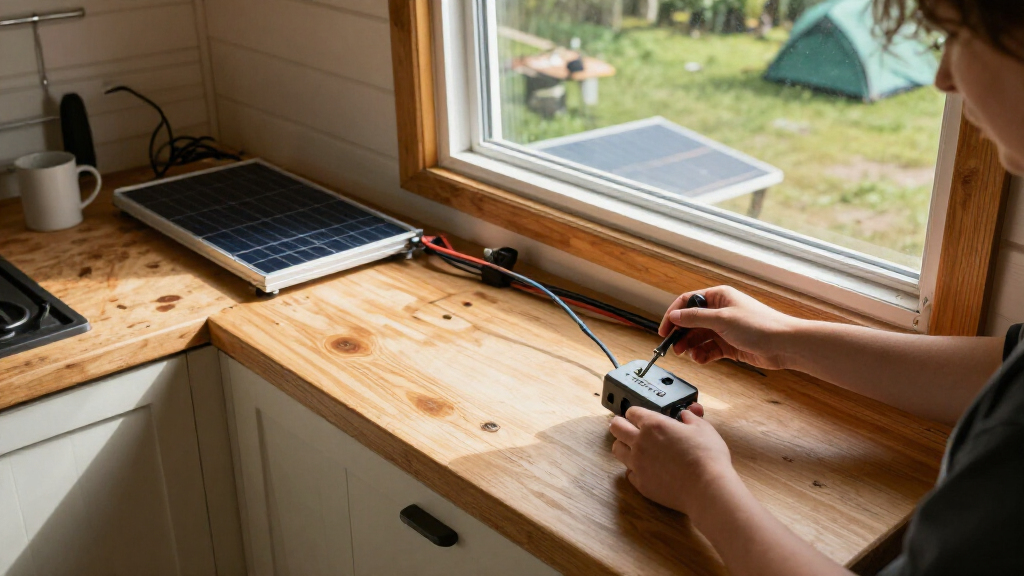
How We Picked
I ranked these kits for tiny-home use by how well their listed panel capacity, battery storage, inverter, controller, and system voltage work together for a defined scale of use. The comparison gives more weight to useful storage and a coherent system configuration than to a large inverter figure by itself: an inverter can run a load briefly, but it does not create more energy or extend battery runtime. I also considered whether a kit appears better suited to modest essential loads, a larger off-grid home, a beginner-scale setup, or a site where wind generation could make sense.
The ranking reflects the information provided for each product, not assumed performance or unlisted components. Larger systems rank well for buyers who need more capacity, but they do not automatically suit every tiny home: roof area, daily energy use, installation complexity, and expansion plans can change the best choice. I treat missing or unclear specifications as a reason for buyers to confirm details before purchase, especially around usable battery capacity, included wiring and mounting hardware, and compatibility among components.
Factors to Consider When Choosing Solar Power Kits For Tiny Homes
Before choosing a kit, I’d work backward from the way the home uses electricity. A tiny home with efficient lighting and occasional device charging has different needs from one running an electric fridge, induction cooking, or a well pump. These broader checks help prevent oversizing a system you cannot install—or buying a compact kit that cannot support your routine.
1. Size the system from daily energy use, not inverter wattage
List the appliances you expect to run, their wattage, and roughly how many hours each runs per day. That estimate gives a more useful starting point than the headline inverter rating, which describes the power available at a moment rather than the energy available over a day. Pay special attention to appliances with motors or heating elements, since their starting demand or sustained consumption can be high. A common mistake is choosing a large inverter and assuming it guarantees long runtime. If you have not settled on appliances yet, build in some flexibility but avoid treating every possible load as a daily load.
2. Match battery storage to nights and low-sun periods
Battery capacity determines how much stored energy is available when panels are not producing, so it matters most for evening use, overnight loads, and cloudy stretches. Compare usable capacity where it is specified; a headline capacity alone may not tell you how much energy you can routinely draw. Consider whether you need one night of backup or several days, then balance that goal against the system’s charging capacity. A large battery paired with limited panels may take longer to recharge, while more panels without enough storage can leave surplus daytime production unused. Ask the seller for usable capacity and recommended operating limits if those details are absent.
3. Check roof space, panel placement, and seasonal sun
Panel wattage is only useful if you have a suitable place to install the panels and enough sunlight reaches them. Measure clear roof area and check for shading from trees, nearby buildings, vents, and roof equipment before selecting a kit. Fixed panels, ground-mounted panels, and portable arrangements each bring different tradeoffs in access, security, wiring, and seasonal adjustment. Do not assume listed panel output will be available throughout the day or year; weather, orientation, and shade affect production. If roof space is tight, compare the physical dimensions and mounting requirements rather than choosing by wattage alone.
4. Choose voltage and components as a system
Battery voltage, inverter input, charge controller, and panel wiring must be compatible. The 12V options in this roundup point toward smaller setups, while 24V and 48V systems are intended for different scales; moving between them later can mean replacing components rather than making a simple adjustment. Confirm the inverter’s continuous rating and surge capacity, controller limits, battery chemistry, and supported charging methods. Also check whether the kit includes cables, fuses, disconnects, mounting equipment, and any other parts needed for a safe installation. When details are unclear, get component specifications in writing before planning around the kit.
5. Decide whether wind generation fits the site
A wind turbine can add another source of power, but it makes the most sense where wind is steady and the turbine can be sited with adequate clearance. Sheltered tiny-home locations may not deliver useful wind, and local rules, noise, tower placement, and maintenance access can complicate installation. Solar-and-wind kits in this roundup are specialized alternatives, not default upgrades over solar-only systems. Compare the turbine’s rated output and operating conditions with the solar and battery specifications, and ask how its controller integrates with the rest of the system. If the site is not meaningfully windy, a solar-only kit may be simpler to plan and maintain.
6. Plan for installation, expansion, and maintenance
A kit can reduce component-matching work without removing the need for safe installation and system planning. Think about where batteries and power electronics will sit, how cables will be routed, and whether you have suitable ventilation and protection from moisture or temperature extremes. If you expect to add panels or batteries later, confirm that the inverter, controller, and battery configuration allow that path; do not assume every kit is expandable. Owners who are new to off-grid electrical systems may benefit from professional help, particularly for permanent wiring and protective devices. A smaller, well-matched system can be a better first step than a larger kit whose installation demands exceed your plans.
Frequently Asked Questions
Can one of these kits power a tiny home full-time?
It can, but the answer depends on your daily energy use, available sunlight, battery storage, and whether you have backup power. A kit’s inverter rating alone cannot establish full-time suitability because it says little about how long appliances can run. Start with an appliance load estimate and compare it with expected daily solar production and usable battery capacity. Homes using electric space heating, water heating, or cooking often need a different scale of system than homes using efficient appliances and propane for some loads. Have the kit’s complete specifications checked against your load plan before relying on it as your sole source.
How much battery storage should I look for?
Choose storage based on the energy you need after sunset and the backup time you want during poor weather. Add up the watt-hours of essential evening and overnight loads, then allow for the fact that usable capacity can be lower than the battery’s stated capacity. If you need multiple days without strong solar production, you will need more storage and a reliable way to recharge it. More battery capacity is not always the best first purchase if your panels cannot replenish it in a reasonable period. Ask for usable capacity, recommended depth of discharge, and charging specifications before comparing battery figures.
Should I choose a 12V, 24V, or 48V kit for a tiny home?
The right voltage depends on system scale and on the compatibility of the battery, inverter, controller, and wiring. The 12V kits in this roundup are associated with smaller setups, while the 24V and 48V choices are aimed at larger configurations. Higher-voltage systems can be a better fit for greater power demands, but they are not automatically simpler or more suitable for every home. Decide on the loads and expansion plan first, then compare complete matched systems rather than mixing components based on a single specification. If you plan to add capacity later, confirm that future components will work with the original voltage and equipment.
Are solar-and-wind kits a better choice than solar-only kits?
Only when the site has enough consistent, usable wind and a practical place to install a turbine. Wind generation can complement solar, but it brings added placement, noise, maintenance, and local-rule questions. A turbine’s advertised rating also does not tell you how much energy it will generate at your specific location. Compare the turbine’s operating conditions and controller setup with your site’s wind patterns before treating it as extra dependable power. For a sheltered property with limited airflow, a well-planned solar-only system may be the more practical choice.
What should I confirm before buying a kit for permanent installation?
Request a complete component list and confirm that the panels, controller, battery, inverter, and wiring are compatible. Check which protective devices, cables, mounting parts, and connectors are included rather than assuming the word “kit” covers everything needed. Verify the inverter’s continuous and surge ratings, the battery’s usable capacity, and the controller’s limits for your panel configuration. Also check installation requirements, applicable electrical rules, and whether the system can be expanded if your needs change. If any specification is missing, get clarification before committing to a layout or relying on the kit for essential loads.
Conclusion
For the broadest off-grid capacity in this lineup, my best overall pick is the ECO-WORTHY 10kW kit with a 48V 314Ah battery, provided its scale fits your home and installation plan. The best value in capability is the ECO-WORTHY 5kW kit for buyers who want a substantial system without starting with the largest listed setup; confirm its exact storage and included components first. For a best premium-scale choice, I’d compare the two 10kW ECO-WORTHY systems by their documented battery capacity and panel configuration, then choose the one that better matches your daily use. The best beginner pick is the 200W 12V ECO-WORTHY starter kit for modest loads and learning the basics, not whole-home power. If you need a specific fit, choose the 780W kit for its listed 7.168kWh battery emphasis, or consider a solar-and-wind option only when your site has suitable wind. My final recommendation is to match daily energy use, storage, and installation conditions before choosing by headline wattage.