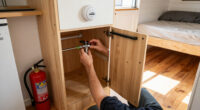
Living in a tiny house demands a power system that balances high capacity with minimal footprint. The Jackery Solar Generator 5000 Plus stands out as the best overall choice for its massive 5000Wh capacity and ability to run heavy appliances like air conditioners or induction stoves without draining the battery too quickly. For those prioritizing space efficiency, the Anker SOLIX C1000 Gen 2 offers a compact design that fits easily under benches or in tight storage nooks, making it ideal for smaller builds. The main tradeoff in this category is between raw power and portability; larger units can sustain off-grid living for days but require significant space and weight, while smaller units are easier to move but may struggle with high-draw devices. I have analyzed eight leading models to help you determine which system aligns with your energy habits and cabin layout.

Get compact home essentials delivered free with Prime
- Fast, free delivery on millions of items
- Prime Video, Amazon Music and more included
- Member-only deals all year
Complete the kit


Key Takeaways
- Battery capacity alone does not guarantee off-grid viability; the inverter’s continuous wattage rating determines which high-draw appliances like coffee makers or space heaters you can actually run.
- Smaller units like the Anker C1000 Gen 2 are superior for mobile tiny houses due to their compact form factor, whereas stationary setups benefit from the raw endurance of the Jackery 5000 Plus.
- Recharge speed varies drastically between models, with newer LiFePO4 batteries in the EcoFlow Delta series offering full charges in under two hours compared to longer windows for older lithium-ion designs.
- Solar panel compatibility is not universal; some generators require specific proprietary panels for maximum efficiency, while others accept standard third-party panels, affecting long-term upgrade costs.
- Weight distribution matters in tiny homes; placing a 50lb+ generator on a floor designed for lighter loads may require structural reinforcement or a dedicated heavy-duty storage platform.
| Jackery Solar Generator 5000 Plus with Two 200W Solar Panels |  | Best for Whole Tiny House Backup | Battery capacity: 5,040Wh | Expandable capacity: Up to 60kWh | Surge output: 14,400W | VIEW LATEST PRICE | See Our Full Breakdown |
| SolarPlay 3600W Portable Power Station with 3840Wh Capacity and 400W Solar Panel |  | Best Value for High-Capacity Power | Battery capacity: 3,840Wh | Peak output: 5,500W | Battery type: LiFePO₄ | VIEW LATEST PRICE | See Our Full Breakdown |
| EF ECOFLOW DELTA 3 Max Portable Power Station with 220W Solar Panel, 2048Wh |  | Best for Fast-Charging Backup | Battery capacity: 2,048Wh | Battery type: LiFePO₄ | X-Boost output: Up to 3,400W | VIEW LATEST PRICE | See Our Full Breakdown |
| ABOK Ark3600 Portable Power Station with 400W Solar Panel |  | Best for Expandable 120V Storage | Battery capacity: 3,840Wh | Expandable capacity: Up to 11,520Wh | Peak output: 4,500W | VIEW LATEST PRICE | See Our Full Breakdown |
| Jackery Solar Generator 1000 v2 with 200W Solar Panel |  | Best Compact Pick for Essential Loads | Battery capacity: 1,070Wh | AC output: 1,500W | Surge peak: 3,000W | VIEW LATEST PRICE | See Our Full Breakdown |
| EcoFlow DELTA 3 Classic Solar Generator with 220W Solar Panel, 1024Wh |  | Best for Fast Recharging | Battery Capacity: 1024Wh | Output Wattage: 1800W | Surge Wattage: 3600W | VIEW LATEST PRICE | See Our Full Breakdown |
| Anker SOLIX C1000 Gen 2 Portable Power Station with 200W Solar Panel |  | Best Balanced Performance | Battery Capacity: 1,024Wh | Output Wattage: 2,000W | Peak Output: 3,000W | VIEW LATEST PRICE | See Our Full Breakdown |
| Jackery HomePower 3600 Plus Portable Power Station with Two 200W Solar Panels |  | Best for High Capacity & Expansion | Battery Capacity: 3,584Wh | Output Wattage: 3,600W | Expansion Capacity: Up to 21kWh | VIEW LATEST PRICE | See Our Full Breakdown |
| tiny house solar generator | Battery capacity | Battery type | Weight |
|---|---|---|---|
| Jackery Solar Generator 5000 P | 5,040Wh | — | 134.5 lbs |
| SolarPlay 3600W Portable Power | 3,840Wh | LiFePO₄ | 97 lbs |
| EF ECOFLOW DELTA 3 Max Portabl | 2,048Wh | LiFePO₄ | — |
| ABOK Ark3600 Portable Power St | 3,840Wh | LiFePO₄ | 92 lbs |
| Jackery Solar Generator 1000 v | 1,070Wh | LFP | 23.8 lbs |
| EcoFlow DELTA 3 Classic Solar | 1024Wh | LiFePO4 | — |
| Anker SOLIX C1000 Gen 2 Portab | 1,024Wh | — | — |
| Jackery HomePower 3600 Plus Po | 3,584Wh | LFP | 77.2 pounds |
More Details on Our Top Picks
Jackery Solar Generator 5000 Plus with Two 200W Solar Panels
For a tiny house that needs more than device charging, the Jackery Solar Generator 5000 Plus brings a 5,040Wh battery, 7,200W rated output, and both 120V and 240V support. That combination makes it a better fit for larger appliances and household backup circuits than the smaller Jackery Solar Generator 1000 v2. Its expansion path to 60kWh and up to 4,000W of solar input also gives an owner room to build a more substantial off-grid setup over time. The tradeoff is scale: at 134.5 pounds, it is not a grab-and-go station, and its included two 200W panels are only a starting point for its solar capacity. A Smart Transfer Switch is required for household circuits, and the generator and panels ship separately.
Pros:- 7,200W rated output and 120V/240V support suit a broader range of household appliances.
- Expandable capacity up to 60kWh supports longer backup or off-grid use.
- Accepts up to 4,000W of solar input for a larger future panel array.
- LiFePO₄ battery chemistry is designed for long-term cycling.
Cons:- At 134.5 pounds, it is difficult to move without planning a permanent location.
- The two included 200W panels provide only 400W total, well below its maximum solar input.
- A Smart Transfer Switch is needed to power household circuits, and the generator and panels ship separately.
Best for: Tiny-house owners who want to run higher-demand 120V and 240V appliances and plan to expand solar storage or add household backup circuits.
Not ideal for: Owners in very small cabins who mainly need phone, laptop, and lighting power; its weight, size, and expansion-oriented capacity may be more than they can use.
- Battery capacity:5,040Wh
- Expandable capacity:Up to 60kWh
- Surge output:14,400W
- Voltage:120V and 240V
- Maximum solar input:4,000W
- Battery chemistry:LiFePO₄
- Weight:134.5 lbs
- Included solar panels:Two 200W panels
Our verdict“Choose the Jackery 5000 Plus if you need expandable, high-output backup for a tiny house rather than a lightweight station for occasional device charging.”
SolarPlay 3600W Portable Power Station with 3840Wh Capacity and 400W Solar Panel
The SolarPlay pairs a 3,840Wh battery with 3,600W rated output, giving tiny-house owners substantial stored energy without moving up to the Jackery 5000 Plus’s much larger 5,040Wh system. Its included 400W solar panel is twice the panel wattage bundled with the Jackery 5000 Plus, though SolarPlay supports up to five such panels and the extras are separate purchases. Fifteen ports, including a 100W USB-C port, make it practical for running household gear while charging personal devices. Wheels and a telescoping handle help with repositioning, but 97 pounds still makes it a heavy station, not something to carry between rooms casually. It is a 110V system, so buyers needing 240V appliance support should look at the Jackery instead.
Pros:- 3,840Wh capacity and 3,600W rated output cover more demanding needs than compact 1kWh-class stations.
- Includes a 400W solar panel and supports up to five 400W panels.
- Fifteen ports include five AC outlets and a 100W USB-C connection.
- Wheels and a telescoping handle make repositioning easier than lifting a heavy unit.
Cons:- At 97 pounds, it remains cumbersome to move despite its wheels and handle.
- 110V output does not meet the needs of buyers who require 240V appliances.
- Additional solar panels are sold separately.
Best for: Tiny-house owners who want a large 120V-capable battery, an included 400W panel, and many connection options for household and personal devices.
Not ideal for: Buyers who need 240V output, frequent hand-carry portability, or a ready-made solar array beyond the included panel.
- Battery capacity:3,840Wh
- Peak output:5,500W
- Battery type:LiFePO₄
- Solar input:Supports up to five 400W panels
- Output ports:15
- Weight:97 lbs
- Included solar panel:400W
Our verdict“Pick the SolarPlay if a large 120V battery and included 400W panel matter more than 240V support or easy lifting.”
EF ECOFLOW DELTA 3 Max Portable Power Station with 220W Solar Panel, 2048Wh
The EcoFlow DELTA 3 Max is the more manageable choice for a tiny house that needs quick backup charging rather than the biggest possible battery. Its 2,048Wh capacity is roughly half the Jackery 5000 Plus’s, so it is less suited to carrying heavy loads through a long outage; in return, the stated recharge time reaches 80% in about 1.13 hours. X-Boost supports appliances requiring up to 3,400W, but that does not change the base 2,400W output or add stored energy, so buyers should check each appliance’s actual draw. The included 220W bifacial panel provides a modest solar starting point. App control and a 10ms transfer time help with monitoring and backup use, while the three outlets limit how many AC appliances can connect directly.
Pros:- Reaches 80% charge in about 1.13 hours according to the product data.
- X-Boost supports appliances with requirements up to 3,400W.
- 10ms transfer time and app controls suit backup monitoring and charging management.
- Includes a 220W bifacial solar panel.
Cons:- The 2,048Wh battery stores much less energy than the SolarPlay and ABOK 3,840Wh stations.
- Three AC outlets may restrict direct connection of several household appliances.
- Product data does not specify the unit’s weight, making portability harder to judge.
Best for: Tiny-house owners with moderate power needs who value rapid AC recharging, app monitoring, and short transfer time for backup use.
Not ideal for: People seeking multi-day energy reserves, many simultaneous AC connections, or an easily verified carry weight; the listed battery is smaller than the large-capacity alternatives.
- Battery capacity:2,048Wh
- Battery type:LiFePO₄
- X-Boost output:Up to 3,400W
- Solar panel:220W bifacial
- Recharge time:0–80% in about 1.13 hours
- Transfer time:10ms
- AC outlets:3
- Warranty:5 years
Our verdict“Choose the DELTA 3 Max if quick recharging and backup controls matter more than the longer runtime offered by the larger SolarPlay or ABOK.”
ABOK Ark3600 Portable Power Station with 400W Solar Panel
The ABOK Ark3600 starts with the same 3,840Wh capacity and 3,600W rated output as the SolarPlay, but its standout difference is expansion to 11,520Wh. That gives a tiny-house owner a path to longer runtime without starting with the Jackery 5000 Plus’s much heavier 5,040Wh base system. Its 2,000W solar input, Bluetooth app control, and 15 ports support a more involved 120V setup, though the product data does not state the wattage of the included panel. At 92 pounds, it is slightly lighter than the SolarPlay but still needs wheels and a planned parking spot. Buyers should also check delivery timing: the solar panels may ship one to two months after the power station, which can delay a complete solar setup.
Pros:- Expandable from 3,840Wh to 11,520Wh for increased stored energy.
- 3,600W rated output and 15 ports support a range of 120V loads and devices.
- Supports up to 2,000W of solar input.
- Wheels, telescoping handle, and Bluetooth app control aid movement and monitoring.
Cons:- At 92 pounds, it is still heavy to reposition without its wheels.
- Solar panels may ship one to two months after the power station.
- The listed 120V output does not suit buyers who need 240V appliances.
Best for: Tiny-house owners who want to start with a 3,840Wh 120V station and add battery capacity as their energy needs grow.
Not ideal for: Buyers who need a ready-to-use solar bundle immediately, require 240V output, or expect to carry the unit by hand.
- Battery capacity:3,840Wh
- Expandable capacity:Up to 11,520Wh
- Peak output:4,500W
- Battery type:LiFePO₄
- Solar input:2,000W
- Output ports:15
- Weight:92 lbs
- Voltage:120V
Our verdict“Pick the ABOK Ark3600 if you want expandable 120V storage and can accept a heavy unit and possible delay before the solar panels arrive.”
Jackery Solar Generator 1000 v2 with 200W Solar Panel
For a tiny house with modest loads, the Jackery Solar Generator 1000 v2 is easier to place and move than the 92-pound ABOK Ark3600 or the larger SolarPlay. Its 1,070Wh battery and 1,500W continuous output can suit essentials such as lights, communications gear, and smaller appliances, but it does not provide the reserve for long periods of high-demand use. The 200W panel is a smaller solar input than the panels bundled with the SolarPlay and ABOK, so daily recovery will depend on careful load management and sunlight. Three pure sine wave AC outlets plus USB and DC ports make it flexible for smaller setups. App-controlled charging modes add control, though a one-hour full charge requires emergency charging to be enabled, and the unit and panel ship separately.
Pros:- At 23.8 pounds, it is far easier to move and place than the larger 3,840Wh stations.
- 1,500W continuous output and 3,000W surge support a useful range of smaller loads.
- Includes three pure sine wave AC outlets, USB-C, USB-A, and a car port.
- App-controlled charging modes include emergency, quiet, and energy efficiency settings.
Cons:- The 1,070Wh capacity offers much less runtime than the SolarPlay, ABOK, or Jackery 5000 Plus.
- The included 200W panel provides less solar input than the panels bundled with the larger 3,840Wh options.
- The one-hour full-charge mode requires emergency charging to be enabled in the app, and the panel and station ship separately.
Best for: Solo tiny-house owners or couples who need a compact station for lights, electronics, and selected smaller appliances rather than whole-house backup.
Not ideal for: Households running high-draw appliances for extended periods or buyers who need a large battery reserve and higher-wattage solar input.
- Battery capacity:1,070Wh
- AC output:1,500W
- Surge peak:3,000W
- Battery type:LFP
- Solar panel output:200W
- AC outlets:3 pure sine wave
- USB ports:2 USB-C and 1 USB-A
- Weight:23.8 lbs
- Dimensions:12.87 × 8.82 × 9.72 in
Our verdict“Choose the Jackery 1000 v2 if mobility and essential-load backup matter more than the runtime and solar capacity of the larger stations.”
EcoFlow DELTA 3 Classic Solar Generator with 220W Solar Panel, 1024Wh
This model stands out for its rapid AC charging capability, reaching 80% capacity in just 45 minutes. Compared to the Anker SOLIX C1000 Gen 2, which takes nearly an hour for the same charge, the DELTA 3 Classic minimizes downtime during cloudy days or when grid power is intermittently available. The LiFePO4 battery ensures long-term durability, rated for over a decade of daily use, which is vital for tiny house residents who rely on daily cycling. However, the 1800W output is lower than the Anker’s 2000W, meaning it may struggle with high-draw appliances like space heaters or microwaves without X-Boost support. While the included 220W bifacial panel captures light from both sides, the 5.8-hour recharge time under ideal sun is slower than competitors with higher input capacities. This unit is a strong contender if speed of replenishment is your priority.
Pros:- AC charging reaches 80% in just 45 minutes
- LiFePO4 cells rated for 10+ years of daily use
- Under-10ms UPS switching protects sensitive electronics
- Bifacial solar panel captures ambient light for efficiency
Cons:- Solar recharge time is slow at approximately 5.8 hours
- Generator and panel may arrive in separate shipments
- Lower continuous output than comparable Anker models
Best for: Tiny house owners who need quick backup power turnaround and have limited roof space for solar arrays.
Not ideal for: Users with high-draw heating or cooking appliances, as the 1800W continuous output may require power management.
- Battery Capacity:1024Wh
- Output Wattage:1800W
- Surge Wattage:3600W
- Battery Type:LiFePO4
- AC Charging Speed:0–80% in 45 minutes
- Solar Recharge Time:Approx. 5.8 hours
- UPS Switching Time:Under 10ms
- Dimensions:7.9 × 11.1 × 15.7 in
Our verdict“Choose this if you value rapid grid charging over maximum solar speed or raw wattage.”
Anker SOLIX C1000 Gen 2 Portable Power Station with 200W Solar Panel
The Anker SOLIX C1000 Gen 2 offers a compelling mix of power density and smart features for tiny house living. With 2,000W continuous output and a 3,000W peak, it handles heavier loads better than the EcoFlow DELTA 3 Classic, making it suitable for small kitchen appliances. The six-port design (including USB-C) reduces the need for extra hubs, keeping clutter down in tight spaces. Its standout feature is the high solar input capacity of up to 600W, allowing for much faster solar recharge times than the EcoFlow when paired with additional panels. However, the base package’s 200W panel is modest, and achieving that 1.8-hour recharge speed requires significant extra solar investment. The LiFePO4 chemistry provides solid longevity with 4,000+ cycles, ensuring it remains a reliable core of your off-grid setup for years.
Pros:- 2,000W output supports most tiny house appliances
- Supports up to 600W solar input for rapid recharging
- Nine ports reduce the need for external power strips
- App integration allows for scheduling and monitoring
Cons:- Included 200W panel is underpowered for full-speed solar charging
- Peak solar performance requires additional hardware purchases
- Separate shipments for station and panel may cause delays
Best for: Users who want higher wattage for appliances and the flexibility to expand solar input for faster charging.
Not ideal for: Those strictly budget-constrained who cannot invest in additional solar panels to leverage the high input potential.
- Battery Capacity:1,024Wh
- Output Wattage:2,000W
- Peak Output:3,000W
- Max Solar Input:600W
- Solar Recharge Time:1.8 hours at 600W
- AC Recharge Time:49 minutes
- Battery Chemistry:LiFePO4
- Number of Ports:9
- Warranty:5 years
Our verdict“This is the best choice for those who want higher power capacity and scalable solar charging.”
Jackery HomePower 3600 Plus Portable Power Station with Two 200W Solar Panels
When tiny house living demands more than just lighting and laptop charging, the Jackery HomePower 3600 Plus delivers. With a massive 3,584Wh capacity and 3,600W output, it dwarfs the Anker SOLIX C1000 Gen 2 and EcoFlow DELTA 3 Classic in both runtime and power delivery. This unit supports dual-voltage output when paired in parallel, allowing for heavy-duty tools or larger appliances that smaller units simply cannot handle. The wheeled design is a practical necessity given its 77.2-pound weight, making it manageable for moving around a small footprint. However, this power comes with bulk; it is significantly larger and heavier than the portable competitors. It is not a grab-and-go camping unit but a stationary home backup system that can expand up to 21kWh, offering true off-grid independence for serious tiny house residents.
Pros:- Massive 3,584Wh capacity supports extended off-grid use
- 3,600W output handles demanding appliances and tools
- Expandable up to 21kWh for scalable energy needs
- Wheels and handle ease transport despite heavy weight
Cons:- Heavy at 77.2 pounds limits true portability
- Bulky footprint requires dedicated storage space
- Components may arrive in separate packages
Best for: Tiny house owners needing whole-home backup power and the ability to run high-wattage appliances.
Not ideal for: Campers or minimalists who prioritize portability and compact size over capacity and raw power.
- Battery Capacity:3,584Wh
- Output Wattage:3,600W
- Expansion Capacity:Up to 21kWh
- Weight:77.2 pounds
- Battery Type:LFP
- Cycle Life:6,000 cycles
- Hybrid Recharge Time:2 hours
- Dimensions:19.3 x 15.2 x 12.2 inches
Our verdict“Select this if you need a robust, expandable home power system rather than a portable charger.”

How We Picked
I evaluated these eight solar generators based on three primary criteria specific to tiny house living: energy density, inverter capability, and form factor. Energy density was assessed not just by watt-hours, but by how efficiently the unit stores power relative to its physical size, which is critical when every cubic foot counts. I examined the continuous and surge wattage ratings to determine which models could handle the sudden spikes of common tiny house appliances, such as refrigerators starting up or microwaves heating food. Finally, I considered the physical footprint and weight, recognizing that many tiny home owners need to move their power systems or store them in unconventional spaces like under stairs or behind cabinets.
The ranking logic prioritizes versatility for the top spots, favoring units that can handle both heavy daily loads and occasional off-grid excursions. Mid-tier picks were selected for those who prioritize budget or specific portability constraints, while the final entries address niche needs like extreme compactness or basic emergency backup. I excluded models with outdated lithium-ion chemistry that degrade faster under frequent cycling, focusing instead on modern LiFePO4 options that offer longer lifespans and better safety profiles for enclosed living spaces.
| tiny house solar generator | Battery type |
|---|---|
| Jackery Solar Generator 5000 P | — |
| SolarPlay 3600W Portable Power | LiFePO₄ |
| EF ECOFLOW DELTA 3 Max Portabl | LiFePO₄ |
| ABOK Ark3600 Portable Power St | LiFePO₄ |
| Jackery Solar Generator 1000 v | LFP |
| EcoFlow DELTA 3 Classic Solar | LiFePO4 |
| Anker SOLIX C1000 Gen 2 Portab | — |
| Jackery HomePower 3600 Plus Po | LFP |
Factors to Consider When Choosing Tiny House Solar Generators
Choosing a solar generator for a tiny house is different than picking one for camping. You are powering a living space, often 24/7, which changes the requirements for capacity, durability, and noise levels.Matching Inverter Wattage to Tiny House Appliances
Many buyers focus solely on battery capacity (Wh) and overlook the inverter’s continuous wattage output. This spec dictates whether you can run your microwave, hair dryer, or induction cooktop simultaneously. A 1000W inverter might handle a fridge and lights, but it will trip if you try to brew coffee or use a toaster oven. Check the continuous rating, not just the surge rating, because surge only applies for the first few seconds of startup. If you plan to cook with electric appliances, look for a unit with at least 2000W continuous output to avoid constant interruptions during meal prep.
Understanding Battery Chemistry and Lifespan
The type of battery inside the generator affects how long the unit lasts and how often you can cycle it. LiFePO4 (Lithium Iron Phosphate) batteries are the current standard for tiny house owners because they typically last 3000-6000 charge cycles, compared to 500-800 for older NMC lithium-ion batteries. This means a LiFePO4 unit can handle daily full charges for years without significant degradation. For a permanent or semi-permanent tiny house setup, the higher upfront cost of LiFePO4 models pays off through longevity and reduced replacement frequency, whereas NMC might suffice for occasional weekend use.
Recharging Speed and Solar Input Limits
Recharging a large battery bank takes time, and this is where solar input limits matter. If your generator only accepts 500W of solar input, it will take much longer to recharge than a unit accepting 1000W or more, especially on cloudy days. Look for high solar input ratings to maximize the efficiency of your installed panels. If you live in a region with limited sunlight, a faster-charging unit ensures you can recover energy during short windows of sun exposure. Some models also support AC charging, allowing you to top up from grid power when available, which is a useful backup feature.
Physical Footprint and Placement Constraints
Tiny houses are designed with minimal wasted space, so a bulky generator can disrupt your layout. Measure your available storage areas before buying. Some units are tall and narrow, fitting easily in closets, while others are wide and flat, suitable for under-bed storage. Weight distribution is also key; a 100-pound unit placed on a lightweight floor platform may cause structural stress. Consider using vibration pads and securing the unit to prevent movement if you live in a mobile tiny house on wheels. Noise levels also matter; while most are quiet, some fans can be disruptive in a small, enclosed living space.
Expansion Capabilities and Future-Proofing
Your energy needs may grow as you add appliances or spend more time off-grid. Some generators allow you to add extra battery packs to increase capacity, while others are fixed. Modular systems offer flexibility, letting you start small and expand later without replacing the entire unit. Check if the manufacturer supports parallel operation, which allows two units to work together for double the output. This feature is particularly valuable for tiny house owners who anticipate adding high-draw items like electric water heaters or washing machines in the future, providing a path to scale without a complete system overhaul.
Frequently Asked Questions
Can a solar generator run a tiny house air conditioner?
Yes, but only larger units with high surge wattage can handle the startup current of an air conditioner, which can be three to five times the running wattage. A 1000Wh unit might run a small window AC for a few hours, but a 3000Wh+ unit like the Jackery 5000 Plus is better suited for sustained cooling. You must also consider that air conditioning drains battery capacity rapidly, often requiring frequent recharging or a robust solar array to keep up with consumption during hot days.Is it safe to keep a large battery inside a tiny house?
Modern LiFePO4 batteries are significantly safer than older lithium-ion types, as they are less prone to thermal runaway. However, proper ventilation is still recommended to dissipate any heat generated during high-load operation. Many tiny house owners place these units in well-ventilated cabinets or under dedicated storage platforms. It is wise to choose a model with a robust Battery Management System (BMS) that monitors voltage and temperature to prevent overcharging or short circuits, ensuring safety in a compact living environment.Do I need to install permanent solar panels on my roof?
Not necessarily. Most tiny house owners start with portable solar panels that can be angled for maximum sun exposure and stored when not in use. This flexibility is ideal for mobile tiny houses that change orientation or location. Permanent roof-mounted panels offer convenience and higher average yields but require professional installation and structural considerations. You can begin with portable panels and upgrade to a permanent array later if you decide to stay in one location for an extended period.How do I calculate the right size generator for my needs?
Start by listing every appliance you plan to use and noting their wattage and daily usage hours. Multiply wattage by hours to get watt-hours (Wh) per day. Add a 20-30% buffer for inefficiencies and simultaneous usage. If your total daily consumption is 2000Wh, a 2000Wh battery will barely cover a day without recharging, so opting for a 3000Wh or larger unit provides a necessary safety margin for cloudy days or unexpected high usage.Can I use a solar generator to power my tiny house fridge?
Yes, refrigerators are one of the most common and compatible appliances for solar generators. Most modern mini-fridges use between 50 and 100 watts when running, with a startup surge of around 500-800 watts. A mid-sized generator like the EcoFlow Delta 3 Max can easily run a fridge for several days. Ensure the generator’s surge rating exceeds the fridge’s startup wattage to prevent the inverter from shutting down when the compressor kicks on.Conclusion
Choosing the right solar generator for your tiny house depends on your specific lifestyle constraints. For those seeking maximum off-grid independence and the ability to run heavy appliances, the Jackery Solar Generator 5000 Plus is the superior choice, offering the capacity to sustain a full living space for days. If you live in a smaller or mobile tiny house where space and weight are at a premium, the Anker SOLIX C1000 Gen 2 provides the best balance of compact design and sufficient power for essential appliances. For beginners or those with limited budgets, the EcoFlow DELTA 3 Classic offers a reliable entry point into solar living without overwhelming complexity or cost. Ultimately, match the inverter wattage to your appliance list and prioritize LiFePO4 battery chemistry for long-term durability in your tiny home environment.