For most homes, I’d start with the AEOCKY RHEA-001 80-pint: its stated capacity and coverage make it the strongest candidate for large, persistently damp spaces. The Dr. Prepare 38-pint is a more measured choice for medium-size rooms, while the Kesnos 30-pint may suit buyers who want a smaller-capacity option with hose drainage. Choosing an Energy Star dehumidifier means balancing moisture-removal capacity and stated coverage against energy use, upkeep, and where collected water will go. A larger unit may be a better fit for a damp basement, but it can be more machine than a smaller room needs. Read on for my comparison of all 11 models and how I’d match them to different homes.

Get compact home essentials delivered free — and shop member deals
- Fast, free delivery on millions of items
- Access to Prime Big Deal Days deals on October 6–7
- Prime Video, Amazon Music and more included
Complete the kit


Key Takeaways
- Large spaces point toward the 80-pint group: AEOCKY, Kesnos, Ludatido, and Waykar all list high-capacity models, but their stated coverage varies from large rooms to up to 5,500 square feet.
- Coverage claims do not tell the whole story: The listed range runs from 1,750 square feet for the UKOKE to 5,500 for the AEOCKY, so match capacity to dampness and room conditions rather than square footage alone.
- Mid-capacity models offer the broadest choice: The 34- to 52-pint options span smaller homes and moderate rooms, giving buyers alternatives to the higher-capacity 80-pint machines.
- Drainage is a practical separator: Several listings explicitly include a drain hose, making continuous drainage a clear point of comparison for spaces where manual tank emptying would be inconvenient.
- Repeated model names call for close listing checks: The roundup includes two Waykar 34-pint listings and both 30- and 80-pint Kesnos models, so verify the exact capacity, coverage, and included accessories before choosing.
| Arecovas 52-Pint Dehumidifier for Areas up to 3,500 Sq. Ft. |  | Best for Flexible Drainage | Dehumidification capacity: 52 pints per day | Coverage area: Up to 3,500 sq. ft. | Tank capacity: 0.66 gallons | VIEW ON AMAZON | See Our Full Breakdown |
| Energy Star Dehumidifier for Areas up to 4,500 Sq. Ft. |  | Best for Quiet, Certified Coverage | Energy certification: ENERGY STAR | Coverage area: Up to 4,500 sq. ft. | Listed dehumidification capacity: 45–80 pints; another listing states 45 gallons per day | VIEW ON AMAZON | See Our Full Breakdown |
| AEOCKY RHEA-001 80-Pint Dehumidifier for Homes up to 5,500 Sq. Ft. |  | Best for High-Capacity ENERGY STAR Efficiency | Model: RHEA-001 | Dehumidification capacity: Up to 80 pints per day | Coverage area: Up to 5,500 sq. ft. | VIEW ON AMAZON | See Our Full Breakdown |
| Dr. Prepare Energy Star Dehumidifier, 38-Pint, for Rooms up to 2,600 Sq. Ft. |  | Best for Quiet Smaller Rooms | Dehumidification capacity: Up to 38 pints per day at 95°F and 90% RH | Coverage area: Up to 2,600 sq. ft. | Humidity range: 30% to 80% RH | VIEW ON AMAZON | See Our Full Breakdown |
| UKOKE 1750 Sq. Ft. Dehumidifier, 34-Pint, Energy Star Certified |  | Best Compact ENERGY STAR Pick | Model: UDH0125 | Energy certification: ENERGY STAR | Coverage area: Up to 1,750 sq. ft. | VIEW ON AMAZON | See Our Full Breakdown |
| Waykar 34-Pint Dehumidifier for Home, Up to 2,000 Sq. Ft. |  | Best Mid-Size ENERGY STAR Pick | Certification: ENERGY STAR | Moisture removal: Up to 34 pints per day at 95°F and 90% RH | Coverage: Up to 2,000 sq. ft. | VIEW ON AMAZON | See Our Full Breakdown |
| Kesnos 80-Pint Energy Star Dehumidifier with Drain Hose |  | Best for Large, Very Damp Areas | Model: JD025N-80 | Dehumidification capacity: 80 pints per day | Coverage area: Up to 6,000 sq. ft. | VIEW ON AMAZON | See Our Full Breakdown |
| Waykar 34-Pint Dehumidifier for Spaces up to 2,000 Sq. Ft. | 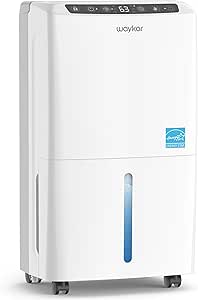 | Best Quiet-Operation Pick | Dehumidification capacity: 34 pints per day | Coverage area: Up to 2,000 sq. ft. | Tank capacity: 0.62 gal. | VIEW ON AMAZON | See Our Full Breakdown |
| Ludatido 80-Pint Energy Star Dehumidifier for Large Rooms |  | Best for Quiet, High-Capacity Operation | Certification: ENERGY STAR | Dehumidification capacity: Up to 80 pints per day at 95°F and 90% RH | Coverage area: Up to 5,000 sq. ft. | VIEW ON AMAZON | See Our Full Breakdown |
| Kesnos 30-Pint Dehumidifier for Up to 2,500 Sq. Ft. with Drain Hose |  | Best Compact, Low-Power Pick | Dehumidification capacity: 30 pints per day | Coverage area: Up to 2,500 sq. ft. | Water tank capacity: 0.39 gal. | VIEW ON AMAZON | See Our Full Breakdown |
| Waykar 80-Pint Energy Star Dehumidifier for Spaces up to 5,000 Sq. Ft. |  | Best for Large Spaces with Flexible Drainage | Moisture removal capacity: Up to 80 pints per day at 95°F and 90% RH | Coverage area: Up to 5,000 sq. ft. | Humidity control range: 30%–80% RH | VIEW ON AMAZON | See Our Full Breakdown |
| energy star dehumidifier | Coverage area | Dehumidification capacity | Noise level | Drainage |
|---|---|---|---|---|
| Arecovas 52-Pint Dehumidifier | Up to 3,500 sq. ft. | 52 pints per day | — | Manual tank or continuous drainage with included 6-foot hose |
| Energy Star Dehumidifier for A | Up to 4,500 sq. ft. | — | 40 dB | Removable tank or drain hose |
| AEOCKY RHEA-001 80-Pint Dehumi | Up to 5,500 sq. ft. | Up to 80 pints per day | 44 dB at lowest fan speed | — |
| Dr. Prepare Energy Star Dehumi | Up to 2,600 sq. ft. | Up to 38 pints per day at 95°F and 90% RH | — | Manual tank or continuous drainage hose |
| UKOKE 1750 Sq. Ft. Dehumidifie | Up to 1,750 sq. ft. | Up to 34 pints per day at 95°F and 90% RH | 38 dB on low speed | — |
| Waykar 34-Pint Dehumidifier fo | — | — | — | Removable tank or included hose for continuous drainage |
| Kesnos 80-Pint Energy Star Deh | Up to 6,000 sq. ft. | 80 pints per day | — | — |
| Waykar 34-Pint Dehumidifier fo | Up to 2,000 sq. ft. | 34 pints per day | As low as 38 dB | Tank or included 3.3 ft. drain hose |
| Ludatido 80-Pint Energy Star D | Up to 5,000 sq. ft. | Up to 80 pints per day at 95°F and 90% RH | 35 dB | Continuous drainage option |
| Kesnos 30-Pint Dehumidifier fo | Up to 2,500 sq. ft. | 30 pints per day | 36 dB | — |
| Waykar 80-Pint Energy Star Deh | Up to 5,000 sq. ft. | — | Around 42 dB | — |
More Details on Our Top Picks
Arecovas 52-Pint Dehumidifier for Areas up to 3,500 Sq. Ft.
The Arecovas pairs a 52-pint daily capacity with coverage for spaces up to 3,500 square feet, giving it more headroom than the Dr. Prepare 38-Pint for larger or damper areas. Its manual or continuous drainage lets you use the tank when a drain is unavailable or attach the included hose for less hands-on emptying. Three modes cover humidity control, drying, and continuous operation, while auto-defrost and power-outage memory add practical safeguards. The tradeoff is the 0.66-gallon tank: in humid conditions it can fill quickly, so manual-drain users may need frequent trips to empty it. The provided product data does not state an ENERGY STAR certification, so buyers choosing specifically for verified certification should compare it with the certified UKOKE or AEOCKY instead.
Pros:- Rated to remove up to 52 pints per day across spaces up to 3,500 square feet
- Supports tank drainage and continuous drainage with an included 6-foot hose
- Three operating modes provide options for humidity control, drying, and continuous use
- Includes auto-defrost, full-tank shutoff, child lock, and power-outage memory
Cons:- The 0.66-gallon tank may need frequent emptying during heavy moisture removal
- The supplied product information does not list ENERGY STAR certification
- At 31.9 pounds, it is less convenient to move than the lighter UKOKE
Best for: Homeowners managing a damp basement or large living area who want a high stated capacity and the option to connect a drain hose.
Not ideal for: Buyers who require a stated ENERGY STAR certification, or anyone relying on tank-only drainage and wanting fewer emptying trips.
- Dehumidification capacity:52 pints per day
- Coverage area:Up to 3,500 sq. ft.
- Tank capacity:0.66 gallons
- Wattage:350 watts
- Operating modes:DEHU, DRY, CONT
- Drainage:Manual tank or continuous drainage with included 6-foot hose
- Dimensions:8.86 × 12.6 × 19.29 in.
- Weight:31.9 lbs
Our verdict“Choose the Arecovas for flexible drainage and substantial stated capacity, but look elsewhere if documented ENERGY STAR certification is your deciding requirement.”
Energy Star Dehumidifier for Areas up to 4,500 Sq. Ft.
This is the clearest fit in this group for shoppers who put stated ENERGY STAR certification and quiet operation ahead of a simple capacity comparison. It lists coverage up to 4,500 square feet, a 40 dB sleep mode, humidity sensing, and five modes—more control than the three-mode Arecovas. Its 1.72-gallon tank is also larger than the Arecovas’ 0.66-gallon reservoir, though either can be connected to a drain hose. There is a significant data caveat: capacity is described as 45–80 pints in one place and 45 gallons per day elsewhere. I would verify the actual rating before matching it to a demanding space. At 200 watts, its listed power draw is modest, but capacity figures are too inconsistent to treat as a straightforward performance comparison.
Pros:- Lists ENERGY STAR certification and coverage up to 4,500 square feet
- Quiet mode is listed at 40 dB
- 1.72-gallon tank and drain-hose option offer more drainage flexibility than the Arecovas tank alone
- Includes humidity sensing, auto defrost, a timer, and five operating modes
Cons:- Capacity information conflicts between 45–80 pints and 45 gallons per day
- Manual drainage still requires emptying the tank when a hose connection is unavailable
- Its large stated coverage does not resolve uncertainty about the actual moisture-removal rating
Best for: Buyers seeking a stated ENERGY STAR-certified unit for a large home who value quiet sleep operation, humidity sensing, and multiple modes.
Not ideal for: Shoppers who need a precise, dependable moisture-removal rating before choosing a unit for a particularly damp basement.
- Energy certification:ENERGY STAR
- Coverage area:Up to 4,500 sq. ft.
- Listed dehumidification capacity:45–80 pints; another listing states 45 gallons per day
- Tank capacity:1.72 gallons
- Noise level:40 dB
- Power:200 watts
- Operating modes:5 selectable modes
- Timer:24-hour programmable auto on/off
- Drainage:Removable tank or drain hose
Our verdict“Pick this model for its stated certification and quiet, feature-rich operation only after confirming the conflicting capacity information.”
AEOCKY RHEA-001 80-Pint Dehumidifier for Homes up to 5,500 Sq. Ft.
For a large, persistently damp home, the AEOCKY combines the strongest clearly stated capacity here—up to 80 pints per day—with ENERGY STAR Most Efficient 2025 certification. That makes it a more persuasive efficiency-focused high-capacity choice than the Arecovas, whose supplied details do not list certification and whose rating is 52 pints per day. Coverage is stated at up to 5,500 square feet, and smart humidity control can adjust operation around the room’s conditions instead of requiring constant manual changes. A low-speed noise rating of 44 dB and power-off memory add useful everyday touches. The key compromise is missing practical drainage detail: the product information gives no tank capacity or drainage method. I would confirm those points before buying, especially for a basement where continuous drainage can save frequent maintenance.
Pros:- Rated for up to 80 pints per day and coverage up to 5,500 square feet
- ENERGY STAR Most Efficient 2025 certification is specifically stated
- Smart humidity control can reduce the need for constant manual adjustment
- Includes power-off memory and low-temperature defrost operation
Cons:- Product information does not state tank capacity or drainage options
- The 44 dB figure applies to the lowest fan speed, not necessarily other settings
- Energy savings and lifespan claims are manufacturer statements rather than independently supplied usage results
Best for: Owners of large homes or damp basements who want high stated moisture-removal capacity and a specific ENERGY STAR Most Efficient certification.
Not ideal for: Buyers who need a published tank size, a confirmed hose-drain setup, or complete operating-cost information before purchase.
- Model:RHEA-001
- Dehumidification capacity:Up to 80 pints per day
- Coverage area:Up to 5,500 sq. ft.
- Energy certification:ENERGY STAR Most Efficient 2025
- Noise level:44 dB at lowest fan speed
- Compressor:Rotary compressor
- Dimensions:14.45 × 8.66 × 24.09 in.
- Weight:31 lbs
- Controls and protections:Smart humidity control, power-off memory, low-temperature defrost
Our verdict“Choose the AEOCKY when certified efficiency and large-space capacity lead your priorities, provided its drainage setup suits your room.”
Dr. Prepare Energy Star Dehumidifier, 38-Pint, for Rooms up to 2,600 Sq. Ft.
The Dr. Prepare is the smaller-capacity option for buyers who want quiet, adjustable humidity control rather than the 80-pint output of the AEOCKY. It is rated for up to 38 pints per day under hot, very humid test conditions and covers rooms up to 2,600 square feet. Its standout figure is 35 dB in sleep mode, making it the quietest stated operating mode in this batch. Auto, continuous, and sleep settings keep the controls less sprawling than the five-mode certified model, while a washable filter and four casters make routine care and repositioning easier. The 2-liter tank is small, though the included hose supports continuous drainage. The supplied data does not specify ENERGY STAR certification, so the UKOKE is a safer match for buyers who require that claim to be explicit.
Pros:- Sleep mode is rated at 35 dB
- Offers adjustable humidity control and coverage up to 2,600 square feet
- Includes a hose for continuous drainage as well as a removable 2-liter tank
- Washable filter, four casters, and automatic restart support routine use
Cons:- The 2-liter tank can require frequent emptying without continuous drainage
- Its 38-pint capacity is below the Arecovas and AEOCKY ratings
- The supplied product data does not explicitly state ENERGY STAR certification
- Requires 24 hours upright before first use
Best for: People managing moisture in bedrooms, offices, or medium-sized rooms who prioritize a very quiet sleep setting and easy repositioning.
Not ideal for: Buyers with very large, heavily damp areas or shoppers who require explicitly documented ENERGY STAR certification.
- Dehumidification capacity:Up to 38 pints per day at 95°F and 90% RH
- Coverage area:Up to 2,600 sq. ft.
- Humidity range:30% to 80% RH
- Sleep-mode noise:35 dB
- Tank capacity:2 liters (0.53 gallons)
- Modes:Auto, continuous, sleep
- Fan speeds:3
- Drainage:Manual tank or continuous drainage hose
- Dimensions:8.7 × 9.8 × 17.5 in. (D × W × H)
Our verdict“Choose the Dr. Prepare for quieter operation in a modest-size room, but favor a larger or explicitly certified model for other priorities.”
UKOKE 1750 Sq. Ft. Dehumidifier, 34-Pint, Energy Star Certified
The UKOKE is the most focused choice for a smaller home or single problem room: it lists ENERGY STAR certification, covers up to 1,750 square feet, and weighs about 20 pounds according to its specifications. Its 38 dB low-speed rating is quieter than the Arecovas’ listed product data, and integrated handles support moving it between rooms. The 34-pint rating is given under 95°F and 90% RH conditions, so it should not be read as a guaranteed daily yield in cooler or less humid spaces. Compared with the Dr. Prepare, it covers less area but gives a more explicit certification claim and a lower listed annual energy consumption. Its 0.53-gallon tank is the main practical limit, and the supplied details do not list continuous hose drainage. Listed weight also varies between the specifications and description.
Pros:- ENERGY STAR certification is explicitly listed
- Designed for spaces up to 1,750 square feet with a 34-pint stated capacity
- Low-speed operation is rated at 38 dB
- Lists 105 kWh annual energy consumption and integrated handles
Cons:- The 0.53-gallon tank may need frequent emptying
- Capacity is stated under hot, highly humid conditions, which may differ from typical room conditions
- Weight information conflicts between 20 lbs and 22.05 lbs
- The supplied product details do not list a continuous-drain hose
Best for: Apartment residents or homeowners targeting one smaller, humid area who want stated ENERGY STAR certification and a portable unit.
Not ideal for: People dehumidifying a large basement, or buyers who want a large reservoir or a documented continuous-drain option.
- Model:UDH0125
- Energy certification:ENERGY STAR
- Coverage area:Up to 1,750 sq. ft.
- Dehumidification capacity:Up to 34 pints per day at 95°F and 90% RH
- Tank volume:0.53 gallons
- Noise level:38 dB on low speed
- Annual energy consumption:105 kWh
- Modes:Automated, Ultra-Quiet, Continuous
- Weight:20 lbs in specifications; 22.05 lbs in description
Our verdict“Choose the UKOKE for a portable, explicitly certified dehumidifier in a smaller space, not for heavy moisture loads or hands-off drainage.”
Waykar 34-Pint Dehumidifier for Home, Up to 2,000 Sq. Ft.
I’d shortlist this ENERGY STAR-certified Waykar for a damp basement or shared living area where a 34-pint daily rating is a better fit than a high-capacity unit. Its coverage claim reaches 2,000 square feet, and the adjustable 30%–80% humidity range gives buyers room to set a target rather than run it without control. Compared with the Kesnos 80-Pint, it removes less moisture per day, but its more moderate capacity may suit homes that do not need a large-room workhorse. The included hose supports continuous drainage, while the 2.5-liter tank is available when a drain is not convenient. That tank is small enough to need regular attention during wet spells. I also can’t compare its “low” noise description with measured sound levels, since none are provided. The 24-hour timer and safety features add useful day-to-day control.
Pros:- ENERGY STAR certification and up to 34 pints of moisture removal per day
- Adjustable humidity from 30% to 80% and two fan speeds
- Included hose enables continuous drainage
- Automatic shutoff, auto-restart, defrost, and overload protection
Cons:- The 2.5-liter tank needs emptying when continuous drainage is not used
- No measured noise rating is provided
- Coverage and moisture-removal needs may exceed its 34-pint capacity in very damp large spaces
Best for: Homeowners seeking an ENERGY STAR-certified unit for a basement or living area up to 2,000 square feet, with the option to drain continuously.
Not ideal for: People managing very damp, expansive spaces who need more than 34 pints of rated daily removal, or buyers who want a published decibel figure.
- Certification:ENERGY STAR
- Moisture removal:Up to 34 pints per day at 95°F and 90% RH
- Coverage:Up to 2,000 sq. ft.
- Humidity range:30%–80% RH
- Water tank capacity:2.5 L (0.66 gal)
- Drainage:Removable tank or included hose for continuous drainage
- Fan speeds:2
- Timer:24 hours
- Warranty:1 year, extendable up to 2 years
Our verdict“Choose this Waykar for ENERGY STAR-certified, mid-size moisture control with flexible drainage, but step up to the Kesnos 80-Pint for heavier dampness.”
Kesnos 80-Pint Energy Star Dehumidifier with Drain Hose
I’d put this Kesnos near the top of a shortlist for large areas with persistent moisture: its stated 80-pint daily capacity and coverage of up to 6,000 square feet exceed the 34-pint Waykar models in this batch. That extra capacity makes it the more suitable choice when a smaller unit could run short of the removal needed, though actual results depend on room conditions. The control range of 30%–80% RH and two fan speeds let buyers adjust operation to the space. Drainage is the main practical compromise. The tank holds 1.06 gallons, so continuous drainage can reduce manual emptying; however, the supplied 3.3-foot hose is not a garden hose, and the description says a compatible garden hose is needed for continuous drainage. At 30.6 pounds, it is portable but not especially light to move between floors. I’d choose it for capacity, not compact convenience.
Pros:- Up to 80 pints of daily moisture removal and coverage listed up to 6,000 square feet
- ENERGY STAR designation in the product name
- Adjustable humidity control and two fan speeds
- Automatic shutoff and tank-full alert
Cons:- The 1.06-gallon tank may need frequent emptying without continuous drainage
- A compatible garden hose for continuous drainage is not included
- At 30.6 pounds, it is less convenient to carry between floors than smaller units
Best for: Owners of large basements, multi-room areas, or other persistently damp spaces who need high stated moisture-removal capacity and can arrange a drain connection.
Not ideal for: Buyers with only a small damp room, limited space, or no suitable drainage setup who want a lightweight unit with a larger collection tank.
- Model:JD025N-80
- Dehumidification capacity:80 pints per day
- Coverage area:Up to 6,000 sq. ft.
- Humidity range:30%–80% RH
- Water tank capacity:1.06 gal (4 L)
- Drain hose length:3.3 ft.
- Fan speeds:2
- Airflow capacity:106 CFM
- Weight:30.6 lb.
Our verdict“Pick the Kesnos over the 34-pint Waykar when large-area moisture removal is the priority and you can provide a suitable continuous-drain setup.”
Waykar 34-Pint Dehumidifier for Spaces up to 2,000 Sq. Ft.
This Waykar’s clearest point of difference is its stated 38 dB low noise level, giving noise-conscious buyers a concrete figure that the other 34-pint Waykar listing does not provide. It removes up to 34 pints per day and is listed for spaces up to 2,000 square feet, making it a better match for a bedroom-adjacent area or modest basement than the high-capacity Ludatido 80-Pint. Three modes—dehumidifying, drying, and continuous—add flexibility for different tasks, while two drainage options reduce the need to empty the tank if the included hose can reach a drain. The 0.62-gallon tank is small, so manual collection can mean frequent trips to empty it. I’d also pay attention to the drain connection: the product data warns that the pipe switch must be tightened when using the tank to prevent leaks. This is a compact-capacity choice, not a heavy-duty substitute.
Pros:- Listed noise level as low as 38 dB
- Up to 34 pints per day for spaces up to 2,000 square feet
- Three operating modes and two fan speeds
- Included 3.3-foot hose, tank-full shutoff, defrost, and power-outage memory
Cons:- The 0.62-gallon tank may require frequent emptying
- The drain-pipe switch must be tightened when using the tank to help prevent leaks
- Its 34-pint capacity is below the 80-pint Ludatido for large, heavily damp spaces
Best for: Noise-conscious buyers seeking a 34-pint unit for a space up to 2,000 square feet, especially where the listed 38 dB rating matters.
Not ideal for: People handling severe moisture across a very large area, or anyone who wants a large tank and does not plan to use hose drainage.
- Dehumidification capacity:34 pints per day
- Coverage area:Up to 2,000 sq. ft.
- Tank capacity:0.62 gal.
- Drainage:Tank or included 3.3 ft. drain hose
- Operating modes:Dehumidifying, drying, continuous
- Noise level:As low as 38 dB
- Power:190 W
- Dimensions:10.87 × 8.39 × 19.3 in.
- Weight:22.1 lb.
Our verdict“Choose this Waykar for a quieter, compact 34-pint setup with multiple modes, but opt for the Ludatido when moisture volume matters more than sound and size.”
Ludatido 80-Pint Energy Star Dehumidifier for Large Rooms
I’d consider the Ludatido when a buyer wants high stated capacity without giving up a low listed noise figure. It is ENERGY STAR certified, rated for up to 80 pints per day, and intended for areas up to 5,000 square feet; its stated 35 dB is quieter on paper than the Waykar 34-Pint’s 38 dB, though those figures do not tell me how either will sound in a particular room. It also offers a 1.72-gallon tank and continuous drainage, plus sleep, fan, and dry modes. Compared with the Kesnos 80-Pint, the Ludatido lists a smaller coverage area but a larger tank and more operating modes. Its capacity claim is based on 95°F and 90% RH conditions, so I would not treat 80 pints as an everyday expectation in milder spaces. The tank may still need regular emptying if no drain is available.
Pros:- ENERGY STAR certified with up to 80 pints of stated daily removal
- Coverage listed up to 5,000 square feet
- 35 dB listed noise level and sleep, fan, and dry modes
- 1.72-gallon tank plus continuous drainage option
Cons:- The 80-pint capacity figure is specified at 95°F and 90% RH
- The tank may need frequent emptying without continuous drainage
- Its 5,000-square-foot coverage listing is below the Kesnos 80-Pint’s 6,000-square-foot claim
Best for: Buyers with a large, damp area who want an ENERGY STAR-certified 80-pint unit, a larger-than-compact tank, and a low stated noise level.
Not ideal for: People who need a lightweight unit—the listed weight is 13.5 kg—or buyers who cannot use continuous drainage and want to avoid regular tank emptying.
- Certification:ENERGY STAR
- Dehumidification capacity:Up to 80 pints per day at 95°F and 90% RH
- Coverage area:Up to 5,000 sq. ft.
- Humidity range:30%–80%
- Tank capacity:1.72 gal.
- Drainage:Continuous drainage option
- Noise level:35 dB
- Modes:Sleep, fan, dry
- Timer:24 hours
Our verdict“Choose the Ludatido if you want high stated capacity with a low listed noise level and a larger tank, while recognizing that the capacity figure depends on very humid test conditions.”
Kesnos 30-Pint Dehumidifier for Up to 2,500 Sq. Ft. with Drain Hose
I’d steer buyers toward this Kesnos when they want a smaller-capacity unit with a low listed power draw rather than the 80-pint performance of the Ludatido. It is rated for up to 30 pints per day and listed for spaces up to 2,500 square feet, with a stated 165-watt draw and 36 dB noise level. Those figures make it a potentially practical fit for a smaller damp area, but the product data does not identify it as ENERGY STAR certified, so I would not choose it when that certification is a firm requirement. Its four modes—Comfort, Dry, Continuous, and Turbo—give it more operating choices than the Waykar 34-Pint’s three modes. The key compromise is the 0.39-gallon tank: use the included hose if frequent emptying would be inconvenient. A separate garden hose is not included.
Pros:- 30-pint daily capacity with coverage listed up to 2,500 square feet
- Listed power draw of 165 W and noise level of 36 dB
- Four modes: Comfort, Dry, Continuous, and Turbo
- Included drain hose, automatic defrost, memory restart, and tank-full shutoff
Cons:- The product data does not state ENERGY STAR certification
- The 0.39-gallon tank is small and can require frequent emptying
- A garden hose for the drain connection is not included
Best for: Buyers seeking a compact 30-pint unit for a smaller damp area who value low listed wattage, multiple modes, and a supplied drain hose.
Not ideal for: Shoppers who require documented ENERGY STAR certification, need high-capacity removal, or cannot use continuous drainage and want a larger tank.
- Dehumidification capacity:30 pints per day
- Coverage area:Up to 2,500 sq. ft.
- Water tank capacity:0.39 gal.
- Drain hose length:3.3 ft.
- Noise level:36 dB
- Power:165 W
- Operating modes:Comfort, Dry, Continuous, Turbo
- Dimensions:11.02 × 7.68 × 15.2 in.
- Warranty:1 year
Our verdict“Pick the Kesnos for compact capacity and low listed wattage if ENERGY STAR certification is not a requirement and you can use its drain hose.”
Waykar 80-Pint Energy Star Dehumidifier for Spaces up to 5,000 Sq. Ft.
The Waykar 80-Pint suits large, persistently damp areas where smaller units such as the Dr. Prepare 38-Pint may have less moisture-removal headroom. Its listed capacity of up to 80 pints per day and coverage up to 5,000 square feet make it a candidate for broad basements or open-plan areas, though actual performance depends on room conditions. Adjustable humidity control from 30% to 80% RH gives buyers more control than a basic on-off approach, while the 90-degree auto-swing airflow helps distribute air across the room.
At around 42 dB, it is specified for relatively quiet operation, but its 4.3-liter tank can still mean frequent emptying during heavy moisture removal. The included hose supports continuous drainage, making this a better fit near a drain than for anyone who wants a large-capacity unit with no setup or tank maintenance.
Pros:- Rated to remove up to 80 pints of moisture per day under the stated test conditions
- Coverage specification of up to 5,000 sq. ft. suits large areas
- Includes both a removable tank and a drain hose for different setups
- Humidity control range of 30%–80% RH and 90-degree swing airflow add control over operation and air distribution
Cons:- The 4.3-liter tank requires manual emptying when continuous drainage is not used
- The included drain hose is 3.3 feet long, which may limit placement relative to a drain
- Its large-area capacity is more than many small rooms need
Best for: Homeowners managing a large basement or other damp area who want high stated capacity, adjustable humidity settings, and the choice of tank or hose drainage.
Not ideal for: People with no nearby drain who want to avoid regular tank emptying, or buyers seeking a compact unit for a small room.
- Moisture removal capacity:Up to 80 pints per day at 95°F and 90% RH
- Coverage area:Up to 5,000 sq. ft.
- Humidity control range:30%–80% RH
- Airflow:90° auto swing
- Noise level:Around 42 dB
- Water tank capacity:4.3 L (1.14 gal)
- Drain hose length:3.3 ft
- Timer:24-hour
- Certifications:ENERGY STAR, DOE, CSA, CEC
Our verdict“Choose this Waykar for a large damp area where its high stated capacity and hose drainage are useful, but skip it if frequent tank emptying or limited drain access would be a problem.”
How We Picked
I ranked these models around the decisions that matter when shopping for an Energy Star dehumidifier: stated pint capacity, claimed coverage, drainage options, and how clearly each listing communicates its intended use. Capacity and coverage helped separate smaller-room candidates from machines aimed at basements or other large damp areas. I also treated included hose drainage as a practical advantage for buyers who want less frequent tank emptying, while recognizing that a hose only helps when a suitable drain is available.
The order reflects likely buyer fit, not a claim that every unit has been independently tested or that broad coverage figures guarantee identical results in every home. I placed the AEOCKY 80-pint first for its combination of high listed capacity and broad stated coverage, then balanced room-size needs against the drawbacks of buying more capacity than necessary. Where listings provide similar headline specifications, I distinguish them by stated coverage, capacity, and the usefulness of the available information rather than assuming unlisted performance, features, or certification details.
| energy star dehumidifier | Drainage |
|---|---|
| Arecovas 52-Pint Dehumidifier | Manual tank or continuous drainage with included 6-foot hose |
| Energy Star Dehumidifier for A | Removable tank or drain hose |
| AEOCKY RHEA-001 80-Pint Dehumi | — |
| Dr. Prepare Energy Star Dehumi | Manual tank or continuous drainage hose |
| UKOKE 1750 Sq. Ft. Dehumidifie | — |
| Waykar 34-Pint Dehumidifier fo | Removable tank or included hose for continuous drainage |
| Kesnos 80-Pint Energy Star Deh | — |
| Waykar 34-Pint Dehumidifier fo | Tank or included 3.3 ft. drain hose |
| Ludatido 80-Pint Energy Star D | Continuous drainage option |
| Kesnos 30-Pint Dehumidifier fo | — |
| Waykar 80-Pint Energy Star Deh | — |
Factors to Consider When Choosing Energy Star Dehumidifier
I’d choose by working backward from the damp space: identify its size and moisture load, decide how water will drain, and then compare operating demands and day-to-day handling. The product names in this roundup give a useful starting point, but the right Energy Star dehumidifier depends on conditions the headline square-foot figure cannot capture.
Match capacity to dampness, not just room size
A square-foot coverage figure is a guide, not a promise that one unit will handle every room of that size equally well. A cool, enclosed basement with persistent dampness can demand more moisture removal than a warmer, better-ventilated room with the same floor area. Look at the listed pint capacity alongside the coverage claim, and consider whether dampness is occasional or ongoing. Buyers often make the mistake of choosing by the largest coverage number alone. That can lead to an oversized machine in a modest room or an undersized one in a persistently wet space. In this roundup, the 80-pint models suit the largest stated areas, while the 30- to 38-pint options fit a more restrained capacity range.
Treat Energy Star status as one part of the efficiency picture
Energy Star certification is a useful screening point for energy-conscious shoppers, but it does not tell you how much electricity a particular unit will use in your home. Runtime, humidity settings, room conditions, and how hard the machine has to work all affect consumption. Compare the exact model and certification details on the product listing or manufacturer documentation rather than relying on a broad title. A larger capacity can remove moisture faster under suitable conditions, but it may not be the right choice if your space rarely needs that output. Also check whether the listing gives energy-use information that lets you compare models on more than capacity. I would favor a well-matched unit over simply buying the largest certified model.
Plan for where the collected water goes
Tank drainage can shape how convenient a dehumidifier feels after the first few days. A bucket requires periodic emptying, and that routine can become tiresome when a unit runs often or sits in a basement. A drain hose can support continuous drainage, but only if gravity can carry water to a suitable floor drain or another approved outlet. Check whether the hose is included, how it connects, and whether your planned setup gives water a clear path. A hose-equipped listing is not automatically easier if the drain is far away or higher than the unit. Decide on the drainage route before buying, especially for spaces you do not visit daily.
Check the room conditions and placement options
Dehumidifier performance can vary with temperature, airflow, and how enclosed the room is. Before buying, check the manufacturer’s recommended operating-temperature range and any guidance for basement or cooler-room use. Leave room around the unit for airflow and make sure its exhaust will not be blocked by stored items or furniture. Think through access to a power outlet and a drain, too, since those can limit placement more than the stated coverage does. A common misstep is buying a high-capacity model without confirming that it fits the available floor space and layout. Good placement helps the machine circulate air through the area it is meant to dry.
Budget for maintenance and routine handling
Every dehumidifier needs basic care, including emptying or checking its water container and cleaning filters or other user-serviceable parts as the manual directs. For a unit in a dusty basement, filter access and a practical cleaning routine may matter more than a long feature list. Review the listing and manual for tank capacity, indicator behavior, filter access, and any maintenance schedule before committing. A larger-pint model is not automatically the easiest to live with if its tank fills quickly or the unit is awkward to move. Check dimensions and weight if you expect to reposition it between rooms. Buyers who want a low-touch setup should give drainage and simple maintenance equal weight with headline capacity.
Pay for capacity only when your space calls for it
The move from a 30- or 34-pint machine to an 80-pint model is worthwhile when a large area has a substantial moisture problem, but a bigger number alone does not make a better fit. Higher-capacity units may take up more room and can be excessive for a small space with mild dampness. On the other hand, choosing too little capacity for a large, wet basement may leave the machine working hard without meeting your needs. Compare the capacity and coverage claims, then weigh them against how damp the area is and how often the unit will run. The 34- to 52-pint listings here give buyers a middle ground between compact capacity and the 80-pint group. I’d pay for the larger class only when the space and moisture load justify it.
Frequently Asked Questions
Should I choose an 80-pint model or a 30- to 38-pint model?
Start with the damp area’s size and how persistent the moisture problem is, not capacity alone. The 80-pint options in this roundup are aimed at larger spaces, while the 30- to 38-pint models offer a lower-capacity fit for more limited areas. A large basement with recurring dampness may justify the bigger class, but a smaller room with mild humidity may not. Compare the manufacturer’s coverage guidance and operating conditions for the exact model. If the room is unusually wet or divided by walls, ask the manufacturer how its guidance applies to your layout.
Can I trust the square-foot coverage printed in a product name?
Use it as a starting point rather than a guarantee. Coverage claims do not account for every difference in temperature, airflow, room layout, or moisture load. A mostly open room and a set of connected, closed-off rooms may behave very differently despite having the same total floor area. Compare the coverage number with the unit’s pint capacity and the manufacturer’s conditions for that claim. When a space is persistently damp, choosing solely by square footage can leave you with too little capacity.
Is a drain hose worth prioritizing over a larger water tank?
It depends on whether you have a suitable drain near the planned location. A hose can reduce manual emptying when it supports continuous drainage, while a larger tank may offer more time between emptying trips if there is no drain available. Check whether the hose comes with the exact model and whether your setup allows water to flow to the drain as intended. A hose does not help if the route is impractical or the outlet is not positioned correctly. For a basement that runs frequently, planning the drainage route before purchase can settle this choice.
Does an Energy Star label mean one dehumidifier will always use less electricity than another?
No; certification is a useful efficiency signal, but it does not establish the electricity use you will see in every home or operating condition. Runtime, humidity settings, room temperature, and the moisture load all affect consumption. Check certification details for the exact model and compare any published energy information rather than relying on the label alone. A larger-capacity machine may be appropriate for a large wet area, but it can be unnecessary for a small room. Matching the unit to the space is part of avoiding needless operation.
How should I choose between the two Waykar 34-pint listings?
Compare the exact model numbers and listing details before treating them as interchangeable. Both are presented as 34-pint units for spaces up to 2,000 square feet, so the headline figures do not provide a clear reason to prefer one. Look for differences in included accessories, drainage details, dimensions, operating guidance, and the manufacturer’s documentation. Confirm whether each listing identifies Energy Star certification for that exact model rather than assuming it from a similar product name. If the specifications appear identical, use verified seller and manufacturer details to confirm what is included.
Conclusion
For the broadest large-space fit, I’d choose the AEOCKY RHEA-001 80-pint as my best overall pick, based on its listed capacity and coverage. The UKOKE 34-pint is my best value-style option for buyers whose needs align with its more limited stated coverage, while the Waykar 80-pint is a strong premium-capacity candidate for a large area if its exact listing and drainage setup suit your home. For beginners, I’d start with a 30- to 38-pint model such as the Kesnos 30-pint or Dr. Prepare 38-pint, then choose between them by room size and drainage needs. For a large damp basement, compare the 80-pint models and prioritize a workable drain route; for a smaller or moderately damp space, the 34- to 52-pint group is the more sensible place to begin. Before ordering, verify the precise model, Energy Star certification, coverage guidance, and included hose details.
Halloween Picks
halloween
As an affiliate, we earn on qualifying purchases.