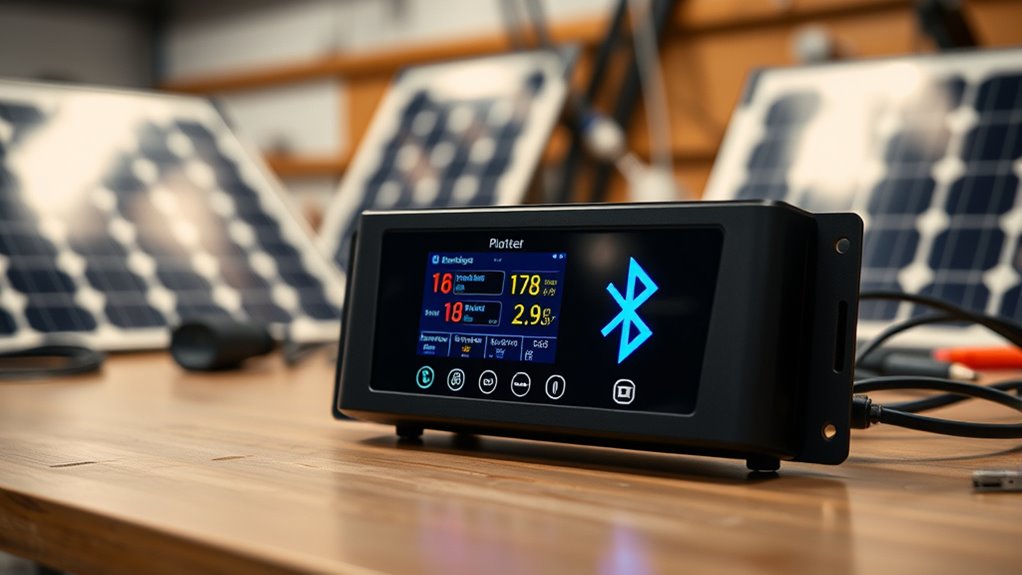

For anyone looking to optimize their solar energy system, a solar charge controller with Bluetooth offers remote monitoring and easier management. The top pick, Victron Energy SmartSolar MPPT, stands out for its advanced MPPT technology and seamless app control. Another notable option is the ECO-WORTHY 30A PWM with Bluetooth, which provides reliable performance at a lower price point. These devices often trade off between features like MPPT vs. PWM, and between connection options like WiFi or Bluetooth. Keep reading to see how these choices compare and which might suit your setup best.

Get compact home essentials delivered free with Prime
- Fast, free delivery on millions of items
- Prime Video, Amazon Music and more included
- Member-only deals all year
Key Takeaways
- MPPT controllers generally offer higher efficiency than PWM models, especially in variable sunlight conditions.
- Bluetooth connectivity varies in sophistication; some controllers include app control, while others add WiFi or USB ports for more versatile monitoring.
- Price range reflects feature set, with premium MPPT options costing more but providing greater long-term savings.
- Ease of use and app stability are critical for beginners, while advanced users may prioritize detailed data logging and customization.
- Build quality and compatibility with different battery voltages can significantly affect the controller’s lifespan and performance.
| ECO-WORTHY 30A 12/24V PWM Solar Charge Controller with Bluetooth |  | Best Overall for Versatile Monitoring and Compatibility | Max Current: 30A | Voltage Compatibility: 12V/24V | Discharge Current: 10A | VIEW ON AMAZON | See Our Full Breakdown |
| Dyness MPPT Solar Charge Controller with Bluetooth APP Control 40A 12V/24V |  | Best for High Efficiency and Power Handling | Maximum Current: 40A | Voltage Compatibility: 12V/24V | Supported Power: 600W at 12V, 1200W at 24V | VIEW ON AMAZON | See Our Full Breakdown |
| Victron Energy SmartSolar MPPT Solar Charge Controller 100V, 50A, 12/24V |  | Best for Advanced, System-Wide Energy Optimization | Brand: Victron Energy | Model: SCC110050210 | Voltage: 12/24V | VIEW ON AMAZON | See Our Full Breakdown |
| ECO-WORTHY PWM Solar Charge Controller 30A 12/24V with Bluetooth and WiFi |  | Best for Remote Monitoring with Dual Connectivity | Voltage Compatibility: 12V/24V | Current: 30A | Connectivity: Bluetooth, WiFi | VIEW ON AMAZON | See Our Full Breakdown |
| 30A PWM Solar Charge Controller Bluetooth 12V/24V/36V/48V Auto |  | Best for Multi-Voltage Systems with Extended Compatibility | Max photovoltaic input voltage: 100V | Max photovoltaic input power: 360W (12V), 760W (24V), 1170W (36V), 1560W (48V) | Battery compatibility: Lead-acid, gel, lithium iron phosphate | VIEW ON AMAZON | See Our Full Breakdown |
| 20A Bluetooth Solar Charge Controller 12V/24V with APP Remote Monitoring and Intelligent PWM Regulation |  | Best for Small Off-Grid Setups with Wireless Monitoring | Rated charging current: 20A | Rated discharge current: 10A | System voltage: 12V/24V auto matching | VIEW ON AMAZON | See Our Full Breakdown |
| Victron Energy SmartSolar MPPT Solar Charge Controller 75V 10A 12/24V |  | Best for Efficient MPPT and System Synchronization | Voltage: 75V | Current: 10A | Battery Voltage Range: 12/24V | VIEW ON AMAZON | See Our Full Breakdown |
| Victron Energy SmartSolar MPPT Solar Charge Controller 75V, 15A, 12/24V |  | Best for Higher Power MPPT with Bluetooth Connectivity | Voltage: 75V | Current: 15A | Battery Voltage Range: 12/24V | VIEW ON AMAZON | See Our Full Breakdown |
| ECO-WORTHY 60A MPPT Solar Charge Controller with Bluetooth & WiFi |  | Best for High-Capacity, Remote Monitoring with Multi-Protocol Access | Max PV Input: 150V | Rated Charging Current: 60A | System Voltage Compatibility: 12V/24V/36V/48V | VIEW ON AMAZON | See Our Full Breakdown |
| Solar Charge Controller 20A with Bluetooth, LCD Display & USB Port, Compatible with 12V/24V Batteries |  | Best for Small, User-Friendly Systems with Manual Diagnostics | Voltage: 12V/24V auto-detect | Current: 20A | Charging Stages: Bulk, Absorption, Float | VIEW ON AMAZON | See Our Full Breakdown |
| 20A Bluetooth Solar Charger Controller 12V 24V with USB Port and APP Monitoring |  | Best for Versatile Battery Support and Remote Monitoring | Maximum Current: 20A | Voltage Compatibility: 12V/24V | Battery Types: Sealed lead acid, gel lead acid, lithium lead acid, lithium iron phosphate, lithium ternary | VIEW ON AMAZON | See Our Full Breakdown |
| 30A PWM Solar Charge Controller with Bluetooth, USB Port, and Multiple Load Modes for 12V/24V Batteries |  | Best for Larger Systems with Versatile Load Control | Rated charging current: 30A | Rated load current: 20A | System voltage: 12V/24V auto matching | VIEW ON AMAZON | See Our Full Breakdown |
More Details on Our Top Picks
ECO-WORTHY 30A 12/24V PWM Solar Charge Controller with Bluetooth
This ECO-WORTHY model stands out for supporting multiple battery types, including lithium phosphate, which makes it highly adaptable for various solar setups. Its Bluetooth connectivity allows easy app monitoring within a 98-foot range, comparable to the WiFi-enabled ECO-WORTHY PWM controller, but with a simpler connection. The LCD display provides clear system status updates, and multiple protections enhance safety, yet it can heat up during extended use, requiring careful ventilation. Installation may be tricky for beginners due to its disassembly process. Compared to the 30A PWM controller with WiFi, this model offers more straightforward Bluetooth connectivity but lacks WiFi for remote access. It is ideal for users who want a reliable, versatile controller with straightforward app monitoring, but less suitable for those needing remote system access over WiFi.
Pros:- Supports multiple battery types including lithium phosphate
- Bluetooth connectivity for easy app monitoring
- Multiple protection features enhance system safety
- LCD display offers clear real-time status
Cons:- Controller may heat up during prolonged operation
- Installation requires careful placement for ventilation
- Disassembly can be confusing for beginners
Best for: Homeowners or small business operators seeking a flexible, Bluetooth-compatible controller supporting various battery chemistries.
Not ideal for: Users wanting WiFi remote monitoring or with limited ventilation options, as the unit may overheat and lacks WiFi connectivity.
- Max Current:30A
- Voltage Compatibility:12V/24V
- Discharge Current:10A
- USB Output:5V/2.5A
- Battery Types:Lead-acid, Gel, Lithium phosphate
- Protection Functions:Short-circuit, open-circuit, reverse, over-load
- Display:LCD
- Bluetooth Range:98 feet
Our verdict“This controller offers broad compatibility and straightforward Bluetooth monitoring, making it suitable for users who prioritize versatility and safety.”
Dyness MPPT Solar Charge Controller with Bluetooth APP Control 40A 12V/24V
The Dyness 40A MPPT controller excels in maximizing solar energy harvest thanks to its advanced MPPT technology, which is more efficient than PWM options like ECO-WORTHY’s 30A PWM. Its Bluetooth app control provides real-time monitoring, and it supports a wide range of battery types, including lithium, AGM, and flooded options, with automatic recognition. However, the manual lithium voltage setting can be inconvenient, especially for users unfamiliar with system configurations. Its power capacity of 600W at 12V and 1200W at 24V makes it suitable for larger systems but limits its use in very high-capacity setups. Compared to the Victron SmartSolar MPPT, this model offers simpler setup but with slightly fewer features like integrated load management. It is best suited for those seeking high efficiency and flexible battery compatibility, but less ideal for users who want automatic voltage recognition for all battery types.
Pros:- Efficient MPPT technology for maximum solar conversion
- Bluetooth app control for remote system management
- Supports multiple battery types with automatic detection
- Includes RS485 Modbus and dual-controller parallel charging
Cons:- Requires manual voltage setting for lithium batteries
- Limited to 600W at 12V or 1200W at 24V
- Setup may be complex for inexperienced users
Best for: Enthusiasts or small commercial operators needing efficient MPPT technology for medium-sized solar systems.
Not ideal for: Beginners or users with very simple setups, as manual voltage adjustments can be confusing for novices.
- Maximum Current:40A
- Voltage Compatibility:12V/24V
- Supported Power:600W at 12V, 1200W at 24V
- Battery Types:Lithium, AGM, Gel, Flooded, User-defined
- Bluetooth:Yes
- LCD Display:Yes
- Additional Features:RS485 Modbus, dual-controller
Our verdict“This MPPT controller delivers superior energy harvesting for users comfortable with manual settings and seeking robust power capacity.”
Victron Energy SmartSolar MPPT Solar Charge Controller 100V, 50A, 12/24V
The Victron Energy SmartSolar 50A MPPT controller is tailored for users who want highly efficient energy harvesting and system integration. Its Bluetooth connectivity allows detailed monitoring and configuration, but the setup is more complex compared to simpler controllers like ECO-WORTHY’s PWM models. Its ability to handle voltages up to 100V makes it suitable for large, multi-panel arrays. The intelligent load output and synchronized charging improve overall system performance. However, the higher cost and need for technical knowledge can be hurdles for casual users. Compared with the Dyness MPPT, it offers more extensive system management features, making it ideal for those with larger, more complex solar setups. This pick makes the most sense for experienced users who need advanced system control and maximum efficiency, but it may be overkill for small or simple installations.
Pros:- High efficiency with maximum power point tracking
- Bluetooth monitoring for detailed insights
- Synchronized charging and intelligent load management
- Handles large voltages up to 100V for multi-panel setups
Cons:- Setup can be complex for newcomers
- Higher price point compared to basic controllers
- Requires technical knowledge for optimal configuration
Best for: Experienced solar system installers or homeowners with large, complex panel arrays requiring system-wide optimization.
Not ideal for: Beginners or those with small-scale or straightforward setups, due to its complexity and higher price point.
- Brand:Victron Energy
- Model:SCC110050210
- Voltage:12/24V
- Maximum Voltage:100V
- Current:50A
- Connectivity:Bluetooth
- Warranty:Warranty available
Our verdict“This controller is well-suited for advanced users seeking system-wide optimization and detailed monitoring, despite its higher complexity and cost.”
ECO-WORTHY PWM Solar Charge Controller 30A 12/24V with Bluetooth and WiFi
This ECO-WORTHY PWM controller combines Bluetooth and WiFi options, making it stand out for users who want flexible remote monitoring. Its dual connectivity supports real-time system updates via app, comparable to the Bluetooth-only models but with added WiFi for broader access. The inclusion of two USB ports and multiple charging modes enhances usability for outdoor applications like RVs and boats. However, the need for an additional data acquisition unit for WiFi can complicate setup, and the 30A current limit might restrict larger systems. Compared with the 30A PWM controller without WiFi, this model offers more connectivity options but at the cost of added complexity. It is best for outdoor adventurers or remote users who want versatile system access, but less suited for those seeking a straightforward, plug-and-play solution.
Pros:- Supports both Bluetooth and WiFi for remote access
- Includes dual USB ports and multiple charging modes
- Advanced voltage/current measurement for system health
- Multiple protection features for safety
Cons:- Requires additional unit for WiFi functionality
- Limited to 30A current capacity
- WiFi range may be limited in open areas
Best for: Outdoor enthusiasts or remote system operators needing both Bluetooth and WiFi access for monitoring and control.
Not ideal for: Users with small or simple setups that do not require remote connectivity, as the extra complexity may be unnecessary.
- Voltage Compatibility:12V/24V
- Current:30A
- Connectivity:Bluetooth, WiFi
- USB Ports:2 (5V/2A)
- Charging Modes:Bulk, Absorption, Float, CUS
- Protection Features:Reverse, short circuit, overcurrent, low/high voltage, overheating
Our verdict“This controller offers flexible remote monitoring options for outdoor or off-grid users willing to handle a more complex setup.”
30A PWM Solar Charge Controller Bluetooth 12V/24V/36V/48V Auto
This 30A PWM controller is notable for supporting a wide range of voltages from 12V up to 48V, making it highly adaptable for various battery configurations. Its Bluetooth connectivity simplifies remote monitoring, and the four-stage PWM charging process boosts efficiency and battery life, similar to the advanced modes in higher-end controllers. The inclusion of four USB ports adds convenience for charging devices on the go. However, its maximum photovoltaic input power varies with system voltage, which could limit larger installations. Setting parameters for 36V and 48V systems may be cumbersome, especially for less experienced users. Compared to the other PWM options, this model’s multi-voltage support makes it a flexible choice, but it sacrifices some of the more advanced features seen in MPPT controllers like Victron or Dyness. It’s best for users with diverse voltage needs looking for a cost-effective, Bluetooth-enabled solution, but not for large or highly complex systems.
Pros:- Supports multiple voltages from 12V to 48V
- Bluetooth connectivity for monitoring
- Four-stage PWM charging enhances battery lifespan
- Multiple USB ports for device charging
Cons:- Limited photovoltaic input power for larger systems
- Parameter setup can be complex for some systems
- PWM technology less efficient than MPPT for high-power arrays
Best for: Users with varied battery voltages seeking an adaptable, Bluetooth-controlled PWM controller for small to medium systems.
Not ideal for: Large-scale systems or users needing maximum energy harvesting efficiency, as PWM technology is less effective than MPPT for such setups.
- Max photovoltaic input voltage:100V
- Max photovoltaic input power:360W (12V), 760W (24V), 1170W (36V), 1560W (48V)
- Battery compatibility:Lead-acid, gel, lithium iron phosphate
- USB ports:4 (5V/2.5A)
- Bluetooth range:65 feet
Our verdict“This controller offers flexible multi-voltage support with Bluetooth monitoring for users managing diverse battery configurations, though it’s less suited for large-scale systems.”
20A Bluetooth Solar Charge Controller 12V/24V with APP Remote Monitoring and Intelligent PWM Regulation
This compact 20A Bluetooth-enabled controller stands out for its wireless monitoring capabilities, making system management more accessible compared to wired-only options like the ECO-WORTHY 60A MPPT. Its support for multiple battery types, including lithium and gel, provides flexibility, but the limited current capacity means it’s not suitable for larger arrays. The app-based monitoring offers convenience, yet relying on a smartphone app can be inconvenient for users who prefer simple, manual controls. Its comprehensive protections help safeguard your system, though initial setup may require careful attention to connection details. Compared to the larger-capacity MPPT controllers, this model prioritizes simplicity and mobility over high power output or advanced features.
Pros:- Wireless Bluetooth monitoring via mobile app for easy system management
- Supports multiple battery types including lithium and gel batteries
- Multiple load modes for flexible control and operation
- Comprehensive protection features for safety
Cons:- Requires smartphone app for full functionality, which can be inconvenient
- Limited to 20A current capacity, unsuitable for bigger setups
Best for: Small off-grid homeowners or RV users who want wireless system management without complexity.
Not ideal for: Larger solar systems exceeding 20A, or users who prefer a display-based interface over app monitoring.
- Rated charging current:20A
- Rated discharge current:10A
- System voltage:12V/24V auto matching
- Maximum photovoltaic voltage:50V
- USB output:5V/2A
- Dimensions:4.5″ x 3.7″ x 1.2″
Our verdict“This controller suits small off-grid or mobile applications where wireless monitoring and battery flexibility matter most.”
Victron Energy SmartSolar MPPT Solar Charge Controller 75V 10A 12/24V
This Victron SmartSolar MPPT controller emphasizes efficiency with fast maximum power point tracking, making it a strong choice for users seeking maximum energy harvest. Its ability to synchronize with multiple units and connect via app offers scalable system management, outperforming basic PWM controllers like the 30A PWM Bluetooth in terms of power maximization. However, its setup can be complex for beginners unfamiliar with MPPT technology or system integration. The 75V maximum PV voltage and 10A current make it suitable for small to medium systems, but not for larger arrays. Compared to the 20A Bluetooth Controller, it provides higher voltage handling and system integration but at the cost of increased complexity.
Pros:- Efficient MPPT technology maximizes power output
- Synchronized charging for multi-controller systems
- App connectivity for monitoring and configuration
- Intelligent load management protects batteries
Cons:- Requires compatible solar panels and batteries, adding complexity
- May be challenging for beginners to configure properly
Best for: Experienced DIYers or small-scale off-grid setups requiring efficient MPPT technology and system synchronization.
Not ideal for: Beginners or those with larger solar arrays needing higher current capacity or easier setup.
- Voltage:75V
- Current:10A
- Battery Voltage Range:12/24V
Our verdict“This MPPT controller is ideal for users who want efficient energy harvesting and system integration, despite the setup complexity.”
Victron Energy SmartSolar MPPT Solar Charge Controller 75V, 15A, 12/24V
This 15A MPPT controller from Victron offers a step up in current capacity and features, making it suitable for slightly larger or more demanding systems. Its Bluetooth connectivity via the VictronConnect app allows effortless monitoring and parameter adjustments, outperforming simpler controllers like the 20A Bluetooth in terms of power. The intelligent algorithms optimize power under shading and variable conditions, but the lack of a specified warranty and limited data on long-term reliability could concern cautious buyers. Its seamless synchronization with other Victron units makes it an excellent choice for expanding systems, though the setup may still challenge beginners unfamiliar with MPPT technology.
Pros:- Efficient MPPT technology maximizes power output
- Bluetooth connectivity for easy monitoring and adjustments
- Synchronized charging across multiple units
- Supports various battery types for flexibility
Cons:- Warranty information not specified, raising some uncertainty
- Requires compatible solar panels and batteries, adding setup effort
Best for: Small to medium off-grid projects or users looking for a reliable, scalable MPPT solution with smart monitoring.
Not ideal for: Complete beginners or systems requiring over 15A charging capacity, where larger controllers are needed.
- Voltage:75V
- Current:15A
- Battery Voltage Range:12/24V
Our verdict“This controller is well-suited for users seeking reliable MPPT performance with convenient Bluetooth monitoring, though it may not fit very large systems.”
ECO-WORTHY 60A MPPT Solar Charge Controller with Bluetooth & WiFi
This 60A MPPT controller from ECO-WORTHY offers high current capacity and dual wireless monitoring options, setting it apart from smaller controllers like the 20A Bluetooth. Its support for multiple battery types and load control modes makes it versatile, suitable for large or complex systems. The inclusion of both Bluetooth and WiFi monitoring provides flexible access, but the need for separate modules and potentially complex setup could deter less experienced users. Its high efficiency tracking (up to 99.5%) makes it a compelling choice for maximizing energy harvest, yet the limited user reviews and absence of a clear warranty may cause hesitation for some buyers.
Pros:- High efficiency MPPT tracking up to 99.5%
- Supports Bluetooth and WiFi for flexible remote monitoring
- Very high current capacity at 60A
- Compatible with multiple battery types and load modes
Cons:- Requires separate Bluetooth/WiFi modules, increasing complexity
- Setup may be challenging for beginners and limited user feedback
Best for: Larger off-grid or commercial systems requiring high current capacity and remote access via Bluetooth and WiFi.
Not ideal for: Small setups or users seeking plug-and-play simplicity, due to complex setup and additional modules required.
- Max PV Input:150V
- Rated Charging Current:60A
- System Voltage Compatibility:12V/24V/36V/48V
Our verdict“This high-capacity controller is aimed at large-scale or remote systems where maximum energy optimization and monitoring flexibility are priorities.”
Solar Charge Controller 20A with Bluetooth, LCD Display & USB Port, Compatible with 12V/24V Batteries
This 20A controller combines Bluetooth monitoring with a built-in LCD display, offering both remote and local diagnostics. Its support for multiple battery types and 3-stage charging optimizes battery health, similar to the 20A Bluetooth Controller, but with added on-device visibility. The inclusion of a USB port adds convenience, although it’s limited for low-power devices. Its straightforward interface makes it accessible for beginners, but the 20A capacity again limits larger system use. Compared to controllers like the Victron MPPT 75|15, this unit emphasizes ease of use over advanced features or high power output.
Pros:- Bluetooth app for real-time remote system monitoring
- LCD display for on-site diagnostics
- Supports multiple battery types including LiFePO4
- 3-stage charging maximizes battery lifespan
Cons:- Limited to 20A current, unsuitable for larger systems
- Basic USB port may not support high-power devices
- Requires smartphone app for full monitoring
Best for: Beginners or small solar setups where local diagnostics and Bluetooth monitoring are desired without complexity.
Not ideal for: Systems exceeding 20A or users wanting extensive remote monitoring without on-device displays.
- Voltage:12V/24V auto-detect
- Current:20A
- Charging Stages:Bulk, Absorption, Float
- Battery Compatibility:Sealed, Gel, Flooded, LiFePO4
- Connectivity:Bluetooth, LCD, USB
Our verdict“This controller makes the most sense for small, user-friendly systems where local and remote diagnostics are both valued.”
20A Bluetooth Solar Charger Controller 12V 24V with USB Port and APP Monitoring
This 20A PWM controller stands out for supporting a wide range of battery chemistries, including lithium types, making it highly adaptable for different solar setups. Its Bluetooth connectivity enables real-time monitoring and control via a mobile app, which is a step up from basic controllers like the Eco-Worthy Bluetooth model. The built-in USB port adds convenience for charging devices on the go, while advanced protective features bolster system safety. However, it requires a sufficiently charged battery to properly identify system voltage, and the initial app password defaults to security, so users must change it promptly. Compared with smaller controllers, this unit balances capacity and versatility but may be overkill for very small systems. It’s ideal for users needing flexible battery compatibility with remote oversight, but less so for those with simple, small-scale setups.
Pros:- Supports multiple battery types including lithium and lead-acid
- Bluetooth app enables remote monitoring and control
- Includes USB port for device charging
- Provides advanced protection features
Cons:- Requires a sufficiently charged initial battery for proper system detection
- Default app password needs changing for security
Best for: Homeowners or small business owners with mixed battery chemistries who want remote system management.
Not ideal for: Users with very basic systems or who prefer plug-and-play simplicity without app setup.
- Maximum Current:20A
- Voltage Compatibility:12V/24V
- Battery Types:Sealed lead acid, gel lead acid, lithium lead acid, lithium iron phosphate, lithium ternary
- USB Output:5V/1A
- Bluetooth:Yes
- Protection Features:Overvoltage, overcurrent, short circuit, overheating, lightning protection
Our verdict“This controller is best suited for users needing flexible battery support and remote oversight in moderate-sized solar systems.”
30A PWM Solar Charge Controller with Bluetooth, USB Port, and Multiple Load Modes for 12V/24V Batteries
This 30A PWM controller offers a notable upgrade in capacity over more modest options like the 20A model, making it suitable for larger or more demanding solar setups. Its Bluetooth app supports remote system management, which is especially helpful when managing multiple load modes—seven in total—that provide flexible control options beyond simple charging. The controller automatically detects system voltage and supports a range of battery chemistries, including LiFePO4, giving it an edge over basic models. The inclusion of multiple load modes makes it more adaptable for complex systems, but it does require a smartphone app for full remote functionality, and its 30A capacity may limit use in very large systems. Installation is straightforward but assumes some basic electrical knowledge. Overall, this model makes sense for those wanting higher current capacity with detailed load management and remote oversight.
Pros:- Supports Bluetooth app remote monitoring
- Compatible with multiple battery types including LiFePO4
- Includes seven load modes for flexible operation
- Built-in protections against overvoltage, overcurrent, and short circuits
Cons:- Limited to 30A charging capacity, less suitable for very large systems
- Full remote control depends on smartphone app, which may be inconvenient for some
Best for: Homeowners with larger solar arrays who need multiple load modes and remote system control.
Not ideal for: Beginners or users with small, simple systems who don’t need extensive load options or higher amperage.
- Rated charging current:30A
- Rated load current:20A
- System voltage:12V/24V auto matching
- Maximum photovoltaic voltage:50V
- USB output:5V/1.5A
- Control mode:PWM pulse modulation
- Wireless connection:Bluetooth APP
Our verdict“This controller is ideal for users needing higher current capacity with advanced load management and remote monitoring in medium to large systems.”

How We Picked
These products were selected based on their integration of Bluetooth technology, reliability, user interface, and overall value. Priority was given to controllers with proven connectivity features, ease of setup, and positive user feedback. We also considered the range of power ratings, compatibility with various battery types, and whether the controllers include additional features like WiFi or USB ports. Products were ranked to balance performance with affordability, ensuring options for different levels of experience and budget. Our goal was to highlight controllers that combine smart monitoring with dependable solar management.Factors to Consider When Choosing Solar Charge Controller Bluetooth
Choosing the right solar charge controller with Bluetooth involves more than just picking the most popular model. Key factors include technology type (MPPT vs. PWM), power capacity, and connectivity features. Understanding these aspects helps ensure compatibility with your solar system and simplifies operation, especially for remote management. Proper selection can extend your system’s life and improve efficiency, making it worth investing time in comparison. Here are some critical considerations to guide your decision.Technology Type: MPPT vs. PWM
MPPT (Maximum Power Point Tracking) controllers are generally more efficient, especially in fluctuating sunlight conditions, and can extract more energy from your panels. PWM (Pulse Width Modulation) controllers tend to be simpler and more affordable, suitable for smaller or less complex systems. Understanding your energy needs and budget will help determine whether a high-efficiency MPPT controller justifies the higher cost or if a PWM model suffices for your setup. The choice impacts long-term performance and investment value.
Power Capacity and Compatibility
Matching the controller’s capacity with your solar array’s output is essential. Oversizing can lead to unnecessary costs, while undersizing limits your system’s potential. Check the voltage and current ratings carefully; controllers should support your battery bank’s voltage and have enough amperage headroom. Also, consider future expansion—buying a slightly higher capacity controller can save money down the line and prevent the need for early upgrades.
Connectivity and Monitoring Features
Bluetooth connectivity allows you to monitor system performance remotely, which is especially useful if your setup is hard to access physically. Some controllers include dedicated apps, while others also add WiFi or USB ports for more versatile data access. Evaluate how user-friendly the app is, whether it provides real-time alerts, and if it supports data logging for performance analysis. These features can simplify maintenance and help optimize your system’s output.
Build Quality and Durability
Since solar controllers are often installed outdoors, weather resistance and build quality matter. Look for models with proper casing, adequate heat dissipation, and certifications for safety and durability. A robust build reduces maintenance costs and extends the life of your investment. Also, check warranty periods and customer support reputation as indicators of manufacturer confidence and product reliability.
Additional Features and Value Additions
Some controllers offer extra features like USB ports for device charging, LCD displays for local monitoring, and multiple load modes for different applications. While these add convenience, they can also increase costs. Consider which features genuinely add value to your specific setup and avoid paying for extras you won’t use. Balance feature set with your actual needs to find the best overall value.
Frequently Asked Questions
Can I upgrade my existing solar charge controller to include Bluetooth?
Upgrading an existing controller to add Bluetooth generally isn’t possible unless the manufacturer offers a compatible module or model. Many controllers have built-in Bluetooth, so replacing the unit is usually the simplest solution if you need app control. When choosing a new controller, consider future expandability and whether the Bluetooth functionality will meet your monitoring needs long-term. This approach ensures seamless integration without compatibility issues.
Is Bluetooth enough, or should I consider WiFi for remote monitoring?
Bluetooth provides convenient remote access within a limited range, typically around 10 meters, making it suitable for small or accessible setups. WiFi, however, supports broader remote monitoring without proximity constraints, often with more stable connections and additional features like cloud logging. If you need to monitor your system from afar or want more advanced data options, opting for a WiFi-enabled controller may be worth the extra investment.
How do I know if a Bluetooth solar charge controller is compatible with my battery bank?
Compatibility depends on matching the controller’s voltage and current ratings with your battery bank’s specifications. Most controllers specify support for 12V, 24V, or higher systems, so check these details carefully. Additionally, verify if the controller can handle your system’s total current and whether it supports your battery chemistry, such as lead-acid or lithium. Ensuring proper compatibility helps prevent damage and optimizes performance.
Are Bluetooth controllers suitable for large-scale solar setups?
Bluetooth controllers are typically designed for small to medium systems due to range limitations and the nature of Bluetooth technology. For larger setups, controllers with WiFi or Ethernet connectivity, alongside higher power ratings and advanced monitoring options, are usually more appropriate. Bluetooth remains ideal for residential or small commercial systems where remote access is limited to nearby devices.
What is the typical lifespan of a solar charge controller with Bluetooth, and how can I extend it?
The lifespan of a Bluetooth-enabled solar charge controller usually ranges from 5 to 10 years, depending on build quality, environmental conditions, and maintenance. To extend its life, ensure proper installation, avoid exposure to extreme weather, and keep it free of dust and debris. Regularly updating firmware and inspecting connections can also prevent issues and maintain reliable operation over time.
Conclusion
For most users, the Victron Energy SmartSolar MPPT offers excellent efficiency and sophisticated app control, making it the best overall choice. Budget-conscious buyers or those with smaller systems might prefer the ECO-WORTHY 30A PWM with Bluetooth for its affordability and simplicity. Those seeking premium features and future-proofing should consider higher-capacity MPPT models with WiFi, like the ECO-WORTHY 60A, despite the higher cost. Beginners will benefit from models with straightforward interfaces and reliable app support, while advanced users should prioritize controllers with detailed data logging and customization options. Tailor your pick based on your system size, monitoring needs, and budget to get the best fit.
As an affiliate, we earn on qualifying purchases.Halloween Picks
halloween