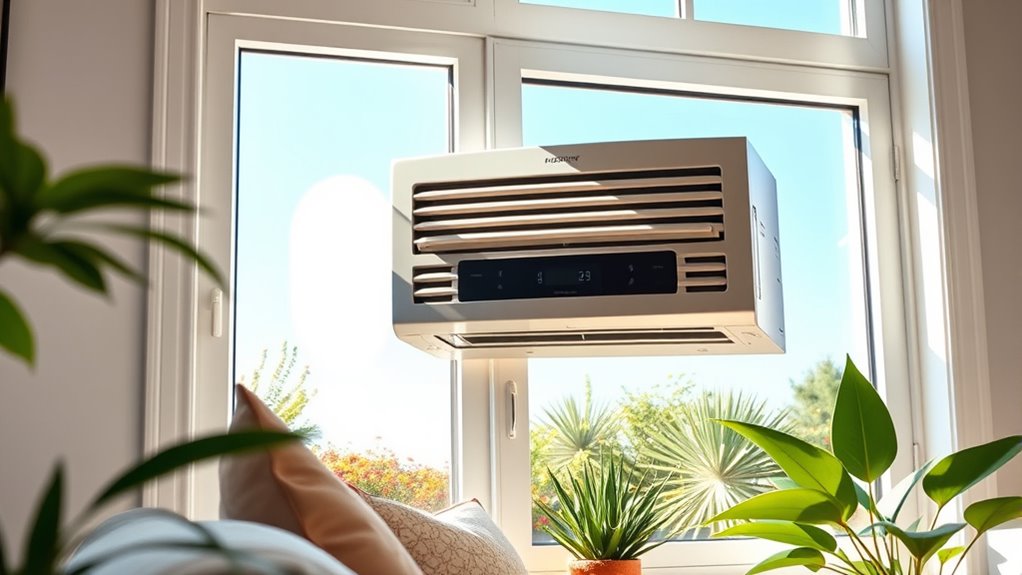

For most buyers, I’d start with the Midea 12,000 BTU Window Air Conditioner with Heat, which pairs substantial cooling capacity with supplemental heat for rooms up to 550 square feet. The Midea 8,000 BTU Smart Inverter is a strong fit for smaller rooms and buyers who value app controls, while the Soleus Air 12,000 BTU Saddle Mount stands out for its distinctive installation style and quieter-operation focus. The main tradeoffs are room size, how much you expect the heater to do, and whether a standard window unit or a saddle mount better suits your space. Capacity alone does not tell you how well a unit will heat in cold weather, so check its heating role and the room’s insulation before choosing. Read on for the full comparison and guidance on matching a unit to your room.

Get compact home essentials delivered free with Prime
- Fast, free delivery on millions of items
- Prime Video, Amazon Music and more included
- Member-only deals all year
Key Takeaways
- The lineup splits into three capacity groups: 8,000 BTU models suit smaller spaces, 12,000 BTU options cover a broader middle ground, and the 18,000 BTU MOVECOM and LG are aimed at larger rooms.
- “Heat” does not always mean the same thing: several listings specify supplemental heat, while the MOVECOM is identified as a heat pump; check the stated heating function before relying on a unit as a main heat source.
- Midea offers two distinct paths: the 12,000 BTU model favors greater room coverage, while the 8,000 BTU Smart Inverter favors smaller rooms and connected controls.
- Installation can separate otherwise similar choices: the Soleus Air’s saddle mount is a different fit from conventional window designs and may appeal to buyers prioritizing a less intrusive room-side profile.
- Smart features and capacity are not interchangeable benefits: Wi-Fi appears on several models, but room fit, heating capability, and installation compatibility should lead the decision.
| Midea 12,000 BTU Window Air Conditioner with Heat for Rooms up to 550 Sq. Ft. |  | Best Overall for Larger Rooms | Cooling capacity: 12,000 BTU | Room coverage: Up to 550 sq. ft. | Heating: Supplemental heat; heat pump does not operate below 41°F | VIEW ON AMAZON | See Our Full Breakdown |
| IDEALHOUSE 8,000 BTU Window Air Conditioner with Heat |  | Best for Flexible Controls in Smaller Rooms | Cooling power: 8,000 BTU | Room coverage: Up to 350 sq. ft. | Functions: Cooling, heating, dehumidifying, fan | VIEW ON AMAZON | See Our Full Breakdown |
| 12,000 BTU Window Air Conditioner with Supplemental Heat, Wi-Fi, and Remote |  | Best for Multiple Control Options | Cooling capacity: 12,000 BTU | Coverage area: Up to 550 sq. ft. | Voltage: 115V | VIEW ON AMAZON | See Our Full Breakdown |
| Midea 8,000 BTU Smart Inverter Window Air Conditioner with Heat |  | Best Quiet Pick for Smaller Rooms | Cooling capacity: 8,000 BTU | Coverage area: Up to 350 sq. ft. | Noise level: As low as 45 dBA | VIEW ON AMAZON | See Our Full Breakdown |
| Soleus Air 12,000 BTU Window Air Conditioner with 10,000 BTU Heater, Wi-Fi Enabled, Saddle Mount, Quiet Operation, White |  | Best for Thick Walls and Saddle-Mount Installation | Cooling power: 12,000 BTU | Heating capacity: 10,000 BTU | Voltage: 115V | VIEW ON AMAZON | See Our Full Breakdown |
| ROVSUN 8000 BTU Window Air Conditioner with Heat |  | Best for Smart Controls in a Small Room | Cooling capacity: 8,000 BTU | Heating capacity: 4,000 BTU | Coverage area: Up to 350 sq ft | VIEW ON AMAZON | See Our Full Breakdown |
| MOVECOM 18,000 BTU Smart Inverter Window Air Conditioner with Heat Pump |  | Best for Large Rooms with Heat-Pump Functionality | Cooling capacity: 18,000 BTU | Heating capacity: 10,600 BTU | Coverage area: Up to 1,000 sq ft | VIEW ON AMAZON | See Our Full Breakdown |
| LG 18,000 BTU Window Air Conditioner with Supplemental Heat, Wi-Fi, and Remote |  | Best for LG ThinQ and Smart-Home Integration | Cooling capacity: 18,000 BTU | Coverage area: Up to 1,000 sq ft | Heating: Supplemental heat | VIEW ON AMAZON | See Our Full Breakdown |
| Keystone 8,000 BTU Inverter Window Air Conditioner with Supplemental Heat |  | Best Efficient Pick for a Small Room | Cooling capacity: 8,000 BTU | Heating capacity: 7,000 BTU supplemental heat | Room coverage: Up to 350 sq ft | VIEW ON AMAZON | See Our Full Breakdown |
| window heat pump ac unit | Noise level | Voltage | Cooling capacity | Window fit |
|---|---|---|---|---|
| Midea 12,000 BTU Window Air Co | As low as 45 dBA | 115V | 12,000 BTU | Double-hung; 24–38.5 in. wide, at least 14.5 in. vertical opening |
| IDEALHOUSE 8,000 BTU Window Ai | 52 dB | 115V | — | 26–36 in. wide; minimum 16 in. high |
| 12,000 BTU Window Air Conditio | 42 dB listed; description states as low as 45 dBA | 115V | 12,000 BTU | 24–38.5 in. wide; minimum 14.5 in. opening height |
| Midea 8,000 BTU Smart Inverter | As low as 45 dBA | 115V | 8,000 BTU | Double-hung; 24–38.5 in. wide, 14.5 in. vertical opening |
| Soleus Air 12,000 BTU Window A | 48 dB | 115V | — | — |
| ROVSUN 8000 BTU Window Air Con | 57 dB | 115 volts | 8,000 BTU | 26–36 in wide; 16 in high |
| MOVECOM 18,000 BTU Smart Inver | 52–56 dB listed | 230 V | 18,000 BTU | 19 in high; 28–41 in wide |
| LG 18,000 BTU Window Air Condi | 61 dB | 230 V | 18,000 BTU | — |
| Keystone 8,000 BTU Inverter Wi | 54 dB | 115 volts | 8,000 BTU | 14.5 in tall; 24–38.5 in wide |
More Details on Our Top Picks
Midea 12,000 BTU Window Air Conditioner with Heat for Rooms up to 550 Sq. Ft.
For a larger room that needs both seasonal cooling and shoulder-season heat, this 12,000 BTU Midea is the most balanced pick in this group. It covers up to 550 square feet and pairs its capacity with inverter operation, app control, and voice-assistant support. Compared with the 8,000 BTU Midea, it is better suited to open living areas or larger bedrooms, though its capacity is more than a small room needs. The listed 45 dBA low noise and five operating modes add flexibility for everyday use. The main limit is shared by several heat-pump window units: supplemental heat stops working below 41°F outdoors, so it is not a cold-weather heating replacement. Its double-hung window requirements also narrow installation options.
Pros:- 12,000 BTU cooling capacity covers rooms up to 550 square feet.
- Inverter technology and Energy Star certification support more efficient operation.
- App, Alexa, and Google Assistant controls offer flexible operation.
- Five modes include heat, cool, dry, fan, and auto.
Cons:- Heat-pump operation is unavailable below 41°F outdoors.
- Requires a double-hung window 24–38.5 inches wide with at least a 14.5-inch opening.
Best for: People cooling rooms up to 550 square feet who want app or voice control and supplemental heat for milder weather.
Not ideal for: Buyers who need dependable heat below 41°F or have windows outside the specified double-hung dimensions.
- Cooling capacity:12,000 BTU
- Room coverage:Up to 550 sq. ft.
- Heating:Supplemental heat; heat pump does not operate below 41°F
- Noise level:As low as 45 dBA
- CEER:13.3
- Voltage:115V
- Modes:Heat, Auto, Cool, Dry, Fan
- Window fit:Double-hung; 24–38.5 in. wide, at least 14.5 in. vertical opening
Our verdict“Choose this Midea for a larger room and quiet, connected operation, provided its outdoor heating limit and window fit work for your home.”
IDEALHOUSE 8,000 BTU Window Air Conditioner with Heat
The IDEALHOUSE is a practical fit for a room up to 350 square feet when control options matter more than especially quiet operation. It includes app, Alexa, remote, and LED-display controls, plus cooling, supplemental heat, dehumidifying, and fan modes. Unlike the 8,000 BTU Midea, its listed specifications give a broader minimum window height requirement and a heavier 81.4-pound body, so installation planning deserves extra attention. Its 52 dB noise figure is also higher than the Midea models’ listed 45 dBA, a meaningful distinction for light sleepers. A washable filter and four-way air swing add useful everyday convenience, but the heating function is described as supplemental, not a substitute for a dedicated heating system.
Pros:- App, Alexa, remote, and LED display provide multiple control methods.
- Cooling, heating, dehumidifying, fan, and auto modes cover varied conditions.
- Four-way air swing helps distribute air around the room.
- Washable filter reduces the need for replacement filters.
Cons:- At 52 dB, it has a higher listed noise level than the Midea options.
- The 81.4-pound weight can make lifting and installation difficult.
- Requires a window 26–36 inches wide and at least 16 inches high.
Best for: People cooling a bedroom, office, or other room up to 350 square feet who want several ways to control the unit.
Not ideal for: Light sleepers seeking the quietest listed option or anyone unable to manage installation of an 81.4-pound unit.
- Cooling power:8,000 BTU
- Room coverage:Up to 350 sq. ft.
- Functions:Cooling, heating, dehumidifying, fan
- Noise level:52 dB
- Voltage:115V
- Weight:81.4 lb
- Window fit:26–36 in. wide; minimum 16 in. high
- Controls:LED display, remote, mobile app, Alexa
Our verdict“Pick the IDEALHOUSE for a smaller room if you value multiple control options and can accommodate its weight and window requirements.”
12,000 BTU Window Air Conditioner with Supplemental Heat, Wi-Fi, and Remote
This 12,000 BTU unit targets the same larger-room job as the Midea 12,000 BTU model: cooling up to 550 square feet with supplemental heat and Wi-Fi features. Its distinguishing point is control variety, with app, remote, touch panel, and voice operation listed, making it a useful fit if household members prefer different ways to adjust settings. Capacity, window dimensions, and CEER match the Midea’s supplied figures, so the product data does not show a clear performance advantage over that pick. There is also a specification inconsistency: noise is listed as 42 dB in one field and as low as 45 dBA in the description. Like the Midea, its heat pump will not operate below 41°F, and it needs a compatible double-hung window.
Pros:- 12,000 BTU capacity is specified for rooms up to 550 square feet.
- App, remote, touch panel, and voice controls offer several operating methods.
- Includes a washable filter and 24-hour timer.
- Five modes cover heating, cooling, drying, fan, and automatic operation.
Cons:- Heat pump does not operate below 41°F outdoors.
- Listed noise figures conflict: 42 dB and as low as 45 dBA.
- Requires a double-hung window 24–38.5 inches wide with a 14.5-inch minimum opening.
Best for: Households with a room up to 550 square feet where app, voice, physical-panel, and remote controls are all useful.
Not ideal for: Buyers who need heat in colder outdoor conditions or want noise specifications without conflicting listed figures.
- Cooling capacity:12,000 BTU
- Coverage area:Up to 550 sq. ft.
- Voltage:115V
- CEER:13.3
- Wattage:1,200 W
- Noise level:42 dB listed; description states as low as 45 dBA
- Operating modes:Heat, Auto, Cool, Dry, Fan
- Window fit:24–38.5 in. wide; minimum 14.5 in. opening height
Our verdict“Choose this model over the Midea 12,000 BTU if its broader listed control mix suits your household, while accepting less consistent noise data.”
Midea 8,000 BTU Smart Inverter Window Air Conditioner with Heat
For a smaller room where noise and connected controls matter more than maximum capacity, this 8,000 BTU Midea is a more suitable match than the 12,000 BTU Midea. It is specified for spaces up to 350 square feet and lists operation as low as 45 dBA, which may suit bedrooms or home offices better than the IDEALHOUSE’s 52 dB listing. Its inverter technology and smart-home support add convenience without stepping up to a larger unit. The tradeoff is limited reach: it is not the choice for the 550-square-foot rooms served by the two 12,000 BTU options. Heating is supplemental and stops when outdoor temperatures reach 41°F or below, while its double-hung window fit excludes some installations.
Pros:- 8,000 BTU capacity is sized for rooms up to 350 square feet.
- Listed noise level as low as 45 dBA suits noise-sensitive spaces.
- Smart inverter technology and Energy Star certification support efficient operation.
- Wi-Fi, Alexa, and Google Assistant provide connected control.
Cons:- Less capacity than the 12,000 BTU Midea and other larger-room options.
- Heat-pump function is ineffective at outdoor temperatures of 41°F or below.
- Requires a double-hung window 24–38.5 inches wide with a 14.5-inch opening.
Best for: People cooling a bedroom or office up to 350 square feet who prioritize quieter operation and app or voice control.
Not ideal for: Buyers with large open rooms, non-compatible windows, or a need for heating during colder weather.
- Cooling capacity:8,000 BTU
- Coverage area:Up to 350 sq. ft.
- Noise level:As low as 45 dBA
- Voltage:115V
- CEER:13.3
- Modes:Heat, Auto, Cool, Dry, Fan
- Connectivity:Wi-Fi, Alexa, Google Assistant
- Window fit:Double-hung; 24–38.5 in. wide, 14.5 in. vertical opening
Our verdict“This is the better Midea choice for a smaller, quiet room, but not for spaces that need the 12,000 BTU models’ wider coverage.”
Soleus Air 12,000 BTU Window Air Conditioner with 10,000 BTU Heater, Wi-Fi Enabled, Saddle Mount, Quiet Operation, White
The Soleus stands apart from the standard window-mounted Midea 12,000 BTU models through its saddle-mount design, which is specified for walls up to 12.5 inches thick and avoids drilling. That installation approach may matter more than smart features for homes where a conventional window bracket is a poor fit. It also lists a specific 10,000 BTU heating capacity alongside 12,000 BTU cooling, while the other large-room products describe heating as supplemental without giving a capacity figure. Its inverter compressor, app control, and 48 dB noise rating round out the feature set. The tradeoffs are a less quiet listed figure than the Midea models’ 45 dBA and the need for a dedicated 115V outlet; very thick-wall installations may call for professional help.
Pros:- Saddle mount fits walls up to 12.5 inches thick without drilling.
- Provides 12,000 BTU cooling and a specified 10,000 BTU heating capacity.
- Inverter compressor supports variable-speed operation.
- Wi-Fi app control and washable activated carbon filter are included.
Cons:- Listed 48 dB noise level is higher than the Midea models’ 45 dBA figures.
- Requires a dedicated 115V outlet.
- Professional installation may be needed for very thick walls.
Best for: People who need a 12,000 BTU window unit for a thick wall and prefer a saddle mount over a conventional window installation.
Not ideal for: Buyers who prioritize the lowest listed noise figure or lack a suitable dedicated 115V outlet.
- Cooling power:12,000 BTU
- Heating capacity:10,000 BTU
- Voltage:115V
- Wattage:1,220 W
- Noise level:48 dB
- Refrigerant:R-32
- Mounting:Window saddle mount
- Wall compatibility:Up to 12.5 in. thick
Our verdict“Choose the Soleus if its thick-wall saddle mount solves an installation problem; choose a Midea instead if quieter listed operation is your priority.”
ROVSUN 8000 BTU Window Air Conditioner with Heat
The ROVSUN pairs 8,000 BTU cooling with 4,000 BTU of heating, making it a sensible fit for a bedroom or office up to 350 square feet when seasonal temperature control matters more than strong winter heating. Its Wi-Fi, app, and voice controls give it a convenience advantage over the Keystone 8,000 BTU Inverter Window Air Conditioner, which relies on remote and touch controls. The tradeoff is that the Keystone has inverter technology and a higher listed heating capacity, while the ROVSUN uses a non-inverter design. At a listed 57 dB, it may also be less appealing to noise-sensitive sleepers. I’d choose this model for flexible remote operation, not for quietest running or primary heat.
Pros:- Combines cooling, heating, dehumidifier, and fan modes for year-round room control.
- Wi-Fi app control and compatibility with Alexa and Google Assistant.
- Washable filter, 24-hour timer, and ECO mode support routine upkeep and scheduling.
- Designed for rooms up to 350 square feet.
Cons:- Non-inverter design lacks the efficiency and operating approach of the Keystone inverter model.
- Listed noise level is 57 dB, which may bother noise-sensitive users.
- Requires a window at least 16 inches high and 26–36 inches wide.
Best for: People outfitting a room up to 350 square feet who want app and Alexa or Google Assistant control alongside cooling and occasional supplemental heat.
Not ideal for: Light sleepers and buyers prioritizing efficient, quiet operation; its non-inverter design and listed 57 dB noise level are less compelling than the Keystone inverter option.
- Cooling capacity:8,000 BTU
- Heating capacity:4,000 BTU
- Coverage area:Up to 350 sq ft
- Voltage:115 volts
- Noise level:57 dB
- Controls:App, remote, touch, and voice control
- Window fit:26–36 in wide; 16 in high
- Refrigerant:R-32
Our verdict“Choose the ROVSUN for smart control in a small room, but pick the Keystone if inverter operation and stronger listed supplemental heating matter more.”
MOVECOM 18,000 BTU Smart Inverter Window Air Conditioner with Heat Pump
For an open-plan space that needs substantial cooling and supplemental heat, the MOVECOM offers the lineup’s clearest large-room capacity: 18,000 BTU cooling and 10,600 BTU heating for areas listed up to 1,000 square feet. That makes it a different class of choice from the 8,000 BTU ROVSUN, which is sized for a much smaller room. The MOVECOM also adds inverter operation, app and voice controls, and dehumidification rated up to 36 L/day. Those capabilities come with substantial installation demands: it weighs 122.8 pounds and needs a 230 V supply and a compatible window. Compared with the LG 18,000 BTU model, it lists a lower noise figure, but the noise data varies between 52 and 56 dB. I’d shortlist it when capacity leads the decision and installation support is available.
Pros:- 18,000 BTU cooling and 10,600 BTU heating suit larger spaces than the 8,000 BTU models.
- Inverter design paired with app and voice assistant control.
- Dehumidification capacity is listed up to 36 L/day.
- Includes washable filter, mounting kit, and multiple operating modes.
Cons:- At 122.8 pounds, installation may require more than one person.
- Requires 230 V power and a window 19 inches high and 28–41 inches wide.
- Listed noise figures vary from 52 to 56 dB.
Best for: Homeowners cooling a large living area up to 1,000 square feet who have a 230 V outlet, a compatible window, and help for a heavy installation.
Not ideal for: Renters or solo installers without a compatible 230 V connection and the ability to handle a 122.8-pound window unit.
- Cooling capacity:18,000 BTU
- Heating capacity:10,600 BTU
- Coverage area:Up to 1,000 sq ft
- Voltage:230 V
- Noise level:52–56 dB listed
- Dehumidification:Up to 36 L/day
- Weight:122.8 lb
- Window fit:19 in high; 28–41 in wide
Our verdict“Pick the MOVECOM for large-room capacity and inverter operation if your electrical supply, window, and installation setup can accommodate it.”
LG 18,000 BTU Window Air Conditioner with Supplemental Heat, Wi-Fi, and Remote
The LG is the smart-home-focused alternative among the large-capacity choices, combining 18,000 BTU cooling for spaces up to 1,000 square feet with supplemental heat and LG ThinQ app control. Alexa and Google Assistant compatibility make it easier to fold into an existing smart-home setup than the MOVECOM if LG ThinQ is already part of your routine. Its four-way air deflection also gives users more flexibility to direct airflow around a room. The tradeoff is a listed 61 dB noise level and a 132-pound body, heavier than the MOVECOM’s 122.8 pounds. Both require 230 V power, so neither is a simple swap for a standard 115 V small-room unit like the ROVSUN. I’d favor the LG for smart controls and airflow direction, not for easy installation or quiet operation.
Pros:- 18,000 BTU cooling is rated for areas up to 1,000 square feet.
- LG ThinQ Wi-Fi works with Alexa and Google Assistant.
- Four-way air deflection helps direct air where it is needed.
- Includes auto restart, a washable filter, and a 24-hour timer.
Cons:- Requires 230 V power, unlike the 115 V ROVSUN and Keystone options.
- Weighs 132 pounds, making installation especially demanding.
- Listed noise level is 61 dB.
Best for: Buyers with a large room, a 230 V outlet, and an existing LG ThinQ or Alexa and Google Assistant smart-home setup.
Not ideal for: People with standard 115 V outlets, difficult-to-access windows, or a need for a lighter and quieter large-room unit.
- Cooling capacity:18,000 BTU
- Coverage area:Up to 1,000 sq ft
- Heating:Supplemental heat
- Voltage:230 V
- Noise level:61 dB
- Smart features:LG ThinQ Wi-Fi; compatible with Alexa and Google Assistant
- Weight:132 lb
- Air deflection:4-way
Our verdict“Choose the LG for large-room cooling and LG-centered smart controls if you can manage its 230 V requirement, weight, and listed noise level.”
Keystone 8,000 BTU Inverter Window Air Conditioner with Supplemental Heat
The Keystone is the small-room choice for buyers who value inverter operation over built-in Wi-Fi. It cools spaces up to 350 square feet and lists 7,000 BTU of supplemental heat, compared with the ROVSUN’s 4,000 BTU; the heating mode is still limited to outdoor temperatures of 41–75°F and is not intended as a primary heat source. Its 54 dB noise level and stated 17% greater energy efficiency than standard window units give it a more efficiency-minded profile than the non-inverter ROVSUN. The compromise is simpler control: Keystone includes a remote and touch controls, but no app or voice compatibility is listed. Its lower minimum window height requirement may also fit openings that the ROVSUN cannot. I’d choose it for seasonal supplemental heat and inverter efficiency, not smart-home control.
Pros:- Inverter technology and a stated 17% efficiency improvement over standard window units.
- 7,000 BTU supplemental heating capacity, compared with 4,000 BTU for the ROVSUN.
- 115 V power and coverage for rooms up to 350 square feet.
- Washable filter, clean-filter alert, and programmable 24-hour timer.
Cons:- Supplemental heat is not a primary heat source and is limited to outdoor temperatures of 41–75°F.
- No Wi-Fi, app, or voice control is listed.
- Window opening must be 14.5 inches tall and 24–38.5 inches wide.
Best for: People cooling a room up to 350 square feet who want inverter operation, a 115 V connection, and supplemental heat during mild outdoor conditions.
Not ideal for: Buyers seeking primary winter heating, app or voice control, or heat-pump operation outside the listed 41–75°F outdoor range.
- Cooling capacity:8,000 BTU
- Heating capacity:7,000 BTU supplemental heat
- Room coverage:Up to 350 sq ft
- Voltage:115 volts
- Noise level:54 dB
- Dehumidification:Up to 1.1 pints per hour
- Window fit:14.5 in tall; 24–38.5 in wide
- Controls:Remote and touch controls
Our verdict“Choose the Keystone for a small room where inverter efficiency and mild-weather supplemental heat matter more than app-based control.”

How We Picked
I compared these nine units by the factors that change how a window heat pump AC works in a real room: cooling capacity and intended room size, the stated heating type, installation style, and controls. I gave more weight to clear capacity guidance and a defined use case than to feature names alone. Since the product information provided does not establish cold-weather heating performance, noise measurements, or energy-use figures across the lineup, I avoid treating those as proven advantages.
The ranking favors options with a clear fit for common buyer needs, then separates alternatives by room size and practical distinction. The Midea 12,000 BTU leads as a balanced starting point with stated coverage; the compact Midea and saddle-mount Soleus earn their places for more specific priorities. Higher-capacity models rank well for larger rooms, but their size is not an advantage in a small space. I also distinguish supplemental heat from a unit explicitly identified as a heat pump, since buyers should not assume every heating feature serves the same purpose.
| window heat pump ac unit | Coverage area |
|---|---|
| Midea 12,000 BTU Window Air Co | — |
| IDEALHOUSE 8,000 BTU Window Ai | — |
| 12,000 BTU Window Air Conditio | Up to 550 sq. ft. |
| Midea 8,000 BTU Smart Inverter | Up to 350 sq. ft. |
| Soleus Air 12,000 BTU Window A | — |
| ROVSUN 8000 BTU Window Air Con | Up to 350 sq ft |
| MOVECOM 18,000 BTU Smart Inver | Up to 1,000 sq ft |
| LG 18,000 BTU Window Air Condi | Up to 1,000 sq ft |
| Keystone 8,000 BTU Inverter Wi | — |
Factors to Consider When Choosing Window Heat Pump Ac Unit
Before choosing from this lineup, I’d settle the room and installation questions first. A unit can have useful controls and generous capacity yet still be a poor fit if the window, electrical setup, or heating expectations do not match.
Match Capacity to the Room, Not the Largest Number
Start with the room’s floor area, then account for conditions that make it harder to cool, such as strong afternoon sun, high ceilings, or an open connection to another space. A larger BTU rating is not automatically a safer choice: an oversized unit may cool the area quickly without addressing comfort evenly. The lineup ranges from 8,000 BTU models through 12,000 BTU options to 18,000 BTU units, so measuring the room helps narrow the field. Treat a stated coverage figure as a starting point rather than a guarantee for every layout. If the room opens into a hallway or kitchen, think about the combined area instead of only the space around the window. When a room falls between capacity classes, check the manufacturer’s sizing guidance before buying.
Check What the Heater Is Designed to Do
Do not read “with heat” as a promise that every model can replace central heating or a dedicated heater. Some products here are described as having supplemental heat, while the MOVECOM listing explicitly identifies a heat pump. Those labels point to different buyer expectations, but the supplied details do not establish comparable heating output or performance in low outdoor temperatures. If you need heat for occasional chilly mornings, supplemental heating may meet a different need than regular winter heating. Ask what temperature range the unit supports and whether heating operation is suitable for your climate. Keep a separate heat source in mind if the window unit will not be your primary winter system.
Confirm Window Fit and Installation Style
Measure the window opening before comparing features, including width, height, sill depth, and any obstructions. A standard window unit and a saddle-mount design do not occupy the opening in the same way, so the Soleus Air may suit a different installation preference than the conventional-style choices. Check whether your window opens in a compatible direction and whether it can support the unit’s weight. Also account for any required clearance outside the window and whether the installation instructions call for additional support. A mismatch can turn a seemingly suitable unit into a return or a difficult installation. If you rent, confirm building rules before changing a window setup.
Choose Smart Controls for a Real Routine
Wi-Fi is most useful when you will actually adjust the unit remotely, set schedules, or manage it from a regular household routine. If you mainly use buttons on the unit or a remote, a connected feature may add little to your decision. Check which controls are included and whether the app requires a reliable wireless connection in the room. Smart features should not outweigh a poor capacity or window fit. For buyers deciding between the 8,000 BTU Midea Smart Inverter and a larger non-smart option, first establish the right capacity, then treat connectivity as a tie-breaker. Also review whether household members can use the controls easily without relying on a phone.
Plan for Electrical Demand and Everyday Upkeep
Window AC units draw substantial electrical power, and larger-capacity models can place different demands on a home circuit than smaller ones. Read the product’s electrical requirements and compare them with the outlet and circuit available near the window; do not assume a convenient plug means the setup is suitable. Filters need routine cleaning, while the exterior and condensate arrangement also affect ongoing care. Before installation, make sure the unit can be accessed safely for filter removal and seasonal maintenance. Ask whether drainage needs special attention in your window setup. These checks may feel less exciting than Wi-Fi or capacity, but they can prevent installation problems and poor day-to-day usability.
Decide When a Premium Feature Is Worth It
Paying more makes sense only when a feature solves a specific problem in your room. A saddle mount may be worthwhile if its installation profile fits your space better, while an 18,000 BTU model makes sense only when the room calls for that capacity. Inverter operation and connected controls may appeal to buyers who value finer control or remote access, but confirm the exact product specifications rather than inferring performance from the feature name. If the unit will cool a small bedroom, extra capacity can be less useful than a correct size and a compatible installation. If it will serve a large shared room, the smaller models may leave you wanting more capacity. Write down your must-haves first so optional features do not distract from fit.
Frequently Asked Questions
Can a window unit labeled with heat replace my home’s main heating system?
Not automatically. Several units in this lineup are described as having supplemental heat, and that wording does not establish that they can heat a home through cold weather. Even a product identified as a heat pump needs to be checked for its rated heating range and performance in your climate. Compare the unit’s heating specifications with the room’s heat loss and your expected outdoor temperatures. If losing heat would be a problem, keep a dependable backup source rather than relying on an unspecified heating feature.
Should I choose an 18,000 BTU model for a large room even if the room is open to other spaces?
Room area is only one part of the sizing decision. An open floor plan, sun exposure, ceiling height, insulation, and the way air moves between rooms all affect the load. The MOVECOM and LG are the lineup’s 18,000 BTU options, but their capacity does not guarantee even comfort across connected rooms. Use the manufacturer’s sizing guidance for the full area the unit is expected to serve. If the adjoining space has a doorway or can be closed off, that may change which capacity makes sense.
Is a saddle-mount window AC a better choice than a standard window unit?
It depends on the window and the room-side clearance you want. The Soleus Air’s saddle-mount design gives it a distinct installation profile, but it is not a universal fit for every opening. Measure the sill, opening, and exterior clearance, then compare those measurements with the installation requirements. Also check how the design affects access to the window and any building or rental restrictions. If your window does not match the required setup, a conventional design may be the more practical choice.
When is it worth choosing an inverter model over a simpler window AC?
An inverter model may appeal if you want more controlled operation, but the listing name alone does not tell you how it will perform in your room or what its energy use will be. Compare the full product specifications, including capacity, operating modes, and electrical requirements. A correctly sized unit with a straightforward control setup can be a better fit than an inverter model that is too large or incompatible with your window. Think about how many hours per day you expect to run it and whether fine control matters to your routine. Treat inverter technology as one factor, not a substitute for fit.
What should I verify before ordering a window heat pump AC unit?
Measure the window opening and confirm the installation style, unit support needs, and required clearances. Check the room’s floor area and any conditions that raise its cooling load, then compare that with the manufacturer’s capacity guidance. Read the heating specifications closely so you know whether the heater is supplemental or intended for broader heat-pump use. Confirm electrical requirements, outlet access, and any building restrictions before arranging installation. Finally, make sure you can reach the filter and drainage points for regular care.
Conclusion
For a balanced starting point, I’d choose the Midea 12,000 BTU Window Air Conditioner with Heat, especially when its stated room coverage aligns with your space. The best value direction is an 8,000 BTU model for a smaller room where extra capacity would be unnecessary; among these, compare the IDEALHOUSE, ROVSUN, and Keystone by their full specifications and window fit. For a premium, larger-room choice, look at the 18,000 BTU MOVECOM or LG, with the MOVECOM standing out by being explicitly identified as a heat pump. Beginners may find the Midea 12,000 BTU’s stated coverage an easier starting point for sizing, while buyers who prioritize a distinct installation profile should investigate the Soleus Air saddle mount. Before deciding, verify heating capability, electrical requirements, and window compatibility; those details matter more than choosing the model with the longest feature list.