

While the idea of refueling your fuel-cell car at home might still seem like something from the distant future, technological advancements are steadily bringing it closer to reality. Improvements in safety standards, storage systems, and industry regulations are paving the way for more convenient, at-home hydrogen fueling options. Yet, questions remain about how soon these innovations will be widely accessible—and what challenges still need to be addressed before they become commonplace.

Get compact home essentials delivered free with Prime
- Fast, free delivery on millions of items
- Prime Video, Amazon Music and more included
- Member-only deals all year
Key Takeaways
- Home hydrogen refueling is advancing with new safety standards and compact storage solutions, making it closer to reality.
- Industry efforts focus on developing easier-to-use, affordable systems for residential hydrogen refueling.
- Regulatory frameworks are evolving to ensure safety while enabling consumer access to home refueling stations.
- Costs and safety concerns remain challenges, but technological progress aims to lower barriers.
- Widespread adoption may soon be feasible, offering convenient, at-home fueling akin to electric vehicle charging.
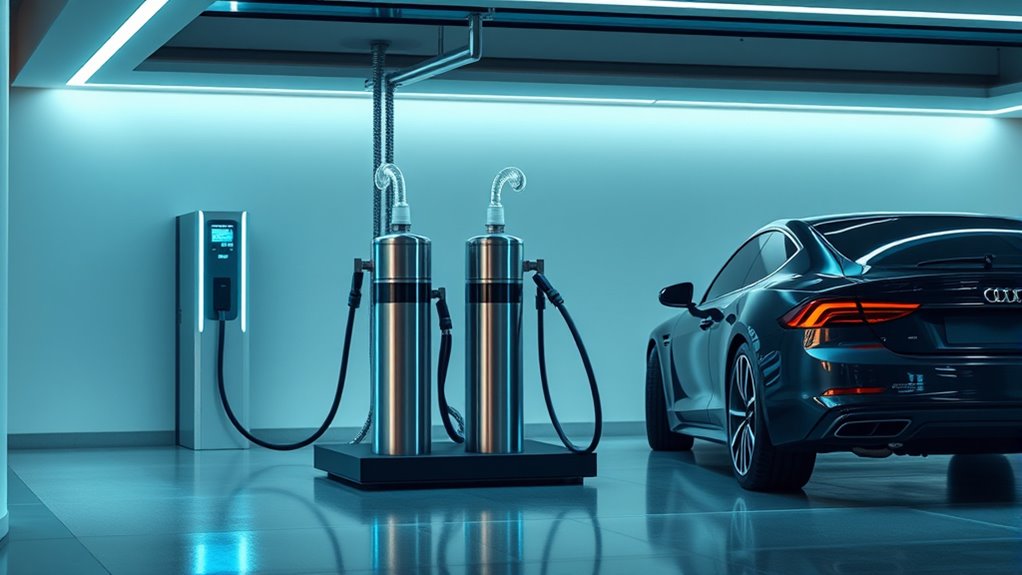
Imagine being able to refuel your fuel-cell car conveniently at home, eliminating trips to hydrogen stations. This idea is becoming more realistic as advancements in technology and infrastructure progress, but it also raises important questions about safety, costs, and practicality. Home hydrogen refueling involves storing and dispensing hydrogen safely within your garage, offering a level of convenience that could transform how you use your fuel-cell vehicle. However, implementing such a system isn’t just about installing a tank and a pump; it requires strict adherence to safety regulations designed to prevent leaks, explosions, or other hazards associated with hydrogen. These regulations are in place to protect you and your property, and they cover everything from storage tank design and installation to ventilation and leak detection systems. Ensuring compliance can involve significant upfront planning and investment, but it’s essential for safe operation. Manufacturers and regulators are working to develop standards that make home refueling safer and more accessible, which could eventually lower the barrier for widespread adoption. Additionally, ongoing research into cost reduction strategies aims to make home hydrogen refueling more affordable for consumers in the future. Cost considerations play a major role in determining whether home hydrogen refueling becomes a common feature. The initial investment includes purchasing specialized storage tanks, safety equipment, and a hydrogen dispenser, which can be expensive compared to traditional gasoline or electric charging stations. Additionally, setting up a home refueling station may require professional installation and periodic maintenance to ensure safety and efficiency. While these costs are currently high, economies of scale and technological advancements are likely to reduce prices over time. Moreover, the convenience of refueling at home could save you money in the long run by avoiding the need to travel to hydrogen stations, which are still limited in number and often situated far from residential areas. Despite the hurdles, progress is underway. Companies are exploring compact, safer storage solutions and simplified refueling systems tailored for residential use. Governments and industry stakeholders are also working on regulations that balance safety and affordability, making home refueling more feasible. As these developments unfold, you might soon find it easier to top off your fuel-cell vehicle safely and conveniently without leaving your driveway. While there are still challenges to overcome, the vision of a home hydrogen refueling system is steadily approaching reality, promising a future where fueling your car is as simple as plugging it in overnight. With ongoing innovation and careful regulation, this concept could become an accessible, safe, and practical option for fuel-cell vehicle owners.
As an affiliate, we earn on qualifying purchases.
Conclusion
Soon, you’ll find home hydrogen refueling isn’t just a dream but a reality in motion. As safety standards and technology advance, the promise of effortless, at-home fueling becomes clearer—like a beacon guiding you toward a cleaner, more convenient future. While challenges remain, the horizon shines bright with opportunity. Imagine a world where refueling your fuel-cell car is as simple as plugging in—your journey to sustainability is just around the corner.
Halloween Picks
halloween
As an affiliate, we earn on qualifying purchases.