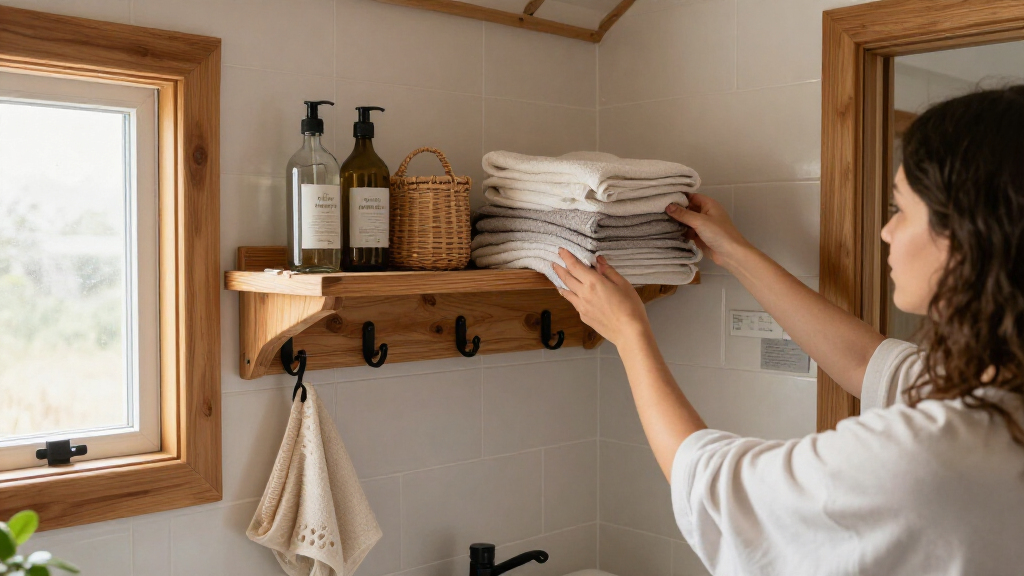
This checklist is for anyone making a small bathroom work harder in a tiny home. It focuses on storage ideas that make use of overlooked space while keeping everyday items within reach.

Get compact home essentials delivered free with Prime
- Fast, free delivery on millions of items
- Prime Video, Amazon Music and more included
- Member-only deals all year
The sections follow common bathroom storage slots: over the toilet, on the wall, in the shower, beneath the sink, beside the laundry area, and in a medicine cabinet. Some include a named pick; others offer planning advice only.
Before choosing anything, measure the available space and check clearances around doors, plumbing, and fixtures. Use the checklist to compare each option with your layout and routines, then prioritize the storage gaps that cause the most clutter.
Over-Toilet Storage
The area above the toilet can provide useful vertical storage without taking up much floor space. Before settling on shelves or a cabinet, measure from the floor and note the toilet tank height, the distance to the ceiling, and any nearby door or window. Those measurements help you choose a setup that fits the room and leaves the toilet comfortable to use. Clearance matters as much as storage capacity.
A common mistake is choosing a deep unit that makes a compact bathroom feel crowded or interferes with access to the tank. Consider what you plan to store and how often you need it: daily toiletries should be easy to reach, while occasional supplies can go higher. Check how the unit attaches and whether the wall or floor arrangement suits your bathroom. In a tiny home, plumbing and wall construction can vary, so confirm the mounting approach works for the actual space before buying. Measure the full footprint, including supports and doors, and keep frequently used items within comfortable reach.
What to look for:
- Measure tank, ceiling, and side clearances
- Check depth against the walkway
- Confirm mounting needs for your wall
- Plan storage by how often items are used
- Keep access to the tank unobstructed
Wall-Mounted Towel Rack
A wall-mounted towel rack can keep towels off limited floor space and give them a consistent place to dry. First, choose a location that is convenient from the shower or sink and does not block a doorway, cabinet, or other fixture. Measure the wall area and consider how many towels need to hang there at once. Placement shapes usability: a rack that technically fits may still be awkward to reach.
One frequent buying mistake is focusing on the rack’s appearance without checking how it attaches or how much wall space its arms or bars require. Look at the available wall surface, the intended fasteners, and any nearby plumbing or wiring before drilling. If the walls are finished in a way that limits mounting, consider whether the proposed attachment method is appropriate for that surface. Think through towel size and how they will hang; crowded towels may be harder to access and dry. In a compact bathroom, leave enough room to move around the rack and avoid placing it where hanging fabric brushes against wet surfaces. Check reach and clearance with the bathroom in its everyday layout.
What to look for:
- Measure the wall and nearby clearances
- Choose a location near the shower or sink
- Check the attachment method for the wall surface
- Allow space for the towels you use
- Avoid blocking doors, fixtures, or movement
Shower Caddy
A shower caddy keeps bathing items together and can free up a small shower’s ledges or floor. The YASONIC Shower Caddy Adhesive is the named pick for this slot. Before choosing it, check the shower wall surface and the available area, including the places where the caddy and its adhesive pieces would sit. Confirm that bottles and other items you use fit the intended storage arrangement. Surface compatibility comes first for an adhesive-mounted organizer.
A common mistake is buying a caddy without checking the wall finish, grout lines, or placement constraints. Review the product’s installation guidance and verify that the mounting area matches its requirements; do not assume every tile or shower surface is suitable. Consider the height and reach of the shelves, the space needed for bottles, and whether the caddy would interfere with shower controls or movement. The product name describes it as rustproof and large capacity, but your own shower dimensions still determine whether it fits comfortably. Measure before installing, and arrange frequently used items where they are easy to reach without crowding the shower.
What to look for:
- Check the installation guidance for surface compatibility
- Measure the intended wall area
- Account for grout lines and shower controls
- Confirm bottles fit the storage space
- Place daily items within easy reach
YASONIC Shower Caddy Adhesive – Rustproof Large Capacity Shower Organizer with S

This 6-in-1 shower caddy set includes large and mini shelves, soap holder, hooks, and adhesive pads, providing versatile and heavy-duty shower storage. Made of rustproof stainless steel with a strong adhesive system, it offers easy, tool-free installation and can be relocated easily.
Pros:
- Heavy-duty adhesive holds up to 40 lbs without sagging
- Rustproof stainless steel construction ensures durability
- Easy, tool-free installation and relocation
Cons:
- Requires 24 hours to fully adhere and support weight
- Adhesive pads may need replacement when relocating
- Limited to smooth surfaces for optimal adhesion
Best for: Showers with a suitable adhesive mounting surface
Not ideal for: Surfaces or layouts that do not meet the mounting guidance
Bottom line: Choose the YASONIC caddy only after confirming its adhesive placement suits your shower.
Under-Sink Organizer
The space beneath a bathroom sink often has to accommodate both supplies and plumbing, so an organizer needs to fit the real shape of the cabinet. The Kitstorack 2-Pack Adjustable 3-Tier Under-Sink Organizer is the named pick for this slot. Before choosing it, measure the cabinet’s interior width, depth, and usable height, then note the drain, supply lines, and any other obstructions. Plumbing sets the usable space, not the cabinet’s outside dimensions.
A common mistake is assuming adjustable tiers will automatically clear pipes or fit around stored items. Check the organizer’s dimensions and adjustment details against the measured cabinet, including the space needed to slide it in and reach items afterward. Consider whether both units in the pack have a practical place in your bathroom, and whether the arrangement leaves room for taller bottles or frequently used supplies. Avoid filling every tier so tightly that items are hard to see or remove. In a tiny home, access can be as important as capacity: keep routine products near the front and leave the plumbing reachable if needed. Mock up the footprint before organizing the cabinet.
What to look for:
- Measure interior dimensions and usable height
- Map pipes and other obstructions
- Check tier adjustment and product dimensions
- Confirm both organizers have a suitable location
- Leave access to plumbing and daily supplies
Kitstorack 2-Pack Adjustable 3-Tier Under-Sink Organizer

This two-pack under-sink organizer has three sliding metal mesh tiers with five or more height settings to fit items of different sizes. Thickened carbon steel, a reinforced frame, suction cups, and adhesive films provide stability, and each set is described as supporting up to 60 pounds.
Pros:
- Three sliding tiers make stored items easier to reach.
- Five or more height settings accommodate items of different sizes.
- Thickened steel and a reinforced frame are designed for stability.
- Suction cups and adhesive films help secure the organizer.
Cons:
- The listed 60-pound capacity may limit storage of heavier loads.
- The three-tier configuration may not suit items that need more vertical clearance.
Best for: Cabinets with enough clear space for adjustable tiers
Not ideal for: Under-sink spaces dominated by pipes or tight obstructions
Bottom line: Match the Kitstorack organizer dimensions to the cabinet and plumbing before arranging supplies.
Slim Laundry Hamper
A slim hamper can give laundry a defined spot in a bathroom where a standard basket would be difficult to place. The Handwoven Slim Laundry Hamper with Lid, Narrow Wicker Laundry Basket is the named pick for this slot. Measure the proposed location carefully, including the space needed to open the lid and remove the hamper when carrying laundry. Check the whole footprint, not only the narrowest dimension.
A frequent mistake is choosing a hamper based on a slim profile without checking how it works alongside doors, drawers, or the bathroom’s path through the room. Confirm the listed dimensions and compare them with your available floor space. Consider the laundry volume from your household and routines; the product name alone does not establish how much it holds. Think about where the hamper will sit in relation to moisture and everyday movement, and whether the lid is easy to access in that spot. If wicker is part of the appeal, make sure the location and care guidance suit your bathroom. Plan the removal path so a full hamper can be moved without shifting other storage.
What to look for:
- Compare listed dimensions with the intended space
- Allow room to open the lid
- Check door and drawer swing clearances
- Consider laundry volume and removal path
- Review care guidance for the bathroom location
Handwoven Slim Laundry Hamper with Lid, Narrow Wicker Laundry Basket, Natural Wa

This handwoven laundry hamper is made from natural water hyacinth, offering breathable storage with a slim design suitable for narrow spaces. It includes a removable liner and two mesh laundry bags for easy organization and transport, available in 55L and 75L sizes.
Pros:
- Made from natural, eco-friendly water hyacinth
- Includes removable liner and mesh bags for convenience
- Slim design fits narrow spaces and small rooms
- Handwoven by skilled artisans adds unique character
Cons:
- Limited color options
- Potentially less durable than synthetic materials
- Requires occasional maintenance to prevent wear
Best for: Bathrooms with a measured, unused narrow floor area
Not ideal for: Locations where the lid or hamper would block movement
Bottom line: Choose the Handwoven Slim Laundry Hamper only if its footprint and access fit the room.
Compact Medicine Cabinet
A compact medicine cabinet can use wall space for small bathroom essentials while keeping the counter clearer. Start by measuring the intended wall area and checking what lies behind it, including plumbing or wiring where relevant. Consider whether you want a recessed or surface-mounted arrangement, then confirm that the wall and available depth can accommodate the chosen style. Wall depth and mounting determine which options are practical.
A common mistake is selecting a cabinet that fits the wall but leaves too little room for its door to open. Check the door swing against nearby mirrors, lights, faucets, and walkways. Think about what you plan to store and whether the interior arrangement can accommodate those items without making them difficult to find. For a tiny home, avoid placing a cabinet where it crowds the sink area or complicates daily routines. Confirm mounting requirements for the particular wall construction, and keep the cabinet reachable for the people who will use it. Measure the door clearance as well as the cabinet body before making a choice.
What to look for:
- Measure wall area and available depth
- Check mounting requirements for the wall
- Confirm the door swing clears nearby fixtures
- Match interior space to intended contents
- Choose a reachable spot that does not crowd the sink
Set your buying order by the storage problem you want to solve first: begin with organizers for existing spaces, then address wall or over-toilet storage after measuring, and add a hamper if laundry needs a dedicated spot. For each item, verify dimensions and installation requirements against your bathroom before committing. Fit comes before capacity in a tiny layout.
You do not need to change every storage area at once. Start with the most frustrating clutter, make one measured improvement, and see how it works in your routine. A few well-placed choices can make a compact bathroom feel easier to use.