
Imagine a drop of water holding the weight of an entire industry’s future — that’s how significant water consumption can be for green hydrogen. As you explore how much water is truly needed to produce this clean fuel, you’ll find that the figures depend heavily on technology and efficiency. With ongoing innovations aiming to cut down water use, understanding the real impact of green hydrogen becomes more complex and vital than ever.
Key Takeaways
- Producing one kilogram of green hydrogen typically consumes about 9 liters of water.
- Water consumption depends on electrolysis efficiency; higher efficiency reduces water use.
- Improved systems can lower water footprint per unit of hydrogen by increasing energy conversion rates.
- Purification processes add to total water requirements, ensuring hydrogen quality.
- Advances in technology aim to decrease water consumption, making green hydrogen more sustainable.
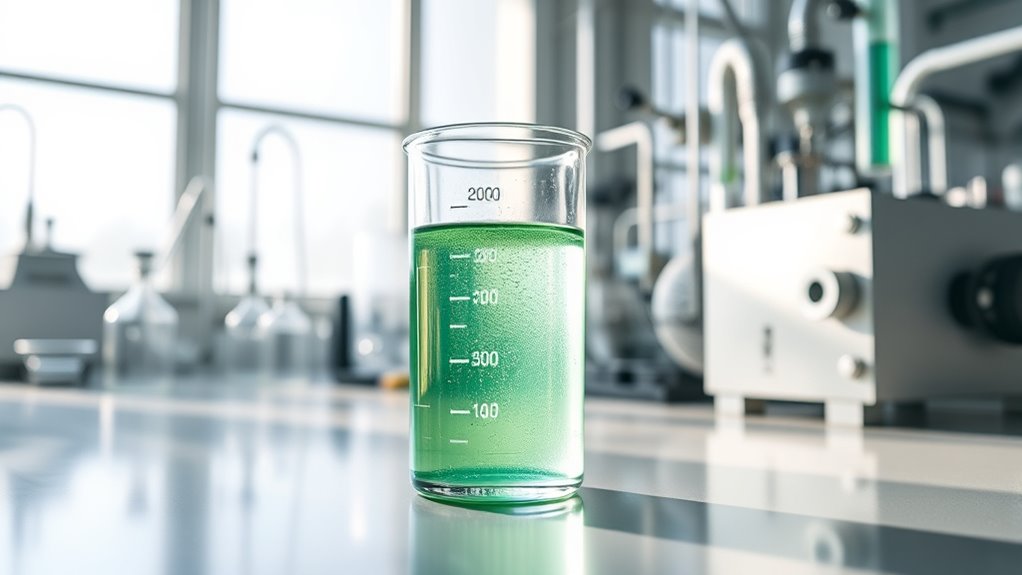
Green hydrogen water, produced through environmentally friendly methods, is gaining popularity as a sustainable alternative to traditional water sources. As you explore its potential, it’s important to understand how much water this process actually consumes. Unlike conventional water use, green hydrogen production relies on renewable water—meaning it taps into water sources that are sustainable and minimally impactful on the environment. This focus on renewable water helps guarantee that the process doesn’t deplete freshwater supplies or cause ecological harm. Instead, it emphasizes efficiency metrics—key indicators used to measure how effectively energy and water are converted during production. These metrics are vital because they help you assess the true sustainability of green hydrogen water, guaranteeing that the process maximizes output while minimizing resource use.
Green hydrogen water relies on sustainable water sources, emphasizing efficiency to minimize environmental impact and resource use.
When you look into the water consumption involved, you’ll find that electrolysis—the primary method used to produce green hydrogen—requires a significant amount of water. However, the efficiency of this process plays a big role in determining overall water use. Higher efficiency metrics mean that less water is needed to generate a unit of hydrogen. For example, advanced electrolysis systems might convert about 70-80% of the electrical energy into hydrogen, which directly translates to less water per unit of hydrogen produced. This improved efficiency reduces the demand on renewable water sources, making the process more sustainable and practical, especially in regions where water is scarce.
You might wonder how much water is actually needed for large-scale green hydrogen production. Estimates suggest that producing one kilogram of hydrogen via electrolysis consumes roughly 9 liters of water, but this number can vary depending on the technology’s efficiency. As efficiency metrics improve, the water footprint per kilogram of hydrogen decreases, making green hydrogen an even more attractive sustainable option. It’s also worth noting that the water used in electrolysis is often purified to prevent contamination, which adds to the overall water requirement but ensures the purity of the hydrogen.
Ultimately, your understanding of green hydrogen water consumption hinges on these efficiency metrics. They act as a benchmark for sustainability, helping you gauge whether this emerging technology can truly serve as a renewable water resource with minimal environmental impact. As advancements continue and efficiency improves, the water consumption per unit of hydrogen will decrease, making green hydrogen a more viable alternative for a resource-conscious future. By focusing on these key indicators, you can better appreciate the role green hydrogen water plays in sustainable energy solutions without overestimating its water footprint.
Conclusion
While producing green hydrogen requires about 9 liters of water per kilogram, higher efficiency can cut this use considerably. Think of it as turning a small tap into a more sustainable flow—less water wasted, more environmentally friendly. Advances in technology help you generate clean energy without draining precious water resources, especially in arid regions. So, as innovation improves, you can enjoy the benefits of green hydrogen while respecting our planet’s limited water supply.