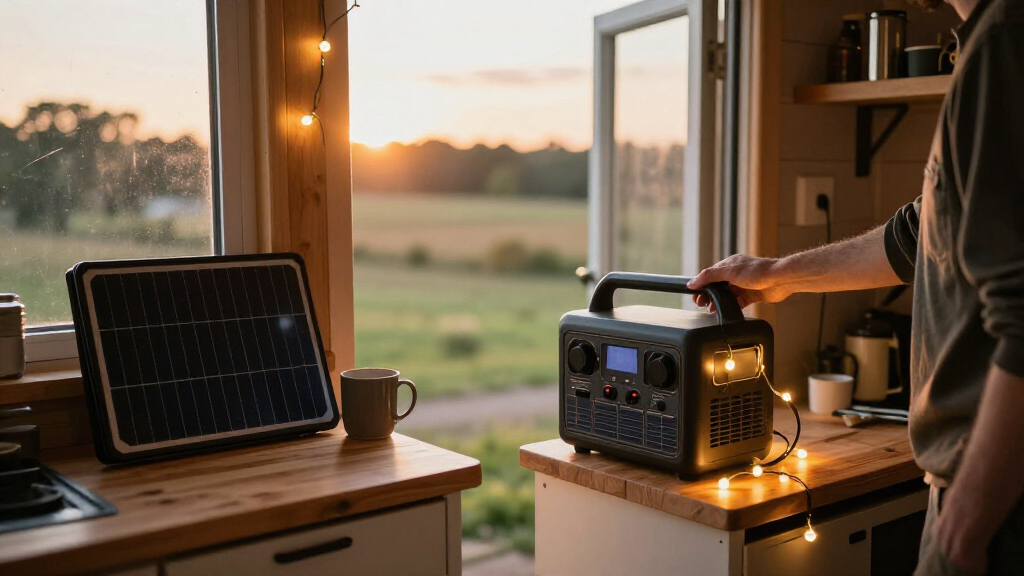
Tiny house solar generator kits range from compact portable stations to larger power systems with roof panels or wind generation. My best overall pick is the FOSSiBOT F2400 with 2,048Wh capacity, which pairs substantial storage with included solar panels; the Jackery HomePower 3600 Plus stands out for buyers needing more capacity, while the ECO-WORTHY 200W starter kit offers a simpler entry into fixed solar components. The main tradeoff is portability and setup simplicity versus the greater storage and installation work a tiny home may need. Panel wattage, battery capacity, inverter output, and compatibility all affect what appliances a kit can run and for how long. Read on for the full comparison and guidance on matching a kit to your daily loads.

Get compact home essentials delivered free with Prime
- Fast, free delivery on millions of items
- Prime Video, Amazon Music and more included
- Member-only deals all year
Complete the kit


Key Takeaways
- The FOSSiBOT F2400 kits lead on listed battery capacity: both offer 2,048Wh, but the 2×200W panel bundle differs from the version listed with a 420W panel, so check the exact package before choosing.
- The Jackery HomePower 3600 Plus has the largest listed battery here: its 3,584Wh capacity suits buyers who value longer runtimes more than compact size.
- Included solar varies widely: the roundup spans a 40W panel with the Jackery Solar Generator 300 to a four-panel 800W package with the Jackery HomePower 3600 Plus.
- Not every kit is a plug-and-play battery generator: the wind-and-solar hybrids and Zamp roof-mount kit call for installation planning and component compatibility checks.
- Small starter kits have a narrower role: the 292Wh Jackery 300 and 200W ECO-WORTHY kit make more sense for light loads or system expansion than as stand-alone whole-home power.


| tiny house solar generator kit | Battery capacity | Weight | Battery type |
|---|---|---|---|
| FOSSiBOT F2400 Solar Generator | 2048Wh | 48.5 pounds | LiFePO4 |
| OUPES Mega 1 Solar Generator w | 1024Wh | 27.8 pounds | LiFePO4 |
| FOSSiBOT F2400 Solar Generator | 2048Wh | 48.5 pounds | LiFePO4 |
| 1000 Watts Wind & Solar Hybrid | — | — | — |
| 2pcs 120W Mono Flexible Solar | — | — | — |
| Zamp Solar Legacy Series 680-W | — | 128.3 pounds | — |
| Jackery HomePower 3600 Plus wi | 3584Wh | 77.2 pounds | LFP (Lithium Iron Phosphate) |
| OUPES Mega 1 Lite Solar Genera | 1024Wh | 26.7 pounds | LiFePO4 |
| ECO-WORTHY 200 Watt 12V Comple | 50Ah LiFePO4 | — | — |
| EcoFlow Delta 3 Classic Solar | 1024Wh | — | LiFePO4 |
| Jackery Solar Generator 300 wi | 292Wh | 12.9 pounds | — |
More Details on Our Top Picks
FOSSiBOT F2400 Solar Generator, 2048Wh LiFePO4 Portable Power Station with 2×200W Solar Panels
I rank this FOSSiBOT F2400 first for tiny-house owners who want a substantial battery and panels in one package. Its 2048Wh LiFePO4 battery and 2400W continuous output can support more than small electronics, while the included two 200W panels provide a starting point for solar charging without a separate panel purchase. Compared with the OUPES Mega 1, it offers twice the listed battery capacity, but the OUPES is lighter and can be expanded with additional batteries. The F2400’s 90-minute charging claim is useful when AC and solar input are available, though actual solar recharge depends on sunlight and setup. At 48.5 pounds, it is better treated as a movable power hub than something to carry around daily. It is not a whole-house system: check appliance loads and daily energy needs before relying on it as a tiny home’s sole supply.
Pros:- 2048Wh LiFePO4 capacity gives more stored energy than the 1024Wh OUPES Mega 1 base unit.
- 2400W continuous output and 4800W surge support a wider range of appliance startup loads than smaller power stations.
- Two included 200W solar panels provide a ready-made charging setup.
- Multiple charging options and USB-C PD 100W support both backup charging and everyday electronics.
Cons:- At 48.5 pounds, it is cumbersome to move around a compact home or take on frequent trips.
- The included 400W of panel capacity may not replenish the battery quickly in weak sunlight or during heavy use.
- A 2048Wh portable battery is not a replacement for a properly sized, permanently installed tiny-house energy system.
Best for: Tiny-house owners who want a bundled, portable backup unit for essential appliances and device charging, with included panels for solar replenishment.
Not ideal for: People seeking a permanently installed, high-output roof system or a lightweight station they can move frequently; the battery is finite and the unit weighs 48.5 pounds.
- Battery capacity:2048Wh
- Battery type:LiFePO4
- Continuous output:2400W
- Surge output:4800W
- Solar panels included:2 × 200W
- Charging time:90 minutes
- Weight:48.5 pounds
- USB-C output:PD 100W
Our verdict“Choose this F2400 if you want a high-capacity portable backup with panels included; skip it if your priority is low weight or whole-home, long-duration power.”
OUPES Mega 1 Solar Generator with 100W Panel Included, 2000W 1024Wh LiFePO4
The OUPES Mega 1 earns its place for tiny-house owners who want to start with a manageable station and add capacity later. Its 1024Wh battery is half the listed capacity of either FOSSiBOT F2400, but the system can expand to 5120Wh with additional batteries—a more flexible path for a household whose backup needs may grow. The 2000W pure sine wave inverter offers substantial output for a compact unit, and the listed 27.8-pound weight is easier to handle than the F2400’s 48.5 pounds. Its included 100W panel is a modest solar starter rather than a fast-recharging array, so plan for more panel capacity if daily off-grid use is the goal. This pick is strongest as a scalable backup hub, not an all-in-one solution for extended cloudy periods.
Pros:- Expandable capacity up to 5120Wh offers a growth path that the listed FOSSiBOT F2400 bundles do not specify.
- 2000W pure sine wave AC output supports many household and work devices.
- At 27.8 pounds, it is lighter than either 2048Wh FOSSiBOT F2400.
- Fast AC charging and multiple output types support varied backup needs.
Cons:- The base 1024Wh capacity is lower than the 2048Wh batteries in both FOSSiBOT F2400 options.
- The included 100W panel is limited for replenishing the battery during regular off-grid living.
- Reaching the stated 5120Wh capacity requires purchasing additional batteries.
Best for: Tiny-house residents who need a lighter backup station now and want the option to add battery capacity as their energy needs grow.
Not ideal for: Buyers who need substantial stored energy straight out of the box or expect the included 100W panel to sustain heavy daily loads.
- Battery capacity:1024Wh
- Expandable capacity:Up to 5120Wh
- Battery type:LiFePO4
- AC output:2000W pure sine wave
- Surge output:4500W
- Included solar panel:100W
- Weight:27.8 pounds
- AC charging:0–80% in 36 minutes
Our verdict“Pick the Mega 1 if you value a lighter, expandable backup system, but choose a larger-capacity bundle if you need more stored energy immediately.”
FOSSiBOT F2400 Solar Generator, 2048Wh LiFePO4 Portable Power Station with 2400W (4800W Surge), 420W Solar Panel, USB-C PD for Home Backup, RV, Camping
This FOSSiBOT F2400 bundle suits tiny-house owners who place more value on panel capacity than on a ready-to-use multi-panel package. It pairs the same 2048Wh LiFePO4 battery and 2400W output as the other F2400 listing with a single 420W panel. Against the version with two 200W panels, the rated solar capacity is slightly higher, which may help with replenishment in good conditions, though real-world harvest depends on placement, weather, and system compatibility. The tradeoff is practical: one larger panel may be less convenient to position than two separate panels, and the station itself still weighs 48.5 pounds. The OUPES Mega 1 is easier to move and expand, but starts at half the battery capacity. I’d favor this bundle for a fixed solar setup and keep a separate plan for prolonged low-sun stretches.
Pros:- The 420W panel has slightly more rated solar capacity than the two 200W panels in the other FOSSiBOT F2400 bundle.
- 2048Wh LiFePO4 storage and 2400W continuous output suit a broad range of backup tasks.
- 4800W surge output provides headroom for some appliances with higher startup demand.
- USB-C PD and other charging options support both household backup and device charging.
Cons:- The 48.5-pound station is not convenient for frequent carrying.
- A single panel can be less flexible to position than the two-panel arrangement in the other F2400 kit.
- Solar charging speed varies with sunlight and use, so the rated panel output does not guarantee a quick recharge.
Best for: Tiny-house owners who want a 2048Wh portable battery paired with a higher-rated solar panel for charging in favorable conditions.
Not ideal for: People who need a lightweight, frequently moved station or a panel arrangement that can be spread across multiple sunny spots.
- Battery capacity:2048Wh
- Battery type:LiFePO4
- Continuous output:2400W
- Surge output:4800W
- Solar panel power:420W
- AC and solar charging time:Approximately 1.5 hours
- Weight:48.5 pounds
- Dimensions:15.2 × 11.2 × 12.64 inches
Our verdict“Choose this F2400 bundle if you want the higher-rated single panel with a large battery, and prefer the two-panel version if placement flexibility matters more.”
1000 Watts Wind & Solar Hybrid Kit for Home Off-Grid System: 5 x 120W Flexible Solar Panels, 400W Wind Turbine, 1000W Inverter
For a tiny house in a consistently breezy location, this kit offers a different approach from the portable battery stations in this roundup: it combines 600W of flexible solar panels with a 400W wind turbine and a 1000W inverter. That solar-plus-wind mix can broaden generation opportunities when sunlight is limited, while the FOSSiBOT F2400 bundles provide stored energy and simpler portable backup. The distinction matters: this is a generation kit, not a listed battery-based power station, so the supplied specs do not establish how electricity is stored or how much usable energy is available overnight. The 1000W inverter also provides less output headroom than either FOSSiBOT F2400. I’d shortlist it for owners planning a properly designed off-grid installation and comfortable with setup and maintenance, not for buyers seeking a plug-and-play backup box.
Pros:- Combines 600W of flexible solar panels with a 400W wind turbine for two generation sources.
- Flexible panels can suit some curved or space-constrained mounting surfaces better than rigid panels.
- The 1000W pure sine wave inverter offers a defined output rating for compatible loads.
- At a listed 17.6 pounds, the kit’s stated weight is lower than the portable FOSSiBOT F2400 units.
Cons:- No battery capacity is listed, so the supplied information does not specify stored energy for night or cloudy periods.
- The 1000W inverter has less output capacity than the 2000W OUPES Mega 1 and 2400W FOSSiBOT F2400.
- Installation and maintenance demands make it less suitable for buyers who want a simple portable setup.
Best for: Tiny-house builders in windy areas who want solar and wind generation in one installation and can handle system setup.
Not ideal for: Renters, beginners seeking a ready-to-use battery generator, or households that need stated battery storage and higher inverter output out of the box.
- Solar panel configuration:5 × 120W flexible monocrystalline panels
- Inverter type:Pure sine wave
- Listed item weight:17.6 pounds
Our verdict“Choose this hybrid kit for a windy, planned off-grid installation, but choose a battery generator if you need straightforward stored backup power.”
2pcs 120W Mono Flexible Solar Panel + 400W 12V Wind Turbine + 20A Controller Hybrid System Kit for Home RV Boat
This hybrid kit is the more compact solar-and-wind option for tiny-house owners working with limited or irregular mounting surfaces. Its two 120W flexible panels total 240W, far less solar capacity than the five-panel, 600W hybrid kit, but the smaller array may be easier to fit on a small roof, RV, or boat. It also includes a 400W wind turbine and 20A controller, offering a second generation source when conditions allow. Unlike the OUPES Mega 1 or either FOSSiBOT F2400, this is not presented as a battery power station; the supplied data does not list battery storage or an inverter. That makes it a component kit for a planned system, rather than an immediate source of stored household power. The flexible panels call for careful handling and thoughtful installation.
Pros:- Two flexible 120W panels can fit some surfaces where rigid panels are difficult to mount.
- A 400W wind turbine adds a generation source beyond the 240W solar array.
- The listed 20A controller is included as part of the hybrid kit.
- The turbine has a stated startup wind speed of 2.5 m/s.
Cons:- The 240W total solar rating is substantially below the 600W array in the other hybrid kit.
- No battery capacity or inverter rating is provided, so this is not a complete portable generator setup.
- Flexible panels require careful handling and installation to reduce the risk of damage.
Best for: Tiny-house, RV, or boat owners with limited or curved mounting space who are assembling a separate solar-and-wind system.
Not ideal for: Buyers who need a complete battery generator, a specified inverter, or more solar panel capacity than 240W.
- Solar panel configuration:2 × 120W flexible panels
- Solar panel type:Monocrystalline
- Panel dimensions:1015 × 670 × 30mm
- Panel weight:5.5 pounds each
- Controller:20A
- Rotor diameter:1.2 meters
- Wind startup speed:2.5 m/s
Our verdict“Pick this kit when flexible mounting and wind generation matter more than high solar capacity or a ready-made battery backup.”
Zamp Solar Legacy Series 680-Watt Roof Mount Solar Panel Kit with Digital Charge Controller
For a tiny house with a fixed 12-volt battery system, the Zamp kit offers a roof-mounted approach rather than a portable power station: four panels provide 680 watts, while the 60-amp controller has a remote LCD for checking system status. Its ability to expand to 1020 watts gives owners room to add generation later, a different kind of flexibility from the ready-to-use EcoFlow Delta 3 Classic, which bundles a battery and a portable panel. The tradeoff is that this kit supplies solar charging hardware, not a stated battery or inverter, so it is not a complete generator by itself. At 128.3 pounds, it also calls for a suitably strong roof and careful installation. I’d rank it for permanent, technically planned setups—not compact cabins or buyers seeking a plug-and-play package.
Pros:- Four panels provide 680 watts of rated solar capacity.
- 60-amp charge controller includes a remote LCD display.
- Expandable to a stated maximum of 1020 watts.
- Supports 12-volt batteries, including lithium.
Cons:- At 128.3 pounds, the kit needs sturdy mounting and careful roof-load planning.
- The 12-volt system limit may not suit buyers building around a different battery voltage.
- No battery or inverter is listed, so additional components are needed for a complete power system.
Best for: Tiny-house owners with a sturdy roof, an existing 12-volt battery setup, and plans to expand solar capacity.
Not ideal for: Owners of very small or weight-sensitive structures, and buyers who need an included battery and inverter in one ready-to-use kit.
- Panel capacity:680 watts total
- Panel configuration:Four 170-watt panels
- Charge controller:60 amps with remote LCD display
- Maximum stated system power:1020 watts
- System voltage:12 volts
- Dimensions:58.3 x 26.4 x 1.5 inches
- Weight:128.3 pounds
- Warranty:25-year output warranty
Our verdict“Choose the Zamp for a permanent, expandable 12-volt roof array, but not if you need a complete solar generator in one package.”
Jackery HomePower 3600 Plus with 4x200W Solar Panels & Connectors, 3584Wh
The Jackery suits a tiny-house owner who wants substantial stored energy and appliance-level output without designing a roof-mounted battery system. Its 3584Wh capacity and 3600W output put it well above the 1024Wh EcoFlow Delta 3 Classic on stated storage and output, making longer outages or heavier loads a more plausible use. Fast AC-plus-DC charging is listed at two hours, and the LFP battery is rated for 6,000 cycles. The tradeoff is scale: at 77.2 pounds, it is portable with wheels and a handle, but not easy to carry around a tiny home. The listing also says the solar panels and station ship separately, so setup may not arrive all at once. I’d pick it for backup capacity, not minimal-footprint living.
Pros:- Large 3584Wh battery capacity for extended backup needs.
- 3600W output supports a broader range of appliance loads than the 1024Wh EcoFlow Delta 3 Classic.
- LFP battery is rated for 6,000 cycles.
- Wheels and a telescopic handle make moving it easier than lifting it by hand.
Cons:- The 77.2-pound unit is difficult to carry manually.
- Solar panels and power station may ship in separate packages.
- Its size and backup-first capacity may be more than a compact tiny-house setup needs.
Best for: Tiny-house residents who need substantial battery reserve and high output for outages, with room to store a wheeled power station.
Not ideal for: Buyers prioritizing a light, compact unit or a permanently integrated roof system; the station is heavy and its solar components may arrive separately.
- Battery capacity:3584Wh
- Output:3600 watts
- Voltage:120V and 240V in parallel
- Battery type:LFP (Lithium Iron Phosphate)
- Weight:77.2 pounds
- Dimensions:15.2 x 12.2 x 19.3 inches
- AC plus DC charge time:2 hours
- Solar charge time:4 hours
Our verdict“Choose the Jackery when outage reserve and appliance output matter more than a lightweight, space-saving footprint.”
OUPES Mega 1 Lite Solar Generator with 100W Panel Included, 2000W AC Rated
The Mega 1 Lite pairs a 1024Wh LiFePO4 power station with a 100W foldable panel, giving tiny-house owners a more self-contained starting point than the roof-only Zamp kit. Its 26.7-pound weight and four AC outlets make it easier to move between a small living area, porch, or vehicle, while app control can help track power use without standing beside the unit. The main compromise is the included panel’s modest 100-watt rating: it makes solar recharging possible, but the listing does not establish fast replenishment for daily household consumption. The 2000W continuous output also limits high-load appliances compared with the 3600W Jackery HomePower 3600 Plus. I’d choose this for portable essentials and moderate loads, not as the sole power source for an energy-hungry tiny house.
Pros:- Includes a foldable 100W solar panel alongside the power station.
- 1024Wh LiFePO4 battery provides portable stored energy.
- Four AC outlets plus USB and 12V ports accommodate varied devices.
- Bluetooth, Wi-Fi, and app control support remote monitoring.
Cons:- The included 100W panel is modest for recharging a 1024Wh battery or supporting ongoing household loads.
- 2000W continuous output is below the Jackery HomePower 3600 Plus’s 3600W rating.
- At 26.7 pounds, it is portable but still a substantial item to move frequently.
Best for: Tiny-house owners who want a movable battery-and-panel kit for devices, lights, and moderate loads, with app-based monitoring.
Not ideal for: Households expecting fast solar replenishment from a small panel or needing more than 2000 watts of continuous output.
- Battery capacity:1024Wh
- AC output:2000 watts rated
- Surge power:4500 watts
- Included solar panel:100 watts
- Battery type:LiFePO4
- Weight:26.7 pounds
- Ports:4 AC, 2 USB-C, 2 USB-A, 1 12V car socket
- Cycle life:3500+ cycles to 80% capacity
- Connectivity:Bluetooth, Wi-Fi, and app control
Our verdict“Pick the Mega 1 Lite for a portable, app-monitored starter kit, but look to a larger panel or higher-output system for heavier daily use.”
ECO-WORTHY 200 Watt 12V Complete Solar Panel Starter Kit for RV Off Grid
This ECO-WORTHY kit is the most approachable route here for someone assembling a small 12-volt off-grid system: it includes a 200W panel, 50Ah LiFePO4 battery, 600W pure sine wave inverter, and 30A charger. That bundled hardware fills a gap in the Zamp kit, which provides a larger roof array and controller but no listed battery or inverter. The ECO-WORTHY’s lower panel capacity, however, makes it better suited to basic loads than sustained tiny-house living; its stated daily output of up to 800Wh depends on optimal sunlight. Compared with the portable EcoFlow Delta 3 Classic, this is a component-based system that may require more setup but can suit an owner building around 12 volts. I’d choose it for a modest first system, not heavy appliances.
Pros:- Includes a 200W panel, 50Ah LiFePO4 battery, inverter, and charger.
- 600W pure sine wave inverter provides a defined limit for planning small loads.
- 12-volt components suit basic RV-style off-grid setups.
- Monocrystalline N-Type panel is specified as high efficiency.
Cons:- The 200W panel and 50Ah battery are limited for sustained whole-house use.
- The 600W inverter rules out many high-wattage appliances.
- Some assembly and setup are required, and no warranty is specified in the product data.
Best for: First-time off-grid builders who want a bundled 12-volt panel, battery, inverter, and charger for basic tiny-house or RV loads.
Not ideal for: Tiny-house households with high daily energy use or appliances beyond a 600W inverter’s capacity, and buyers seeking a fully plug-and-play portable station.
- Solar panel capacity:200 watts
- Panel type:Monocrystalline N-Type
- Battery capacity:50Ah LiFePO4
- Inverter:600W pure sine wave
- Charger:30A
- Maximum voltage:12 volts
- Panel dimensions:35.63 x 23.03 x 1.18 inches
- Panel weight:11.5 pounds
Our verdict“Choose this as a bundled, modest 12-volt starter system for basic loads, not as a high-capacity tiny-house power plant.”
EcoFlow Delta 3 Classic Solar Generator with 220W Solar Panel, 1024Wh
The Delta 3 Classic makes a strong case for a tiny-house owner who wants a portable battery system with a useful solar panel and built-in backup behavior. Its 1024Wh battery, 1800W continuous output, and 3600W surge rating put it above the ECO-WORTHY kit’s 600W inverter for running a wider range of devices. The included 220W panel also has more rated capacity than the OUPES Mega 1 Lite’s 100W panel, which can help with solar replenishment, though the stated charge time is still 5.8 hours under the specified conditions. A UPS response under 10ms is a notable fit for sensitive electronics. The tradeoffs are its 1024Wh storage ceiling and separate delivery of panel and generator. I’d favor it for portable backup, not all-day high-demand household power.
Pros:- 220W solar panel is rated above the OUPES Mega 1 Lite’s included 100W panel.
- 1800W continuous and 3600W surge output exceed the ECO-WORTHY kit’s 600W inverter rating.
- UPS response time under 10ms supports sensitive electronics.
- LiFePO4 battery chemistry and a stated five-year warranty.
Cons:- The 1024Wh battery may not cover sustained high-demand use or extended outages.
- Solar panel and generator may be delivered separately.
- Portable format and stated dimensions may take up meaningful storage space in a small home.
Best for: Tiny-house residents who need portable backup for electronics and moderate appliances, especially where fast UPS response matters.
Not ideal for: Buyers needing multi-day stored energy or a permanent high-capacity roof system; its 1024Wh battery and portable format may fall short.
- Battery capacity:1024Wh
- Continuous output:1800 watts
- Surge power:3600 watts
- Solar panel power:220 watts
- Solar charging time:5.8 hours
- Battery type:LiFePO4
- UPS response time:Under 10ms
- Dimensions:7.9 x 11.1 x 15.7 inches
- Warranty:5 years
Our verdict“Choose the Delta 3 Classic for portable, electronics-friendly backup with a stronger included panel than the OUPES Lite, but not for long-duration high loads.”
Jackery Solar Generator 300 with 40W Solar Panel, 292Wh, 300W AC
For a tiny house, I’d treat the Jackery Explorer 300 as a portable reserve for small electronics, lights, and other modest loads—not as a system to run major appliances. Its 292Wh capacity and 300W rated output are far below the FOSSiBOT F2400’s capacity and output, but the Jackery weighs 12.9 pounds, making it easier to move between a living space, vehicle, or campsite. Multiple charging options, including AC, USB-C, and a car port, add flexibility when solar conditions are poor. The listed kit includes a 40W solar panel, though charging from such a small panel will be limited compared with the larger-panel kits in this roundup. Its main tradeoff is clear: portability comes at the expense of runtime and appliance compatibility.
I’d pick it for a tiny-house owner who needs a grab-and-go backup, and skip it as the home’s primary power source.
Pros:- At 12.9 pounds, it is easier to carry and reposition than the larger FOSSiBOT F2400 and OUPES Mega 1 systems.
- AC, USB-C, and car-port charging give buyers several ways to recharge or power compatible devices.
- The included 40W solar panel offers a basic solar-charging option without requiring a separate panel purchase.
- LiFePO4 battery chemistry is specified for over 4,000 charge cycles.
Cons:- The 292Wh capacity provides much less stored energy than the 1,024Wh OUPES Mega 1 or 2,048Wh FOSSiBOT F2400.
- Its 300W rated output rules out many high-draw household appliances.
- The included 40W panel is small for replenishing the battery quickly during regular tiny-house use.
Best for: Tiny-house owners who want a lightweight backup for phones, laptops, lights, and other low-wattage essentials, with the option to take the unit camping.
Not ideal for: Buyers who need to run a refrigerator, cooking appliance, power tools, or several household loads for extended periods; its 292Wh capacity and 300W rated output are limiting.
- Battery capacity:292Wh
- Surge output:600W
- Included solar panel:40W
- Battery chemistry:LiFePO4
- Weight:12.9 pounds
- Outlets:3
- Dimensions:15.43 × 9.92 × 11.89 inches
Our verdict“Choose this Jackery for portable backup of small essentials, but choose a higher-capacity kit if you need meaningful household runtime.”
How We Picked
I compared the 11 options through the needs of a tiny-home owner: usable battery storage, stated inverter output, included solar capacity, system type, setup demands, and likely fit for everyday loads. I gave more weight to kits that combine meaningful storage with a practical charging path, since a large battery without enough solar input can be limiting during extended off-grid use. I also separated portable power stations from fixed or hybrid component kits rather than treating them as interchangeable.
The ranking favors flexible, ready-to-use systems first, then options for buyers with more specific priorities such as larger storage, roof installation, or wind generation. Product listings do not provide every detail needed for a complete system design, so I avoid assuming runtimes, solar charge times, or appliance compatibility that are not stated. Buyers should confirm package contents, electrical specifications, and installation requirements before purchase.
| tiny house solar generator kit | Battery type |
|---|---|
| FOSSiBOT F2400 Solar Generator | LiFePO4 |
| OUPES Mega 1 Solar Generator w | LiFePO4 |
| FOSSiBOT F2400 Solar Generator | LiFePO4 |
| 1000 Watts Wind & Solar Hybrid | — |
| 2pcs 120W Mono Flexible Solar | — |
| Zamp Solar Legacy Series 680-W | — |
| Jackery HomePower 3600 Plus wi | LFP (Lithium Iron Phosphate) |
| OUPES Mega 1 Lite Solar Genera | LiFePO4 |
| ECO-WORTHY 200 Watt 12V Comple | — |
| EcoFlow Delta 3 Classic Solar | LiFePO4 |
| Jackery Solar Generator 300 wi | — |
Factors to Consider When Choosing Tiny House Solar Generator Kits
Choosing a solar kit for a tiny house starts with the power you need after sunset, not the panel count on the box. I would work through these factors before deciding whether a portable station, a roof-mounted array, or a hybrid kit suits the home.
1. Size the battery around overnight use
List the devices you expect to run after solar production drops, then estimate their watt-hours over a typical night. Battery capacity tells you how much energy is stored, while inverter output tells you whether the unit can power a device at all. These are separate limits: a station can have ample storage yet still lack the output for a demanding appliance. Leave some margin for conversion losses and unusually cloudy days rather than sizing exactly to an ideal day. A common mistake is to treat a headline capacity as a promise of whole-house runtime. For loads such as refrigeration, lighting, and electronics, prioritize a realistic daily energy budget before choosing a larger or smaller battery.
2. Match solar input to your weather and routine
Panel wattage describes potential input under suitable conditions, not guaranteed daily energy. Shade, roof angle, season, and local weather all change how much power reaches the battery. A small included panel may be convenient for occasional charging but can be slow for a home that uses power every day. More panel capacity can shorten recovery time, yet it also needs more suitable space and compatible charge equipment. Check the power station’s accepted solar input and connector requirements before adding panels; a panel’s rated output alone does not confirm compatibility. If the home has limited sun exposure, plan for backup charging or lower consumption instead of relying on optimistic panel estimates.
3. Choose portable storage or a fixed system deliberately
Portable power stations combine a battery, inverter, and charging controls in one package, which can reduce setup complexity and make the unit useful away from the home. Roof-mounted panels and hybrid wind-and-solar kits can suit a permanent off-grid installation, but they bring wiring, mounting, controller, and maintenance questions. A component kit is not automatically a complete household power system, even when its listing uses the word complete. Confirm whether batteries, cables, mounting hardware, and protection devices are included. Avoid buying a wind turbine based only on its rated wattage; site conditions and safe mounting matter to real output. Choose the architecture you can install, inspect, and maintain safely.
4. Check appliance startup and continuous power needs
Some appliances draw more power briefly when their motors start than they use while running. Compare that startup demand with the inverter’s surge rating as well as its continuous output. Heating appliances can also consume a battery quickly, even when their wattage falls within the inverter limit. Make a list of devices that might run at the same time, since combined demand can exceed the system’s capacity. Do not assume that a high surge figure means a unit can sustain that load. If a critical appliance’s startup requirements are unclear, check its label or manual before selecting a generator.
5. Plan for expansion, compatibility, and maintenance
A tiny home’s power needs may grow as you add appliances, so check whether the battery, solar input, and system design support expansion. Expansion is only useful when components communicate and operate within compatible voltage, current, and connector limits. Fixed panels need secure mounting and periodic inspection, while portable panels need safe placement and protection from weather or damage. Hybrid systems add more components to maintain and more details to verify, including charge-controller limits and turbine installation needs. Ask what replacement parts are available and how the equipment is serviced before building a long-term setup around it. Buying a smaller compatible system now can be sensible, but only if its growth path is clear.
6. Decide what backup means for your household
Some buyers want power for lights and phones during an outage; others expect to live off-grid through several low-sun days. Those goals call for different amounts of stored energy, solar generation, and backup planning. A portable station can cover selected circuits or appliances, but it does not automatically power a whole home through its existing wiring. Whole-home integration may require transfer equipment and a qualified installer. Decide which loads are essential and which can be switched off when energy is scarce. Paying for more storage makes sense when it supports a defined backup plan, not simply because the largest capacity sounds safer.
Frequently Asked Questions
Can one of these kits power a tiny house all day and night?
It depends on the home’s daily energy use, available sunlight, and the system’s battery and solar capacity. The larger power stations in this roundup store more energy than the compact Jackery Solar Generator 300, but capacity alone does not prove that a system can cover every appliance. Add up the watt-hours used each day and compare that figure with expected solar production for your location and season. Plan for cloudy periods and high-demand appliances, which can change the answer substantially. For a full-time home, treat a listed kit as a starting point for system design rather than an automatic whole-house solution.
Is a 1,024Wh power station enough for full-time tiny-house living?
It may cover a modest set of efficient loads, but it can be limiting if you rely on electric cooking, heating, hot water, or several appliances at once. Battery capacity represents stored energy, not how much solar you can collect each day or how much power the inverter can supply at one time. Check both the continuous output and the startup needs of appliances such as refrigerators or pumps. Then estimate a full day’s use and account for periods with less sunlight. Buyers considering the OUPES Mega 1, OUPES Mega 1 Lite, or EcoFlow Delta 3 Classic should base the decision on that load calculation rather than the capacity figure alone.
Should I choose a portable power station or a roof-mounted solar kit?
A portable station is a better fit when you want an integrated battery and inverter with less installation work, or when you may use the equipment away from home. Roof-mounted options such as the Zamp kit suit buyers planning a more permanent solar setup and who can handle mounting, wiring, and system compatibility. The wind-and-solar kits add another generation source but also introduce turbine siting, mounting, and controller requirements. Neither style is automatically a complete tiny-house electrical system. Compare the work and components needed to finish the installation, not just the listed panel wattage.
Can I connect extra solar panels to a kit later?
Possibly, but the power station or charge controller must accept the panels’ voltage and current, and the connectors must match or use an appropriate compatible cable. Adding panels beyond the system’s input limits may not increase charging and can create an electrical hazard. Check the manufacturer’s specifications for maximum solar input and supported panel configurations before buying add-ons. Also consider whether your roof or outdoor area can safely fit and orient the extra panels. Expansion should be planned as part of the system design, not assumed from the presence of a solar port.
Are the wind-and-solar hybrid kits a good choice for a tiny house?
They can suit a site with reliable wind, adequate space, and an owner prepared to install and maintain more system components. A turbine’s rated output does not indicate what it will generate at a particular location; wind patterns, mounting height, and obstructions affect production. These kits also should not be treated as equivalent to a portable battery generator, since the included parts and installation needs may differ. Verify whether the kit includes batteries and all required balance-of-system equipment before planning around it. If your site has inconsistent wind or limited mounting options, a solar-focused setup may be simpler to manage.
Conclusion
For a flexible all-around pick, I would start with the FOSSiBOT F2400 with 2×200W panels, while confirming the exact bundle and solar-input specifications. The best value for a modest setup is the ECO-WORTHY 200W starter kit if you want basic solar components and understand that it is not a full battery generator. For the best premium capacity, the Jackery HomePower 3600 Plus has the largest listed storage in this lineup. Beginners who want an integrated station and a smaller solar bundle may prefer the EcoFlow Delta 3 Classic, while buyers seeking a compact option for light loads can look at the Jackery Solar Generator 300. For a permanent roof installation or a site with useful wind, compare the Zamp and hybrid kits closely, and confirm installation needs before committing.
Halloween Picks
halloween
As an affiliate, we earn on qualifying purchases.