
Portable power stations for tiny homes need to strike a balance that regular camping units don’t: enough capacity to run daily essentials, a physical footprint small enough for limited square footage, and battery chemistry durable enough for near-daily cycling. After comparing 15 models across capacity, output, battery type, and charging flexibility, the Anker SOLIX C1000 Gen 2 stands out as the best overall pick thanks to its large capacity and fast recharging that suits whole-evening tiny home use. The BLUETTI Elite 30 V2 earns the premium slot with LiFePO4 longevity and a strong 600W output in a compact body, while the DARAN 288Wh and EnginStar 300W deliver the best capacity-per-dollar value. The main tradeoff you’ll face in this category is between the sub-100Wh units that are cheap and airline-friendly but underpowered for real tiny home loads, and the 250–300Wh LiFePO4 models that cost more but can actually back up a fridge or run a workstation. Keep reading for the full breakdown of which station belongs in which tiny home setup.

Get compact home essentials delivered free — and shop member deals
- Fast, free delivery on millions of items
- Access to Prime Big Deal Days deals on October 6–7
- Prime Video, Amazon Music and more included
Complete the kit


Key Takeaways
- LiFePO4 chemistry was the clearest dividing line in this lineup: models like the BLUETTI Elite 30 V2, DARAN 288Wh, and both 192Wh DaranEner-class units offer thousands of cycles versus roughly 500 for standard lithium units like the Flashfish 200W and EnginStar 300W — a major difference when a tiny home cycles the battery daily.
- The five sub-100Wh models (HOWEASY 98Wh, ZeroKor 97.6Wh, ZeroKor 100W, SinKeu 122.8Wh, ENOFLO 97.68Wh) are effectively personal backup units, not tiny home infrastructure; they suit lights, phones, and a CPAP but cannot carry a mini-fridge through a night.
- Only one pick in the lineup, the ZeroKor with bundled 40W solar panel, ships with solar included — everyone else should budget separately for panels if off-grid recharging matters.
- The Anker SOLIX C1000 Gen 2 is the only station here with the capacity and inverter headroom to attempt partial whole-home backup, which is why it tops the ranking despite its higher cost and larger footprint.
- 300W-class inverters dominated the mid-range, but surge ratings varied widely (600W to 1200W surge), and that surge number — not the continuous rating — decides whether a station can start a mini-fridge compressor.
| HOWEASY Portable Power Station, 98Wh, 135W |  | Best Pocket-Sized Backup | Battery capacity: 98Wh | AC output: 2 outlets, 110V/135W | Peak output: 270W | VIEW LATEST PRICE | See Our Full Breakdown |
| HOWEASY Portable Power Station, 120W |  | Best for Device-Heavy Desks | Capacity: 88Wh | Running wattage: 120W | Peak output: 240W | VIEW LATEST PRICE | See Our Full Breakdown |
| DaranEner Portable Power Station, 192Wh LiFePO4 Battery, 300W Output |  | Best Battery Longevity | Battery capacity: 192Wh | Battery chemistry: LiFePO4 | Cycle life: 3,500+ cycles | VIEW LATEST PRICE | See Our Full Breakdown |
| Anker SOLIX C1000 Gen 2 Portable Power Station |  | Best Overall | Battery capacity: 1,024Wh | Output power: 2,000W (3,000W peak) | Devices supported: Up to 10 | VIEW LATEST PRICE | See Our Full Breakdown |
| ZeroKor 120W Portable Power Station, 97.6Wh |  | Best Budget Starter | Battery capacity: 97.6Wh / 26,400mAh | AC outlets: 2 (120W) | Total outlets: 6 | VIEW LATEST PRICE | See Our Full Breakdown |
| EnginStar 300W Portable Power Station, 296Wh |  | Best Mid-Size Workhorse | Capacity: 296Wh | Output power: 300W | AC outlets: 2 × 110V pure sine wave | VIEW LATEST PRICE | See Our Full Breakdown |
| DARAN 288Wh LiFePO4 Portable Power Station, 600W |  | Best Battery Longevity | Battery capacity: 288Wh | Battery chemistry: LiFePO4 | Output: 600W continuous, 1200W surge | VIEW LATEST PRICE | See Our Full Breakdown |
| ZeroKor 100W Portable Power Station |  | Best Budget Backup | AC outlets: 2 (100W max) | DC output: 9V–12.6V / 6A max | USB outputs: 2 × 5V/3A, 1 QC, 1 USB-C | VIEW LATEST PRICE | See Our Full Breakdown |
| SinKeu 122.8Wh Portable Power Station with 150W AC Outlet |  | Best Compact Long-Life Pick | Battery capacity: 122.8Wh | Battery type: LiFePO4 (3,500+ cycles) | AC output: 150W continuous | VIEW LATEST PRICE | See Our Full Breakdown |
| ENOFLO Portable Power Station, 97.68Wh |  | Best Pocket-Size Pick | Battery capacity: 26,400mAh / 97.68Wh | Battery type: Lithium-ion (1,000+ cycles) | AC output: 110V, 120W peak | VIEW LATEST PRICE | See Our Full Breakdown |
| BLUETTI Elite 30 V2 Portable Power Station, 288Wh, 600W |  | Best Backup Power Pick | Capacity: 288Wh | Weight: 9.4 lbs | Continuous Output: 600W | VIEW LATEST PRICE | See Our Full Breakdown |
| 300W Portable Power Station with 192Wh LiFePO4 Battery |  | Best Battery Longevity Value | Battery Capacity: 192Wh | Battery Type: LiFePO4 | AC Output: 300W (600W surge) | VIEW LATEST PRICE | See Our Full Breakdown |
| Flashfish 200W Portable Power Station, 151Wh (40,800mAh) |  | Best Budget Starter | Battery Capacity: 151Wh (40,800mAh) | Output Power: 200W | AC Outlet: 1 × 110V | VIEW LATEST PRICE | See Our Full Breakdown |
| ENOFLO 300W Portable Power Station, 228Wh |  | Best for Multi-Device Charging | Capacity: 228Wh | Surge Output: 600W | AC Outlets: 2 × 110V pure sine wave | VIEW LATEST PRICE | See Our Full Breakdown |
| ZeroKor Portable Power Station with 40W Foldable Solar Panel |  | Best Complete Solar Kit | Battery Output: 100W maximum | Included Solar Panel: 40W foldable monocrystalline (22.8% efficiency) | AC Outlets: 2, 100W maximum | VIEW LATEST PRICE | See Our Full Breakdown |
| portable power stations for tiny home | Weight | Battery capacity |
|---|---|---|
| HOWEASY Portable Power Station | 2.3 lbs | 98Wh |
| HOWEASY Portable Power Station | 2.3 lbs | — |
| DaranEner Portable Power Stati | 5.73 lbs | 192Wh |
| Anker SOLIX C1000 Gen 2 Portab | 11.3 kg (24.9 lbs) | 1,024Wh |
| ZeroKor 120W Portable Power St | 2.2 lbs | 97.6Wh / 26,400mAh |
| EnginStar 300W Portable Power | — | — |
| DARAN 288Wh LiFePO4 Portable P | 8.86 lbs | 288Wh |
| ZeroKor 100W Portable Power St | About 3.3 lbs | — |
| SinKeu 122.8Wh Portable Power | 4 lbs | 122.8Wh |
| ENOFLO Portable Power Station | 2.2 lbs | 26,400mAh / 97.68Wh |
| BLUETTI Elite 30 V2 Portable P | 9.4 lbs | — |
| 300W Portable Power Station wi | 5.5 lbs | 192Wh |
| Flashfish 200W Portable Power | 4.07 lbs | 151Wh (40,800mAh) |
| ENOFLO 300W Portable Power Sta | Lightweight portable design | — |
| ZeroKor Portable Power Station | About 3.3 lbs | — |
More Details on Our Top Picks
HOWEASY Portable Power Station, 98Wh, 135W
Of all the sub-100Wh units in this roundup, this HOWEASY stands out for its 65W PD input/output, which is the fastest small-unit recharging option here — the ZeroKor 120W model recharges through a slower USB-C wall adapter by comparison. At 2.3 lbs, it tucks into a closet shelf or under a loft bed without claiming any of the scarce square footage a tiny home demands. Seven simultaneous ports means a phone, a tablet, a router, and a lantern can all stay alive during an outage. The tradeoff is real: 135W of AC output rules out anything with a heating element or motor, so this is a communications-and-lighting backup, not an appliance backup. The four-mode LED light with SOS is genuinely useful off-grid rather than a gimmick.
Pros:- 65W PD input recharges the unit faster than most sub-100Wh rivals
- Powers up to seven devices at once despite its size
- Wall, car, and solar recharging options add flexibility
- Four-mode LED light doubles as an emergency beacon
Cons:- 135W AC ceiling excludes nearly all kitchen appliances
- Discrepancy between listed 98Wh and 99Wh capacity muddies expectations
Best for: Tiny home owners who want a grab-and-go emergency backup for phones, lights, and small electronics during short outages
Not ideal for: Anyone hoping to run a mini fridge, kettle, or power tools — 135W simply will not support them
- Battery capacity:98Wh
- AC output:2 outlets, 110V/135W
- Peak output:270W
- PD port:65W input/output
- Simultaneous devices:Up to 7
- Weight:2.3 lbs
- Charging methods:65W PD, solar (15V–24V), 12V car outlet, wall adapter
- Warranty:24 months
Our verdict“This pick makes the most sense for buyers prioritizing portability and fast recharging over raw power.”
HOWEASY Portable Power Station, 120W
This sibling to the HOWEASY 98Wh model trades a little capacity (88Wh vs. 98Wh) for an extra port: eight total outputs, including two QC 3.0 USB-A ports that the smaller unit matches but with a broader port spread overall. Compared with the ZeroKor 120W, it offers the same 2.3 lb footprint but adds a hidden carry handle that makes moving it between a desk and a sleeping loft noticeably easier. The battery is rated past 1,500 charge cycles, which stretches its useful lifespan well beyond cheap lithium competitors. Still, 120W running output means a laptop, monitor, and router are the realistic ceiling — anything with a compressor or heating coil will trip it. Solar charging works, but the panel is sold separately, unlike the bundled ZeroKor solar kit elsewhere in this guide.
Pros:- Eight output ports handle a full desk setup at once
- Rated for more than 1,500 charge cycles
- AC, solar, and 12V/24V car recharging options
- Hidden handle improves portability
Cons:- 120W output cannot run anything beyond small electronics
- Solar panel not included, adding cost for off-grid setups
Best for: Remote workers in tiny homes who need to keep a laptop, monitor, router, and phone running from one compact unit during outages
Not ideal for: Buyers wanting a solar-ready kit out of the box — the panel is an extra purchase
- Capacity:88Wh
- Running wattage:120W
- Peak output:240W
- Total output ports:8
- USB-C output:18W
- Cycle life:1,500+ cycles
- Weight:2.3 lbs
- Warranty:24 months
Our verdict“A sensible desk-side backup for multi-device workstations where output count matters more than wattage.”
DaranEner Portable Power Station, 192Wh LiFePO4 Battery, 300W Output
The DaranEner’s headline advantage over every lithium-ion unit here is chemistry: a LiFePO4 battery rated for 3,500+ cycles, which means it should outlast the HOWEASY 120W (1,500+ cycles) by more than double. For a tiny home where one station does daily duty rather than occasional emergency work, that lifespan difference is the whole decision. Its 300W pure sine wave inverter is clean enough for sensitive electronics and finally opens the door to small appliances the 120W units can’t touch, though still not a microwave or hair dryer. At 5.73 lbs, it’s roughly double the weight of the sub-100Wh models — a fair trade for double the capacity. The main annoyance is unbundled accessories: neither the solar panel nor car charging cables ship in the box.
Pros:- LiFePO4 chemistry rated for 3,500+ cycles
- 300W pure sine wave output is safe for sensitive electronics
- Up to six devices charged simultaneously
- AC, car, and solar recharging supported
Cons:- 300W still rules out high-power appliances
- Solar panel and car cables sold separately
Best for: Off-grid tiny home dwellers who cycle their power station daily and want a battery that won’t degrade in a few years
Not ideal for: Budget-conscious buyers who need a complete charging kit included on day one
- Battery capacity:192Wh
- Battery chemistry:LiFePO4
- Cycle life:3,500+ cycles
- AC output:300W (600W surge)
- USB-C output:60W PD
- AC charging input:Up to 100W
- Solar input:Up to 60W DC
- Weight:5.73 lbs
Our verdict“The smart middle step for buyers who’ve outgrown 100Wh units but don’t need kilowatt-class power.”
Anker SOLIX C1000 Gen 2 Portable Power Station
In a lineup dominated by sub-200Wh units, the Anker SOLIX C1000 plays a different sport entirely. With 1,024Wh of capacity and 2,000W of output, it can genuinely run a tiny home’s core loads — mini fridge, lights, router, and a laptop — where the DaranEner 192Wh can only keep electronics alive. Two features justify its premium position: a 49-minute AC recharge at 1,600W, and UPS switchover in under 10 ms, meaning plugged-in devices never notice a grid failure. Paired with 600W of solar input, a full solar recharge lands in about 1.8 hours. The compromises are physical: at 11.3 kg, it is five times heavier than the small HOWEASY units and demands dedicated storage space in a floor plan that has little to spare. The 600W solar ceiling also caps expansion for serious off-grid builds.
Pros:- 2,000W output runs appliances no small unit in this guide can handle
- 49-minute AC recharge is dramatically faster than smaller rivals
- Sub-10ms UPS switchover protects sensitive devices during outages
- Battery rated to retain 80% capacity after 4,000 cycles
Cons:- 11.3 kg weight and large footprint consume precious tiny home storage
- Solar input capped at 600W limits large off-grid arrays
Best for: Tiny home owners who want whole-space backup power capable of running a refrigerator and multiple appliances through real outages
Not ideal for: Minimalists or renters who need something they can carry one-handed or stash in a drawer
- Battery capacity:1,024Wh
- Output power:2,000W (3,000W peak)
- Devices supported:Up to 10
- AC recharge time:49 minutes at 1,600W
- Solar input:600W max, 1.8-hour solar recharge
- UPS switchover:Under 10 ms
- Cycle life:80%+ capacity after 4,000 cycles
- Weight:11.3 kg (24.9 lbs)
Our verdict“If the goal is true household backup rather than gadget insurance, this is the only option in this batch that delivers it.”
ZeroKor 120W Portable Power Station, 97.6Wh
For a first dip into backup power, the ZeroKor keeps things simple: six output ports across AC, DC, USB-A, and USB-C in a 2.2 lb package — the lightest in this batch. Compared with the similarly sized HOWEASY 120W, it matches the two AC outlets and portable form factor but takes a different charging approach, drawing power through a USB-C wall adapter or even a car USB port, which means fewer proprietary cables to keep track of in a small space. The five-layer protection suite (short circuit, over-current, over-voltage, overload, overheating) covers the safety basics. The honest limits: 120W caps you at lights, phones, and small electronics, USB-C tops out at around 18W rather than the 65W PD of the HOWEASY 98Wh, and the warranty runs just 12 months — half what HOWEASY offers.
Pros:- Six ports cover every common charging need from one unit
- Lightest model here at 2.2 lbs
- Recharges from a car USB port with no special adapter
- Five-layer protection suite covers core safety risks
Cons:- 120W output excludes nearly all household appliances
- Slower USB-C charging than PD-equipped rivals like the HOWEASY 98Wh
Best for: First-time buyers testing whether a power station earns a permanent spot in their tiny home before committing to a larger unit
Not ideal for: Anyone with fast-charging laptops or USB-C gear — the 18W-class output will feel slow
- Battery capacity:97.6Wh / 26,400mAh
- AC outlets:2 (120W)
- Total outlets:6
- DC output:12–16.8V / 6A max
- Charging methods:USB-C wall adapter, car USB port, solar panel (sold separately)
- Weight:2.2 lbs
- Warranty:12 months
Our verdict“A low-commitment entry point for small-device backup, best paired with realistic expectations about its wattage ceiling.”
EnginStar 300W Portable Power Station, 296Wh
Among the roughly 300Wh options in this lineup, the EnginStar 296Wh stands out for having two pure sine wave AC outlets rather than one, which matters in a tiny home where you might run a lamp and a small fan at the same time without unplugging anything. Compared with the DARAN 288Wh below, it gives up battery chemistry — this is standard lithium rather than LiFePO4 — but it adds a 24V barrel output that suits some DC appliances and routers. The tradeoff is recharge speed: roughly seven hours from a wall outlet is slow next to the DARAN’s two hours to 80%, so anyone planning daily solar cycling may find the wait frustrating. Solar input is supported but the panel is sold separately, a pattern repeated across this entire roundup.
Pros:- Two pure sine wave AC outlets let you run two devices at once
- 296Wh capacity is the largest in this batch, stretching runtime for lights, fans, and phones
- Three recharge paths including a 24V-compatible solar input range
- Full suite of overload, overcharge, and short-circuit protections
Cons:- Roughly 7-hour AC recharge is the slowest in this batch
- Standard lithium chemistry won’t match LiFePO4 cycle life in the DARAN or SinKeu
Best for: Tiny home dwellers who need to run two low-watt AC devices simultaneously and prioritize outlet count over recharge speed
Not ideal for: Buyers who want fast daily recharges or a battery rated for thousands of cycles — the 7-hour AC recharge and standard lithium chemistry fall short of the DARAN
- Capacity:296Wh
- Output power:300W
- AC outlets:2 × 110V pure sine wave
- USB outputs:3, including 1 × USB-C 18W
- Other outputs:12V car port, 12V DC, 24V DC barrel
- AC recharge time:Approximately 7 hours
- Recharge options:AC wall adapter, 12–25V solar panel, or car charger
- Dimensions:9 × 5.5 × 7.5 inches
Our verdict“This pick makes the most sense for tiny home owners who want the most usable AC capacity per dollar in this batch and can tolerate slow recharges.”
DARAN 288Wh LiFePO4 Portable Power Station, 600W
The DARAN 288Wh is the most future-proofed unit in this batch, and the reason comes down to chemistry: its LiFePO4 battery is rated for far more charge cycles than the lithium-ion cells in the EnginStar 296Wh or ZeroKor 100W, which means it holds up better as a daily-use power source in an off-grid tiny home. Its 600W continuous output with 1200W surge also clears appliances the 300W EnginStar simply can’t start — think small blenders or a heated blanket. Recharging to 80% in about two hours is the fastest in this group by a wide margin. The tradeoffs are real though: solar and car charging cables are not included, and at 8.86 lbs it is the heaviest here, so it reads more like a fixed bedside unit than something you tote to the porch.
Pros:- LiFePO4 chemistry delivers dramatically longer cycle life than lithium-ion rivals in this roundup
- 600W continuous / 1200W surge output handles appliances other sub-300W units cannot start
- Charges up to six devices at once
- Two-hour AC recharge to 80% is the fastest in this batch
Cons:- Solar panel and solar/car charging cables sold separately, adding hidden cost
- Heaviest unit here at 8.86 lbs
Best for: Off-grid tiny home residents who cycle their power station daily and occasionally need to start 500W-class appliances
Not ideal for: Buyers who want a grab-and-go unit for outdoor projects — at nearly 9 lbs with no included charging accessories beyond the AC cable, it stays put
- Battery capacity:288Wh
- Battery chemistry:LiFePO4
- Output:600W continuous, 1200W surge
- AC charging time:2 hours to 80%
- Ports:2 AC, 1 USB-C, 2 USB-A, 1 car socket
- Weight:8.86 lbs
- Dimensions:10.0 × 6.6 × 8.2 in
- Recommended solar input:100W
Our verdict“This model is better suited to tiny home owners treating a power station as daily infrastructure rather than an occasional gadget.”
ZeroKor 100W Portable Power Station
For keeping a phone, a headlamp, and a small fan alive during an outage, the ZeroKor 100W covers the basics without asking much in return. Its strength is what comes in the box: unlike the DARAN, it includes both the wall adapter and car charging cable, so you’re not shopping for accessories after checkout. Two AC outlets at this output level is generous compared with the single outlet on the SinKeu 122.8Wh. The obvious ceiling is the 100W AC limit — a laptop charger is fine, but anything with a heating element is out of the question, and battery capacity sits near the bottom of this roundup. Compared with the similar-capacity ENOFLO 97.68Wh, the ZeroKor trades a little portability (3.3 lbs vs 2.2) for a second AC outlet and a DC output rated to 6A.
Pros:- Two AC outlets for a unit this small
- AC adapter and car charging cable included in the box
- Full protection suite covering shorts, over-current, and overheating
- LED flashlight with reading and SOS modes doubles as emergency lighting
Cons:- 100W output is the lowest ceiling in the roundup
- Small battery capacity means short runtime for anything beyond phones and lights
Best for: Tiny home owners on a tight budget who want a lights-and-phones emergency kit with two AC outlets included
Not ideal for: Anyone hoping to run a mini fridge, microwave, or power tools — the 100W ceiling rules out nearly all appliances
- AC outlets:2 (100W max)
- DC output:9V–12.6V / 6A max
- USB outputs:2 × 5V/3A, 1 QC, 1 USB-C
- Weight:About 3.3 lbs
- Battery type:Lithium-ion
- Recharge methods:Wall adapter, car port, or optional solar panel
- Included accessories:15V adapter, cigarette lighter adapter, car charging cable, manual
Our verdict“A sensible low-cost backup for communication and lighting, as long as you accept that no real appliance will run off it.”
SinKeu 122.8Wh Portable Power Station with 150W AC Outlet
The SinKeu 122.8Wh splits the difference between the tiny ENOFLO 97.68Wh and the heavier EnginStar 296Wh, and its differentiator is that it puts LiFePO4 chemistry rated for 3,500+ cycles into a 4-pound package. The ENOFLO’s lithium-ion cells are rated for around 1,000 cycles, so the SinKeu will still be holding useful capacity years after the ENOFLO has faded — a real advantage if it lives on a tiny home shelf as your go-to emergency unit. The single 150W AC outlet handles laptop charging and LED lighting comfortably but stops well short of the DARAN’s 600W ceiling. Recharge times are middling at about four hours from the wall, and the digital display is a genuinely useful touch the ZeroKor 100W lacks, letting you see remaining percentage instead of guessing.
Pros:- LiFePO4 battery rated for 3,500+ cycles, far outlasting lithium-ion rivals at this size
- Digital display shows exact remaining charge
- Charges via AC, car, or compatible solar panel
- At 4 lbs with a handle, it is easy to move between rooms or vehicles
Cons:- Single 150W AC outlet caps what appliances you can run
- Around 4-hour AC recharge is slower than the DARAN
Best for: Minimalist tiny home dwellers who want a small, long-lived emergency unit for lights, phones, and laptops that won’t need replacing in a few years
Not ideal for: Anyone needing to power anything beyond a laptop-class load — one 150W AC outlet is the only option here
- Battery capacity:122.8Wh
- Battery type:LiFePO4 (3,500+ cycles)
- AC output:150W continuous
- Ports:1 USB-C PD 18W, 2 USB-A, 2 DC
- Recharge methods:AC, 12V car port, or 13–23V solar panel
- Approximate AC recharge time:About 4 hours
- Weight:4 lbs
- Dimensions:7.5 × 4.5 × 6.5 in
Our verdict“The right choice if longevity in a small footprint matters more to you than raw wattage.”
ENOFLO Portable Power Station, 97.68Wh
At 2.2 lbs and 5.7 inches wide, the ENOFLO is the most portable unit in this entire roundup — small enough to live in a drawer, a bike basket, or a bedside cubby in a tiny home where every shelf counts. Its six output ports punch above its size, and the unusual car USB-C recharging option gives it a third refill path without needing the car socket adapter the ZeroKor requires. The compromises are the steepest here too: a 120W peak AC outlet means even some laptop chargers and small fans push against the limit, and lithium-ion chemistry rated for just over 1,000 cycles means it will age faster than the similarly compact SinKeu 122.8Wh. What you get in exchange is genuine grab-and-go freedom plus both a flashlight and a light panel, making it a decent double-duty lantern for nighttime trips outside.
Pros:- Smallest and lightest in this roundup at 2.2 lbs with a hidden handle
- Six output ports and three recharge paths including car USB-C
- Both a 3-level flashlight and a 2-level light panel built in
- Battery management system with short-circuit and overload protection
Cons:- 120W peak AC output can’t sustain many laptop or fan loads
- Lithium-ion chemistry rated for around 1,000 cycles ages faster than the LiFePO4 SinKeu
Best for: Tiny home residents and van-lifers who want grab-and-go power for phones, cameras, and an LED light that tucks into any shelf or bag
Not ideal for: Anyone expecting to run laptops at full tilt or appliances — the 120W peak output is the tightest ceiling short of the ZeroKor 100W
- Battery capacity:26,400mAh / 97.68Wh
- Battery type:Lithium-ion (1,000+ cycles)
- AC output:110V, 120W peak
- Output ports:6 total
- Recharge methods:AC outlet, 13–25V solar panel (not included), car USB-C 9V/3A
- Weight:2.2 lbs
- Dimensions:5.7 × 4.4 × 4.1 inches
- Lighting:3-level flashlight with SOS; 2-level light panel
Our verdict“Choose this if portability and lighting matter more than wattage — just don’t expect it to be your only power source.”
BLUETTI Elite 30 V2 Portable Power Station, 288Wh, 600W
Among the compact units in this roundup, the BLUETTI Elite 30 V2 stands out for its 10ms UPS switching, which matters more in a tiny home than anywhere else — plug a router, CPAP machine, or fridge controller into it and a grid outage becomes a non-event rather than a reset. Its 0–80% recharge in 45 minutes also beats slower rivals like the ENOFLO 300W, which needs six to seven hours on AC. The 1500W Power Lifting Mode briefly runs heavier gear that would trip a 300W unit outright. Compared with the 192Wh LiFePO4 model, capacity is 50% higher, though runtime is still modest for sustained appliance use. Buyers should note the solar panel is sold separately, so an off-grid recharging setup costs extra.
Pros:- 10ms UPS switching for seamless backup power during outages
- Fast 380W wall charging reaches 80% in 45 minutes
- 1500W Power Lifting Mode handles brief high-draw device startups
- Eight charging modes give flexible recharging options
Cons:- 288Wh capacity limits runtime for higher-power devices
- Compatible solar panel is sold separately
- Higher idle power draw than smaller units when left plugged in
Best for: Tiny home owners who want automatic backup power for sensitive devices like CPAP machines, routers, and laptops during outages
Not ideal for: Anyone planning to run kitchen appliances or power tools for extended periods — 288Wh drains quickly under sustained loads
- Capacity:288Wh
- Weight:9.4 lbs
- Continuous Output:600W
- Surge Output:1500W (Power Lifting Mode)
- Wall Charging:380W or 200W adjustable
- Charging Time:0–80% in 45 minutes; 0–100% in 70 minutes
- UPS Switch Time:10ms
Our verdict“This pick makes the most sense for tiny home dwellers who prioritize instant outage protection and fast recharges over raw capacity.”
300W Portable Power Station with 192Wh LiFePO4 Battery
Most budget power stations in this size class use lithium-ion cells, but this unit ships with a LiFePO4 battery, which typically lasts several times more charge cycles — a real advantage for a tiny home where the unit cycles daily. Compared with the Flashfish 200W, it adds a second AC outlet, a dedicated 45W USB-C port, and a slightly larger 192Wh capacity while staying under six pounds. The included carry bag is a nice touch for moving it between rooms or taking it on the road. The tradeoff is raw speed: 45W USB-C charging is fine for phones but slow for modern laptops, and the capacity still falls short of the BLUETTI Elite 30 V2 when the lights go out for hours.
Pros:- LiFePO4 chemistry offers longer cycle life than standard lithium-ion
- Two AC outlets plus USB and DC ports charge several devices at once
- 5.5 lb weight and included carry bag make it easy to reposition
- Supports wall, solar, and car recharging
Cons:- 192Wh capacity limits runtime for higher-power devices
- USB-C output capped at 45W is slow for larger laptops
Best for: Small-space residents who want a durable, daily-use battery for lights, fans, phones, and a laptop without paying for premium capacity
Not ideal for: Buyers running high-wattage appliances or fast-charging power-hungry laptops — the 300W output and 45W USB-C cap will bottleneck both
- Battery Capacity:192Wh
- Battery Type:LiFePO4
- AC Output:300W (600W surge)
- Ports:2 AC, 1 DC5521 (120W), 1 USB-C (45W), 2 USB-A (18W)
- Weight:5.5 lbs
- Charging Options:Wall outlet, solar, car
- Included Accessories:AC charging cable, user manual, carry bag
Our verdict“This model is better suited to buyers who value long-term battery durability and portability over maximum capacity or charging speed.”
Flashfish 200W Portable Power Station, 151Wh (40,800mAh)
For a first foray into backup power without much cash outlay, the Flashfish 200W covers the basics: one AC outlet, two DC ports, and three USB ports, including two QC3.0 fast-charge ports. At just over four pounds with a carry handle, it is lighter than both the 192Wh LiFePO4 unit and the ENOFLO 300W, making it easy to shuttle between a loft sleeping area and a main living space. Its separate AC/DC controls let you shut down unused outputs to stretch runtime. The compromises are clear, though — 151Wh will not carry a fridge through the night, 200W rules out most heating appliances, and solar recharge takes 5–6 hours with a panel sold separately.
Pros:- Multiple output types cover phones, tablets, small lights, and DC devices
- Lightweight 4.07 lb design with integrated carry handle
- Three recharging options including a compatible 60W solar panel
- Built-in battery management and overload protection
Cons:- 200W output cannot run most kitchen or heating appliances
- Solar panel sold separately
- Slower recharge times than premium rivals like the BLUETTI Elite 30 V2
Best for: First-time buyers or tiny home renters who want an inexpensive way to keep phones, lights, and a fan running during short outages
Not ideal for: Households relying on it as their only backup — 151Wh and 200W output cannot support appliances or multi-hour heavy use
- Battery Capacity:151Wh (40,800mAh)
- Output Power:200W
- AC Outlet:1 × 110V
- Ports:1 AC outlet, 2 DC ports, 3 USB ports (2 QC3.0, 1 2.4A)
- Recharge Time:AC: 4–4.5 hours; car: 5 hours; solar: 5–6 hours
- Weight:4.07 lbs
- Warranty:12 months
Our verdict“A sensible low-cost entry point for light backup needs, provided you accept that capacity and output are strictly for small devices.”
ENOFLO 300W Portable Power Station, 228Wh
What separates the ENOFLO 300W from similarly sized competitors is output variety: with AC, USB-A, USB-C, DC, a car port, and wireless charging, it can power up to nine devices at once — useful in a tiny home where one outlet might be doing the work of three. The pure sine wave output is safer for sensitive electronics than modified sine units, matching the 192Wh LiFePO4 model in output quality while adding a rear LED light for emergency illumination. Its weakness is patience: at 6–7 hours for a full AC recharge, it recharges far slower than the BLUETTI Elite 30 V2’s 70 minutes, and the 300W ceiling means anything with a heating element is off the menu.
Pros:- Powers up to nine devices simultaneously across five output types
- Pure sine wave AC output is safe for sensitive electronics
- Includes rear LED light and LCD status screen
- Recharges via AC outlet, car, or compatible solar panel
Cons:- 6–7 hour AC recharge is much slower than premium rivals
- Devices must stay under 300W rated power
- Compatible solar panel sold separately
Best for: Tiny home dwellers juggling many small devices at once — phones, speakers, lights, a router, and a laptop from a single station
Not ideal for: Anyone needing quick turnarounds between uses — the 6–7 hour AC recharge makes it a poor fit for frequent cycling
- Capacity:228Wh
- Surge Output:600W
- AC Outlets:2 × 110V pure sine wave
- Maximum Devices:9 simultaneously
- Wireless Charging:Supported
- Charging Methods:AC outlet, car, or compatible solar panel
- AC Charging Time:Approximately 6–7 hours
- Weight:Lightweight portable design
Our verdict“This option stands out for buyers who prioritize charging lots of small devices from one unit rather than raw capacity or speed.”
ZeroKor Portable Power Station with 40W Foldable Solar Panel
Every other unit in this roundup sells its solar panel separately, which makes the ZeroKor bundle the only true grab-and-go solar kit here — station, 40W foldable monocrystalline panel, and all. For an off-grid tiny home or a parked van setup, that means genuinely renewable trickle charging from day one, with the panel’s 22.8% conversion efficiency keeping the battery topped up in decent sun. At roughly 3.3 pounds total, it is the lightest full setup in the lineup. The ceiling is low, though: a 100W output limit confines it to phones, LED lights, small fans, and similar devices, and unlike the Flashfish or ENOFLO units, it cannot even approach small appliance territory. Note also that the panel’s junction box is not waterproof, so wet-weather placement needs care.
Pros:- Includes a 40W foldable monocrystalline solar panel in the box
- 22.8% solar conversion efficiency for reliable trickle charging
- Lightweight and compact at about 3.3 lbs total
- Built-in safety protections and SOS flashlight for emergencies
Cons:- Limited to devices under 100W total output
- Solar panel junction box is not waterproof
- Very small capacity compared with rivals like the BLUETTI Elite 30 V2
Best for: Off-grid tiny home or van dwellers who want an all-in-one solar charging solution for lights, phones, and small DC devices
Not ideal for: Anyone expecting to run AC appliances — the 100W ceiling rules out nearly everything beyond small electronics
- Battery Output:100W maximum
- Included Solar Panel:40W foldable monocrystalline (22.8% efficiency)
- AC Outlets:2, 100W maximum
- Other Outputs:DC, USB-A, QC USB, and USB-C
- Recharge Methods:Wall outlet, car outlet, or solar panel
- Weight:About 3.3 lbs
- Battery Protections:Short circuit, over-current, over-voltage, overload, and overheating protection
Our verdict“The only pick here that works as a complete solar starter kit out of the box — ideal for minimal off-grid power needs, not for appliances.”
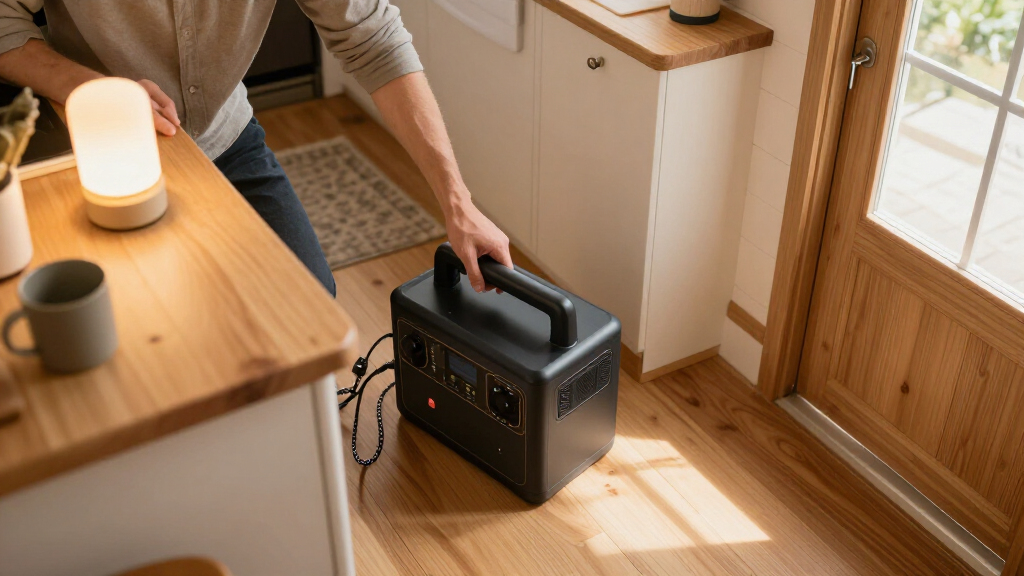
How We Picked
I evaluated each station against what actually matters inside a tiny home: usable capacity versus real appliance loads, inverter size and surge headroom, battery chemistry and cycle life, recharge speed and solar input options, and physical footprint relative to storage-constrained living. A station that can’t run a mini-fridge, a laptop setup, and lighting simultaneously isn’t a tiny home backup — it’s a large power bank — so the sub-100Wh units were ranked strictly as bedside or single-device solutions rather than whole-space units.
Capacity-per-dollar and cycle life heavily favored the LiFePO4 models, which is why the DARAN 288Wh, BLUETTI Elite 30 V2, and 192Wh LiFePO4 units cluster near the top of the mid-range. The Anker SOLIX C1000 Gen 2 ranks first because it’s the only option here built for sustained household loads rather than weekend duty. Budget lithium units like the EnginStar and Flashfish earned value positions on price, with the caveat that their shorter cycle life matters more for daily tiny home use than for occasional camping.
Factors to Consider When Choosing Portable Power Stations For Tiny Homes
Choosing a portable power station for a tiny home involves different math than buying one for camping trips. Your space, your appliances, and how often you’ll cycle the battery all change which specs matter most. These are the factors I’d weigh before spending anything.Match Capacity to Your Real Evening Load, Not the Marketing Number
The most common mistake is buying capacity based on the headline watt-hour figure without doing a load audit. A tiny home evening — mini-fridge cycling, LED lights, laptop, phone charging, and a fan — typically draws 250–400Wh, which means a sub-100Wh station covers maybe two hours of that. Write down the wattage of your five most-used devices and multiply by the hours you’d run them; that number, plus 20% headroom for inverter losses, is your minimum capacity. Remember that a 300Wh station doesn’t deliver 300Wh to your devices — expect around 85% usable after conversion losses. If your audit lands above 400Wh per day, no single unit in this class will carry you, and you’re better off with one larger station than two small ones, since consolidation saves recharge time and floor space.
Surge Rating Decides Whether Your Fridge Starts
Compressor appliances like mini-fridges and small freezers draw two to four times their running wattage for a split second at startup. A fridge that runs at 80W may need 300–400W momentarily, and if the station can’t supply that surge, it shuts down or trips even though its continuous rating looks sufficient on paper. That’s why the DARAN 288Wh’s 1200W surge rating matters more in practice than its 600W continuous number. When comparing stations, always check the surge specification against your single most demanding appliance, not your total load. Induction cooktops, hair dryers, and microwaves are generally out of reach for this entire class — plan a propane or butane alternative for cooking rather than oversizing your power station chasing them.
Chemistry and Cycle Life Matter More When You Cycle Daily
Cycle life ratings are easy to ignore when you’re comparing specs, but they define your real cost per year. A standard lithium-ion unit rated for around 500 cycles, cycled once daily, hits end-of-life in under two years. A LiFePO4 unit rated for 3,000-plus cycles, used identically, can last nearly a decade. In a tiny home where the station may be your nightly buffer against grid outages or generator quiet hours, that difference compounds quickly. LiFePO4 also tolerates being stored at partial charge better, which suits intermittent backup use. The tradeoff is weight and upfront cost — LiFePO4 cells are heavier per watt-hour, so the durable units in this lineup are noticeably chunkier than their lithium-ion counterparts at similar capacity.
Solar Input and Recharge Speed Shape Your Off-Grid Routine
If your tiny home is off-grid or semi-off-grid, how fast the station refills matters as much as how fast it drains. A 100W panel in good sun produces roughly 400–600Wh per day — enough to refill a 200–300Wh station by evening, but only if the station’s input ceiling and MPPT controller let it accept that power efficiently. Check the maximum solar input wattage before buying panels; some budget stations cap input at 60–80W and waste the rest of a larger array. Also compare AC recharge times: a station that takes eight hours to refill from a wall outlet is a chore to rotate into service, while the fast-charging units in this class refill in under two hours. Only one product here bundles a panel, so budget for solar separately if that’s your primary recharge path.
Footprint, Weight, and Placement in a Small Space
In a tiny home, every shelf and closet is contested space, and a power station is a long-term resident, not a guest. Measure where the unit will actually live — under a bed platform, in a cabinet, beside the bed — and compare that against the unit’s dimensions before ordering. Weight matters too: a 30-pound station that needs to move between floors or out to a deck for solar charging becomes a daily annoyance. Heat is the forgotten factor; stations need ventilation clearance, so cramming one into a sealed cabinet shortens battery life and can trip thermal shutdowns during heavy discharge. Look at outlet placement as well, since recessed or crowded ports make it hard to use all outputs simultaneously in a tight spot.
When to Skip This Category Entirely
Honesty is worth more here than enthusiasm: if your tiny home has reliable grid connection and you only want outage insurance for a few lights and phones, a sub-150Wh station is genuinely all you need. But if you’re planning to live off-grid full-time, run a hot plate or space heater, or power a full-size refrigerator, portable power stations in this class are the wrong tool — a fixed battery bank with a dedicated inverter and a proper solar array will cost less per watt-hour and last longer. This category shines for part-time off-grid living, quiet-hours backup, work-from-anywhere setups, and bridging the gap before you invest in permanent infrastructure. Buy the small station now if it solves tonight’s problem, but size your long-term plan honestly rather than chaining together multiple portable units.
Frequently Asked Questions
Can a portable power station actually run a tiny home, or is it just for emergencies?
It depends entirely on your definition of “run.” A 288–300Wh LiFePO4 station like the BLUETTI Elite 30 V2 or DARAN 288Wh can comfortably carry lighting, phone and laptop charging, a fan, and a CPAP through a night, and can run a small mini-fridge for several hours on its own. What none of these units can do is run heating, cooking, or full-size appliances — a space heater alone would drain any station in this lineup in under an hour. Think of these stations as your quiet-hours and small-essentials layer, not a replacement for grid power or a proper off-grid battery bank. The Anker SOLIX C1000 Gen 2 stretches furthest into true backup territory, but even it has limits you should calculate before relying on it.
Is LiFePO4 really worth the extra cost over standard lithium for tiny home use?
For occasional camping, probably not — but for a tiny home, yes, and the reason is duty cycle. If your station sits unused for weeks, lithium-ion’s shorter cycle life barely matters. If it cycles daily as a buffer between solar input and evening use, a 500-cycle lithium battery may need replacing within two years, while a 3,000-cycle LiFePO4 unit could outlast your tenure in the home. LiFePO4 also holds up better when stored at partial charge and handles heat more gracefully, both of which describe real tiny home conditions. The counterargument is weight and price: LiFePO4 units cost noticeably more per watt-hour in this class. If your budget forces a choice between a bigger lithium unit and a smaller LiFePO4 unit, my advice is to buy the LiFePO4 — capacity you can’t use because the battery died is worthless capacity.
What size station do I need just for overnight backup of essentials?
For a realistic overnight essentials list — LED lights, phone charging, a laptop, a fan, and a CPAP machine — you’re looking at roughly 120–200Wh of actual consumption. That means a 150–200Wh station covers one night with modest headroom, and a 288–300Wh unit covers two nights or one night plus a mini-fridge. The sub-100Wh units in this roundup handle only the lightest version of that list; they’ll run lights and charge devices all night but adding a CPAP with a humidifier pushes them to their limit. Do the math on your CPAP specifically if you use one, since heated humidification can double its draw. And remember to test your setup before you need it — discovering your station won’t start the fridge during an actual outage is a bad time to learn about surge ratings.
Should I buy one bigger station or two smaller ones for my tiny home?
One bigger station is almost always the better call for a tiny home, for three reasons. First, a single larger battery is more efficient — you lose conversion overhead twice when splitting loads across two units. Second, larger stations typically have higher solar input ceilings and faster AC charging, so your recharge cycle is simpler. Third, floor and shelf space is your scarcest resource, and two stations with two chargers and two cable sets create clutter that a single unit doesn’t. Where two stations make sense: if you genuinely need power in two physically separated spots, like a loft and a ground-floor workspace, or if you want a redundant backup for a medical device. Otherwise, consolidate — the money you’d spend on a second small station is better saved toward a single unit with LiFePO4 chemistry.
Do I need to buy a solar panel, and what size makes sense for these stations?
If your tiny home has grid power, skip solar initially and treat the station as an outage buffer — recharging from the wall is faster and cheaper. If you’re off-grid or want generator-free recharging, a 100–200W panel is the practical sweet spot for the 200–300Wh stations in this lineup, refilling them in a good day of sun. Before buying, check your station’s maximum solar input wattage, because several budget models here cap input well below 100W and simply can’t absorb more panel capacity. Also verify the connector type and whether the station has a built-in MPPT controller — some cheap units use basic PWM regulation that wastes a meaningful share of your panel’s output. Only one product in this roundup bundles a panel, so treat solar as a separate line item in your budget, and prioritize a panel quality that matches your battery investment.
Conclusion
Mapping these picks to buyer types: if you want the best overall portable power station for a tiny home, the Anker SOLIX C1000 Gen 2 is the only unit here with the capacity and inverter headroom to back up multiple appliances at once, and it justifies its premium price if nightly or emergency household use is the goal. For the best premium mid-size option, the BLUETTI Elite 30 V2 pairs LiFePO4 longevity with a genuine 600W output in a footprint that fits a tiny home shelf. For best value, the DARAN 288Wh and DaranEner 192Wh deliver durable LiFePO4 chemistry and strong surge ratings at accessible prices — the DARAN in particular if fridge-starting matters to you. For beginners or anyone wanting a plug-and-play start, the ZeroKor with bundled 40W solar panel removes the guesswork of matching panels to a station, and its small size makes mistakes cheap. And for specific needs — a bedside or CPAP-only backup — the SinKeu 122.8Wh or Flashfish 200W cover single-room duty without wasting money on capacity you won’t use. Whatever you choose, run the load math first: the right station is the one sized to your actual evenings, not the biggest number on a spec sheet.
Fall Picks
fall essentials
As an affiliate, we earn on qualifying purchases.