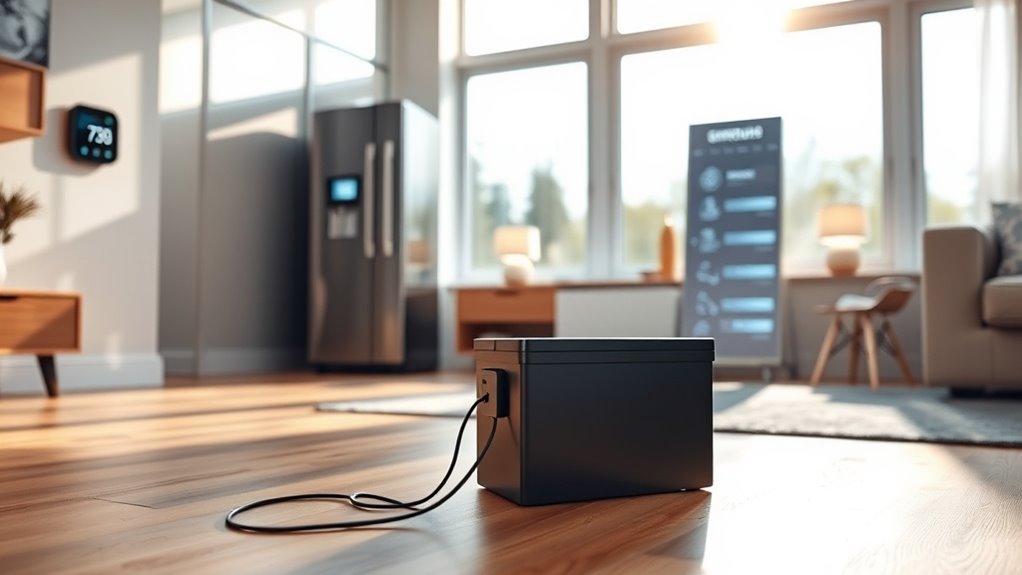

A 1-kWh battery in your home can provide power for essential devices during outages or peak times, but exactly what it can run depends on your energy needs. You might wonder how long it can keep your lights on or your fridge cold, and what factors influence its effectiveness. Understanding its capabilities helps you make smarter decisions about energy use and backup plans—something worth exploring if you’re aiming for greater energy independence.
Key Takeaways
- Powers small, essential household devices like LED lights, Wi-Fi routers, and a refrigerator for several hours.
- Can support critical loads during power outages, ensuring basic home functions remain operational.
- Duration depends on the total household energy consumption and the efficiency of connected appliances.
- Ideal for low-power appliances, extending battery runtime and maximizing energy savings.
- Supplemented by energy-efficient devices, a 1‑kWh battery enhances home energy independence and reduces grid reliance.

Ever wonder how a 1-kWh battery can impact your home energy use? At first glance, it might seem small, but it can serve as a surprisingly effective energy buffer, especially if you’ve invested in solar panel efficiency. When your solar system produces more power than you immediately need, a 1-kWh battery allows you to store that excess instead of wasting it. Later, during cloudy days or at night, you can draw from the battery, reducing your reliance on the grid and maximizing your solar investment. This setup makes your entire home more energy-independent and cost-effective. Understanding what a 1-kWh battery can actually power helps clarify its real-world benefits. For example, a typical household’s essential devices—such as LED lighting, a refrigerator, Wi-Fi, and a few small appliances—can be powered by this battery capacity for several hours. If your home has energy-efficient appliances, the battery might even cover critical loads during outages or peak demand times. Keep in mind, though, that the actual duration depends on your energy consumption habits. If you’re running high-wattage devices, the battery will drain faster. Conversely, if your home mostly runs on low-power devices, you can extend its usefulness substantially. Battery longevity is an essential factor to weigh. A well-maintained 1-kWh battery can last for many years, especially if you choose a model designed for longer cycle life. Proper care and avoiding deep discharges prolong the battery’s lifespan, ensuring you get the most value over time. Additionally, the longevity of your battery is influenced by how your system manages charge cycles and temperature conditions. Regularly monitoring and maintaining your battery helps prevent premature wear, so it continues to serve your home reliably. When paired with high solar panel efficiency, a durable battery can maximize your energy savings over the years, making your investment more worthwhile. Maximizing the battery’s lifespan by understanding how to properly care for and maintain it can significantly improve its performance and longevity. While a 1-kWh battery isn’t meant to power an entire home for extended periods, it’s a fundamental component of a resilient, renewable energy system. It complements your solar panels by storing excess energy for later use, smoothing out power supply during less sunny days, and providing backup during outages. Over time, the combination of efficient solar panels and a long-lasting battery can markedly reduce your reliance on traditional energy sources, lowering your bills and your carbon footprint. So, even with a modest capacity, your 1-kWh battery plays a key role in creating a more sustainable, self-sufficient home.
Conclusion
A 1-kWh battery can keep your essential devices running during outages or help you cut back on grid use. With efficient appliances and proper maintenance, it becomes a reliable backup and energy saver. Think about how much peace of mind it offers knowing your basics are covered. Isn’t it worth investing in a small battery that boosts your energy independence and sustainability? After all, every bit of extra control counts in today’s energy-conscious world.