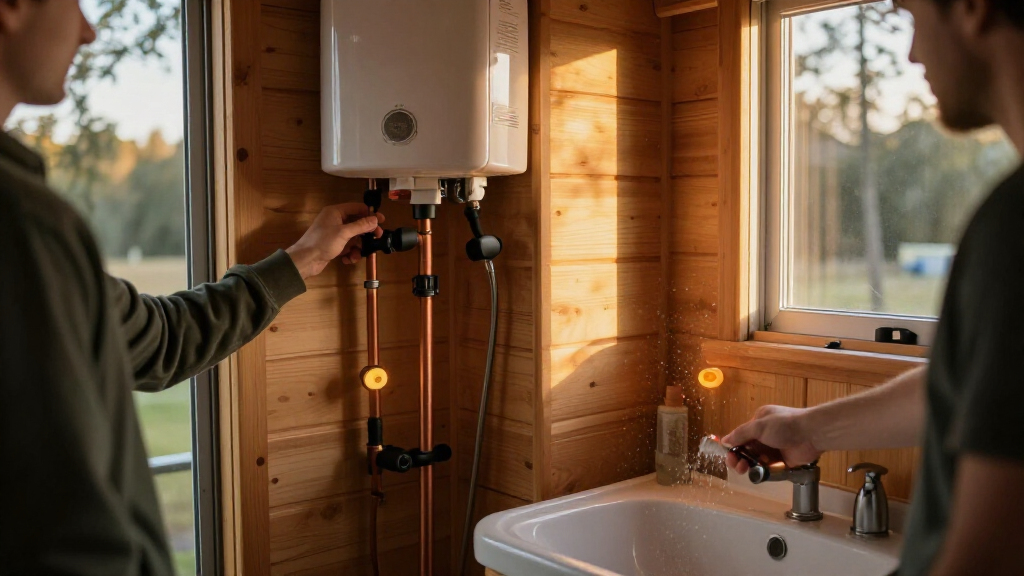

For most tiny houses with natural gas service and room for professional installation, I’d start with the GASLAND Gasmart E, which combines a high stated flow rate with a wall-mounted indoor design. The Rheem RTEX-18 is a more straightforward electric option, while the GASLAND CG360LP suits compact homes set up for propane. The main tradeoff is between the higher flow potential of gas models and the electrical capacity, wiring, and climate limits that shape electric choices. Small 110V units require far less power but are not equivalent to whole-home heaters. Read on for how all nine options compare and which fits your tiny house setup.

Get compact home essentials delivered free with Prime
- Fast, free delivery on millions of items
- Prime Video, Amazon Music and more included
- Member-only deals all year
Key Takeaways
- Fuel and utility access separate the shortlist: the GASLAND Gasmart E and ThermoMate CZ750NG are natural-gas picks, while the CG360LP and Camplux outdoor unit run on propane; electric models depend on a capable 240V supply, except the much lower-output 110V unit.
- High stated flow does not settle the choice: the 7.6 GPM Gasmart E and up-to-8 GPM ThermoMate are the strongest candidates on paper for multiple fixtures, but climate, inlet-water temperature, and installation conditions affect delivered hot-water flow.
- The 18 kW electric models occupy a different lane from gas: Rheem and APUS can fit homes avoiding combustion appliances, but their electrical demand and cold-water performance need to match the home’s service and use pattern.
- Adjustable power adds flexibility but not free capacity: Mount Steel’s 19–27 kW range can suit a prepared electrical system, yet selecting its higher setting calls for careful circuit and service planning.
- The 110V 3,500W unit is a limited-use choice: its lower electrical demand can suit a point-of-use sink or a modest hot-water task, but it should not be treated as a like-for-like substitute for the higher-output whole-home models.


| tiny house tankless water heater | Dimensions | Maximum flow rate | Voltage | Maximum temperature |
|---|---|---|---|---|
| GASLAND Gasmart E 199,000 BTU | 14.25 × 24.69 × 7.28 in (W × H × D) | 7.6 GPM | — | 140°F |
| Westinghouse 14 kW Electric Ta | 12.59 × 9.56 × 3.28 in (H × W × D) | 3.4 GPM under stated test conditions | 240 V | 140°F |
| Rheem RTEX-18 18 kW 240 V Tank | 14.5 × 18.25 in (W × H) | Up to 4.4 GPM | 240 V | 140°F |
| ThermoMate CZ750NG Natural Gas | 21 × 13 × 7 in (H × W × D) | Up to 8 GPM at a 33°F temperature rise | — | — |
| GASLAND CG360LP Compact Indoor | — | 4.0 GPM | — | — |
| Mount Steel Electric Tankless | 12.2 in W × 18.5 in H × 3.3 in D | — | 240 V | — |
| APUS 18 kW Electric Tankless W | 11.42 × 13.7 × 3.54 in | 4.4 GPM | 240 V | — |
| 110V 3500W Electric Tankless W | 9.13 in W × 7.59 in H | — | 110 V | 131°F |
| Camplux Outdoor Propane Tankle | — | — | 3 V | 167°F |
More Details on Our Top Picks
GASLAND Gasmart E 199,000 BTU Natural Gas Tankless Water Heater, 7.6 GPM, Indoor Wall-Mount
For a tiny home connected to natural gas, the GASLAND Gasmart E offers a high stated output without taking up floor space: its 199,000 BTU burner and up-to-7.6 GPM rating suit households that want more than one hot-water draw. The wall-mounted cabinet is only 7.28 inches deep, a practical advantage where utility space is scarce. Compared with the GASLAND CG360LP, it has much more stated capacity, but it needs natural gas and an indoor installation rather than propane. Freeze, dry-combustion, and flame-failure protections add useful safeguards, though they do not replace proper installation. The 140°F maximum may not suit every high-temperature use, and the manufacturer’s efficiency and energy-saving claims are not independently verified. Check local gas and venting requirements before choosing it.
Pros:- Up to 7.6 GPM and 199,000 BTU provide substantial stated capacity for a compact home.
- Wall-mounted body keeps the floor clear and is 7.28 inches deep.
- Includes freeze, dry-combustion, flame-failure, and high-water-pressure protections.
- CSA certification is listed in the product data.
Cons:- Requires a natural-gas supply and indoor installation.
- The 140°F maximum temperature may limit some applications.
- Efficiency and energy-use comparisons are manufacturer claims, not independently verified here.
Best for: Tiny-house owners with an existing natural-gas connection who want strong hot-water capacity for multiple draws.
Not ideal for: Off-grid builders using propane, or owners who cannot accommodate indoor gas venting and installation requirements.
- Fuel:Natural gas
- Heat output:199,000 BTU
- Maximum flow rate:7.6 GPM
- Maximum temperature:140°F
- Dimensions:14.25 × 24.69 × 7.28 in (W × H × D)
- Weight:37.5 lb
- Mounting:Wall-mounted
- Certification:CSA
- Manufacturer-stated UEF:0.8
Our verdict“Choose this GASLAND if your tiny house has natural gas and you value higher stated flow over fuel flexibility.”
Westinghouse 14 kW Electric Tankless Water Heater with Wi-Fi, 240 V, Gray
The Westinghouse 14 kW is the smart-control choice for a tiny house already equipped for a substantial 240V load. Its Wi-Fi and voice-control compatibility with Alexa and Google Home make temperature adjustments convenient, while temperature memory restores the previous setting after a power outage. At up to 3.4 GPM under stated test conditions, it is better matched to one shower or modest, carefully timed use than to several simultaneous hot-water demands. The Rheem RTEX-18 offers higher listed power and flow, making it a stronger candidate when capacity matters more than connected controls. This Westinghouse is shallow and compact, but the required dedicated 60A double-pole breaker and 6 AWG wiring can be a significant electrical project in a small home. Flow also varies with incoming water temperature.
Pros:- Wi-Fi control and compatibility with Alexa and Google Home.
- Temperature memory restores the prior setting after a power interruption.
- Compact, shallow wall-mounted design.
- ETL certification and listed safety protections.
Cons:- Requires a dedicated 60A double-pole breaker and 6 AWG wiring.
- The 3.4 GPM maximum is lower than the listed flow of the Rheem RTEX-18.
- Flow depends on inlet and outlet water temperatures, and the filter and rotor need periodic cleaning.
Best for: Tiny-house owners with a suitable 240V electrical system who want app or voice control for a single-shower setup.
Not ideal for: Builders with limited electrical service, or households expecting dependable simultaneous shower and sink use.
- Power:14 kW
- Voltage:240 V
- Maximum flow rate:3.4 GPM under stated test conditions
- Minimum startup flow:0.53 GPM
- Electrical requirements:Dedicated 60A double-pole breaker and 6 AWG wire
- Dimensions:12.59 × 9.56 × 3.28 in (H × W × D)
- Maximum temperature:140°F
- Certification:ETL
- Smart-home compatibility:Alexa and Google Home
Our verdict“Pick the Westinghouse for smart controls and compact electric installation only if your service can support its dedicated circuit.”
Rheem RTEX-18 18 kW 240 V Tankless Electric Water Heater
The Rheem RTEX-18 is a compact electric option for tiny homes where a gas supply or vent route is unavailable and the electrical service can handle an 18 kW appliance. Its listed up-to-4.4 GPM flow and self-modulating power make it a more capacity-focused electric choice than the Westinghouse 14 kW, whose listed maximum is 3.4 GPM. The actual flow available for a comfortable shower depends on incoming water temperature, so a cold-climate installation may deliver less than the headline figure suggests. A digital display with ±1-degree control helps make temperature adjustments precise, while the field-serviceable copper heating elements may simplify repairs. It takes no venting and weighs 14.8 pounds, but that does not eliminate the need to confirm wiring and service capacity before installation.
Pros:- Listed flow of up to 4.4 GPM exceeds the Westinghouse 14 kW model’s stated maximum.
- Self-modulating power adjusts output to hot-water demand.
- Digital LED display offers temperature control with ±1-degree accuracy.
- Compact wall installation requires no venting, and heating elements are field-serviceable.
Cons:- Whole-home performance depends on incoming water temperature and available electrical service.
- The listed flow may not support simultaneous hot-water use in a small household.
- The product data does not specify the required breaker or wire size.
Best for: Tiny-house owners seeking an indoor, vent-free electric heater for one shower or limited hot-water use, with adequate 240V service.
Not ideal for: Households that need multiple hot-water fixtures at once or have limited electrical capacity, especially in locations with very cold incoming water.
- Power:18 kW
- Voltage:240 V
- Maximum flow rate:Up to 4.4 GPM
- Efficiency:99.8%
- Maximum temperature:140°F
- Dimensions:14.5 × 18.25 in (W × H)
- Weight:14.8 lb
- Water connections:Bottom 3/4-in NPT
- Temperature control:Digital LED display; ±1-degree accuracy
Our verdict“Choose the Rheem for a vent-free electric tiny-house setup centered on one shower, provided your electrical system can support 18 kW.”
ThermoMate CZ750NG Natural Gas Tankless Water Heater, Up to 8 GPM
Among these options, the ThermoMate CZ750NG makes the clearest case for a tiny house with several occupants and multiple hot-water draws: it is rated for up to 8 GPM at a 33°F temperature rise and is described as serving three to five fixtures. That stated capacity is slightly above the GASLAND Gasmart E’s 7.6 GPM, with a listed 98% maximum thermal efficiency and ±1°F temperature stability. Those figures depend on conditions; the 8 GPM headline should not be read as guaranteed flow at every inlet temperature. Its indoor wall-mounted format saves floor area, but the natural-gas supply and 3-inch-OD vent requirement make it a less flexible fit than electric models such as the Rheem RTEX-18. Freeze protection and eight listed safety features add reassurance, not a substitute for proper installation.
Pros:- Up to 8 GPM at a stated 33°F temperature rise, with three-to-five-fixture use described.
- Listed temperature stability of ±1°F.
- Wall-mounted design conserves floor space.
- Freeze protection and eight listed safety features.
Cons:- Requires natural gas and indoor venting through a listed 3-inch-OD vent.
- Maximum flow depends on temperature rise and water demand.
- The stated multiple-fixture capacity may not reflect performance in colder incoming-water conditions.
Best for: Tiny-house households with natural gas, more than one regular hot-water draw, and room for indoor venting.
Not ideal for: Off-grid propane users, electric-only homes, or very small layouts where indoor venting is impractical.
- Fuel:Natural gas
- Heat output:199,000 BTU
- Maximum flow rate:Up to 8 GPM at a 33°F temperature rise
- Simultaneous fixtures:Designed for 3–5 fixtures
- Thermal efficiency:Up to 98%
- UEF:0.81
- Temperature stability:±1°F
- Dimensions:21 × 13 × 7 in (H × W × D)
- Vent size:3-in OD
Our verdict“Choose the ThermoMate when multiple fixtures matter and your tiny house has natural gas and a suitable vent route.”
GASLAND CG360LP Compact Indoor Propane Tankless Water Heater, 4 GPM, 98,500 BTU, Black
The GASLAND CG360LP is the propane-focused choice for a small home without natural gas, and its stated 4.0 GPM sits between point-of-use needs and the higher-capacity gas models. Compared with the natural-gas GASLAND Gasmart E, this unit offers fuel flexibility for propane users but substantially less listed flow and heat output. Its wall-mount format and slim stated depth help save space, while the claimed ±0.5°F temperature control could appeal to owners who want stable adjustments. There is a notable planning problem: the product information gives two conflicting width-and-height measurements, so I would not commit to a tight installation location until the manufacturer confirms the correct dimensions. Claims about quiet operation and simultaneous multi-fixture use also lack supporting detail in the provided data.
Pros:- Propane fuel suits homes without a natural-gas connection.
- Listed 4.0 GPM flow and 98,500 BTU output serve modest hot-water needs.
- Wall-mounted design with a stated depth of 6.38 inches.
- Product data claims temperature control accuracy of ±0.5°F.
Cons:- Lower stated capacity than the 199,000 BTU GASLAND Gasmart E and ThermoMate CZ750NG.
- Conflicting dimensions are listed: 18.5 × 12.2 × 6.38 inches in the description and 15.1 × 9.4 × 6.38 inches in product information.
- Quiet-operation and simultaneous-use claims are not substantiated in the supplied details.
Best for: Propane-equipped tiny-house owners who want an indoor wall-mounted heater for modest hot-water demand and can verify installation dimensions.
Not ideal for: Households needing high simultaneous flow, or builders who must finalize cabinetry and clearances before confirming the unit’s actual dimensions.
- Fuel:Propane
- Model:CG360LPN1
- Maximum heat output:98,500 BTU
- Maximum flow rate:4.0 GPM
- Temperature control accuracy:±0.5°F
- Mounting:Wall mount
- Color:Black
- Description dimensions:18.5 × 12.2 × 6.38 in
- Product-information dimensions:15.1 × 9.4 × 6.38 in
Our verdict“Choose the CG360LP for modest propane-powered hot-water needs, but confirm its dimensions before planning the installation space.”
Mount Steel Electric Tankless Water Heater, Adjustable 19–27 kW, 240 V
The Mount Steel stands out for tiny-house owners who want an electric unit with adjustable power rather than a fixed-output design. Its self-modulating controls are meant to adjust output as demand changes, helping maintain a steadier temperature when a tap is opened. At 12.2 × 18.5 × 3.3 inches, it mounts close to the wall, though its listed height is greater than the compact APUS 18 kW. The main tradeoff is electrical: a 19–27 kW unit can place a substantial load on a small home’s 240 V system. The listing also conflicts, with the title giving 19–27 kW while the style name says 12–18 kW. I’d verify the actual rating and panel requirements before choosing it over the more clearly specified APUS.
Pros:- Adjustable power range is intended to let the unit match household demand
- Self-modulating operation is designed to help stabilize water temperature
- Slim, wall-mounted enclosure saves floor space
- Dry-heating design is intended to reduce mineral buildup and corrosion
Cons:- Requires a compatible 240 V supply and enough electrical panel capacity
- Conflicting listed power ranges make installation planning uncertain
- Dimensions are taller than the APUS 18 kW unit
Best for: Tiny-house owners with a verified 240 V electrical system, sufficient panel capacity, and a preference for adjustable output and wall-mounted installation
Not ideal for: Off-grid or electrically constrained tiny homes, and buyers who need a clearly confirmed power rating before planning installation
- Power:19–27 kW adjustable (listing also states 12–18 kW in style name)
- Voltage:240 V
- Heat output:27 kW
- Listed efficiency:99%
- Dimensions:12.2 in W × 18.5 in H × 3.3 in D
- Mount type:Wall-mounted
- Protection and controls:Self-modulating operation; overheat protection
- Warranty:8 years on heat exchanger; 3 years on parts
Our verdict“Choose the Mount Steel if your electrical system can support it and you confirm its actual rating; otherwise, the APUS listing is more straightforward.”
APUS 18 kW Electric Tankless Water Heater, 240V, Up to 4.4 GPM
For a tiny house with a robust electrical service and more than one regular hot-water draw, the APUS is the clearest electric option in this group. Its listed 18 kW output and up to 4.4 GPM are intended to serve two or three points, while the digital control lets owners set water temperature from 86°F to 131°F. Compared with the Mount Steel, APUS has a more specific power rating and smaller listed dimensions, but it lacks Mount Steel’s adjustable 19–27 kW range. Its compact body does not make installation light-duty: the unit calls for two 40A breakers, paired 8 AWG wiring, and hardwiring. That electrical demand may rule it out in a small or off-grid home, and its two-year warranty is shorter than Mount Steel’s heat-exchanger coverage.
Pros:- Listed capacity targets up to two or three points of use
- Digital temperature setting spans 86°F–131°F
- Compact wall-mounted dimensions and 15.2 lb listed weight
- Self-modulating operation and listed safety protections
Cons:- Requires two 40A breakers and two sets of 8 AWG wire
- Hardwired installation may call for professional electrical work
- Two-year warranty is shorter than Mount Steel’s stated heat-exchanger warranty
Best for: Tiny-house residents with a high-capacity 240 V electrical system who want one electric unit for several nearby fixtures
Not ideal for: Owners with limited panel capacity, off-grid electrical setups, or a preference for a simple plug-in installation
- Wattage:18,000 watts
- Voltage:240 V
- Maximum flow rate:4.4 GPM
- Temperature range:86°F–131°F
- Dimensions:11.42 × 13.7 × 3.54 in
- Weight:15.2 lb
- Electrical requirements:Two 40A breakers; two sets of 8 AWG wire; hardwired
- Warranty:2 years
Our verdict“Pick the APUS for a clearly specified, compact electric unit only if your tiny house can handle its dedicated 240 V circuit requirements.”
110V 3500W Electric Tankless Water Heater with LED Temperature Display
This small 110 V heater fills a narrow but useful role: supplying a single sink without the dedicated 240 V service required by the APUS or Mount Steel. Its 3,500 W output and listed flow of 1.9 liters per minute suit handwashing or light kitchen use, not a shower or simultaneous fixtures. That limited capacity is the key tradeoff for a tiny house: it may simplify a point-of-use setup, but it cannot replace a whole-home heater for most residents. The LED temperature display and protections for low flow, dry combustion, and overheating add useful feedback and safeguards. Compared with the APUS, it draws from a lower-voltage supply but offers a much smaller hot-water flow. Treat the stated five-year warranty as a listing claim to confirm before purchase.
Pros:- 110 V operation may suit a point-of-use installation where 240 V is unavailable
- Compact wall-mounted body fits near a sink
- LED display provides a direct temperature readout
- Includes low-flow, dry-combustion, and overheat protections
Cons:- Listed flow of 1.9 liters per minute is limited to light sink use
- Low 3,500 W output is unsuitable for showers
- Does not match the APUS or Mount Steel as a whole-house electric option
Best for: Tiny-house owners who need supplemental hot water at one kitchen or bathroom sink and have a suitable 110 V circuit
Not ideal for: Anyone seeking a primary whole-house heater, shower supply, or hot water at multiple fixtures
- Wattage:3,500 W
- Voltage:110 V
- Flow rate:1.9 liters per minute
- Maximum temperature:131°F
- Maximum pressure:6 bar
- Dimensions:9.13 in W × 7.59 in H
- Materials:304 stainless steel water pipe, aluminum heating body, ABS housing
- Features:LED display; dry-combustion, low-water-flow, and overheat protection; temperature lock
- Warranty:5 years, as stated in title
Our verdict“Choose this unit only for one sink or another light-duty point of use, not as the main water heater for a tiny house.”
Camplux Outdoor Propane Tankless Water Heater – 4.22 GPM, 16 L, 110,000 BTU
Among these four, the Camplux is the strongest fit for a tiny house that relies on propane and can mount its heater outside. Its 110,000 BTU/h output and 4.22 GPM listed flow offer far more practical shower potential than the 110 V, 3,500 W sink heater, while avoiding the high-capacity electrical demand of the APUS and Mount Steel. Outdoor placement can free indoor space, and the LED display, temperature knob, and listed flame-failure and low-flow protections make operation more legible. The tradeoff is exposure: this unit requires propane and is not for indoor installation. Freeze protection is listed, but the product guidance still calls for draining and warm storage to prevent freeze damage. Its 27 lb weight and 27.56-inch height also need a suitable mounting location.
Pros:- 110,000 BTU/h output and 4.22 GPM flow suit outdoor showers and other substantial draws
- Propane operation avoids the high electrical demand of the APUS and Mount Steel
- LED display and temperature knob provide direct operating controls
- Lists flame-failure, anti-freezing, low-flow, dry-combustion, and overheat protections
Cons:- Outdoor installation only; not suitable for indoor use
- Requires a propane supply
- Must be drained and stored in warm conditions to reduce freeze-damage risk
- Larger and heavier than the electric wall-mounted options in this batch
Best for: Tiny-house owners with a propane supply who need shower-capable hot water and can install the heater outdoors with freeze-safe seasonal care
Not ideal for: Homes without outdoor mounting space or propane, and owners who need an indoor heater or a setup that can remain exposed to freezing conditions
- Fuel source:Liquid propane
- Heat output:110,000 BTU/h
- Flow rate:4.22 GPM
- Capacity:16 L
- Wattage:32 kW
- Voltage:3 V
- Maximum temperature:167°F
- Dimensions and weight:17.32 in W × 27.56 in H; 27 lb
- Safety features:Anti-freezing, dry-combustion, flame-failure, low-water-flow, and overheat protection
Our verdict“Choose the Camplux if propane and outdoor mounting suit your tiny house and you need more than sink-only hot water.”
How We Picked
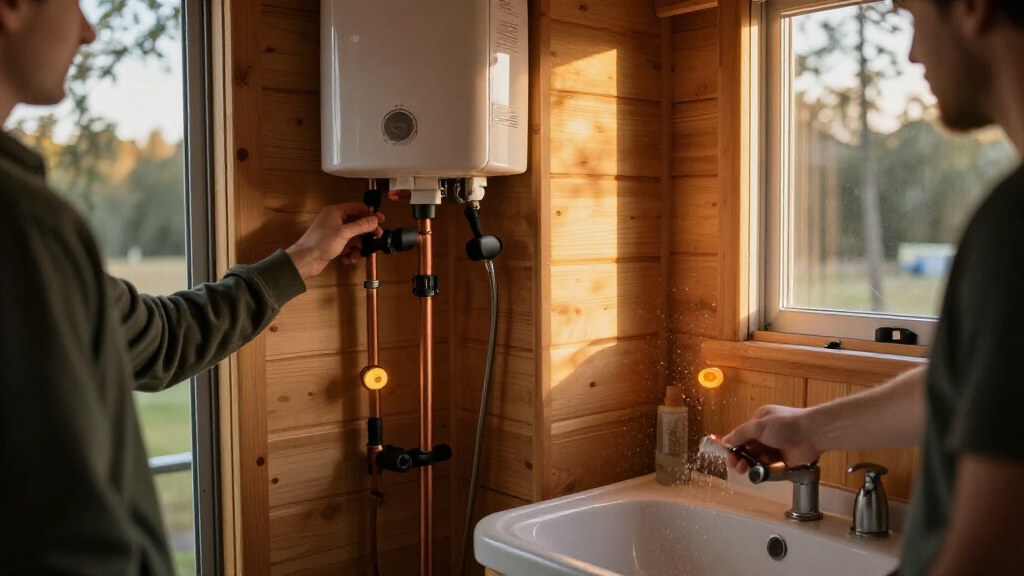
I compared these nine tankless heaters for tiny-house constraints, focusing on fuel availability, stated output, electrical or gas requirements, installation location, and how realistically each could serve a small home. A compact footprint matters, but it does not outweigh whether the home can supply the required power or fuel. I also separated whole-home candidates from products better suited to one fixture, since those uses are easy to confuse when comparing GPM figures.
The ranking favors models with a plausible balance of useful capacity and a clear tiny-house use case, then distinguishes options that make sense only with specific utilities or installation conditions. The GASLAND Gasmart E leads for its high stated flow and indoor wall-mount format when natural gas is available. Electric picks rank according to their power demands and likely fit; propane models earn their place for homes without natural gas, while the 110V unit ranks as a narrow point-of-use option rather than a whole-home contender. Manufacturer flow and power specifications are not guarantees of performance in every climate or installation.
Factors to Consider When Choosing Tiny House Tankless Water Heaters
Before choosing among tiny house tankless water heaters, match the heater to the home’s utilities and actual hot-water routine. A small footprint can hide a large electrical load, venting requirements, or a fuel setup that does not suit a mobile or off-grid home. I’d settle those system questions before comparing convenience features.
Match the heater to the utilities you already have
Start with the home’s actual service: natural gas, propane, or electricity. A natural-gas heater is not a practical bargain if the site has no gas connection, and propane operation brings tank sizing, regulator, and refill logistics into the plan. Electric models may avoid combustion and venting, but higher-output units can demand substantial 240V capacity. Have an electrician confirm available service and circuit needs before treating an electric model as a simple swap. For a mobile tiny house, check whether the intended fuel and electrical setup can be supplied safely at each planned location.
Estimate simultaneous hot-water use, not just fixture count
List what might run at the same time: a shower, kitchen tap, washing machine, or another bathroom fixture. A single resident who staggers use may be well served by less capacity than a household expecting overlapping showers and dishes. Published GPM figures need context because the heater must raise incoming water to the selected temperature; colder inlet water can reduce usable flow. Avoid sizing from a headline GPM alone, and compare the unit’s performance information with your local winter water temperature. If the routine is uncertain, prioritize scheduling flexibility over buying capacity the home cannot supply.
Check electrical service before choosing a high-kilowatt model
Electric tankless heaters draw power while heating, so the home’s panel, service, wiring, and breakers matter as much as the heater’s stated kW. A unit that appears compact can still exceed the capacity of a small cabin or an RV-style electrical setup. Ask a qualified electrician to review the exact model’s installation requirements and the home’s other major loads. Do not assume that a 240V outlet or a nominal service rating proves the system can support the heater at full demand. If the electrical upgrade would be extensive, compare the full installation plan with a gas or propane option instead.
Plan for venting, combustion air, and freeze exposure
Indoor gas models need an installation plan that follows the manufacturer’s venting and combustion-air instructions; a wall mount alone does not make placement flexible. Outdoor propane models avoid placing the heater inside, but weather exposure and freeze protection still need attention. Tiny houses often have short plumbing runs and little spare wall space, so service access and clearances should be mapped before installation. Think through winter shutdowns, power outages, and periods when the home will sit unused. A heater that fits physically may still be a poor fit if safe venting or freeze management is impractical.
Decide whether you need whole-home service or one hot-water point
A point-of-use heater can be useful near a sink when the main goal is reducing wait time or serving a limited task. It is not automatically capable of running a shower and kitchen tap like a larger whole-home unit. Compare the intended flow and temperature rise with the fixture’s real demand, especially if the water supply is cold. For whole-home service, account for every fixture rather than assuming a small floor plan means low peak demand. Choosing the right scope can prevent both an undersized purchase and an unnecessarily demanding installation.
Compare installation and upkeep, not just the heater body
The purchase decision includes the surrounding system: gas piping or propane supply, vent materials, electrical work, water connections, and any required filtration or isolation valves. Hard water can contribute to mineral scale in tankless heat exchangers, so check the manufacturer’s maintenance instructions and whether periodic flushing is manageable in your home. A remote or seasonal tiny house may need a clear winterization routine rather than a set-and-forget assumption. Confirm local code and qualified installation requirements before buying. A model with a lower equipment burden may still cost more in setup if it needs major utility changes.
Frequently Asked Questions
Can an 18 kW electric tankless heater run a tiny house shower?
It may, but the answer depends on the heater’s specified flow at the temperature rise your water supply requires, along with the shower’s flow rate. Cold groundwater can reduce the hot-water flow available compared with milder inlet conditions. The home also needs enough 240V service and correctly sized circuits for the heater. I would check the manufacturer’s performance chart and have an electrician verify the system before choosing the Rheem RTEX-18 or APUS 18 kW for a shower. A small footprint does not remove those capacity requirements.
Is a 110V tankless heater enough for a tiny house?
A 110V, 3,500W unit is better treated as a limited point-of-use heater than as a full-home solution. Its lower power demand can fit a sink or another modest task, but it is a different class of output from the 240V models in this roundup. Check the unit’s flow and temperature-rise specifications against the intended fixture, especially in cold weather. If you expect shower use or multiple fixtures, compare a properly sized whole-home gas, propane, or 240V option instead. Avoid buying based on voltage convenience alone.
Should I choose propane or natural gas for a tiny house?
Choose based on what the site can reliably supply and how the home is used. Natural gas models such as the GASLAND Gasmart E and ThermoMate CZ750NG make sense where a compatible gas connection is available. Propane models can suit homes without natural-gas service, but tank capacity, delivery access, regulator setup, and cold-weather operation become part of the plan. If the tiny house moves between sites, confirm the fuel arrangement and installation rules at each location. Do not assume a gas model can be converted between fuels unless the manufacturer explicitly supports that configuration.
Will a high GPM rating guarantee two hot-water fixtures at once?
No. A stated GPM figure is not a universal promise that the heater can supply that flow at every temperature rise or under every water condition. The colder the incoming water, the more work the heater must do to reach the set temperature, which can reduce usable output. Add together the likely demands of the fixtures you plan to run simultaneously and compare that total with the manufacturer’s performance information. For a tiny house, changing habits—such as avoiding a shower while running another hot-water appliance—can be a more practical solution than oversizing the system.
What should I check before installing an outdoor propane heater?
Confirm that the specific model is approved for the intended outdoor placement and follow its clearance, mounting, and gas-supply instructions. Check local rules, the propane regulator and tank requirements, and whether the site can protect plumbing and the heater from freezing. Outdoor placement can reduce indoor venting needs, but it does not remove weather, service-access, or freeze-management concerns. Plan how the unit will be drained or protected during extended cold periods or seasonal shutdowns. Have a qualified installer review the location and fuel setup before connecting it.
Conclusion
For a tiny house with natural gas, I’d choose the GASLAND Gasmart E as the best overall because its stated 7.6 GPM capacity and indoor wall-mount format make it the strongest broad-use candidate here, subject to correct installation and local conditions. The Rheem RTEX-18 is my best value-style electric pick for buyers whose electrical service can support an 18 kW heater and who want a straightforward electric setup; the Mount Steel 19–27 kW is the premium-style choice for a home prepared for its higher electrical demand. For beginners, I’d favor the APUS 18 kW if an electrician confirms the service and the household’s use is modest, rather than jumping straight to adjustable higher power. Choose the GASLAND CG360LP for compact indoor propane use, the Camplux outdoor unit when outdoor propane installation fits the site, or the 110V heater only for limited point-of-use needs. If natural gas is unavailable but indoor high-flow service is the goal, compare the ThermoMate CZ750NG only where its fuel requirements can be met. The right pick is the one that matches your actual utilities, winter water temperature, and simultaneous fixture use—not simply the largest number on the label.