
A blower-door test is a key step in understanding your home’s airtightness, but the numbers can seem confusing at first. You’ll see results like ACH50, which tell you how many times your home’s air volume exchanges each hour at a specific pressure. Knowing what these figures mean can help you identify leaks and improve your home’s efficiency—but what exactly do those numbers reveal about your house’s performance? Let’s explore how to interpret them and why they matter.
Key Takeaways
- The blower-door test measures how much air leaks from your home, indicated by ACH50, at a standard pressure of 50 Pa.
- A lower ACH50 number means your home is more airtight and energy-efficient; higher numbers indicate more leaks.
- Typical ACH50 benchmarks: below 3 is well-sealed; above 7 suggests significant air leakage.
- The test identifies specific leak sources that can be targeted for sealing and energy savings.
- Results help you understand your home’s energy performance and guide improvements to reduce heating and cooling costs.
Ever wondered how to accurately assess your home’s air tightness? The blower-door test is a powerful tool that helps you understand exactly that. When you start this process, the first thing you’ll notice is the importance of identifying air leakage sources. Air leaks can occur around windows, doors, electrical outlets, plumbing penetrations, and even tiny cracks in walls or ceilings. These leaks not only make your home less energy-efficient but also compromise indoor air quality and comfort. By pinpointing these air leakage sources, you can target your sealing efforts more effectively, saving money on heating and cooling costs in the long run.
Identifying air leaks around windows, doors, and outlets improves energy efficiency and indoor comfort.
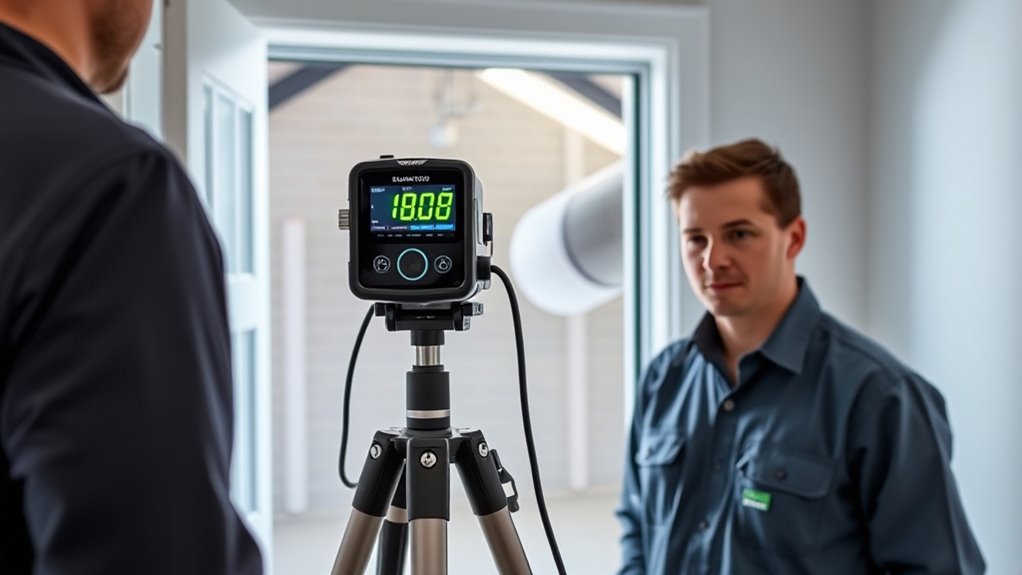
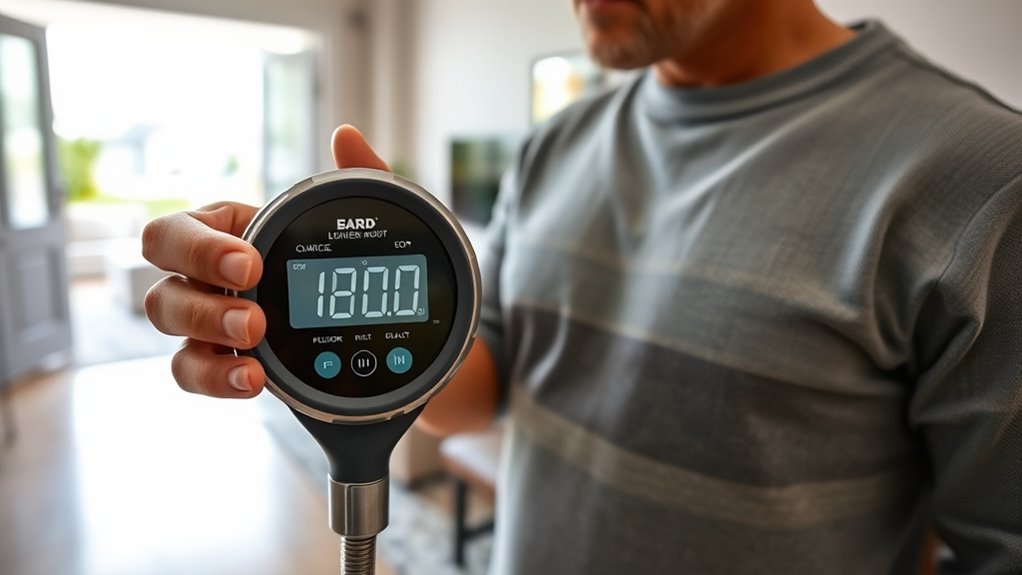
The testing procedures involved in a blower-door test are straightforward but require careful execution. A specialized fan, mounted in an exterior doorway, is used to either pressurize or depressurize your home. When the fan runs, it creates a pressure difference between inside and outside, which causes air to leak through any gaps or cracks. During the test, you’ll monitor the pressure readings on a manometer, which provides real-time data about your home’s airtightness. The goal is to measure the airflow needed to maintain a specific pressure difference, usually 50 Pascals. This measurement, often expressed as ACH50 (air changes per hour at 50 Pascals), gives you a quantifiable number that reflects your home’s airtightness.
Understanding what these numbers mean is essential. A lower ACH50 indicates a tighter home, while a higher ACH50 suggests more significant air leaks. For example, a well-sealed home might have an ACH50 below 3, meaning it gets very few air changes per hour at the standard pressure. Conversely, a home with an ACH50 above 7 could be losing a lot of conditioned air, leading to higher energy bills. These numbers help you assess whether your home meets recommended standards or if additional sealing is necessary. They also serve as benchmarks to track your progress after sealing efforts or upgrades.
In essence, the blower-door test provides a clear snapshot of your home’s air tightness, highlighting air leakage sources that may otherwise go unnoticed. By following the testing procedures correctly, you gain valuable insights into where your home is losing energy and how best to improve it. The numbers you get aren’t just data points—they’re actionable information that guides your sealing project and helps create a more comfortable, energy-efficient living environment. Understanding these results empowers you to make informed decisions, ensuring your home stays cozy and cost-effective year-round. Additionally, knowing the market value of your home’s energy efficiency can motivate targeted improvements.
Top picks for "blower door test"
Open Amazon search results for this keyword.
As an affiliate, we earn on qualifying purchases.
Conclusion
Understanding your blower-door test results is key to improving your home’s energy efficiency. Did you know that the average new home scores around 3 ACH50, while older homes can range much higher? By sealing leaks and reducing ACH50, you could save up to 20% on energy bills. So, use those numbers as a guide—tightening your home not only boosts comfort but also cuts costs and environmental impact. Start sealing today for a more efficient, cozy home.