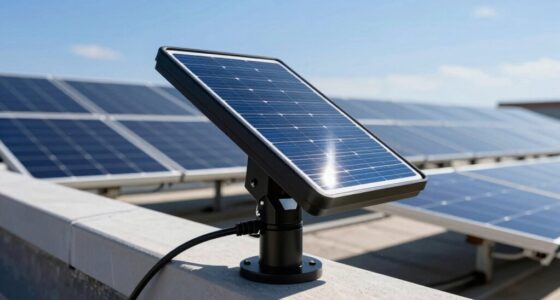
When choosing a mounting system for high wind areas, you need to contemplate how each option performs under extreme conditions. Ground mounts are often more stable due to their direct soil anchoring, but some roof mounts with reinforced brackets can also hold up well if installed properly. Understanding the strengths and limitations of each system can help you make an informed decision—yet, knowing which truly survives the storm requires a closer look.
Get ready for Prime Big Deal Days — try Prime free
Exclusive member deals on October 6–7, plus fast free delivery. Cancel anytime.
As an affiliate, we earn on qualifying purchases.
Key Takeaways
- Ground mounts offer greater stability in high winds due to deep soil anchoring and fixed foundations.
- Properly engineered roof mounts with wind-resistant hardware can perform comparably to ground systems.
- Installation complexity and quality significantly impact the wind resistance of both mounting options.
- Ground mounts typically provide better performance in extreme weather because of their inherent stability.
- Design considerations, including wind ratings and secure attachment, are essential for both systems’ durability during storms.

Are you trying to determine the best mounting system for your project? When it comes to choosing between a ground mount and a roof mount, especially in areas prone to high winds, your decision can considerably impact the durability and safety of your installation. Both options have their advantages, but understanding how they perform under extreme conditions is key. Ground mounts are typically more stable because they are anchored directly into the earth, often with deep pilings or concrete foundations. This added stability makes them less likely to shift or become damaged when wind speeds pick up. They also allow for easier maintenance and adjustments since you can work on them at ground level without needing to climb onto a roof. However, ground mounts require more space and can be more complex and costly to install, especially if your land has rocky or uneven soil.
On the other hand, roof mounts are designed to attach directly to the structure of your building, making them a more space-efficient choice. They are often quicker to install and can be cost-effective, especially if you already have a suitable roof. But when high winds hit, roof mounts can be vulnerable if not properly designed and secured. A poorly installed or weak mounting system can lead to panels lifting or even detaching from the roof. To withstand high winds, roof mounts need to be engineered with reinforced brackets and wind-resistant features. They should also be installed at ideal angles to reduce wind uplift forces. If your building is located in a hurricane-prone or storm-heavy region, you’ll want to ensure your roof mount system is rated for such conditions. Additionally, proper installation practices are crucial to maximize their wind resistance and overall performance.
In high wind zones, the choice often boils down to how well each system is designed and installed. Ground mounts tend to perform better in these conditions because of their inherent stability, provided they are anchored properly. Roof mounts, however, can be equally resilient if they’re specifically engineered for wind loads and installed by experienced professionals. Ultimately, the decision should consider your location, available space, budget, and long-term maintenance needs. Both ground and roof mounts can survive high winds, but only when they’re correctly designed and securely installed. Evaluating these factors carefully will help you select a mounting system that keeps your project safe and secure during severe weather events.
high wind resistant solar panel mounting system
As an affiliate, we earn on qualifying purchases.
As an affiliate, we earn on qualifying purchases.
Conclusion
While ground mounts generally outperform roof systems in high winds, don’t dismiss well-engineered roof mounts entirely—advanced designs with reinforced brackets can still offer excellent resilience. However, for long-term safety in severe weather zones, opting for ground-mounted systems with proper soil anchoring remains the smarter choice. Investing in robust, wind-rated components ensures your installation withstands the fiercest storms, proving that quality engineering truly makes a difference—regardless of the mounting type you choose.
Fall Picks
fall essentials
As an affiliate, we earn on qualifying purchases.