TL;DR

Get compact home essentials delivered free with Prime
- Fast, free delivery on millions of items
- Prime Video, Amazon Music and more included
- Member-only deals all year
A Livingetc report, drawing on the Japanese retailer and craft business Nakagawa, describes four Japanese table-setting habits that can be adapted for autumn hosting. They include combining individual settings with shared dishes, choosing some tableware for the person using it, matching vessels to food, and changing dishes with the season.
Livingetc has outlined four Japanese tablescaping habits that Western hosts can adapt for autumn meals, including serving shared dishes alongside individual place settings and swapping tableware for seasonal colors. The report draws on practices associated with Nakagawa, a Nara craft maker and retailer founded in 1716, and frames the ideas as ways to make a table feel personal and seasonally attuned.
The first suggestion is to combine individual settings with shared dishes. The report describes an oshiki, a flat personal tray holding items such as a rice bowl, soup bowl and small plate, while larger dishes sit in the middle of the table for everyone to share. It calls each person’s place meimei no ba. The approach mixes a composed setting at each seat with the ease of family-style serving.
A second habit is to choose some tableware for the person using it rather than buying only matching sets. The report says family members may have their own rice bowls and chopsticks, selected for hand size and preferred grip. It also recommends collecting small plates, or mame-zara, individually; these can be mixed or matched.
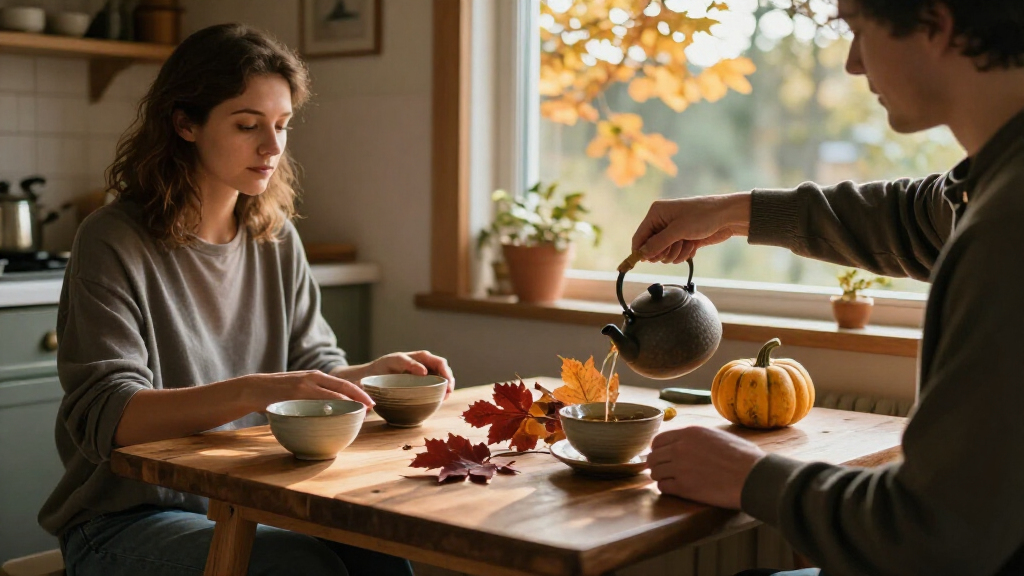
The third lesson treats the vessel as part of the meal. The article attributes the phrase “the vessel is the kimono of the food” to an association with potter Kitaōji Rosanjin, who opened a Tokyo restaurant in 1925 and made vessels for its food. Its final suggestion is seasonal: for autumn, replace summer glass and white porcelain with warm clay and persimmon or rust glazes, then add a modest seasonal detail, such as a chrysanthemum-shaped chopstick rest.
Small Changes Shape Autumn Meals
The suggestions offer hosts a way to make a meal feel considered without changing the whole dining room or buying a coordinated set. A mix of personal dishes and shared serving plates can support both individual comfort and conversation around the table. Choosing bowls that feel right in the hand also makes the setting more specific to the people eating there.
The seasonal advice is similarly restrained: the report recommends changing the plates and bowls, not the entire table, and adding just one small seasonal object. That makes the ideas relevant to readers looking for a practical approach to autumn hosting rather than a full redesign. These are design recommendations, not evidence that any particular arrangement will make guests feel more comfortable.
Products Worth Considering

Dreame H15 Pro Wet-Dry Vacuum and Mop

Philips Hue Large Smart Light Tube, Black – White and Color Ambiance LED Color-Changing Light – 1 Pack

Dyson Purifier Hot+Cool HP1
As an affiliate, we earn on qualifying purchases.
The Four Habits in Practice
The report presents the ideas as habits from autumn tablescapes in Japanese homes that can be transferred to Western dining. It contrasts the described setup—individual tableware plus dishes in the center—with a Western meal organized entirely around either plated courses or family-style service. The proposed blend keeps both formats in use.
For vessels, the article places attention on more than appearance: it points to the weight and warmth of a bowl, the space left around food on a plate, and the variety of forms made in different pottery regions. For seasonal styling, it describes changing materials and colors as part of a wider practice of recognizing the calendar. It recommends welcoming the next season slightly early, rather than waiting for its formal arrival.
“A Japanese table is laid as two things at once. A private setting in front of each person, and shared dishes in the middle for everyone to take from.”
— Livingetc report
Advice, Not a Universal Rule
The source presents these ideas as design guidance, not as a survey of Japanese households or a formal set of rules followed by everyone. It does not establish how common each practice is across Japan, nor does it provide research comparing guest experiences under different table settings. The claim that these habits transfer readily to Western homes is the report’s framing.
The source also provides no publication date, reader data or independent evaluation of the recommendations. Its examples refer to particular vessels and seasonal colors, but the article does not say that hosts need to purchase specific products to follow the approach.
Adapt the Ideas to Your Table
The report does not announce a future event or follow-up. For readers applying the advice, its suggested next step is to begin with what they already own: set a personal place for each guest, put shareable dishes within reach, and choose bowls or small plates that suit the meal. A single autumn-colored vessel or seasonal accent can complete the setting without replacing the rest of the tableware.
Whether hosts adopt one habit or all four is a matter of preference. The source’s practical emphasis is on small, deliberate choices—including the feel of a bowl, the format of serving and the timing of seasonal details—rather than a requirement to recreate a traditional Japanese table in full.
Key Questions
What are the four Japanese tablescaping lessons?
The report recommends combining individual place settings with shared dishes, choosing some tableware for the person using it, treating vessels as part of the meal, and changing plates and bowls with the season.
What is an oshiki?
In the report, an oshiki is a flat personal tray that can hold a rice bowl, soup bowl and small plate at an individual’s place.
What does mame-zara mean?
Mame-zara are small plates, described in the report as roughly saucer-sized. The article suggests collecting them individually and using them in a matched or mixed arrangement.
How does the report suggest making a table feel autumnal?
It suggests replacing summer glass and white porcelain with warm clay and glazes in persimmon and rust tones, then adding one small seasonal detail, such as a floral chopstick rest.
Source: livingetc.com