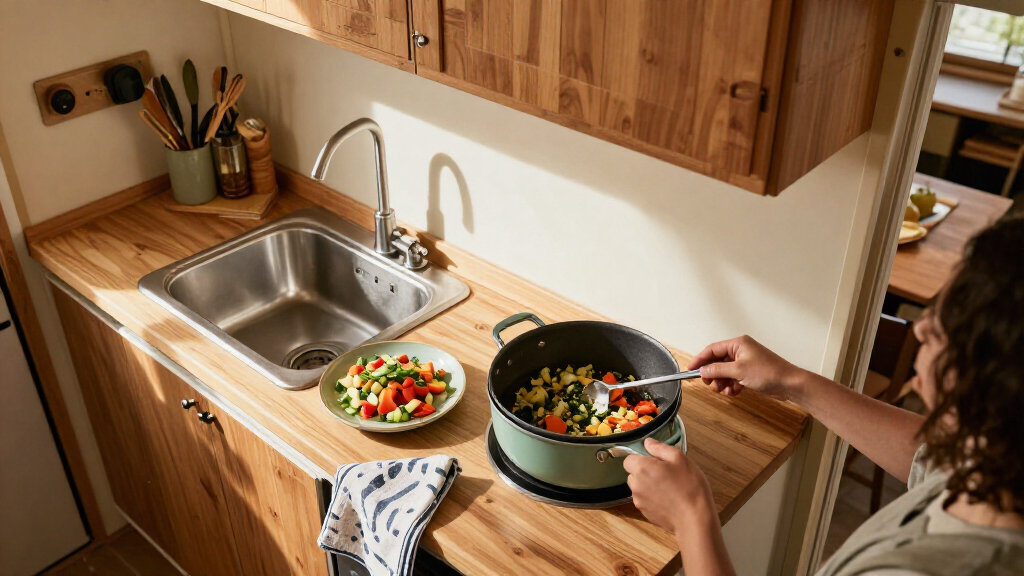

In a tiny kitchen, a cookware set has to earn its shelf space. The choice is often between a nesting set, whose pots and pans stack into a compact bundle, and a modular set, assembled from compatible pieces that may share removable handles or be bought separately. Both can reduce clutter, but they solve different problems: nesting prioritizes storage efficiency, while modular cookware prioritizes control over which pieces you own.

Get compact home essentials delivered free with Prime
- Fast, free delivery on millions of items
- Prime Video, Amazon Music and more included
- Member-only deals all year

Redchef 5-Piece Ceramic Cookware Set with Detachable Handle
- ✔ Pieces: 5
- ✔ Cookware: 2.5-quart saucepan; 8-inch and 10-inch frying pans
- ✔ Lid: 8-inch glass lid with silicone rim

Coicur 8-Piece Ceramic Nonstick Cookware Set with Detachable Handle, Cream White
- ✔ Pieces: 8
- ✔ Cookware: 8-inch and 10-inch frying pans; 2-quart saucepan
- ✔ Included accessories: Glass lid, fridge lid, silicone turner, soup ladle, detachable handle

M MELENTA 7-Piece Teal Ceramic Nonstick Cookware Set
- ✔ Pieces: 7
- ✔ Cookware: 8-inch frying pan; 1.5-quart saucepan; 3-quart casserole
- ✔ Lids: Glass lids for saucepan and casserole
That distinction matters when cabinets are shallow, drawers are crowded, or several pans compete for one burner. Nesting sets are usually the stronger pick for renters, small households, and cooks who need a usable range of cookware in one tidy stack. Modular sets are more appealing if you already own some cookware, want to add pieces gradually, or value using the same pan from stovetop to oven and table. The right choice depends less on the word “compact” on the box and more on how you cook, clean, and store every day.
At a Glance
| Criteria | Nesting cookware sets | Modular cookware sets | Winner |
|---|---|---|---|
| Cabinet footprint | Typically stacks into one compact group; exact space savings vary by shape and included lids. | Can save space when compatible pieces stack or share removable handles; individual lids may still take room. | A |
| Piece selection | Usually sold as a preset bundle, so some pieces may go unused. | High flexibility: buy only the compatible pots, pans, and accessories you need. | B |
| Everyday cooking range | Convenient starter assortment, though the set may omit a specialty size you want. | Can be tailored to a particular menu or expanded over time. | Depends |
| Handle and storage design | Often uses fixed handles; compactness comes mainly from stacking. | Removable handles can simplify stacking and move a pan between cooking stages, if the design supports them. | B |
| Cleaning and upkeep | Simple construction can be easy to maintain, but cookware and lids still need separate washing and storage. | Fewer handles and carefully chosen pieces may simplify storage; detachable parts add an item to clean and keep track of. | Depends |
| Cost and long-term value | Often a lower upfront cost per piece, especially for buyers who need most of the bundle. | May cost more per piece or require separate purchases, but avoids paying for unused cookware. | Depends |
Redchef 5-Piece Ceramic Cookware Set with Detachable Handle
For a tiny kitchen, the strongest reason to choose Redchef is the combination of a detachable handle and a straightforward set of three cooking vessels. The two frying pans are 8 and 10 inches, so we can choose a smaller pan for a modest portion and a larger one when we need more surface area; the 2.5-quart saucepan handles smaller stovetop jobs. The pieces are described as stackable, letting the set use vertical cabinet space instead of requiring each pan to lie flat.Compared with Coicur, Redchef supplies fewer accessories and no listed fridge lid, but its stated oven-safe limit is higher at up to 842°F. That figure belongs to the product description; buyers should still follow the maker’s instructions for the handle, lid, and individual components. Against M MELENTA, Redchef trades a lidded casserole for a second frying pan and a removable handle. That makes it the more convincing choice when cabinet space and pan versatility matter more than having two covered pots.There are limits to the compact setup. Only one detachable handle is included, so moving more than one pan at a time may require planning, and the set does not list a casserole pot or utensils. The green dual-sided ceramic coating is described as free of PFAS, PTFE, PFOA, lead, and cadmium, with all-stovetop compatibility. We would choose it for its storage-minded layout, while buyers seeking a fuller accessory bundle should look at Coicur instead.
Pros:
- Detachable handle and stackable pieces support compact cabinet storage.
- Two frying pans provide 8-inch and 10-inch options.
- Listed for gas, electric, induction, and other stovetops.
- Stated oven-safe limit is up to 842°F.
Cons:
- Only one detachable handle is included.
- No casserole pot or cooking utensils are listed.
Best for: Small households that want two frying-pan sizes, a saucepan, and a removable handle to simplify cabinet storage.
Not ideal for: Cooks who need a lidded casserole, included utensils, or multiple detachable handles.
Bottom line: We recommend Redchef for tight cabinets where a removable handle and two useful pan sizes matter more than a large accessory bundle.
“We recommend Redchef for tight cabinets where a removable handle and two useful pan sizes matter more than a large accessory bundle.”
Coicur 8-Piece Ceramic Nonstick Cookware Set with Detachable Handle, Cream White
Coicur makes the most sense when a tiny kitchen needs a compact set that also supplies small accessories. Alongside an 8-inch frying pan, a 10-inch frying pan, and a 2-quart saucepan, the eight-piece bundle includes a glass lid, fridge lid, silicone turner, soup ladle, and detachable handle. Its stackable design is claimed to save up to 70% of storage space. For someone starting with few kitchen tools, those extras can reduce the number of separate items to find room for.Its lineup resembles Redchef’s, but the details point to different priorities. Both have two frying pans, a saucepan, and a detachable handle; Coicur adds a fridge lid and utensils, while its stated oven limit is 450°F rather than Redchef’s higher stated limit. That makes Coicur the more complete bundle for moving food from cooking toward storage, but less suited to buyers who expect a high-heat oven range. Compared with M MELENTA, it offers two frying pans instead of two lidded pots, so the better configuration depends on whether we sauté more often than we simmer or make casseroles.The ceramic coating is listed as free of PFAS, PTFE, PFOA, cadmium, and lead, and the set is described as dishwasher-safe and compatible with induction, gas, electric, and ceramic cooktops. The instructions also warn that overheating may discolor the cookware and advise detaching the handle while heating when it is not in use. That is worth factoring into a small-kitchen routine: the accessories help, but they require storage too. We would pick Coicur for buyers who want a broad starter bundle and can work within its stated heat guidance.
Pros:
- Includes a turner, ladle, detachable handle, and fridge lid.
- Stackable design is claimed to save up to 70% of storage space.
- Listed as compatible with induction, gas, electric, and ceramic cooktops.
- Dishwasher-safe, with ceramic coating described as free of PFAS, PTFE, and PFOA.
Cons:
- Oven-safe limit is stated as up to 450°F, below Redchef’s stated limit.
- Overheating may cause discoloration.
- Handle guidance calls for removing it while heating when not in use.
Best for: First-time cooks or small households who want cookware, basic utensils, and a fridge lid in one stackable set.
Not ideal for: Buyers prioritizing a higher stated oven-safe limit or a casserole pot with lid.
Bottom line: We favor Coicur when the included utensils and fridge lid are more useful than a higher oven limit or an extra lidded pot.
“We favor Coicur when the included utensils and fridge lid are more useful than a higher oven limit or an extra lidded pot.”
M MELENTA 7-Piece Teal Ceramic Nonstick Cookware Set
M MELENTA is the distinct choice for cooks whose small-space meals depend on pots more than multiple frying pans. Its 1.5-quart saucepan and 3-quart casserole each come with a glass lid, while an 8-inch frying pan covers smaller pan cooking. Two bamboo utensils are included, so the set provides basic tools alongside the cookware. This arrangement gives us more covered-pot flexibility than Redchef or Coicur, both of which list just one glass lid and no casserole.That benefit comes with a different storage tradeoff. M MELENTA has no detachable handle listed, so its pans may be less flexible to stack than the Redchef and Coicur options that explicitly include one. And its single 8-inch frying pan offers less size choice than either competitor’s 8- and 10-inch pair. For a buyer whose cabinet is constrained first and foremost, those differences make Redchef’s removable handle more compelling; for someone regularly preparing grains, sauces, soup, or a small casserole, M MELENTA’s extra pot may earn the space.The aluminum cookware has a magnetic steel base and is listed for induction, electric, ceramic, and gas cooktops. Its ceramic coating is described as free of PFAS, PTFE, PFOA, lead, and cadmium. The product recommends low or medium heat, and the provided details do not state an oven-safe temperature or a detachable handle. We would choose this set for its practical covered-pot mix, while buyers who rely on larger frying surfaces or want the clearest storage-saving handle design should choose one of the other two.
Pros:
- Includes a 1.5-quart saucepan and a 3-quart casserole, both with glass lids.
- Two bamboo utensils are included.
- Magnetic steel base is listed as induction-compatible.
- Coating is described as free of PFAS, PTFE, PFOA, lead, and cadmium.
Cons:
- Only one 8-inch frying pan is included.
- No detachable handle or oven-safe temperature is listed.
- Low or medium heat is recommended.
Best for: Cooks in small kitchens who frequently use a saucepan and casserole pot and want lids and utensils included.
Not ideal for: Buyers who need two frying-pan sizes, a detachable handle, or a stated oven-safe temperature.
Bottom line: We recommend M MELENTA when two lidded pots fit your cooking better than the detachable-handle storage design offered by its rivals.
“We recommend M MELENTA when two lidded pots fit your cooking better than the detachable-handle storage design offered by its rivals.”
As an Amazon Associate we earn from qualifying purchases.
Key Differences
The clearest difference is how each set achieves compactness. A nesting set relies on pieces fitting inside one another, making the full collection easier to store as a unit. This is a meaningful advantage when cabinet volume is the main constraint. Yet a stack can be awkward to access if the pan you use most sits at the bottom, and lids that do not nest can consume much of the space saved.
A modular set gives you more say over the contents. You can start with a skillet and saucepan, then add a pot or specialty pan only when your cooking calls for it. Some modular systems also use removable handles, which can help with storage and oven use. That flexibility comes with compatibility limits: pieces need to fit the same system, and losing or misplacing a handle can interrupt the routine.
Value follows the same split. Nesting is often the better deal when you need a broad starter collection at once. Modular is better value when buying a full preset set would leave you with duplicates or unused pieces. Before choosing, compare the actual dimensions, lid arrangement, oven-use instructions, and replacement availability for the exact products. “Compact” describes a design goal, not a guarantee that every set will fit your cabinets.
Detailed Comparison
Cabinet footprint (Nesting cookware sets wins — moderate)
Nesting sets win, with a moderate to major advantage when storage is the main problem. Pots and pans designed to stack can occupy one contained footprint, which is useful in a narrow cabinet or on a limited shelf. Modular sets can also be compact, especially when pieces nest and handles detach, but their footprint depends on the specific system and how lids are stored. Measure the cabinet and check the largest pan diameter and stack height before buying. If the set is difficult to unpack and repack, the theoretical space saving may not help in daily use.
Piece selection (Modular cookware sets wins — major)
Modular sets win by a major margin for cooks who know what they use. Buying compatible pieces individually lets you skip sizes that would otherwise sit idle and keep the collection aligned with your household and recipes. A nesting bundle is more convenient when you want several basics in one purchase, though the preset selection may include a pot that is too large or a pan that duplicates one you own. For someone furnishing a first kitchen, a well-chosen bundle may still be the simpler route.
Everyday cooking range (moderate difference)
This is a close call that depends on the assortment and the menu. A nesting bundle gives a new cook several common forms at once, which can cover routine boiling, sautéing, and frying. A modular collection can outperform it when selected around actual habits, such as prioritizing a skillet and small saucepan over a large stockpot. Neither format guarantees the right range: compare the number and sizes of usable cooking vessels, not just the total piece count, which may include lids and utensils.
Handle and storage design (Modular cookware sets wins — moderate)
Modular cookware has a moderate advantage when removable handles are part of the system. A handle that detaches can make a pan easier to stack, store, or place in an oven, and some designs can move from cooking to serving. That can replace a separate baking dish or serving vessel for compatible recipes. Fixed-handle nesting cookware is more straightforward and has no handle to attach, remove, or misplace. Check that the handle locks securely and follow the maker’s instructions for oven and stovetop use; not every modular design offers the same functions.
Cleaning and upkeep (minor difference)
There is no universal winner, so the construction and care instructions matter more than the format. A straightforward nesting set may avoid detachable hardware, while modular cookware can reduce the number of handles taking up drawer space. Removable parts, however, need to be cleaned and stored, and some finishes call for gentler care than others. Check which pieces and lids are dishwasher safe, whether handles can go in the dishwasher, and how the cooking surface should be maintained. For a busy household, the easiest set to wash consistently is usually the better fit.
Cost and long-term value (moderate difference)
The winner depends on how much of the set you will use. Nesting bundles can deliver a lower upfront price per included item, which is attractive if you need most of those pieces. Modular cookware may cost more to build piece by piece, but you avoid paying for unwanted sizes and can spread purchases over time. Compare the cost of the specific pieces you need, as well as replacement handles or lids if those parts are sold separately. Paying more for modular flexibility is worthwhile when it prevents duplicate purchases or solves a daily storage problem; otherwise, it may not repay the premium.
Nesting cookware sets: Pros and Cons
Pros:
- Stacks into a compact group when pieces are designed to nest.
- Often an economical way to get a useful starter assortment.
- Simple to choose and purchase as one collection.
- Works well for households with limited shelf space and routine cooking needs.
Cons:
- Preset bundles may include pieces you rarely use.
- The most-used pan may be buried under other cookware.
- Lids can take separate space and reduce the stack’s advantage.
- Fixed handles may be harder to store in very tight cabinets.
Modular cookware sets: Pros and Cons
Pros:
- Lets you select pieces around your recipes and household.
- Can avoid duplicate or rarely used cookware.
- Removable handles on some systems can simplify stacking and oven transfers.
- Makes it easier to build a collection gradually.
Cons:
- Piece-by-piece buying may raise the total cost.
- Compatibility limits can make later additions harder.
- Removable handles need to be kept clean and within reach.
- Space savings depend on the design; lids and accessories still need storage.
Who Should Choose What
Choose Nesting cookware sets if:
- You need several basic pots and pans at once and want one purchase.
- Your cabinet is cramped and the set’s stacked dimensions fit the space.
- You expect to use most of the included pieces and want a lower bundle cost.
Choose Modular cookware sets if:
- You already own some cookware and want to avoid duplicates.
- You know which pan sizes you use and want to add only those.
- Removable handles or a particular stovetop-to-oven routine would solve a real daily problem.
Skip both if: Skip both formats if you already have reliable cookware and neither set fills a genuine gap; buying another collection may add clutter without improving how you cook.
Value for Money
Paying more for a modular set makes sense when its flexibility replaces cookware you would otherwise buy separately, avoids pieces you would not use, or makes storage noticeably easier. It is poor value if the modular system’s main benefit is a feature you rarely need, or if compatible additions and replacement parts are costly or hard to find.
A nesting set is often the better value for someone furnishing a small kitchen from scratch who expects to use most of the included pieces. Judge the price against the cookware you will actually keep in rotation, not the advertised piece count. A bundle with spare utensils or lids is not a bargain if those items occupy scarce drawers and shelves.
Final Verdict
For most people whose main problem is a tiny kitchen, choose a nesting set if its measured stack fits your cabinet and its pieces match your everyday cooking. It offers the more direct space-saving solution and is often a sensible starter purchase. Choose modular cookware if you already own some pieces, want to control the collection, or will regularly benefit from removable handles and adaptable use. The deciding factor is whether you need a compact bundle or a collection tailored to your own routine. Pay more for modular flexibility only when it solves a storage or cooking problem you encounter often.
Frequently Asked Questions
Are nesting cookware sets always smaller?
No. Nesting can reduce the footprint of pots and pans, but the full stack still has a height and width, and lids may not nest with the cookware. Compare the assembled storage dimensions with your cabinet before buying.
Is modular cookware worth the higher price?
It can be when you will use the flexibility, already own compatible pieces, or can avoid buying unwanted cookware. If you need a full basic collection and will use most of a bundle, nesting cookware may deliver better value.
Which format is better for a first kitchen?
A nesting set is usually the simpler starting point when you need several essentials and want to control storage space. A modular set fits better if you already know your cooking habits or own compatible cookware.
What should I check before buying a compact set?
Measure the cabinet, then check cookware diameters, stack height, handle shape, lid storage, oven limits, and care instructions. Also confirm that modular pieces and replacement parts will remain compatible with the set you choose.