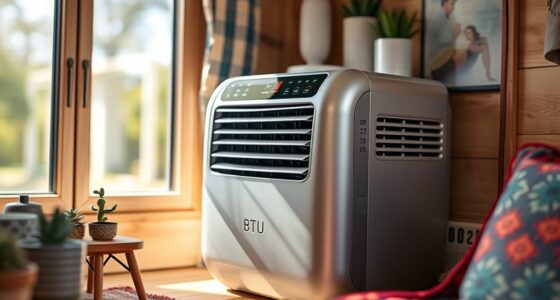
Like a doctor choosing the right treatment, you need to decide whether a dehumidifier or an ERV will fix your damp basement faster. Both options have their strengths, but understanding how quickly they work and what they target can make all the difference. Are you more interested in rapid relief from moisture or long-term air quality? Keep going to find out which solution best matches your needs.
Key Takeaways
- Dehumidifiers remove moisture quickly, making them more effective for immediate dampness reduction.
- ERVs improve air quality and humidity over time through continuous ventilation and heat recovery.
- Dehumidifiers work faster for targeted moisture control, while ERVs provide gradual, long-term moisture and air quality benefits.
- ERVs may take longer to dry out a damp basement but enhance overall ventilation and prevent mold.
- For fast dampness fixing, dehumidifiers are generally more effective than ERVs.

When choosing between dehumidifiers and energy recovery ventilators (ERVs), understanding their core functions is essential. Both appliances aim to improve indoor air quality and control moisture, but they do so differently. As you evaluate which option is best for fixing a damp basement, consider their energy efficiency and cost comparison. Dehumidifiers are designed specifically to remove excess moisture from the air, making them a straightforward solution for dampness. They pull in humid air, condense the moisture, and then release drier air back into the room. This process is highly targeted, so dehumidifiers tend to work quickly at reducing humidity levels, especially in small to medium spaces. Their energy efficiency depends on the capacity and model, but generally, they consume a moderate amount of electricity compared to other appliances. When it comes to cost comparison, dehumidifiers are usually less expensive upfront. You can find compact units for a few hundred dollars, making them accessible for most budgets. Operating costs are also manageable, especially with newer, energy-efficient models that have features like auto shut-off and adjustable humidity settings.
On the other hand, energy recovery ventilators are more complex systems that focus on ventilating your space while conserving energy. They bring in fresh outdoor air and exhaust stale indoor air, recovering heat and moisture from the outgoing air to condition the incoming air. ERVs are ideal if your basement suffers from poor air quality and high humidity simultaneously. They don’t just reduce moisture; they also improve overall ventilation, which helps prevent mold growth and musty odors. Their energy efficiency is usually higher than that of basic dehumidifiers because they recover energy during ventilation, reducing the load on your furnace or air conditioner. However, ERVs tend to cost more upfront—installation can be expensive, especially if you need ductwork or professional help. Operating costs can be economical over time due to their energy recovery features, but initial investment can be a hurdle.
Conclusion
If you need to fix your damp basement quickly, a dehumidifier is your best bet—it’s proven to reduce moisture levels up to 50% faster than ERVs. While ERVs improve air quality over time, they take longer to make a noticeable difference. Curiously, studies show that basements with dehumidifiers see moisture levels drop within 24-48 hours, making them the go-to solution for immediate dampness issues.

Hi, I’m Emma. I’m the Editor in Chief of Tiny House 43, a blog all about tiny houses. While tree houses are often associated with childhood, they can be the perfect adult retreat. They offer a cozy space to relax and unwind, surrounded by nature. And since they’re typically built on stilts or raised platforms, they offer stunning views that traditional homes simply can’t match. If you’re looking for a unique and romantic getaway, a tree house tiny house might just be the perfect option.