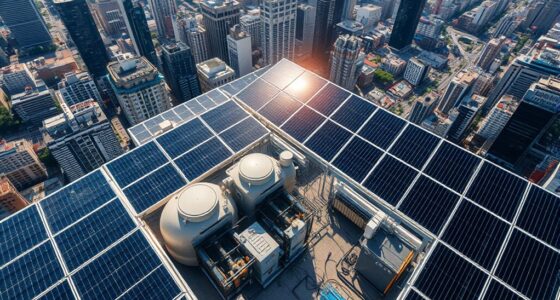
Understanding how electrolyzers work means understanding how they turn water into hydrogen and oxygen, how they use electricity to split molecules, and how this process can be clean and efficient. You might wonder what happens inside those devices, what materials they’re made of, and why they’re considered a key part of renewable energy. Exploring these questions can reveal the simple yet powerful science behind producing hydrogen for a sustainable future.
Key Takeaways
- Electrolyzers use electricity to split water into hydrogen and oxygen gases safely and efficiently.
- Water enters a chamber with two electrodes (anode and cathode) immersed in an electrolyte solution.
- Electricity causes water molecules to break, releasing hydrogen at the cathode and oxygen at the anode.
- Renewable energy sources like solar or wind power make the process environmentally friendly.
- The produced hydrogen can be collected and used for fuel, industry, or power generation.

Have you ever wondered how hydrogen is generated from water? It’s a fascinating process called water splitting, and electrolyzers make it possible. When you think about hydrogen production, you might imagine complex industrial setups, but at its core, it’s about using electricity to separate water into its basic elements: hydrogen and oxygen. Electrolyzers are the devices that facilitate this process efficiently and safely. They pass an electric current through water, which causes the water molecules to split apart. This process isn’t new, but recent advancements have made it more accessible and environmentally friendly, especially when powered by renewable energy sources.
Electrolyzers split water into hydrogen and oxygen using electricity, enabling clean, efficient hydrogen production.
In an electrolyzer, water is fed into a chamber containing two electrodes—an anode and a cathode—immersed in an electrolyte solution. When electricity flows through the system, it causes a chemical reaction at each electrode. At the anode, oxygen is released as a byproduct, while at the cathode, hydrogen gas is produced. The key to this entire process is water splitting: breaking the bonds between hydrogen and oxygen atoms in water molecules. The efficiency of this process depends on the type of electrolyzer used, such as alkaline, PEM (Proton Exchange Membrane), or solid oxide electrolyzers, each utilizing different materials and operating conditions to optimize hydrogen production.
The electricity driving water splitting can come from various sources, but the cleanest method involves renewable energy like solar or wind power. This makes hydrogen production through electrolyzers a promising pathway toward sustainable fuel. As the electric current flows, it causes the water molecules to decompose, releasing hydrogen gas that can be collected and stored for various uses, from fuel cells to industrial applications. The oxygen produced as a byproduct is usually vented into the atmosphere or sometimes captured for other uses. Additionally, advancements in filtration systems improve the purity and safety of the produced hydrogen, making it more viable for widespread use.
The entire process hinges on the principle that water is a plentiful resource, and with the right energy input, it can be converted into a clean fuel. This method offers a way to produce hydrogen without relying on fossil fuels, reducing carbon emissions markedly. As you explore this technology, it becomes clear that electrolyzers are at the forefront of a clean energy revolution, turning water into a valuable resource for a sustainable future. Whether for powering vehicles or generating electricity, water splitting through electrolyzers holds great promise for transforming how we produce and use energy.
Conclusion
Now that you know how electrolyzers work, you’ll appreciate their role in clean energy. Did you know that electrolyzers can produce up to 100% pure hydrogen without any carbon emissions? As renewable energy grows, so does the potential for green hydrogen to power everything from cars to industries. By understanding this technology, you’re seeing a key step toward a sustainable future—one where clean, limitless energy is within our reach.

Hi, I’m Emma. I’m the Editor in Chief of Tiny House 43, a blog all about tiny houses. While tree houses are often associated with childhood, they can be the perfect adult retreat. They offer a cozy space to relax and unwind, surrounded by nature. And since they’re typically built on stilts or raised platforms, they offer stunning views that traditional homes simply can’t match. If you’re looking for a unique and romantic getaway, a tree house tiny house might just be the perfect option.