
TL;DR

Get compact home essentials delivered free — and shop member deals
- Fast, free delivery on millions of items
- Access to Prime Big Deal Days deals on October 6–7
- Prime Video, Amazon Music and more included
A Hunker report highlights the sharpening puck, a roughly 3-inch silicon carbide whetstone, as a portable and beginner-friendly alternative to bench grinders for sharpening lawn mower blades. The method requires removing and clamping the blade, honing with coarse and medium grit sides, and balancing the blade before reinstallation.
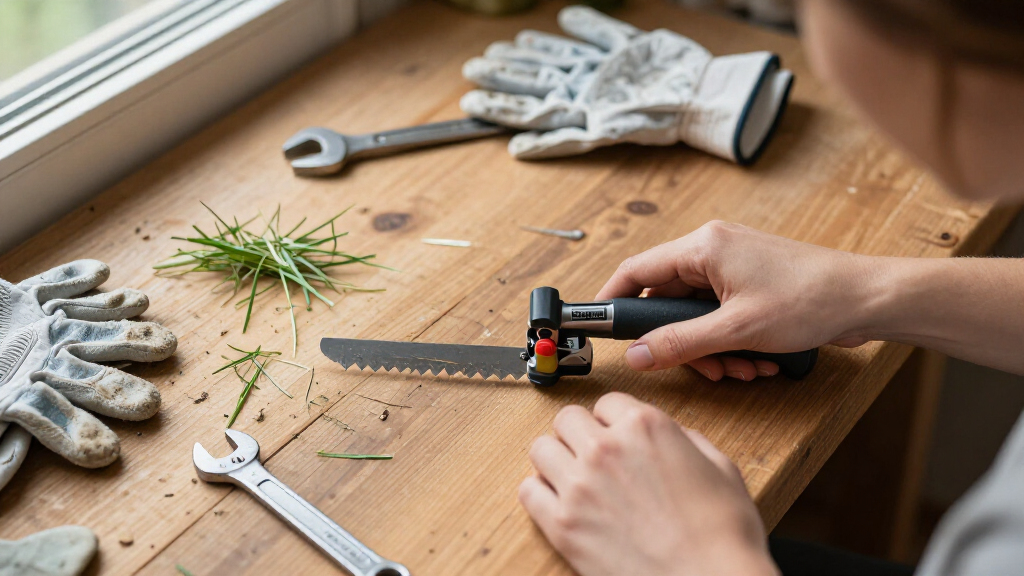
A pocket-sized sharpening puck can sharpen lawn mower blades without a bench grinder, according to a report from the home improvement site Hunker. The report describes the puck — a roughly 3-inch-wide, 1-inch-thick silicon carbide whetstone — as a portable, low-risk alternative that produces a clean cutting edge with basic technique and minimal equipment.
According to Hunker, most sharpening pucks, including the Lansky Puck, are dual grit: one coarse side removes material quickly and establishes the blade’s general shape, while the opposite medium-grit side puts the final edge on the steel. Beyond mower blades, the report says the same tool works on axes and shovels, making it a versatile addition to a toolbox rather than a single-purpose gadget.
The recommended process, as outlined in the report, starts with removing the blade from the mower deck and clamping it securely in a vise so it cannot slip. The puck is then primed with honing oil so the stone glides smoothly over the steel. For very dull metal, the coarse side is used first, moving the stone across the blade in a circular motion at a consistent angle. Once the edge is mostly restored, the user switches to the medium side to finish. Hunker advises balancing the blade before reattaching it to the deck.
The report also flags maintenance and safety points. Because the method involves no fast-spinning wheels, Hunker calls it one of the safest ways to sharpen a mower blade. To maintain the puck itself, the report recommends dousing it with honing oil to clear stuck metal particles and storing it in a toolbox.
Why Sharp Blades Protect Your Lawn
The practical case for regular sharpening, per the report, is lawn health. A sharp blade delivers a clean, even cut that grass heals from quickly, while dull blades tear grass ends, stressing the turf and leaving it more susceptible to disease. For homeowners who skip sharpening because they lack a bench grinder or grinding experience, the puck lowers the barrier to routine blade maintenance.
The approach also trades power for control. Bench grinders are effective, Hunker notes, but they are stationary machines that remove material fast and can overheat or unevenly grind a blade in unskilled hands. The puck’s manual, oil-lubricated stroke works at a pace that is harder to ruin, and its pocket size means it can travel with the tool kit rather than living in a workshop.
How the Puck Compares to Grinders
Bench grinders have long been the default sharpening tool because they handle multiple tasks — sharpening, polishing, and rust removal — as Hunker acknowledges. Their drawback, the report says, is mobility: they are bench-mounted machines, not field tools. Heavily damaged blades with large nicks may still warrant faster material removal than a hand stone provides, though the report does not set a threshold for when a grinder becomes necessary.
The sharpening puck sits among a wider set of alternatives — including purpose-built mower blade sharpeners and attachments — that Hunker references. The report positions the puck as the standout among them for its ease of use and results, though that assessment is the publication’s editorial judgment rather than a comparative test.
“While the bench grinder is undeniably powerful, it’s not what you would call mobile. A better tool in terms of portability and ease of use is a sharpening puck.”
— Hunker report
What the Report Leaves Untested
The report is instructional rather than tested product research. Hunker does not publish benchmark results comparing puck-sharpened blades to grinder-sharpened ones, nor does it quantify how long a puck-honed edge lasts in real mowing conditions. Specific product claims — such as durability of the Lansky Puck or performance on blades with heavy damage — are not independently verified.
The report also leaves open how the method performs on mulching blades with curved profiles or blades with deep nicks, which often need more aggressive material removal. No pricing, blade-removal torque guidance, or typical sharpening frequency is specified.
Practical Steps Before Mowing Season
Homeowners considering the method should first disconnect the mower’s spark plug or power source before removing the blade, and clamp the blade firmly in a vise as the report instructs — safety steps that should not be skipped. A blade balancer or a simple nail-and-wall check can confirm the blade is balanced before reinstallation; an unbalanced blade causes vibration and can damage the mower.
Readers wanting more depth can consult the original Hunker guide for the full walkthrough, and manufacturers’ blade-specific instructions, since some mower makers specify edge angles or replacement intervals. Anyone uncomfortable removing a blade or working around mower decks can have blades sharpened at a small-engine repair shop as an alternative.
Key Questions
What is a sharpening puck?
It is a small, typically 3-inch-wide, 1-inch-thick silicon carbide whetstone. Most, like the Lansky Puck, are dual grit — one coarse side and one medium side — and can sharpen mower blades, axes, and shovels.
How often should lawn mower blades be sharpened?
The Hunker report recommends regular sharpening but does not give a specific interval. A common rule of thumb among mower manufacturers is after roughly every 20–25 hours of mowing, or at least once per season — check your mower’s manual.
Is a sharpening puck safer than a bench grinder?
According to Hunker, yes — the puck has no fast-spinning wheels, making it one of the safest sharpening methods. Any blade work still requires the spark plug disconnected and the blade clamped securely.
Do I need to balance the blade after sharpening?
Yes. Hunker explicitly advises balancing the blade before reattaching it to the deck. Uneven material removal can create vibration that harms the mower.
Can a puck fix a badly nicked blade?
That is unclear. The report describes the puck as ideal for routine sharpening, but heavily damaged blades may require faster material removal, such as a bench grinder, or full replacement.
Source: rss
Halloween Picks
halloween
As an affiliate, we earn on qualifying purchases.