
TL;DR

Get compact home essentials delivered free with Prime
- Fast, free delivery on millions of items
- Prime Video, Amazon Music and more included
- Member-only deals all year
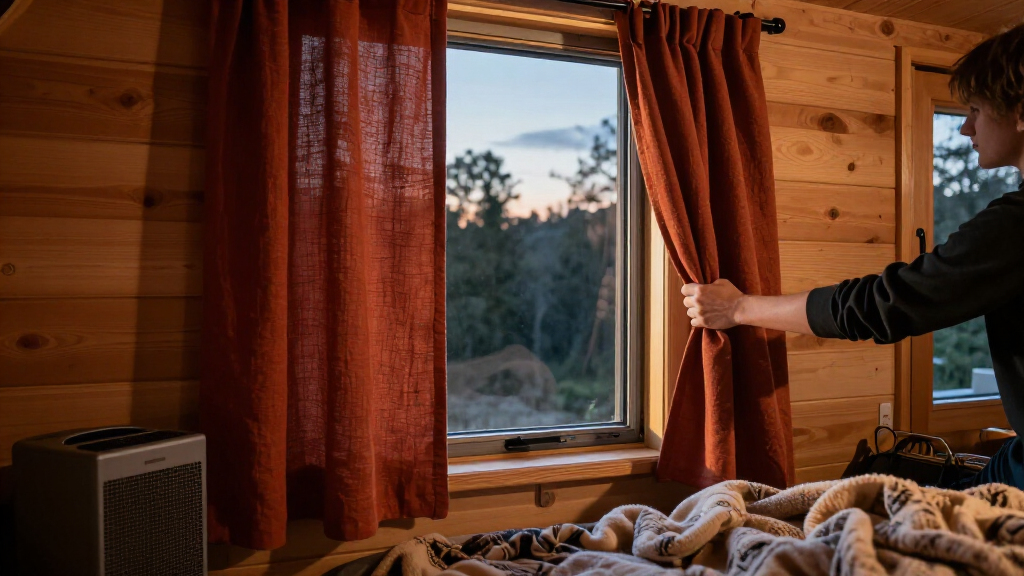
An Ideal Home report says closing curtains shortly before sunset can help reduce heat loss through windows and may delay the need for heating. Its writer measured a 2°C difference across thermal curtains, but that is an individual observation, not a forecast of household energy or bill savings.
An Ideal Home report says closing curtains just before sunset may help households retain heat and use less heating, but the size of any energy saving depends on the home. The writer reported a 2°C temperature difference in front of and behind thermal curtains after dark; the account is a home test, not a controlled measurement of energy use or bills.
The report’s writer said they resumed closing curtains early over the previous week and found that rooms felt warmer for longer in the evening. They said this reduced the need to turn the central heating back on for another hour. The article does not provide meter readings or a comparison of heating consumption, so it does not quantify any resulting energy or cost savings.
Stuart Middleton, So Energy’s consumer energy expert, said windows can be a source of heat loss and that curtains add a layer that slows heat escaping. He said thick, well-fitting or thermally lined curtains can be particularly effective. The report describes the method as a no-cost change for households that already have curtains, though buying or automating window coverings would add expense.
The writer recommended drawing curtains just before sunset, rather than leaving them open after daylight ends. This approach is intended to make use of sunlight during the day and then limit heat loss in the evening. The article suggests checking local sunset times or setting a phone reminder. It also describes curtain motors that can follow a schedule, but these are optional products rather than necessary parts of the energy-saving practice.
How Curtains Could Cut Evening Heating
For households trying to manage heating use during colder weather, a simple change to when curtains are closed may improve comfort without requiring a thermostat adjustment or new appliance. If a room stays comfortable for longer, residents may choose to delay heating or avoid using a portable heater for as long. That is a possible effect, not a measured result in the report.
The benefit is likely to vary from room to room. Curtains can reduce the movement of cold air near a window and add insulation, but they do not correct poor window seals, inadequate insulation elsewhere or other sources of heat loss. The report’s temperature readings offer a practical illustration, while not establishing how much a typical household could save.
Products Worth Considering

TCL 85-Inch QM6K Series QLED Mini LED 4K HDR Smart Google TV

Sonos Era 100 Wireless Smart Speaker, Black

Levoit Core 400S-P Smart Air Purifier for Large Rooms
As an affiliate, we earn on qualifying purchases.
What the Home Test Measured
The Ideal Home writer compared temperatures on either side of different window coverings after sunset. They reported a 2°C difference around thermal curtains and blinds, just under 1°C around wooden blinds, and about 0.5°C around standard curtains and fabric blinds. These readings were taken in the writer’s home; the article does not specify the measuring equipment, exact test conditions or whether the readings were repeated under controlled conditions.
The report says the writer had a mix of thermal curtains, standard curtains and blinds. It recommends timing curtain closure around local sunset, noting that the time changes through the year. The article also mentions a curtain motor with a scheduling feature and other automated devices, but does not establish that automation saves more energy than closing curtains manually.
The article refers to energy-price changes as a reason to seek ways to control bills, but its curtain test does not calculate savings against those prices. The report’s practical claim is narrower: curtains may help a home retain warmth, with effectiveness shaped by the window treatment and the building.
“Windows can be a source of heat loss, so drawing your curtains creates an additional layer of insulation that helps slow the rate at which heat escapes.”
— Stuart Middleton, So Energy consumer energy expert
Savings and Test Limits
The report does not give an estimate of kilowatt-hours saved, a reduction in heating costs, or a typical result across homes. Its temperature readings come from one household and are not presented as a controlled study. It is also unclear how much the difference would change with other window types, room layouts, heating settings or outdoor conditions.
The writer’s statement that the home felt warmer and required less heating is a personal observation. The available material does not show whether energy use was tracked or compare the home’s heating consumption before and after the change. Readers should not treat the reported 2°C difference as a 2°C increase in room temperature or as a guaranteed bill reduction.
When to Try the Curtain Routine
Households interested in the approach can check their local sunset time and close curtains shortly beforehand, as the report recommends. Those who want to judge its effect at home can compare room comfort and heating use over similar periods, while recognizing that outdoor temperatures and other conditions can affect the comparison.
The source material does not announce a follow-up test or a formal study. Any stronger estimate of savings would require measured energy use across defined time periods and comparable conditions. Until then, the supported takeaway is that curtains may slow heat loss, while the effect on bills remains home-specific and unquantified.
Key Questions
Does closing curtains before sunset save energy?
It may help slow heat loss through windows and could reduce how long some households use heating. The Ideal Home report does not measure energy consumption or establish a typical saving.
When should I close my curtains?
The report recommends closing them just before local sunset, so daylight can enter during the day and curtains are drawn as evening temperatures fall. Sunset time varies by location and date.
Which curtains performed best in the reported test?
The writer reported the largest temperature difference, 2°C, around thermal curtains and blinds. They reported a difference of just under 1°C around wooden blinds and about 0.5°C around standard curtains and fabric blinds. These were readings in one home, not a controlled comparison.
How much could I save on my energy bill?
The report gives no bill-saving estimate. So Energy expert Stuart Middleton said results depend on the windows, curtains and insulation in each home, making a single figure difficult to provide.
Source: rss