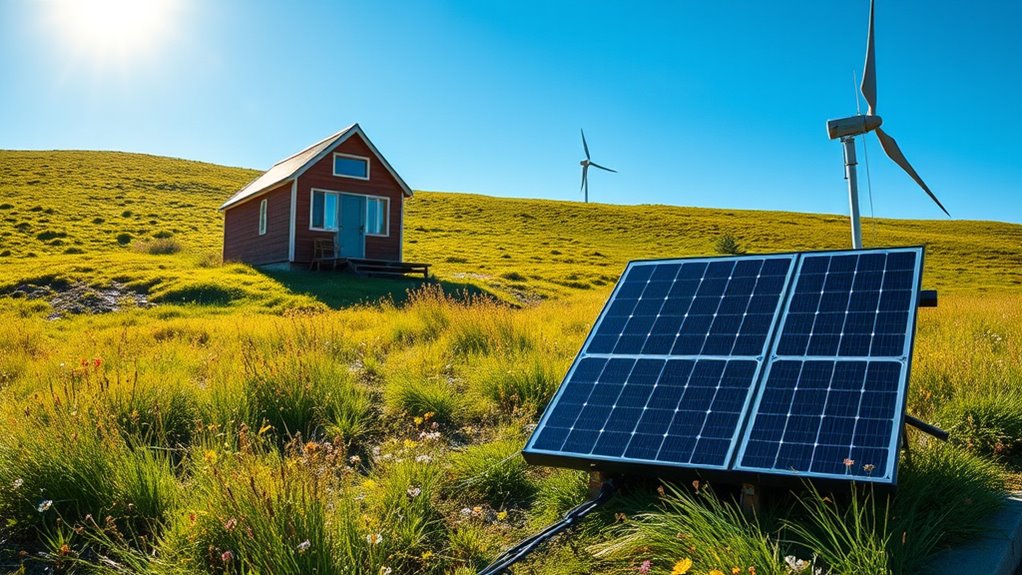
To start your off-grid tiny house power system, plan for enough solar panels to meet your daily energy needs and choose high-quality batteries to store energy for cloudy days and nights. Use an inverter to convert DC power into household AC, and regularly maintain your system by cleaning components and checking connections. Proper sizing and component selection guarantee efficiency and reliability. Keep exploring the details to build a sustainable, eco-friendly setup tailored to your lifestyle.
Open a free Amazon Business account
Business pricing, bulk buying and tax-exempt orders.
As an affiliate, we earn on qualifying purchases.
Key Takeaways
- Calculate daily energy needs to properly size solar panels, batteries, and inverters for your tiny house.
- Choose high-quality, durable components like solar batteries and inverters to ensure system longevity.
- Use solar batteries to store excess energy for nighttime use and cloudy days, maintaining a reliable power supply.
- Select an inverter with sufficient capacity and features like surge handling to power household appliances effectively.
- Regularly maintain and monitor your system components to maximize efficiency and prevent system failures.

Living off-grid in a tiny house offers freedom from utility bills and dependence on public infrastructure, but it also requires understanding how to generate and manage your own power. One of your best options is solar energy, which involves using solar panels to capture sunlight and convert it into usable electricity. However, capturing solar power is just part of the equation. To store this energy for nighttime use or cloudy days, you’ll need reliable solar batteries. These batteries act as your power reserve, guaranteeing you have electricity whenever you need it. When choosing solar batteries, look for high capacity and good cycle life, so your system remains efficient over years of use. Properly sizing your batteries is vital; too small, and you’ll run out of stored energy too quickly, too large, and you might overspend.
Once you’ve gathered your solar energy, you’ll need a way to convert it into usable household power. That’s where power inverters come into play. Power inverters transform the direct current (DC) produced by your solar panels and stored in your batteries into alternating current (AC), which is what most household appliances use. Choosing the right inverter depends on your energy needs. If you only plan to run small devices like LED lights, a smaller inverter will suffice. But if you want to operate larger appliances—like a refrigerator or power tools—opt for a higher-capacity inverter that can handle the load. Some inverters also come with features like surge capacity, which helps when starting motors, and built-in transfer switches for seamless operation.
Integrating solar batteries and power inverters into your off-grid system requires careful planning. You need to consider your daily energy consumption to determine the size of your solar array, batteries, and inverter capacity. It’s wise to add a buffer to accommodate future needs or unexpected energy demands. Regular maintenance of your batteries and inverter ensures longevity and peak performance. Keep batteries clean and check connections periodically, while monitoring your inverter’s performance to prevent overloads. Additionally, understanding quality assessment for components can help you select durable and reliable equipment for long-term off-grid living.
off grid tiny house solar panel kit
As an affiliate, we earn on qualifying purchases.
As an affiliate, we earn on qualifying purchases.
Frequently Asked Questions
How Much Does an Off-Grid Power System Typically Cost?
An off-grid power system usually costs between $10,000 and $30,000, depending on your needs. The cost breakdown includes solar panels, batteries, inverters, and installation. Budget considerations involve choosing the right size system for your energy use and considering ongoing maintenance. You might save by DIYing parts or selecting fewer batteries, but guarantee your system is reliable enough for your tiny house’s power needs.
What Are the Best Solar Panel Brands for Tiny Homes?
You should consider reputable brands like SunPower, LG, and Renogy for your tiny home’s solar panels. These brands are known for their solar panel durability and strong brand reputation, ensuring reliable performance over time. Opting for panels from these manufacturers helps you get high efficiency, longevity, and good customer support. Investing in quality panels from trusted brands will keep your off-grid system running smoothly and efficiently for years.
Can Off-Grid Systems Handle Appliances Like Refrigerators and Air Conditioning?
Think of your off-grid system as a well-trained crew. It can handle appliances like refrigerators and air conditioning, but only if you use a good solar battery and smart power management. You’ll need a robust setup to balance energy needs, especially during cloudy days or high usage. Properly designed, your system can keep everything running smoothly, ensuring your tiny house stays comfortable without grid power.
How Often Do Batteries Need Replacing in Off-Grid Setups?
Batteries in off-grid setups typically last 5 to 15 years with proper maintenance, but this varies based on usage and quality. Regular battery maintenance, like checking electrolyte levels and cleaning terminals, extends their lifespan. Keep an eye on inverter lifespan too, since it affects overall power reliability. Replacing batteries at the right time guarantees your system stays efficient, preventing unexpected power loss and maintaining smooth operation.
Are There Government Incentives for Off-Grid Tiny House Power Systems?
Government grants and tax incentives can considerably support your off-grid tiny house power plans. You might qualify for financial favors that fund your freedom from traditional grids, fueling your future with favorable funding. Keep keenly checking local, state, and federal programs because policies change promptly. Taking advantage of these incentives can lessen your costs, making your move to an off-grid lifestyle more manageable and motivating your mission toward self-sufficiency.
Conclusion
Starting your off-grid tiny house journey might seem overwhelming at first, but with careful planning and simple systems, it’s totally doable. Some worry about the upfront costs or maintenance, but in reality, investing in reliable solar panels and energy-efficient appliances saves money long-term. Plus, you gain independence and peace of mind, knowing you’re reducing your environmental footprint. Embrace the challenge—once you see how self-sufficient you can become, you’ll wonder why you didn’t start sooner.
NFL season / tailgating Picks
team gear
As an affiliate, we earn on qualifying purchases.