Just as a compass guides explorers through unknown terrain, advanced mapping technology directs robot vacuums through your home. These devices use sophisticated sensors to detect walls, furniture, and obstacles in real time, creating detailed maps that help them clean efficiently. But how exactly do they know where they’ve been—and where they need to go next? Understanding the inner workings of their navigation systems reveals how these machines avoid surprises and keep your space spotless.

Get compact home essentials delivered free with Prime
- Fast, free delivery on millions of items
- Prime Video, Amazon Music and more included
- Member-only deals all year
Key Takeaways
- Robot vacuums use sensors like laser, LIDAR, infrared, and bumpers to create real-time maps of their environment.
- Dynamic mapping updates the robot’s layout as new obstacles are detected during cleaning.
- Advanced sensors enable precise navigation, avoiding obstacles, stairs, and fragile objects.
- Mapping technology allows efficient route planning for thorough coverage and quick return to the charging station.
- Continuous sensor improvements enhance environmental understanding, leading to smarter, more reliable robot vacuums.
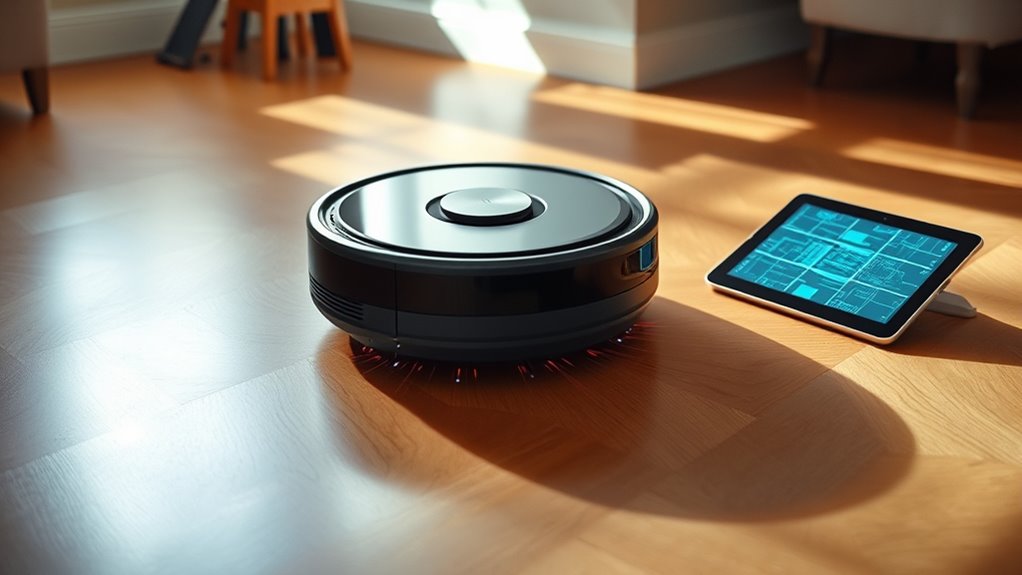
Ever wondered how robot vacuums effortlessly navigate your home? It all comes down to their sophisticated mapping technology and precise sensors. These devices rely heavily on sensor accuracy to understand their environment and avoid mishaps. Sensor accuracy ensures that the vacuum can detect walls, furniture, and other obstacles with minimal errors. When your robot moves across different surfaces, its sensors gather detailed information about the surroundings, allowing it to adapt seamlessly. This heightened awareness prevents it from missing spots or getting stuck in tight corners, making cleaning more efficient.
Obstacle detection is a critical component of this navigation process. Modern robot vacuums use a combination of infrared sensors, bumpers, and sometimes even cameras to identify obstacles in real-time. When the device encounters an object, it quickly assesses whether it’s a piece of furniture, a cable, or a pet toy. The obstacle detection system then triggers the vacuum to alter its path, preventing collisions and potential damage. It’s like having a keen-eyed companion that constantly scans the environment, ensuring smooth movement. Thanks to advanced obstacle detection, your vacuum can maneuver around cluttered spaces with ease, reducing the chances of it getting trapped or causing damage.
The integration of sensor accuracy and obstacle detection allows robot vacuums to create a mental map of your home as they clean. These maps aren’t static; they’re dynamic, updating as the vacuum encounters new obstacles or changes in the environment. Some models even use laser sensors or LIDAR technology, which provide highly detailed and accurate spatial data. This means your vacuum can plan the most efficient route, cover every inch of the room, and return to its charging station without getting lost. The ability to detect obstacles accurately also minimizes the risk of falling down stairs or bumping into fragile objects, giving you peace of mind.
In essence, the combination of precise sensors and advanced obstacle detection systems makes robot vacuums incredibly intelligent. They don’t just blindly wander around; they understand their surroundings, adapt on the fly, and clean more thoroughly. This technological synergy ensures your home stays spotless while requiring minimal intervention from you. As the technology continues to evolve, expect even smarter navigation with better sensor accuracy and obstacle detection capabilities, making your robot vacuum an even more reliable cleaning companion. Additionally, sensor technology continues to improve, leading to more sophisticated mapping and obstacle avoidance features in newer models.
robot vacuum with LIDAR navigation
As an affiliate, we earn on qualifying purchases.
As an affiliate, we earn on qualifying purchases.
Conclusion
Think of your robot vacuum as a skilled explorer, charting a vast, unfamiliar jungle. Its sensors are like keen eyes and gentle hands, guiding it past tangled vines and hidden pitfalls. With each map it creates, it becomes more confident, weaving through your home like a seasoned adventurer. Thanks to its advanced mapping tech, your vacuum navigates smoothly, ensuring every corner is explored and cleaned—turning your messy jungle into a pristine sanctuary.
Fall Picks
fall essentials
As an affiliate, we earn on qualifying purchases.