
Imagine trying to juggle multiple balls without missing a catch—that’s what managing various smart devices can feel like without a hub. Even in 2025, many homes still rely on these central controllers to keep everything running smoothly. But with more devices now boasting built-in voice assistants and compatibility, you might wonder if a hub remains necessary. Is it still worth the extra step, or has technology made hubs obsolete?
Key Takeaways
- Many new devices now have built-in voice control and ecosystem support, reducing the need for a hub.
- Complex multi-brand setups still benefit from a central hub for seamless device integration.
- Hubs enhance automation capabilities by unifying device management and routines.
- Simplified smart homes with single-brand devices may operate effectively without a hub.
- Future-proofing and scalability make having a central hub advantageous in 2025.
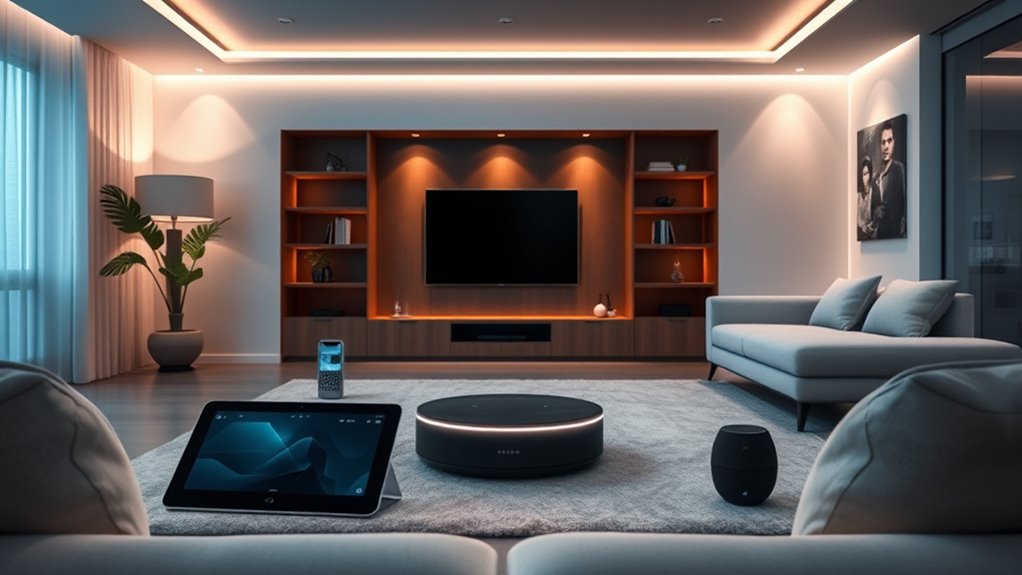
Ever wondered how to seamlessly control all your smart devices in one place? That’s where a smart home hub comes into play. These devices act as the central command center, allowing you to manage everything from lights and thermostats to security cameras and smart appliances. In 2025, the question is whether you still need a dedicated hub, especially with the rapid evolution of smart tech. The truth is, it depends on your setup and what you value most.
Voice control has become a game-changer in the smart home world. With popular assistants like Alexa, Google Assistant, and Siri, you can issue voice commands directly to your devices without needing a hub. These voice assistants are integrated into many smart speakers and displays, making it easier than ever to control your devices with simple spoken requests. However, the key to a smooth experience lies in device compatibility. Not all smart devices work seamlessly with every voice assistant or smart home platform. If you have a diverse array of gadgets from different brands, a smart home hub can help bridge those gaps, ensuring all your devices communicate effectively.
Voice assistants like Alexa, Google, and Siri simplify control but require compatible devices for seamless smart home management.
Without a hub, you might find yourself steering through multiple apps or platforms, which can become frustrating if your devices don’t share the same ecosystem. For instance, a smart light from one brand, a thermostat from another, and security cameras from a third might not all respond to the same voice command. A dedicated smart home hub can unify these devices, providing a single interface and simplifying your control. Plus, many hubs offer automation features—like setting routines that turn off lights, lock doors, and adjust the thermostat when you leave the house—that can be more easily managed through a central device. Additionally, some hubs incorporate home theater integration capabilities, allowing you to synchronize entertainment systems with your other smart devices for a more immersive experience.
That said, many newer smart devices now feature built-in voice control and are compatible with popular ecosystems, reducing the need for a hub. If your smart home is relatively simple and relies on devices from a single brand, you might get by without one. But if your setup is more complex or you want to future-proof your home, a hub can still add value. It can improve device compatibility, streamline automation, and reduce the need to juggle multiple apps. Ultimately, whether you need a smart home hub in 2025 depends on your specific needs, your device compatibility, and how much you want to streamline your smart home experience.
Top picks for "smart home hubs"
Open Amazon search results for this keyword.
As an affiliate, we earn on qualifying purchases.
Conclusion
In 2025, whether you need a smart home hub depends on your setup. If you’re managing multiple brands or craving advanced automation, a hub can still make life easier. But if your devices work seamlessly together and fit your simple needs, you might not need one. Coincidentally, as technology evolves, so do our options—keeping your smart home flexible and tailored to what you want, whether with or without a hub.