For most tiny-house owners with a suitable 240 V electrical setup, I’d start with the Rheem RTEX-13 for its residential focus and middle-ground capacity; the EcoSmart ECO 8 is a smaller-demand alternative, while the ThermoMate 4.5 kW makes sense for a single sink. The main choice is between compact, lower-draw units that suit point-of-use tasks and higher-output models that need more electrical capacity but can serve broader hot-water needs. Cold incoming water, simultaneous fixtures, and the limits of an off-grid or small-panel system can sharply affect performance. An electric tankless heater does not automatically fit a tiny house just because it is compact. Read on for a comparison of all 10 options and guidance on matching one to your wiring, water demand, and living setup.
Key Takeaways
- The Rheem RTEX-13 is the roundup’s best overall candidate for buyers seeking a residential 240 V unit, but its actual flow depends on incoming water temperature and available electrical capacity.
- The 14 kW models are not interchangeable based on wattage alone. The ORBEK, V7B-140B, and SIVUATEK listings differ in stated flow and product details, so verify installation requirements and documentation before choosing among them.
- Low-wattage models fit point-of-use jobs better than whole-house expectations. The ThermoMate and 120 V CAMPLUX are more suited to a nearby sink or limited hot-water demand than multiple fixtures running together.
- Voltage and panel capacity narrow the field before features do. Several higher-output options need a 240 V circuit, while small 110–120 V units may be easier to accommodate but deliver less heating capacity.
- Digital displays do not replace capacity planning. A display can help with operation, but incoming-water temperature, simultaneous use, breaker capacity, and installation rules matter more to tiny-house performance.



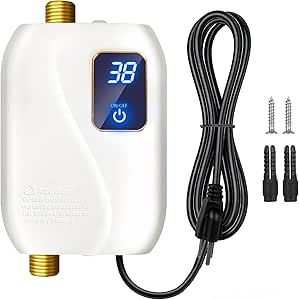


| electric tankless water heater for tiny house | Power | Voltage | Dimensions |
|---|---|---|---|
| CAMPLUX 6 kW Electric Tankless | 6 kW (6000 W) | 240 V | 10.95 × 7.4 × 2.52 in |
| ORBEK 14 kW Electric Tankless | 14 kW | 240 V | 14.2 × 9.5 × 3.1 in (H × L × W) |
| V7B-140B 14 kW Electric Tankle | 14 kW | 240 V | 12.2 in W × 17.25 in H |
| Rheem RTEX-13 Residential 240V | 13 kW | 240 V | — |
| ThermoMate 4.5 kW Electric Tan | 4.5 kW | 110–120 V; 120 V only, hardwired | 10.95 × 7.4 × 2.52 in |
| SIVUATEK 14 kW Electric Tankle | 14 kW | 240 V | — |
| CAMPLUX 4.5 kW 120V Electric T | 4.5 kW | 120 V | 7.4 × 10.9 × 2.52 in |
| 110V 3000W Electric Tankless W | 3000 W | 110 V | 4.32 in W × 7.86 in H |
| EcoSmart ECO 8 8 kW Electric T | 8 kW | 240 V | 8 in W × 11.5 in H × 4 in D |
| 3000W Electric Tankless Water | 3000 W | 110 V | 4.32 in W × 7.86 in H |
More Details on Our Top Picks
CAMPLUX 6 kW Electric Tankless Water Heater
The CAMPLUX 6 kW suits a tiny house where hot water is needed at one sink rather than across several fixtures. Its compact 3.9-pound wall-mounted body takes little room, while self-modulating power adjusts to flow instead of running at full output continuously. The touch controls and temperature display also make point-of-use adjustment straightforward. Compared with the ThermoMate 4.5 kW, it offers a higher stated flow rate and a 240 V supply, but it also calls for a dedicated 30 A circuit and hardwiring. Its 1.5 GPM flow and stated 50°F rise at 1.0 GPM set a clear limit: this is a sink-focused option, not a whole-house answer for simultaneous showers and dishwashing. I’d choose it when space and modest demand matter more than broad fixture coverage.
Pros:- Small wall-mounted footprint and low listed weight suit tight utility spaces.
- Self-modulating operation adjusts power with water flow.
- Touch controls and a temperature display provide direct adjustment.
- Overheat protection is built in.
Cons:- Requires hardwiring, a 30 A circuit breaker, and 10 AWG wire.
- The 1.5 GPM listed flow makes it a poor fit for multiple simultaneous uses.
- A 50°F temperature rise at 1.0 GPM limits performance where incoming water is cold.
Best for: Tiny-house owners who want a compact, hardwired heater for one sink or another low-demand point of use.
Not ideal for: Households expecting to run a shower and sink together, or buyers without room in their electrical panel for a dedicated 30 A, 240 V circuit.
- Power:6 kW (6000 W)
- Voltage:240 V
- Flow rate:1.5 GPM
- Temperature rise:50°F at 1.0 GPM
- Maximum temperature:131°F
- Dimensions:10.95 × 7.4 × 2.52 in
- Electrical requirements:Hardwired; 30 A circuit breaker; 10 AWG wire
- Water connection:1/2 in NPT
Our verdict“Choose the CAMPLUX 6 kW for a compact, dedicated sink supply, not for a tiny house that needs several hot-water fixtures at once.”
ORBEK 14 kW Electric Tankless Water Heater, 240 V, 3.38 GPM
The ORBEK 14 kW is the strongest fit here for a tiny house that needs hot water at more than one point of use: its listed 3.38 GPM maximum flow is higher than the V7B-140B’s 2.3 GPM. The temperature range of 86°F to 140°F gives owners room to set a lower output for everyday use or a hotter one when needed. Leakage, over-temperature, and dry-heating protection add useful safeguards, and the LED display keeps settings visible. The tradeoff is a substantial electrical commitment: this unit calls for a 60 A two-pole breaker, 6 AWG wiring, and a panel rated for at least 150 A. Compared with the Rheem RTEX-13, ORBEK lists greater maximum flow, but the Rheem includes a showerhead and field-serviceable heating elements. I’d shortlist ORBEK only after confirming the electrical system can support it.
Pros:- Highest listed maximum flow in this five-product group at 3.38 GPM.
- Temperature controls span 86°F to 140°F.
- Leakage, over-temperature, and dry-heating protection are included.
- Compact dimensions suit a dedicated wall installation.
Cons:- Requires a 240 V, 60 A two-pole breaker and 6 AWG wiring.
- The specified household panel capacity is at least 150 A.
- Its higher flow potential may be unusable if the tiny house has a constrained electrical supply.
Best for: Tiny-house owners with a 240 V, 150 A-or-larger panel who want one heater to serve two or three points of use.
Not ideal for: Off-grid builders or owners with limited panel capacity, since its 60 A circuit and 6 AWG wiring can make installation impractical.
- Power:14 kW
- Voltage:240 V
- Maximum flow rate:3.38 GPM
- Electrical requirement:60 A two-pole breaker; 1 set of 6 AWG wires
- Temperature range:86°F–140°F
- Dimensions:14.2 × 9.5 × 3.1 in (H × L × W)
- Water connections:1/2 in NPT
- Certification:ETL
Our verdict“Pick ORBEK when multiple fixtures matter and your panel can support its demanding 60 A installation.”
V7B-140B 14 kW Electric Tankless Water Heater
The V7B-140B brings 14 kW of 240 V heating into a wall-mounted unit with self-modulating control, a digital display, and touch controls. That combination makes it a sensible choice for a tiny-house owner who wants to adjust output at the unit while keeping the installation compact. Leakage and overheat protection are also listed. Its main constraint is the 2.3 GPM flow rate, which is well below ORBEK’s 3.38 GPM maximum and makes simultaneous fixtures less plausible. The supplied data lists both a 110°F maximum temperature and a 131°F heat output, so I would verify operating-temperature details with the seller before sizing it around a particular use. Unlike the CAMPLUX 6 kW, this model has substantially more rated power, but it still needs a 240 V supply and is not a low-demand, standard-outlet solution.
Pros:- Self-modulating heating adjusts power to flow and selected temperature.
- Digital display and touch controls simplify local adjustments.
- Wall-mounted format and compact listed dimensions suit limited space.
- Leakage and overheat protection are included.
Cons:- Listed 2.3 GPM flow is lower than ORBEK’s stated 3.38 GPM.
- Requires a 240 V electrical supply.
- Provided temperature data lists a 110°F maximum alongside 131°F heat output, so the figures need clarification.
Best for: Tiny-house owners seeking a compact 240 V heater with touch controls for a modest point-of-use setup.
Not ideal for: Buyers who need higher simultaneous flow or who need clear, consistent maximum-temperature specifications before choosing equipment.
- Model:V7B-140B
- Power:14 kW
- Voltage:240 V
- Flow rate:2.3 GPM
- Temperature data:Maximum temperature listed as 110°F; heat output listed as 131°F
- Dimensions:12.2 in W × 17.25 in H
- Pipe connections:1/2 in NPT
- Certification:ETL certified
Our verdict“Choose the V7B-140B for compact, adjustable 240 V point-of-use heating, but verify its temperature specifications and keep flow expectations modest.”
Rheem RTEX-13 Residential 240V Tankless Water Heater
The Rheem RTEX-13 earns its place for owners who value serviceability and controlled output over the highest listed flow. Its field-serviceable copper immersion elements offer a maintenance advantage that the product data does not specify for the ORBEK or V7B-140B. Self-modulating power and an LED thermostat display, with stated ±1°F control accuracy, give the owner direct control over temperature. Rheem lists up to 3.17 GPM, close to ORBEK’s 3.38 GPM but still a little lower, and the included 1.5 GPM water-saving showerhead is a practical match for a small home. This is not a light electrical load: the unit draws 54 A at 240 V, so the panel and wiring plan deserve attention. I’d favor it over the CAMPLUX 6 kW for shower-oriented use, while recognizing it needs a much more capable electrical setup.
Pros:- Field-serviceable copper immersion elements support maintenance.
- Digital thermostat offers stated temperature control accuracy of ±1°F.
- Self-modulating power adjusts output to demand.
- Includes a 1.5 GPM water-saving showerhead and 1/2 in adapters.
Cons:- Requires a 240 V supply and draws 54 A.
- Maximum listed flow of 3.17 GPM is lower than ORBEK’s 3.38 GPM.
- The provided specifications do not state dimensions or a breaker and wire size, so installation planning needs further confirmation.
Best for: Tiny-house owners with suitable 240 V electrical capacity who want a residential heater with serviceable elements and a showerhead included.
Not ideal for: Owners with limited panel capacity or those seeking a low-amperage sink-only heater, since this unit draws 54 A.
- Voltage:240 V
- Power:13 kW
- Current:54 A
- Maximum flow rate:Up to 3.17 GPM
- Temperature control accuracy:±1°F
- Heating elements:Two copper immersion elements; field-serviceable
- Water connections:1/2 in compression
- Included showerhead:1.5 GPM water-saving showerhead
Our verdict“Choose the Rheem RTEX-13 if serviceable elements and a shower-ready package matter more than minimizing electrical demand.”
ThermoMate 4.5 kW Electric Tankless Under-Sink Water Heater
The ThermoMate 4.5 kW is the most clearly aimed at a single sink: its small body is designed for under-sink or other tight installations, and the 85°F–131°F temperature range allows adjustment for handwashing and light cleanup. Self-modulating power and touch controls add flexibility without the larger output demands of 13–14 kW models such as the Rheem RTEX-13. That lower output is also its limit. The listed 0.26–1.0 GPM range is far below Rheem’s stated maximum of 3.17 GPM, so I wouldn’t plan on it as a shower heater or a source for simultaneous fixtures. Its wiring requirement also needs careful checking: the listing describes 120 V-only hardwiring alongside a 40 A double-pole breaker and 8 AWG minimum wire. That makes it compact, but not a plug-in appliance.
Pros:- Compact dimensions suit under-sink and other space-limited installations.
- Self-modulating 4.5 kW system adjusts power with demand.
- Temperature can be set from 85°F to 131°F using touch controls.
- Stainless steel water tube and cast aluminum heating element are specified.
Cons:- Listed flow range of 0.26–1.0 GPM is restrictive for showers and concurrent uses.
- Requires hardwiring, a 40 A double-pole breaker, and at least 8 AWG wire.
- The 120 V-only supply description and stated circuit requirement call for installation details to be confirmed.
Best for: Tiny-house owners who want a hardwired, under-sink hot-water source for one low-flow faucet and have confirmed the circuit requirements.
Not ideal for: Anyone seeking shower supply, multiple simultaneous fixtures, or a simple plug-in heater; its flow is limited and installation is hardwired.
- Model:SS-45
- Power:4.5 kW
- Voltage:110–120 V; 120 V only, hardwired
- Temperature range:85°F–131°F
- Flow rate:0.26–1.0 GPM
- Circuit requirement:40 A double-pole breaker; 8 AWG minimum wire
- Dimensions:10.95 × 7.4 × 2.52 in
- Water connections:1/2 in NPT
Our verdict“Pick the ThermoMate for a dedicated under-sink faucet, not as the main hot-water source for a shower-equipped tiny house.”
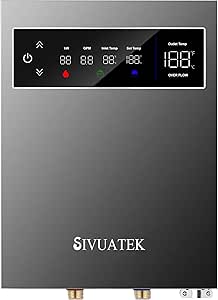
SIVUATEK 14 kW Electric Tankless Water Heater, 240 V
For a tiny house with a 240 V supply and occasional overlap between a sink and another low-flow tap, the SIVUATEK offers more headroom than the CAMPLUX 4.5 kW. Its stated 3.3 GPM flow rate and 14 kW output suit modest shared use, though actual delivery depends on incoming water temperature and the temperature rise required. The LED display adjusts in 1°F increments, giving more control than a simple preset heater, while leakage and overheating protection add useful safeguards in a compact wall-mounted package.
The tradeoff is electrical: this model calls for a 60 A breaker, which may be a difficult fit in a small home with limited panel capacity. It also is not a whole-house answer for several high-flow fixtures at once. Compared with the 110 V 3000 W sink units in this roundup, it can serve a broader use case, but needs substantially more electrical infrastructure.
Pros:- 14 kW output and a stated 3.3 GPM flow rate support more than a single-sink use case
- LED display allows temperature adjustment in precise 1°F increments
- Leakage, overheating, and automatic shut-off protections are included
- Compact wall-mounted design can fit under a sink or on a utility wall
Cons:- Requires 240 V power and a substantial 60 A circuit
- Capacity is limited for several simultaneous high-flow fixtures
- Listed dimensions differ between the unit measurements and alternate measurements provided
Best for: Tiny-house owners with a 240 V electrical system, a 60 A circuit available, and one or two low-flow hot-water uses that may overlap.
Not ideal for: Owners with limited electrical panel capacity, only 120 V service, or expectations of running multiple showers and taps together.
- Power:14 kW
- Voltage:240 V
- Stated flow rate:3.3 GPM
- Temperature range:86°F–131°F
- Temperature adjustment:1°F increments
- Required breaker:60 A
- Water connection:1/2-inch NPT
- Mounting:Wall-mounted
- Certification:ETL certified
Our verdict“Choose the SIVUATEK if your tiny house has the electrical capacity and you want more shared-use headroom than a small point-of-use heater provides.”
CAMPLUX 4.5 kW 120V Electric Tankless Water Heater
The CAMPLUX makes the most sense when a tiny house needs hot water at one specific sink, not a central heater for the entire home. It runs on 120 V and is smaller and lighter than the 14 kW SIVUATEK, but its stated performance—a 50°F rise at 1.0 GPM—sets a clear boundary: it is a point-of-use choice rather than a shower solution. Self-modulating power adjusts to flow and the selected temperature, while the touch panel and LED display make settings easy to read.
Installation still needs planning. This unit requires hardwiring to a 40 A circuit with 10 AWG wire, so 120 V operation does not mean it can simply plug into an ordinary receptacle. Compared with the 110 V 3000 W sink heaters, the CAMPLUX has a higher specified heating output, but it also calls for a much larger circuit and is intended for one sink.
Pros:- 120 V operation can suit systems that do not have a 240 V heater circuit
- Compact 7.4 × 10.9 × 2.52-inch body fits under many sinks
- Self-modulating output responds to flow rate and temperature setting
- Touch controls and an LED display provide clear temperature adjustment
Cons:- Designed for one sink rather than multiple fixtures
- Requires hardwiring to a 40 A circuit using 10 AWG wire
- Specified temperature rise at 1.0 GPM limits its usefulness for showers
Best for: Tiny-house owners who want a compact heater dedicated to a kitchen or bathroom sink and can provide the required 40 A hardwired circuit.
Not ideal for: Buyers seeking shower-capable hot water, a plug-in installation, or one heater to supply several fixtures.
- Model:TE05N4
- Power:4.5 kW
- Voltage:120 V
- Temperature rise:50°F at 1.0 GPM
- Maximum temperature:131°F
- Minimum activation flow:0.26 GPM
- Circuit and wiring:40 A circuit; 10 AWG wire
- Dimensions:7.4 × 10.9 × 2.52 in
- Warranty:2-year limited
Our verdict“Pick the CAMPLUX for a single sink when its hardwired 40 A circuit is practical and you do not need shower-level capacity.”
110V 3000W Electric Tankless Water Heater with Digital Display
This 3000 W unit is a narrow-fit option for a tiny house where the goal is handwashing or sink use, and the available supply is 110 V. Its compact 4.32-inch-wide body uses little wall space, and the display can show Fahrenheit or Celsius. The listed temperature rises—82°F at 0.3 GPM and 131°F at 0.5 GPM—make clear that its strongest use is a very low flow, not a shower. That makes it more limited than the CAMPLUX 4.5 kW, but potentially easier to place near a single sink.
Vertical-only mounting narrows installation options, and the supplied information says a suitable electrical connection is required without specifying a breaker rating. Leak, dry-boil, overheat, and inactivity protections are useful safeguards, but they do not change the low-flow limit. I would choose it over the larger SIVUATEK only for a dedicated sink where compactness and 110 V operation matter more than shared capacity.
Pros:- Very compact 4.32 × 7.86-inch body saves wall space
- 110 V, 3000 W design suits a low-flow point-of-use role
- Display supports both Fahrenheit and Celsius
- Includes leak, dry-boil, overheat, and inactivity shutoff protections
Cons:- Not suitable for showers and performs best at very low flow
- Must be installed vertically
- The provided specifications do not state a breaker or wire requirement
Best for: Tiny-house owners adding a small, dedicated handwashing or sink hot-water point where 110 V service and vertical wall mounting are available.
Not ideal for: Anyone who needs a shower, higher-flow hot water, horizontal installation, or a clearly specified circuit requirement before purchase.
- Power:3000 W
- Voltage:110 V
- Temperature rise:82°F at 0.3 GPM; 131°F at 0.5 GPM
- Maximum temperature:131°F
- Dimensions:4.32 in W × 7.86 in H
- Connections:1/2 in NPT
- Mounting:Wall-mounted; vertical installation only
- Protection:IPX4, leak, dry-boil, overheat, and inactivity shutoff
- Warranty:24 months
Our verdict“Choose this unit for a compact, low-flow sink installation, not as the primary hot-water source for a tiny house.”
EcoSmart ECO 8 8 kW Electric Tankless Water Heater
The EcoSmart ECO 8 sits between the tiny sink heaters and the higher-output SIVUATEK: its 8 kW, 240 V design is for low-flow point-of-use service where a 110 V mini unit falls short, but a 14 kW heater is more capacity than the household needs. Its digital control adjusts in 1-degree increments, and the wall-mounted body is only 8 inches wide. The stated flow range varies with incoming water temperature, so colder supply water can reduce what it can deliver; the “up to” flow figure should not be treated as a guaranteed rate in every season.
Compared with the CAMPLUX 4.5 kW, the ECO 8 offers more rated power but requires 240 V, making it a better fit for a planned electrical upgrade than a simple sink retrofit. Its lifetime warranty on listed components excludes labor and incidental damage, so warranty coverage does not remove repair costs.
Pros:- 8 kW output offers a middle ground between 3000 W sink units and 14 kW heaters
- Digital temperature control adjusts in 1-degree increments
- Compact, lightweight wall-mounted design
- Listed 99.8% efficiency and on-demand operation avoid tank standby heating
Cons:- Flow varies with incoming water temperature and required temperature rise
- Requires 240 V power, unlike the 110 V and 120 V point-of-use options
- Warranty covers the heater components listed, but not labor or incidental damage
Best for: Tiny-house owners with 240 V service who need more low-flow capacity than a small 110 V sink heater, without stepping up to a 14 kW unit.
Not ideal for: Buyers without a 240 V circuit, households needing predictable high flow in cold-inlet conditions, or anyone expecting labor coverage under the warranty.
- Model:ECO 8
- Power:8 kW
- Voltage:240 V
- Stated flow:0.8–1.9 GPM depending on incoming water temperature
- Efficiency:99.8%
- Temperature control:Digital; 1-degree increments
- Dimensions:8 in W × 11.5 in H × 4 in D
- Weight:4.8 lb
- Warranty:Lifetime warranty on electronics, exchanger, and element; heater cost only
Our verdict“Choose the ECO 8 if you have 240 V service and want a compact step up from sink-only heaters without the electrical demand of a 14 kW model.”
3000W Electric Tankless Water Heater with Digital Display
This second 3000 W heater is also a low-flow sink unit, but its listing spells out a minimum 32 A circuit and specific wiring, which gives buyers more electrical planning information than the other 110 V 3000 W option. The compact 4.32 × 7.86-inch body and Fahrenheit/Celsius display suit a small kitchen, bathroom, or RV-style installation. Its stated operating range of 0.3–0.5 GPM is still too low for a shower, so this is a dedicated tap solution rather than a whole-house heater.
Compared with the B0FTCMVRY3 model, the listed 98% efficiency and 10-year product service are distinguishing claims, while both share the same small footprint and vertical-only mounting constraint. The requirement for a circuit rated at least 32 A and 13 AWG wiring may complicate a tiny-home electrical plan; the service statement also does not spell out repair or labor coverage.
Pros:- Compact 4.32 × 7.86-inch wall-mounted format
- Listed for sink use in kitchens, bathrooms, and RVs
- LED display supports Fahrenheit and Celsius
- Includes leakage, dry-burning, and over-temperature protections
Cons:- 0.3–0.5 GPM range is unsuitable for showers or multiple fixtures
- Requires a circuit rated at least 32 A and specified 13 AWG wiring
- Vertical-only installation limits placement options
Best for: Tiny-house or RV owners fitting one low-flow sink who want a compact heater with a stated circuit and wiring requirement.
Not ideal for: Buyers seeking shower use, multi-fixture hot water, flexible mounting, or detailed warranty coverage beyond the product-service statement.
- Power:3000 W
- Voltage:110 V
- Efficiency:98%
- Flow rate:0.3–0.5 GPM
- Maximum temperature:131°F
- Circuit and wiring:At least 32 A circuit; 2.5 mm² (13 AWG) wiring
- Dimensions:4.32 in W × 7.86 in H
- Connections:1/2-inch NPT
- Mounting and service:Vertical wall mounting; 10 years of product service
Our verdict“Choose this model for a single low-flow sink when its 32 A electrical requirement and vertical mounting fit your tiny-house or RV installation.”

How We Picked
I ranked these 10 heaters for the specific constraints of a tiny house: limited electrical service, compact installation space, variable water demand, and the possibility of cold or off-grid water supplies. I compared the stated voltage and wattage, listed flow claims where available, intended point-of-use or residential fit, and how clearly a buyer can judge installation needs from the product details. A higher wattage can support more hot-water demand, but only when the house can safely supply it.
The order favors models with a clearer fit for a small residence and more useful capacity information, then separates point-of-use and low-voltage choices from broader-demand candidates. I treat listed flow as a claim, not a guarantee: delivered hot-water flow varies with inlet temperature and desired outlet temperature. The 14 kW products sit near one another because their real-world fit depends on confirmed specifications and site wiring; the compact 3–6 kW units rank lower for whole-house use but may be better matches for one fixture. I do not assume that any model is compatible with a particular tiny-house electrical system without checking its manual and local installation requirements.
Factors to Consider When Choosing Electric Tankless Water Heater For Tiny House
Choosing an electric tankless heater for a tiny house starts with the building’s electrical and water limits, not the product’s footprint. I’d work through these factors before comparing convenience features, since a small heater can still exceed a circuit’s capacity and a high-output heater can disappoint when cold inlet water reduces flow.
Match the heater to the electrical service
Check the service rating, available breaker spaces, and wiring capacity before settling on a model. A 240 V heater may need dedicated circuits, and a higher-wattage unit can place a large load on a small panel even when the house has enough total service on paper. Tiny homes often share capacity among cooking, space heating, charging, and water heating, so map which appliances could run at the same time. Ask a licensed electrician to confirm conductor size, breaker requirements, and whether the service can handle the planned load. A plug or voltage label alone does not show that a unit is safe for the existing wiring. If adding circuits is impractical, a point-of-use heater or a different hot-water system may be a better fit.
Estimate flow using your coldest inlet water
Tankless performance depends on how much the heater must raise the water temperature, not just the advertised flow rate. A source that is cold in winter can reduce the usable flow compared with a mild climate, and an off-grid supply may vary in temperature and pressure. List the fixtures you want to run and decide whether they will operate at the same time; a shower plus a sink creates a different demand than one hand-washing tap. Use the manufacturer’s temperature-rise charts, if available, rather than treating a maximum GPM figure as a constant. A common mistake is sizing for average conditions and then finding the shower weak during the coldest season. If the product information lacks performance data for your inlet temperature, get clarification before buying.
Choose whole-house or point-of-use placement
A centrally placed heater can serve several fixtures, but long pipe runs waste heat and may delay hot water in a compact floor plan. A small unit mounted near a sink can reduce pipe distance and suit a tiny home with modest demand, yet it may not heat a shower adequately. Decide which fixtures need hot water and whether simultaneous use is a real requirement rather than an occasional possibility. Multiple point-of-use heaters can spread electrical demand and shorten runs, but they also add equipment, connections, and maintenance points. One central unit is simpler only if its capacity and wiring support the whole-house plan. Sketching fixture locations and pipe routes before choosing can prevent a compact heater from being installed in the wrong role.
Plan for water quality, pressure, and maintenance
Tankless heaters contain passages and components that can be affected by scale, sediment, and fluctuating pressure. If the tiny house uses well, rain, or hauled water, check the product’s inlet filtration and water-quality requirements before connecting it. A sediment filter can protect the system, but it adds a service item that needs routine inspection. Hard water may call for periodic descaling, and the installation should allow access for that work rather than burying the heater behind cabinetry. Confirm the required minimum flow and pressure, since low-flow fixtures or a small pump may not trigger a heater consistently. A model that fits the space but cannot be serviced easily can become a poor long-term choice.
Check installation rules and freeze exposure
Electrical and plumbing codes, permits, and required clearances can affect where a heater may go in a tiny house. Manufacturer instructions should guide mounting, wiring, grounding, and water connections; compact dimensions do not remove those requirements. If the home is on wheels or exposed to freezing conditions, consider vibration, travel preparation, and protection of water lines as well as the heater itself. Many electric tankless units are not a substitute for freeze protection when the home is unoccupied or unheated. Ask local officials or a qualified installer about rules that apply to a mobile or off-grid dwelling. Planning access and shutoff points at installation is easier than modifying a finished wall later.
Compare total system demands, not convenience features
A digital display, temperature control, or compact case can make operation easier, but these features do not increase heating capacity. Before paying for controls or a particular finish, confirm that the unit can meet the intended temperature rise and that your electrical service can supply it. Also account for any pump, filter, expansion provisions, or plumbing changes needed by the installation. If hot water demand is intermittent and the electrical system is constrained, a lower-output heater may be sensible for one fixture; if showers and kitchen use overlap, a more capable system or a storage-based alternative may suit the household better. Compare the manuals and support information, not just the headline wattage. The right choice is the one whose complete installation works with the house, not simply the unit with the longest feature list.
Frequently Asked Questions
Can a 120 V tankless heater run a shower in a tiny house?
Some 120 V models can provide hot water for limited uses, but their low wattage generally restricts how much water they can heat at once. A shower demands more sustained hot-water flow than hand-washing at a nearby sink, especially when the incoming water is cold. Check the heater’s temperature-rise and flow charts for your coldest expected inlet temperature rather than relying on its voltage or compact size. Also verify the required circuit and whether other appliances will share the tiny house’s electrical service. If a shower is the main goal, compare 240 V models or other system types before choosing a small 120 V unit.
Will a 14 kW heater work with a small tiny-house electrical panel?
It may not, and wattage by itself cannot confirm compatibility. The heater’s manual specifies voltage, circuit, and breaker requirements, while the home’s service rating and other simultaneous loads determine whether the system can support it. An electrician should review the panel, wiring, and planned appliance use before installation. This is especially relevant in tiny houses where electric cooking, space heating, and charging may overlap. If the panel cannot support the load, choosing a smaller heater does not automatically solve the problem unless its performance also meets the household’s hot-water needs.
How should I choose between one central heater and separate point-of-use units?
Start with fixture locations, how often each one needs hot water, and whether fixtures run together. A central heater can simplify the equipment layout, but long pipe runs can waste water and delay delivery; point-of-use units can shorten those runs but add wiring, plumbing, and service points. In a very compact home with one main sink and occasional hot-water use elsewhere, localized heating may be practical. A household that relies on a hot shower and kitchen use at the same time needs to check combined demand and circuit capacity carefully. Draw the plumbing route before deciding, since the best layout can matter as much as the heater’s physical size.
What happens to tankless performance when the inlet water gets colder?
The heater must raise colder water through a larger temperature difference, which can reduce the flow it can deliver at the desired output temperature. A unit that seems adequate during warm weather may provide less usable flow during winter or when fed by a cold well or storage tank. Look for manufacturer performance tables at a temperature rise close to your site conditions. If those details are unavailable, ask the manufacturer for a realistic flow estimate rather than treating a listed maximum as a promise. Buyers in cold climates may need a higher-capacity system or a lower simultaneous-use expectation.
Is an electric tankless heater a good fit for an off-grid tiny house?
It can be, but the electrical demand may make it harder to power than its small size suggests. High-wattage heaters can require a large inverter, battery bank, generator, and wiring capacity, with enough headroom for other loads running at the same time. Lower-wattage options draw less power but may suit only a sink or modest use, rather than reliable whole-house hot water. Compare the heater’s load with the off-grid system’s continuous output and available energy, not only its peak rating. If the system is constrained, consider a different hot-water approach or a plan that limits when and where hot water is used.
Conclusion
For a tiny house with a verified 240 V circuit and moderate hot-water needs, I’d choose the Rheem RTEX-13 as the best overall starting point in this lineup. The best value for limited demand is a compact lower-wattage option such as the ThermoMate 4.5 kW, provided its point-of-use role matches your needs; I would not treat it as a whole-house shower solution without supporting performance data. For a best premium or higher-demand direction, compare the ORBEK, V7B-140B, and SIVUATEK 14 kW models against their manuals and your electrician’s load assessment, since the stated wattage alone does not settle which is the better fit. A beginner should start with a clearly documented model and have the installation requirements checked before ordering, rather than choosing by display features. For a single sink or low-voltage setup, the 4.5 kW or 120 V CAMPLUX models are more relevant, while buyers with cold inlet water, multiple simultaneous fixtures, or limited off-grid power should confirm capacity first and may need a different system altogether.