Imagine your solar panels as shields against nature’s fiercest hits. While they’re designed to harness sunlight, their ability to withstand hailstorms depends on more than just luck. Materials science holds the key to making panels tougher and more resilient, but how effective are these innovations really? As technology advances, the question remains: can solar energy systems truly endure the fury of a hailstorm without breaking, and what breakthroughs are making this possible?
Key Takeaways
- Modern solar panels use tempered glass and impact-absorbing encapsulants to resist hail damage.
- Material science developments focus on stronger glass, flexible layers, and protective coatings to enhance hail resilience.
- Encapsulants like EVA distribute impact energy, reducing the likelihood of cracks or shattering.
- Protective coatings and specialized frames add extra defense against hail impacts.
- While no panel is completely hail-proof, ongoing material innovations significantly improve storm durability.
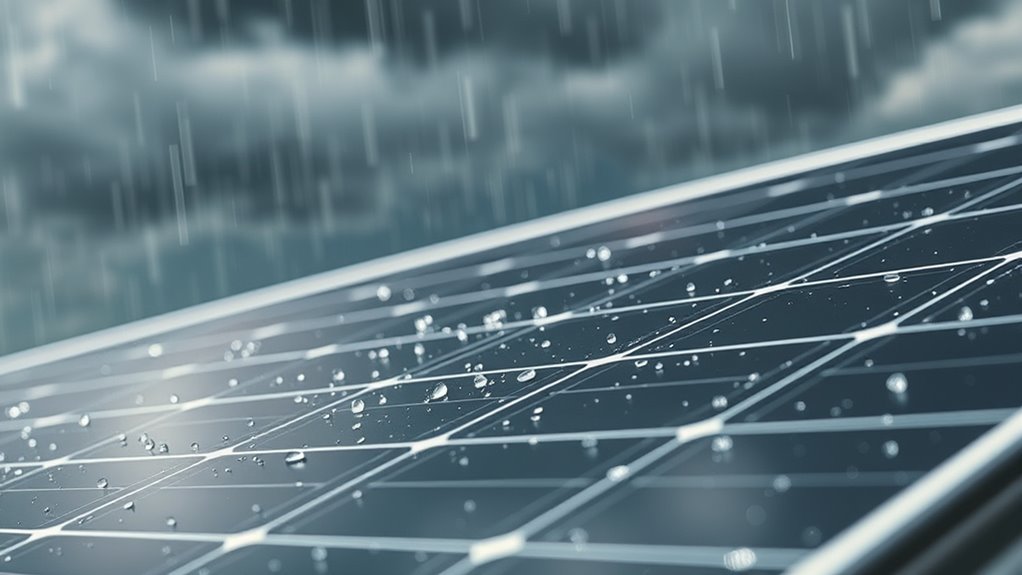
Hailstorms can pose a significant threat to solar panels, causing damage and reducing energy output. When hailstones strike, they can crack or shatter the glass surface, leading to costly repairs and downtime. The hail impact isn’t just superficial; it can compromise the integrity of the entire panel, decreasing its efficiency and lifespan. To combat this, understanding material durability becomes essential. The materials used in solar panels must withstand the relentless force of hail without losing their functionality or safety.
Modern solar panels are designed with durability in mind, often incorporating tempered glass that’s considerably more resistant to hail impact than standard glass. Tempered glass is engineered to absorb and distribute the energy from hailstones more evenly, making it less prone to cracking under impact. Its strength is a result of controlled thermal and chemical treatments that increase its ability to withstand sudden shocks. But even with tempered glass, the size and velocity of hailstones matter. Larger or faster-moving hail can still cause damage, which is why material science continually seeks advanced solutions that improve hail resistance.
Beyond glass, the encapsulant materials—such as EVA (ethylene vinyl acetate)—and backing layers also play essential roles in enhancing hail impact resistance. High-quality encapsulants can help absorb some of the energy from hail strikes, protecting the underlying solar cells. Researchers are exploring composite materials that combine strength with flexibility, allowing panels to bend slightly without cracking under impact. These innovations aim to improve the overall material durability of solar panels, making them more resilient during severe weather events.
The choice of frame material also influences a panel’s hail resistance. Aluminum frames, for example, are lightweight yet strong, providing structural support that helps minimize damage from hail impact. Some designs incorporate additional protective layers or coatings, such as anti-hail films or specialized surface treatments, to further bolster the panel’s defense against hailstones. These coatings not only add an extra layer of protection but can also improve the panel’s overall durability and longevity.
In essence, material science plays a critical role in determining whether solar panels can resist hailstorms. Engineers and scientists are constantly developing new materials and refining existing ones to enhance hail impact resistance. By focusing on material durability—strengthening glass, encapsulants, frames, and coatings—they aim to create solar panels that stand up to the worst weather conditions. While no panel is entirely hail-proof, ongoing advances are bringing us closer to solar solutions that can reliably operate through storms, ensuring consistent energy production and protecting your investment.
Conclusion
So, can solar panels withstand wicked hailstorms? With wise materials and innovative integrations, they can. Tempered glass, tough encapsulants, and tailored coatings team up to tackle tempestuous weather, transforming potential trouble into triumph. While no panel promises perfect protection, ongoing research continually refines resilience, reducing risks and restoring reliability. By embracing advanced materials, you’re empowering your panels to brave brutal hail, boosting durability, and delivering dependable sunshine despite severe storms. Stay strong, stay solar!