Imagine your yard is partly shaded by tall trees during the afternoon, making you wonder if solar panels will still work effectively. While shading can seem like a barrier, it doesn’t mean solar isn’t an option. With careful planning and the right strategies, you might still be able to harness solar energy. Curious about how to make it work in a shaded space? Here’s the approach that can help you get started.
Key Takeaways
- Conduct a detailed shading analysis to identify sunlit areas suitable for solar panel placement.
- Use advanced solar technology like microinverters or power optimizers to mitigate partial shading effects.
- Prune trees and remove obstructions to maximize direct sunlight exposure in the selected areas.
- Adjust panel orientation and tilt to optimize sunlight capture despite shading challenges.
- Regularly maintain and monitor the system to address new shading issues and sustain optimal performance.
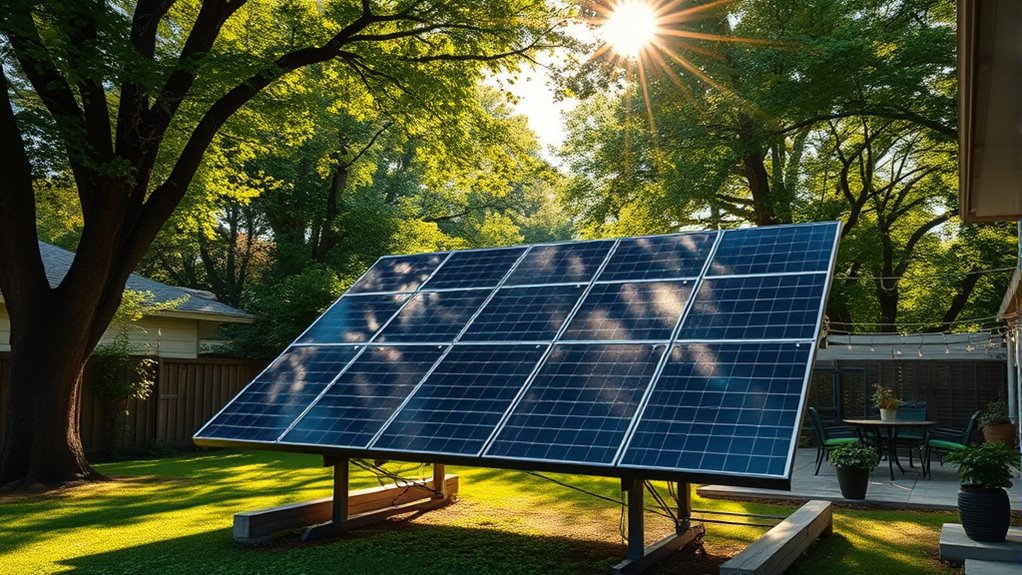
Have you ever wondered if your shaded yard can still power your home with solar energy? While sunlight is essential for solar panels to generate electricity effectively, a shaded yard doesn’t necessarily mean you’re out of luck. With the right approach, you can still harness solar power, but it requires careful planning and assessment. One of the first steps is understanding how shading impacts your system’s performance. That’s where shading analysis techniques come into play. These methods help you identify how much shade falls across different parts of your yard at various times of the day and throughout the year. By conducting a thorough shading analysis, you’ll gain a clear picture of which areas receive enough sunlight and when shading occurs, whether from trees, buildings, or other obstructions.
Understanding shading patterns helps optimize solar panel placement and maximize energy production.
Once you understand the shading pattern, you can strategize accordingly. For instance, if certain spots get partial shade during specific hours, you might consider installing panels in locations that receive more consistent sunlight, or you could opt for solar technologies better suited to shaded environments. Some advanced solar panel maintenance practices and equipment, such as microinverters or power optimizers, enhance energy production from partially shaded panels by maximizing the efficiency of each module individually. This way, even if some panels are shaded, others can still produce significant power, boosting your overall system output.
Additionally, placing panels on the least shaded areas of your roof or yard can make a notable difference. If your yard has tall trees or structures that cast shadows during particular times, trimming or pruning can reduce shading. Sometimes, simply relocating panels to a different part of your property or adjusting their tilt and orientation can improve performance. It’s also worth considering ground-mounted solar systems in open spaces that are less prone to shading, especially if your yard has variable shading patterns. Understanding shading analysis techniques can be crucial for optimizing your system’s efficiency in such environments.
Regular solar panel maintenance is essential regardless of shading conditions. Cleaning dust, debris, and snow ensures maximum efficiency, especially when panels are partially shaded. Keep an eye on your system’s performance and monitor for any new obstructions, like growing trees or new structures, that could impact shading. The combination of detailed shading analysis techniques, strategic placement, and diligent maintenance can maximize your solar energy output, even in a shaded yard. While it may require extra effort upfront, the potential for sustainable energy savings makes it a worthwhile investment. With patience and proper planning, you can turn even a shaded yard into a functional part of your solar energy solution.

Solar Micro Inverter, 600W 110v Microinverter with LCD Display, to 30v Or 36v Solar Panels, WVC-600W Grid Tie Inverter for Homes, Schools, Power Stations
- Maximum Power Point Tracking: Optimizes power harvesting from panels
- Reverse Power Transmission: Efficient power flow in grid mode
- Multiple Safety Protections: Over-voltage, under-voltage, short-circuit, overload, and temperature protection
As an affiliate, we earn on qualifying purchases.
As an affiliate, we earn on qualifying purchases.
Conclusion
Even in shadows, the sunlight’s promise remains within your reach. By carefully steering the shaded landscape, you become the gardener of your energy future, tending to each obstacle with strategy and care. With patience and innovation, you can turn your yard’s shadows into a guiding light, illuminating a path toward sustainable power. Remember, the brightest dawn often emerges after the darkest night—your solar journey is no different.