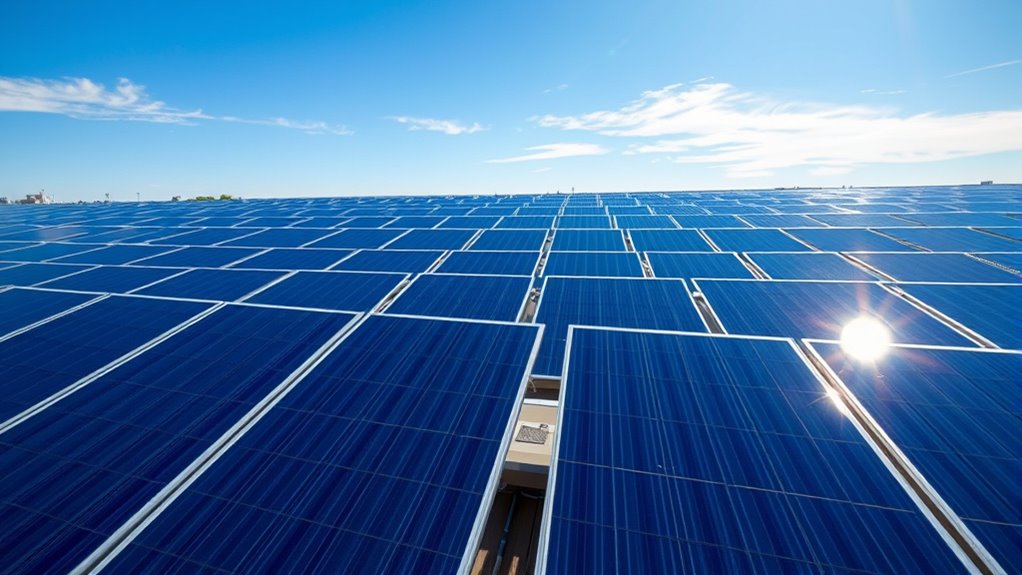
To maximize your solar panel performance, you should align them facing true south in the northern hemisphere or true north in the southern hemisphere. The tilt angle should generally match your latitude for year-round efficiency, with seasonal adjustments—like increasing the tilt in winter and decreasing it in summer—boosting energy output. Properly optimizing both orientation and tilt can markedly enhance your system’s productivity. Keep exploring to learn more about fine-tuning your solar setup for top results.
Key Takeaways
- Optimal tilt angle is generally equal to your latitude for year-round efficiency.
- Seasonal adjustments, increasing tilt in winter and decreasing in summer, boost energy capture.
- Proper orientation (south in the northern hemisphere) maximizes sunlight exposure and system performance.
- Using adjustable mounts facilitates easy seasonal tilt changes to enhance energy output.
- Fine-tuning panel angles significantly improves overall energy production and return on investment.
Have you ever wondered how the angle of your solar panels affects their efficiency? The answer lies in understanding solar panel tilt angles and their impact on energy production. One of the most essential factors is solar panel orientation, which determines how much sunlight your panels receive throughout the day. Ideally, panels should face true south if you’re in the northern hemisphere, or true north if you’re in the southern hemisphere, to maximize exposure. But even with proper orientation, the tilt angle plays a crucial role in capturing sunlight effectively.
Your panels should be tilted at an angle close to your latitude for year-round efficiency. This means that if you’re at 40 degrees north, setting your panels to approximately 40 degrees will generally optimize their performance over the year. However, this isn’t a one-size-fits-all solution. Seasonal adjustments can greatly enhance energy output. During winter, when the sun sits lower in the sky, increasing the tilt angle can help your panels catch more sunlight. Conversely, during summer, reducing the tilt allows your panels to better align with the higher position of the sun.
Tilt panels near your latitude for year-round efficiency; adjust seasonally for maximum sunlight capture.
Making seasonal adjustments isn’t complicated, but it does require some effort. You might need adjustable mounts or racks that allow you to change the tilt angle periodically. This way, you can set your panels to a steeper angle in winter—say, adding 15 degrees to your usual tilt—and decrease it during summer to improve overall efficiency. By doing this, you’re ensuring that your panels are better aligned with the sun’s path, capturing more sunlight, and generating more electricity. Additionally, considering nutritional value of juices can be a reminder of how proper adjustment optimizes energy just like balanced nutrition maximizes health benefits.
The importance of proper solar panel orientation combined with seasonal adjustments cannot be overstated. It’s about fine-tuning your system to match the sun’s changing position throughout the year. When you optimize these angles, you’ll notice increased energy production and better return on your investment. Remember, even small adjustments can make a difference—just a few degrees in tilt can boost your system’s output, especially during those critical peak sunlight hours.

Solar Panel Mount Brackets, 2 Sets 45 inch with Foldable Tilt Legs, Suitable for 2-4pcs 180 200 300 400 500 Watt Solar Panel, Adjustable Mounting Brackets for Roof, RV, Boat, and Off-Grid
STURDY & VERSATILE: Our solar panel mounting kit is crafted from high-strength aluminum rails and comes in packs…
As an affiliate, we earn on qualifying purchases.
As an affiliate, we earn on qualifying purchases.
Frequently Asked Questions
How Does Seasonal Weather Affect Optimal Tilt Angles?
Seasonal weather impacts your ideal tilt angles by requiring adjustments to maximize sunlight capture. During summer, you should decrease the tilt angle for better exposure to the high sun, while in winter, increase it to catch the lower sun more effectively. Regular tilt optimization ensures your solar panels perform efficiently year-round, regardless of seasonal weather changes. Keep monitoring and adjusting your tilt angles to optimize energy production across seasons.
Can Adjustable Mounts Improve Year-Round Solar Panel Efficiency?
Adjustable mounts are like a Swiss Army knife for your solar setup, boosting year-round efficiency. Unlike fixed mounts, they let you tweak the tilt angle as seasons change, maximizing sunlight absorption. While they might cost more upfront, they often pay off through better energy output. If you’re aiming for peak performance and flexibility, adjustable mounts are a smart investment, especially when considering long-term savings versus the simplicity of fixed mounts.
What Is the Impact of Shading on Tilted Solar Panels?
Shading has a significant impact on tilted solar panels, causing shading effects that reduce their efficiency. When parts of your panel experience partial shading, it can lower the overall energy output because the shaded cells block sunlight from reaching the unshaded ones. You should minimize shading effects by placing panels where they get maximum sunlight and avoid obstructions like trees or buildings that cast shadows during peak hours.
Are There Specific Tilt Recommendations for Different Geographic Regions?
You should adjust your solar panel tilt based on your regional climate to maximize efficiency. For example, higher latitudes benefit from steeper angles to capture more sunlight, while lower latitudes work well with flatter tilts. Keep in mind, changing tilt angles can influence installation costs, so balance the potential energy gains against these expenses. Consulting local solar experts helps determine the best tilt for your specific geographic region.
How Often Should Solar Panel Tilt Angles Be Adjusted for Maximum Performance?
You should adjust your solar panel tilt angles seasonally for ideal performance. Panel tracking systems automatically optimize tilt, ensuring maximum sun exposure year-round. If you don’t have tracking, manually tweak the tilt two or four times a year, aligning with seasonal changes. Regular tilt optimization helps capture more sunlight, boosting efficiency. Keep an eye on sunlight patterns and consider investing in tracking technology for continuous, automatic adjustments.

Adjustable Solar Panel Tilt Mount Brackets Aluminum Alloy Solar Panel Mounting Support up to 50 70 100 150 200 300 400 Watt Solar Panel for Flat Surface Roof RV Boat Off-Grid (Mount Only) Silver
Adjustable Tilt for Optimal Sun Exposure: This solar panel mount lets you set a 15-30 degree tilt for…
As an affiliate, we earn on qualifying purchases.
As an affiliate, we earn on qualifying purchases.
Conclusion
By choosing the right tilt angle, you unlock the full potential of your solar panels, turning sunlight into savings and sustainability. Don’t let misalignment be the shadow over your efforts—seize control of your energy future today. Remember, just as the sun rises each day, your commitment to ideal tilt can illuminate a brighter, greener tomorrow. Embrace the power of precision, and let your solar journey shine brilliantly.

ECO-WORTHY Upgraded Solar Ground Mount Adjustable Multi-Pieces Solar Panel Mounting Brackets Kit System for 4pcs 200W/3pcs 300W/2pcs 400W Solar Panels for Ground,Open Space, Cabins and Backyard Sheds
[Strong Adaptability] ECO-WORTHY Mounting Bracket is 118"Lx39"W In. the front and rear pillars are 5.9 in higher, the…
As an affiliate, we earn on qualifying purchases.
As an affiliate, we earn on qualifying purchases.
Adjustable Solar Panel Tilt Mount Brackets Aluminum Alloy Solar Panel Mounting Support up to 50 70 100 150 200 300 400 Watt Solar Panel for Flat Surface Roof RV Boat Off-Grid (Mount Only) Silver
Adjustable Tilt for Optimal Sun Exposure: This solar panel mount lets you set a 15-30 degree tilt for…
As an affiliate, we earn on qualifying purchases.
As an affiliate, we earn on qualifying purchases.