
TL;DR

Get compact home essentials delivered free — and shop member deals
- Fast, free delivery on millions of items
- Access to Prime Big Deal Days deals on October 6–7
- Prime Video, Amazon Music and more included
A framing-lumber stamp identifies the mill, grading agency, grade and wood species, information used to determine the board’s published structural design values. The 2024 International Residential Code requires load-supporting sawn lumber to carry a grade stamp or certificate of inspection; a stamp does not guarantee every board in a retail bin meets its grade.
A lumber stamp can tell buyers whether a framing board is rated for structural use, which wood species it is and who graded it—information that a price tag or a quick visual check cannot provide. A Family Handyman report says those details connect a board’s grade and species to published design values used in building-code span tables.
Most framing lumber carries a block of ink near one end identifying the mill, the grading agency, the board’s grade and its species. The stamp may also indicate how wet the wood was when it was surfaced, or planed to its final dimensions. These fields help distinguish boards that may look similar but are rated differently.
The grade reflects how features such as knots, splits and holes affect strength. Grade and species together key to published design values, which feed span tables for framing members such as joists and rafters. Those tables set allowable spans according to factors including lumber size, spacing, species and grade. The report says the 2024 International Residential Code requires sawn lumber used for load-supporting floor, wall and roof framing to carry a grade stamp or a certificate of inspection.
The stamp’s mill number helps identify where a board was produced; it does not determine how much weight the board can carry. The agency mark identifies the body supervising grading. The report says agencies accredited by the American Lumber Standard Committee (ALSC) supervise mills and that dimension-lumber rules must conform to a common National Grading Rule. That standardization is why a grade such as No. 2 has the same meaning under different accredited agency marks.
Why Grade Changes Framing Choices
For a homeowner or builder choosing lumber, the grade stamp is not just a tracking label: it carries information that can affect whether a board is appropriate for a load-bearing project. A board’s appearance alone may not reveal whether its defects put it in a lower grade, while the stamp connects its grade and species to the values used in span tables.
The report describes a lumber grader who saw a buyer reject five boards for wane—the loss of wood or bark along an edge—and choose five replacements that were all below grade. The example illustrates why picking boards by eye can mislead. It does not mean every visually imperfect board is unsuitable: the relevant question is how its characteristics affect its assigned grade and the use planned for it.
Stamps also have limits. ALSC Executive Vice President Paul Conway wrote that a grading unit is considered on grade when at least 95 percent of its pieces meet the grade. That unit-level standard does not guarantee every board in a retail bin is on grade. For structural work, buyers should follow applicable plans and code requirements rather than treating a stamp or appearance as a substitute for appropriate design and inspection.
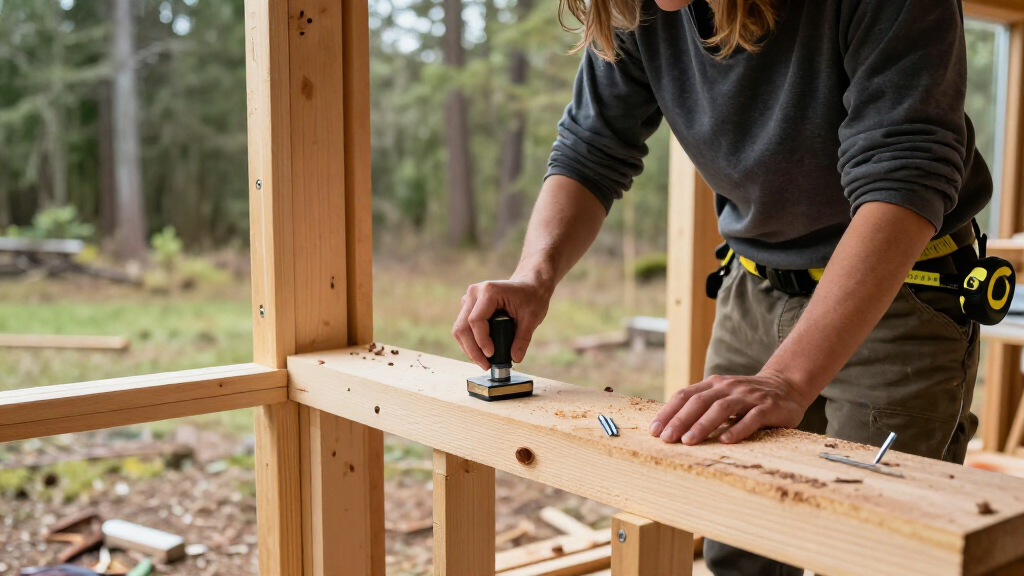
lumber grade stamp identification guide
As an affiliate, we earn on qualifying purchases.
As an affiliate, we earn on qualifying purchases.
How the Grading System Works
The report draws on the federal lumber standard PS 20 and the National Grading Rule for dimension lumber. ALSC accredits grading agencies under that framework. According to the report, an agency must inspect each mill at least 12 times a year, and PS 20 bars an agency controlled by a producer from being accredited to inspect that producer’s products.
The person grading a board is often a mill employee, but the agency oversees the grading system. The report identifies Western Wood Products Association, Pacific Lumber Inspection Bureau and Southern Pine Inspection Bureau among agencies buyers may encounter, alongside regional agencies and Canadian graders. The correct agency depends in part on the lumber’s origin and species. The report says ALSC’s January 2026 list included seven U.S. grading agencies and ten Canadian ones.
Design values are intended to account for weaker boards within a grade. Conway wrote that a published bending value is based on strength near the lower end of the grade and then divided by 2.1 for safety and long-term loads. The report attributes this explanation to the USDA Forest Products Laboratory’s Wood Handbook and Conway. These are design assumptions, not a guarantee that a particular board has been individually tested.
“I don’t think that they fully understand what it is they’re buying.”
— Pete Austin, Western Wood Products Association director of quality, as quoted in Family Handyman
What a Stamp Cannot Guarantee
A stamp identifies a board’s grade under the grading system, but it does not certify that every individual piece in a retail bin meets that grade. The report gives the 95-percent threshold for a grading unit; it does not say how often off-grade pieces appear in retail stores or how many a buyer might encounter.
Nor does the stamp by itself establish that a board is suitable for every project. Its use depends on the specific design, span, spacing, loading and applicable code requirements. The report explains that surfacing moisture information indicates how wet the wood was when planed, but the supplied material does not provide a method for predicting exactly how much a particular board will shrink after installation. A buyer who cannot identify an agency mark can compare it with ALSC’s published list, according to the report.
Check the Mark Before Building
Buyers can read the grade and species before selecting framing lumber, then compare an unfamiliar agency logo with ALSC’s list. For a structural application, those details should be checked against the project’s plans and relevant span tables rather than used as a stand-alone approval. The report does not announce a new rule or change to grading; it explains how the existing stamp and standards inform lumber selection.
For builders and homeowners, the practical next step is to keep the stamp legible and use its information when verifying that lumber matches the specified grade and species. If the stamp is missing or cannot be matched to an accredited agency, the report says the board counts as unstamped. The source material does not describe any further policy change or enforcement action.
Key Questions
What information is printed on a framing-lumber stamp?
A typical stamp identifies the mill, the grading agency, the board’s grade and its species. It may also show how wet the wood was when it was surfaced.
Why does lumber grade matter?
Grade reflects how characteristics such as knots, splits and holes affect strength. Together, grade and species link a board to published design values used in structural span tables.
Does a grade stamp guarantee every board in a store is on grade?
No. Paul Conway of ALSC said a grading unit is considered on grade if at least 95 percent of its pieces meet the grade. That unit-level standard does not guarantee every board in a retail bin meets it.
What should I do if I do not recognize the agency logo?
Check the mark against ALSC’s published list of accredited grading agencies. According to the report, a logo that is not on the list is not an accredited grade stamp, and the board counts as unstamped.
Does the stamp tell me exactly how much a board will shrink?
The stamp may indicate how wet the wood was when it was surfaced, which gives information about its moisture condition. The report does not say that the stamp predicts the exact amount a specific board will shrink after installation.
Source: rss
Halloween Picks
halloween
As an affiliate, we earn on qualifying purchases.