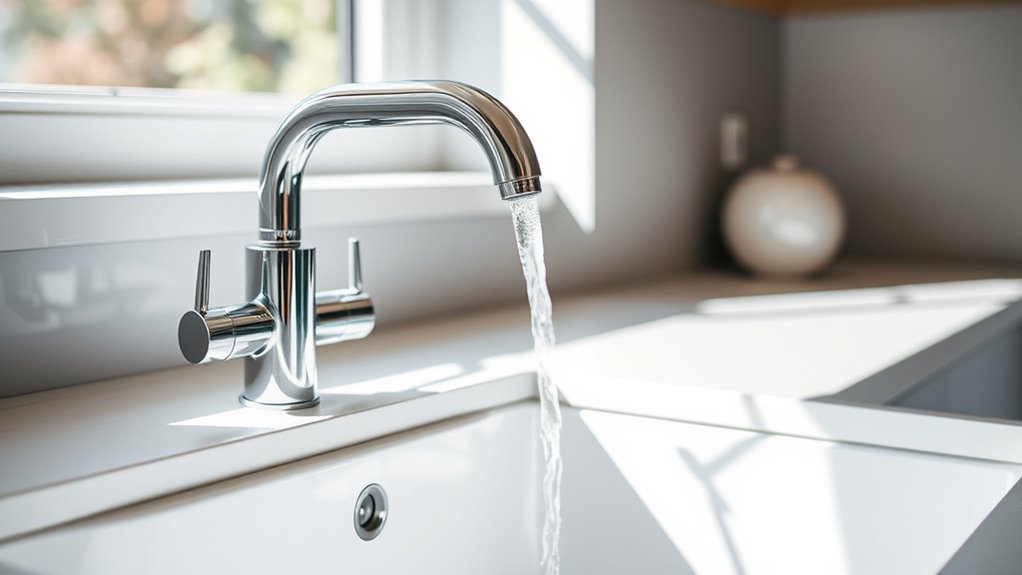

Water-Sense faucets are designed to conserve water, save energy, and reduce costs, yet how much they really save depends on your habits and household needs. They offer a balance of performance and efficiency, but questions remain about whether the investment pays off in the long run. If you’re considering upgrading your fixtures, understanding the true benefits could influence your decision—so, what do the numbers say about their actual savings?
Key Takeaways
- Water‑Sense faucets typically reduce water usage by about 30% compared to standard fixtures.
- The savings on water bills depend on household usage and can add up over time.
- Initial costs are usually comparable, with some models slightly higher but offset by long-term savings.
- Reduced water flow also lowers energy costs associated with heating water.
- Overall, Water‑Sense faucets provide significant water and energy savings while maintaining performance.

Are you looking for an easy way to conserve water and reduce your utility bills? Water‑Sense faucets might be just what you need. These fixtures are designed to use less water without sacrificing performance, which means you get the same comfort and convenience while being kinder to the environment—and your wallet. One of the first things to contemplate is the installation costs. Generally, Water‑Sense faucets are comparable in price to standard fixtures, though some models may be slightly more expensive upfront. However, the investment often pays off quickly because of the savings on your water bill. Plus, installation is straightforward for most DIY enthusiasts or professional plumbers, which helps keep costs down. You shouldn’t expect any major renovations or complicated setups, making these faucets a practical choice for most homes.
When it comes to user satisfaction, Water‑Sense faucets tend to score high among homeowners. They deliver a smooth flow of water while limiting waste, so you don’t have to compromise on function. Many users appreciate the consistent pressure and reliable operation that these faucets provide. Additionally, the modern designs and variety of styles mean you can find options that match your decor perfectly. This visual appeal adds to overall satisfaction, as you’ll enjoy using a fixture that looks great and performs well.
Another factor boosting user satisfaction is the environmental impact. Knowing that you’re helping conserve a precious resource makes using Water‑Sense faucets more rewarding. They’re engineered to reduce water flow without noticeable loss of performance, which means you can enjoy the same tasks—like washing hands or filling a glass—using less water. Over time, the cumulative savings on water and energy bills can be substantial, especially in households with frequent use. People often report that the initial adjustment period is minimal since the faucets operate just as efficiently as traditional ones.
Additionally, these faucets are part of a broader movement toward water conservation in homes, which is increasingly important in areas facing water scarcity.

SOEBIZ Kitchen Faucets with Pull Down Sprayer, Brushed Nickel High Arc Single Handle Stainless Steel Sink Faucet for 1 or 3 Hole, Ideal for Farmhouse RV Laundry Bar Camper & Commercial
Exceptional Value – Premium Performance at an Accessible Price Point. This kitchen faucet with pull down sprayer is…
As an affiliate, we earn on qualifying purchases.
As an affiliate, we earn on qualifying purchases.
Conclusion
So, while water-saving faucets might seem like just a small upgrade, they truly make a difference. Yes, the initial cost is similar to regular fixtures, but the long-term savings on water and energy bills add up quickly. Don’t worry about sacrificing style or performance—you’ll enjoy reliable, modern faucets that work just as well. By choosing WaterSense, you’re not only saving money but also helping conserve our precious water resources for the future.

Ryuwanku Bathroom Faucet Brushed Nickel Modern Waterfall Bathroom Sink Faucet with Single Handle Suitable for 1 or 3 Holes,Supply Deck Plate and Hose
[Single-Handle Design for Effortless Control] The single-handle design makes it easy to adjust water flow and temperature with…
As an affiliate, we earn on qualifying purchases.
As an affiliate, we earn on qualifying purchases.

2PCS 360 Degree Swivel Faucet Aerator Deluxe Water Saving Faucet Sprayer Water Saving Bubbler Pressurized Faucet Filter Kitchen Accessories (360 Degree, Count, 2)
Save energy: Faucet Nozzle Filter Adapter Water saving 30%~70% (compared with standard bubbler) Using 360° rotation: The water…
As an affiliate, we earn on qualifying purchases.
As an affiliate, we earn on qualifying purchases.

Tankless Water Heater Electric 6.5kW 240V, ECOTOUCH Instant Hot Water Heater On Demand for Sink Faucet, Energy Efficient Point of Use Tankless Water Heater with Self-modulating, ECO65BP Black
This tankless water heater electric 6.5kW is a perfect alternative option for those who are unhappy with small…
As an affiliate, we earn on qualifying purchases.
As an affiliate, we earn on qualifying purchases.