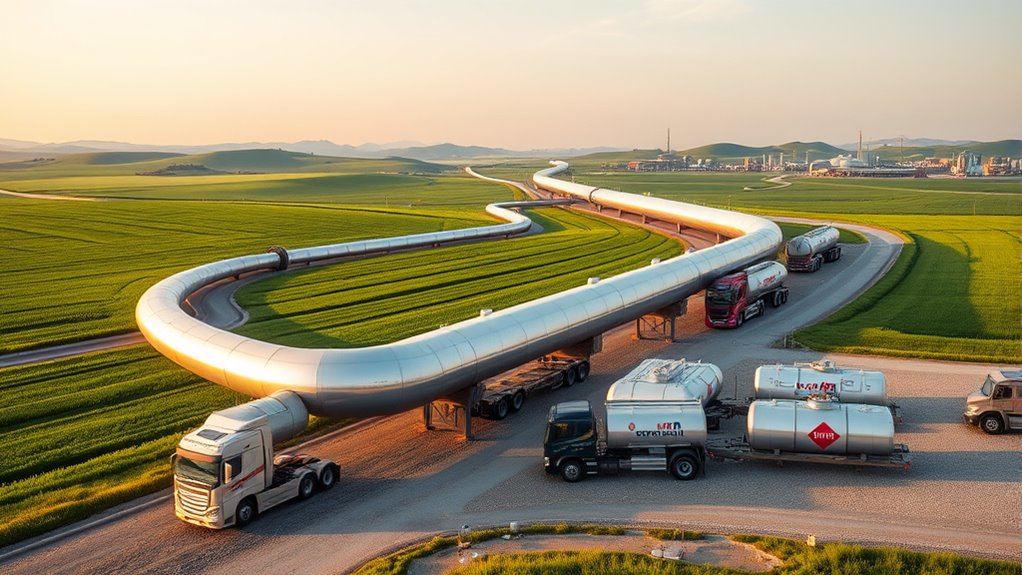

Deciding whether to use pipelines or trucking for local hydrogen transport isn’t always straightforward, especially when considering costs, safety, and flexibility. Each method offers unique advantages and challenges depending on your specific needs and location. Understanding these differences can help you make smarter choices as you plan your hydrogen infrastructure. But which option truly makes sense for your project? Let’s explore the factors that could influence your decision.

Get compact home essentials delivered free — and shop member deals
- Fast, free delivery on millions of items
- Access to Prime Big Deal Days deals on October 6–7
- Prime Video, Amazon Music and more included
Key Takeaways
- Pipelines are ideal for large, continuous hydrogen volumes, offering lower long-term costs and safety through underground, monitored systems.
- Trucking provides flexible, cost-effective transportation for smaller or irregular hydrogen demands and remote or dispersed locations.
- Safety considerations favor pipelines for underground, leak-detection capabilities, while trucking requires strict handling and driver training.
- Infrastructure costs and geographic factors influence suitability; pipelines require high upfront investment, trucking adapts to diverse terrains.
- Local demand size, frequency, and infrastructure readiness determine whether pipelines or trucking best serve specific areas.

When it comes to transporting hydrogen, choosing the right method can considerably impact cost, safety, and efficiency. One of the key factors to think about is how you’ll store and move the hydrogen from production sites to end-users. Storage options are vital because hydrogen needs to be kept either under high pressure, at low temperature as a liquid, or within solid materials. Each storage method has its own safety considerations. For example, high-pressure tanks are common but require rigorous safety protocols because a leak or rupture can lead to flammable and explosive hazards. Liquid hydrogen storage involves extremely low temperatures, which pose risks of frostbite and material brittleness, so specialized insulated tanks are necessary. Solid-state storage, like metal hydrides, can be safer but often needs more space and energy to release the hydrogen, affecting operational efficiency.
Choosing hydrogen transport methods involves balancing safety, storage options, and operational efficiency.
When evaluating pipeline versus trucking, safety considerations should be at the forefront. Pipelines, often seen as a safer, more continuous way to move large quantities of hydrogen, are designed with extensive safety measures. They are buried underground, reducing the risk of accidental damage, and can be monitored constantly for leaks or issues. However, pipelines require significant upfront investment and long-term planning, which can be a challenge in areas with lower demand or shorter-term projects. Trucking, on the other hand, offers flexibility; you can move hydrogen to different locations without the need for an extensive pipeline network. Still, safety concerns with trucking include the risks of accidents, spills, and fire hazards during transit. Proper containment, driver training, and adherence to transportation regulations are essential to guarantee safe delivery.
Cost considerations also influence which method makes more sense locally. Pipelines tend to have higher initial costs but lower operating expenses over time, especially for large, consistent volumes. Trucks might be more economical for small-scale or sporadic deliveries, but operating costs can add up quickly due to fuel, maintenance, and regulatory compliance. Additionally, the local infrastructure and geography play a significant role. If your area has a dense network of roads and short distances, trucking could be more practical. Conversely, remote or industrial zones with high hydrogen demand might benefit more from dedicated pipeline infrastructure.
Ultimately, your choice hinges on balancing storage options, safety considerations, and economic factors. Both methods have their advantages and challenges, and the best solution varies depending on your specific needs and local conditions. Carefully evaluating these aspects will help you determine whether pipeline or trucking hydrogen makes the most sense for your project.
hydrogen storage high pressure tanks
As an affiliate, we earn on qualifying purchases.
As an affiliate, we earn on qualifying purchases.
Conclusion
So, whether you’re dreaming of endless pipeline corridors or just want the flexibility of a trusty truck, remember: one’s perfect for big, steady jobs, while the other’s great for quick, scattered fixes. If safety and cost are your only concerns, pick your poison. But don’t worry—no matter what you choose, you’ll still be making a splash in the hydrogen world. Just try not to drown in the logistics chaos, okay?
Fall Picks
fall essentials
As an affiliate, we earn on qualifying purchases.