📊 Full opportunity report: Exploring US Backyard Homes Through Proptech And Real Estate on IdeaNavigator AI — validation score, market gap, and execution plan.

Get compact home essentials delivered free — and shop member deals
- Fast, free delivery on millions of items
- Access to Prime Big Deal Days deals on October 6–7
- Prime Video, Amazon Music and more included
TL;DR
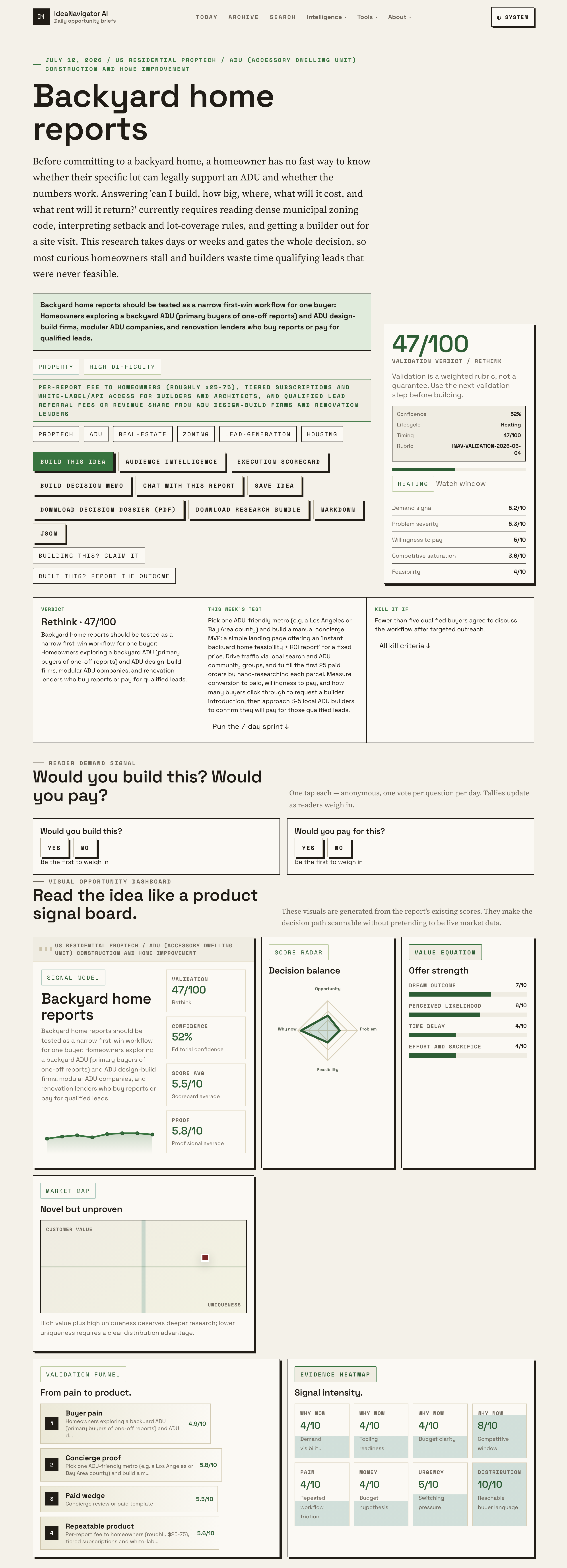
A proposed backyard-home report service would give homeowners an address-specific estimate of ADU rules, buildable area, costs and potential rent. The concept has not been shown to be operating or commercially validated; its suggested first step is to manually fulfill 25 paid reports in one California market.
IdeaNavigator AI has outlined a proposed service that would assess whether a specific U.S. property could support an accessory dwelling unit, or ADU, and estimate its costs and rental potential. The concept targets homeowners weighing a backyard home and firms seeking better-qualified customers, but it remains a business proposal: no launch, completed reports or customer results are described.
The proposed web app would let a homeowner enter a property address and pay for a PDF report. Using county parcel data, including lot boundaries, area and existing building footprint, it would compare the property with state ADU law and a curated set of local rules. The initial report could cover permitted ADU types, maximum size, setbacks, lot coverage and an estimated buildable area.
The report would also provide a build-cost range and projected rental income based on local rent comparisons. IdeaNavigator AI proposes starting in one metro area, such as a few counties in California, and manually curating the rules rather than attempting nationwide coverage. A button offering an introduction to a vetted builder would create a possible route to additional revenue.
The proposed business model combines one-off homeowner reports priced at roughly $25 to $75 with subscriptions or white-label and API access for builders and architects. It also suggests referral fees or revenue sharing with ADU design-build firms and renovation lenders. These are suggested prices and revenue streams, not reported sales or agreements.
A Faster First Check for ADUs
A parcel-specific screening report could address a costly early hurdle for homeowners: working out whether local rules allow an ADU on their lot before paying for extensive design work or a builder visit. The proposal says this information now requires homeowners to work through municipal codes, interpret setback and lot-coverage requirements, and obtain site-specific input. That process can take days or weeks, leaving some interested owners unable to make an informed next decision.
For builders, architects and lenders, the same screening could help identify inquiries with a plausible path to construction. That may reduce time spent qualifying properties that cannot meet basic requirements. Whether a software-generated report can do this reliably enough to justify its price, or provide leads worth paying for, remains to be tested.
The wider stakes are housing supply and homeowner finances. An ADU can create a separate home on an existing residential lot, but feasibility varies by parcel and local rules. A report that helps owners assess likely permissions, costs and rent could inform investment decisions. Its estimates would still need confirmation through local permitting and professional review before construction plans are finalized.
California’s ADU Policy Push
The proposal points to California as a potential starting market. It says the state began legalizing ADUs statewide in 2016 and has loosened rules in subsequent years, while other states and cities are also changing their approaches. Those shifts create a case for tools that organize rules by jurisdiction, though a state-level framework does not remove the need to check local parcel conditions and applicable requirements.
IdeaNavigator AI cites more than 45,000 ADUs permitted in Los Angeles County in 2023 and says ADUs account for roughly one in five new housing units produced in California. It also points to a U.S. housing shortage estimated in the millions. The figures are presented as rationale for exploring the business; they do not establish demand for a paid feasibility report or show how many homeowners would use one.
The proposed timing rests on the availability of parcel and zoning data and the use of language-model tools to parse building codes. The plan still calls for a manually curated rule set in the first market, indicating that automated code interpretation alone is not presented as sufficient for a dependable launch.
Accuracy, Demand and Lead Value
No operating product, paid orders, market test results or partnerships are reported. It is unclear how the proposed service would verify zoning interpretations, account for local exceptions, or update reports as rules change. Parcel records may describe lot dimensions and building footprints, but the proposal does not specify how it would handle incomplete records or site conditions that require an inspection.
The suggested build-cost bands and rental projections also depend on assumptions that are not detailed. Construction costs can vary with design, access and site work, while actual rent depends on the unit and local market. The proposal does not say how uncertainty would be displayed or whether its estimates would be reviewed by licensed professionals.
It is also unknown whether homeowners would pay the proposed fee, how often a report would lead to a builder introduction, or whether local firms and lenders would pay for those referrals. The cited permitting and housing figures provide context but do not answer those commercial questions.
A 25-Order Market Test
IdeaNavigator AI proposes selecting one ADU-friendly metro, such as a county in the Los Angeles or Bay Area region, and launching a basic landing page at a fixed report price. The first 25 paid orders would be researched by hand, using each parcel’s details and the selected market’s rules rather than relying on a fully automated system.
The pilot would track whether visitors convert to paid customers, what buyers are willing to pay and how many request an introduction to a builder. The proposal then calls for approaching three to five local ADU builders to ask whether they would pay for qualified leads. No timetable is given, and there is no stated outcome yet; the concept’s next evidence would be whether those homeowner orders and builder discussions happen.
Key Questions
Is the backyard ADU report service available now?
No launch or operating service is reported. IdeaNavigator AI describes a proposed business and a suggested pilot.
What would a homeowner report include?
The proposed PDF would assess ADU types and size, setbacks, lot coverage and estimated buildable area, along with a build-cost range and projected rent based on local comparisons.
How much might a report cost?
The proposal suggests a one-off homeowner price of roughly $25 to $75. This is a proposed range, not a confirmed price charged by an existing service.
How would the concept be tested?
The suggested test is to select one ADU-friendly metro, manually research the first 25 paid orders, measure purchase and builder-introduction interest, then speak with three to five local builders about paying for qualified leads.
Source: IdeaNavigator AI
Fall Picks
fall essentials
As an affiliate, we earn on qualifying purchases.