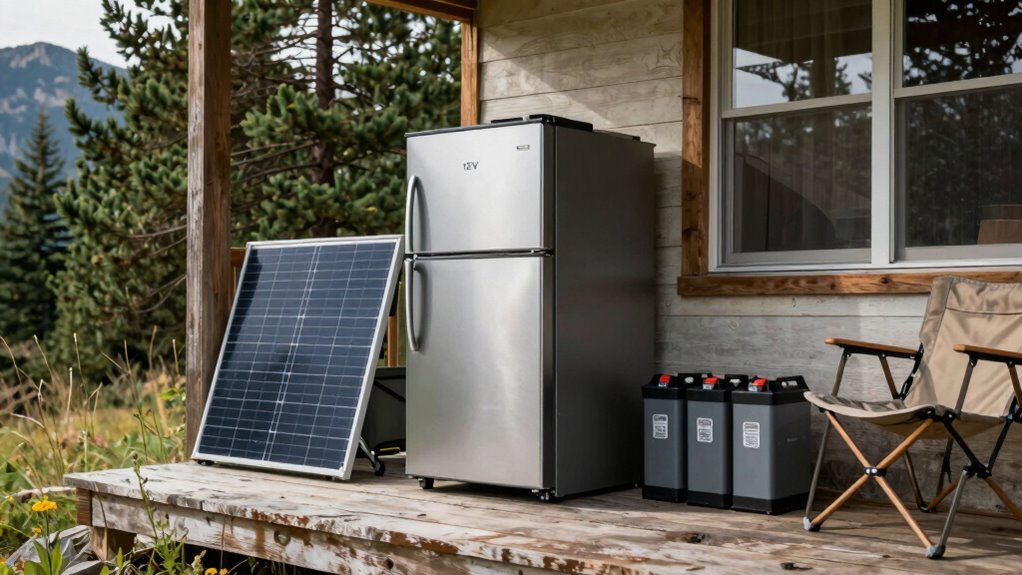

For most off-grid tiny houses, I’d start with the ICECO VL60 Dual Zone: its separate refrigerator and freezer zones offer flexible food storage, though its larger footprint and power needs call for a capable battery system. The EUHOMY 23-Quart is a better fit for one or two people with limited space, while the GEARPASS 2.3 Cu. Ft. offers a more home-like upright layout with a true freezer. The main tradeoffs are storage capacity versus floor space, portable flexibility versus built-in convenience, and cooling features versus battery demand. A 12V label alone does not tell you how well a refrigerator suits a solar-powered home; usable capacity, insulation, ventilation, and operating conditions matter too. Read on for my comparison of all 10 options and guidance on matching a refrigerator to your space and power budget.

Get compact home essentials delivered free with Prime
- Fast, free delivery on millions of items
- Prime Video, Amazon Music and more included
- Member-only deals all year
Key Takeaways
The ICECO VL60 earns the overall lead for flexible storage: dual zones suit households that want fresh and frozen food in one unit, but its size makes it a poor match for the smallest cabins.
Small households have a clear compact alternative: the EUHOMY 23-Quart takes less room than larger dual-zone choices, though its capacity may require more frequent grocery trips.
Portable and upright designs solve different problems: most picks are chest-style portable units, while the GEARPASS and Smad offer upright refrigerator layouts that may be easier to organize in a fixed kitchen.
Dual-zone capacity is not automatically an advantage: the ICECO VL60, Feelfunn 61-Quart, and EKOJUCE 37QT offer compartment flexibility, but buyers should match that storage to real freezer needs and available battery capacity.
The Smad stands apart on power-source flexibility: its 3-way design may suit some RV-style setups, while most other picks are aimed at 12V or 12V/24V electrical systems and need a compatible off-grid power plan.
| ICECO VL60 Dual Zone Portable Refrigerator with SECOP Compressor and Insulated Cover |  | Best for Dedicated Two-Zone Storage | Capacity: 60 liters | Zones: 2 independently controlled zones | Cooling range: 0°F to 50°F (-18°C to 10°C) | VIEW ON AMAZON | See Our Full Breakdown |
| A-Premium 21-Quart Portable Car Refrigerator and Freezer |  | Best Compact Pick for Low-Volume Storage | Capacity: 21 quarts (20.1 liters) | Temperature range: -4°F to 68°F | Cooling method: Compressor | VIEW ON AMAZON | See Our Full Breakdown |
| YELLOW JACKET 16-Quart Portable Car Refrigerator and Freezer |  | Best for Minimalists and Occasional Use | Capacity: 16 quarts (15.3 liters) | Temperature range: -4°F to 68°F | Cooling method: Compressor | VIEW ON AMAZON | See Our Full Breakdown |
| Feelfunn 61-Quart Dual-Zone 12V Portable Refrigerator |  | Best High-Capacity Value for Two-Zone Storage | Capacity: 61 quarts (58 liters) | Zones: 2 independently controlled zones | Temperature range: -4°F to 68°F | VIEW ON AMAZON | See Our Full Breakdown |
| EUHOMY 48-Quart Portable 12V Refrigerator and Freezer |  | Best Mid-Size Everyday Storage | Capacity: 48 quarts | Temperature range: -4°F to 68°F | Cooling method: Compressor | VIEW ON AMAZON | See Our Full Breakdown |
| EUHOMY 23-Quart Portable 12V Refrigerator and Freezer |  | Best Compact Pick | Capacity: 23 quarts | Temperature range: -4°F to 68°F | Cooling method: Compressor | VIEW ON AMAZON | See Our Full Breakdown |
| VEVOR 40L Portable 12V/24V Car Refrigerator and Freezer |  | Best Lightweight Mid-Size Pick | Capacity: 40 liters (42.3 quarts) | Temperature range: 14°F to 50°F | Cooling method: Compressor | VIEW ON AMAZON | See Our Full Breakdown |
| GEARPASS 2.3 Cu. Ft. Portable Refrigerator with True Freezer |  | Best Separate Freezer Compartment | Capacity: 2.3 cu. ft. | Freezer temperature: Down to -4°F | Refrigerator temperature: 32°F–46°F | VIEW ON AMAZON | See Our Full Breakdown |
| Smad 3-Way Compact RV Refrigerator, 2.1 Cu. Ft., Black |  | Best LPG-Ready Option | Capacity: 2.1 cubic feet | Power sources: 12V, 110V, or LPG | LPG pressure: 2.8 kPa (28 mbar) | VIEW ON AMAZON | See Our Full Breakdown |
| EKOJUCE 37QT Dual-Zone 12V Portable Car Refrigerator |  | Best Dual-Zone Portable Pick | Capacity: 37 quarts | Zones: Dual zone: 7.5-quart left and 29.5-quart right | Temperature range: -4°F to 68°F per zone | VIEW ON AMAZON | See Our Full Breakdown |
| 12v refrigerator for off grid tiny house | Capacity | Temperature range | Cooling method | Power input |
|---|---|---|---|---|
| ICECO VL60 Dual Zone Portable | 60 liters | — | — | 12/24V DC; 110–240V AC |
| A-Premium 21-Quart Portable Ca | 21 quarts (20.1 liters) | -4°F to 68°F | Compressor | 12/24V DC; 110/240V AC |
| YELLOW JACKET 16-Quart Portabl | 16 quarts (15.3 liters) | -4°F to 68°F | Compressor | 12/24V DC; 110/240V AC |
| Feelfunn 61-Quart Dual-Zone 12 | 61 quarts (58 liters) | -4°F to 68°F | — | 12/24V DC and 100–240V AC listed; 12V DC also specified |
| EUHOMY 48-Quart Portable 12V R | 48 quarts | -4°F to 68°F | Compressor | 12/24V DC; 100–240V AC |
| EUHOMY 23-Quart Portable 12V R | 23 quarts | -4°F to 68°F | Compressor | — |
| VEVOR 40L Portable 12V/24V Car | 40 liters (42.3 quarts) | 14°F to 50°F | Compressor | — |
| GEARPASS 2.3 Cu. Ft. Portable | 2.3 cu. ft. | — | Compressor | 12V/24V DC and 110V AC |
| Smad 3-Way Compact RV Refriger | 2.1 cubic feet | 32°F to 50°F | Absorption | — |
| EKOJUCE 37QT Dual-Zone 12V Por | 37 quarts | -4°F to 68°F per zone | Compressor | — |
More Details on Our Top Picks
ICECO VL60 Dual Zone Portable Refrigerator with SECOP Compressor and Insulated Cover
For a tiny house where frozen food and fresh groceries need separate space, the ICECO VL60’s independently controlled zones give it a clear advantage over single-zone options such as the YELLOW JACKET 16-Quart. It can run as a refrigerator and freezer at once, while its 12/24V DC and AC inputs suit both an off-grid battery setup and shore or household power. The included insulated cover and ECO mode may help limit cooling demand, though actual use will depend on ambient conditions and how often the lid is opened. The tradeoff is scale: at 64 pounds and over 31 inches wide, it takes substantial floor or counter space and is not easy to reposition. Its listed freezer capacity also appears inconsistent with its overall capacity, so verify the usable compartment measurements before planning storage.
Pros:- Two independently controlled zones can refrigerate and freeze at once
- Accepts 12/24V DC and 110–240V AC power
- ECO and MAX modes offer lower-power operation or faster cooling
- Insulated cover, interior lights, and removable baskets are included
Cons:- At 64 pounds and 31.2 inches wide, it is bulky to move and place in a tiny house
- The listed 63-quart freezer capacity conflicts with the stated 60-liter overall capacity
- Two zones and a large capacity may be more than a minimal off-grid setup needs
Best for: Tiny-house residents who regularly store frozen food and fresh groceries at the same time and have room for a large, mostly fixed appliance.
Not ideal for: Solo occupants with limited floor space or a small solar-and-battery system who need a light, low-draw refrigerator.
- Capacity:60 liters
- Zones:2 independently controlled zones
- Cooling range:0°F to 50°F (-18°C to 10°C)
- Power input:12/24V DC; 110–240V AC
- Dimensions:19.5 × 31.2 × 18.9 inches (D × W × H)
- Weight:64 pounds
- Compressor:SECOP
- Refrigerant:R1234yf
- Included component:Insulated cover
Our verdict“Choose the ICECO VL60 if you need separate freezer and refrigerator space and can spare the room and power budget.”
A-Premium 21-Quart Portable Car Refrigerator and Freezer
The A-Premium 21-Quart is the most compact fit in this group for a tiny-house resident who wants chilled food without giving up much floor space. Its 20.1-liter capacity is far below the EUHOMY 48-Quart’s, so it suits one person’s essentials better than a household pantry. The compressor reaches -4°F, giving it genuine freezer capability, and the 12/24V DC input works with a battery-based system; AC input adds flexibility when grid power is available. ECO mode is specified at under 0.5 kWh per day, a useful planning figure, though real consumption varies with conditions. The touchscreen and USB port add convenience, but the manual defrost means occasional upkeep, and the product details do not say whether a battery is included. Its one-year warranty is also shorter than the ICECO VL60’s compressor coverage.
Pros:- Compact 21-quart size fits tighter spaces than the 48- and 60-quart models
- Compressor cooling reaches -4°F for freezer use
- ECO mode has a stated power-use figure of under 0.5 kWh per day
- Touchscreen display, USB charging port, and AC/DC inputs
Cons:- Limited 20.1-liter capacity is restrictive for shared household food storage
- Manual defrost requires periodic maintenance
- Battery inclusion is not specified and the warranty is one year
Best for: One-person tiny-house residents who need a small compressor fridge-freezer for daily essentials and occasional frozen items.
Not ideal for: Couples, families, or meal preppers who need substantial grocery storage or want to avoid manual defrosting.
- Capacity:21 quarts (20.1 liters)
- Temperature range:-4°F to 68°F
- Cooling method:Compressor
- Power input:12/24V DC; 110/240V AC
- ECO-mode power use:Under 0.5 kWh per day
- Noise level:Under 45 dB
- Dimensions:13.19 × 24.21 × 11.53 inches (D × W × H)
- Defrost system:Manual
- Warranty:One year
Our verdict“Pick the A-Premium if compact dimensions matter more than storing a week’s groceries for multiple people.”
YELLOW JACKET 16-Quart Portable Car Refrigerator and Freezer
With only 16 quarts of capacity, the YELLOW JACKET is better viewed as a compact food locker than the main refrigerator for a shared tiny house. That small footprint is its strongest distinction from the EUHOMY 48-Quart, which offers room for far more groceries but occupies more space. The YELLOW JACKET can cool to -4°F, accepts both AC and DC power, and includes built-in car-battery protection—useful safeguards when operating from a vehicle-style electrical supply. Its stated cooling speed is appealing when loading warm items, though repeated rapid cooling can affect energy use. Bluetooth app control adds remote adjustment, but this unit operates as a fridge or freezer one mode at a time, unlike the ICECO VL60’s two separate zones. Frost-free operation cuts routine defrost work; capacity remains the main limitation for everyday household use.
Pros:- Small 16-quart format is easier to fit into a compact layout
- Reaches -4°F and can operate as a refrigerator or freezer
- Supports AC and DC power and includes built-in car-battery protection
- Frost-free design and Bluetooth app controls
Cons:- 16-quart capacity is restrictive for primary household use
- Fridge and freezer functions cannot run simultaneously
- Cooling performance claims do not indicate actual off-grid energy consumption
Best for: A minimalist living alone who needs a small secondary fridge-freezer, or a tiny-house owner who stores only a few chilled items at a time.
Not ideal for: Households that need a primary grocery refrigerator, separate frozen storage, or capacity for several days of food.
- Capacity:16 quarts (15.3 liters)
- Temperature range:-4°F to 68°F
- Cooling method:Compressor
- Cooling time:68°F to 32°F in 15 minutes; reaches -4°F within an hour
- Power input:12/24V DC; 110/240V AC
- Controls:Touch panel and Bluetooth app
- Battery protection:Built in
- Defrost system:Frost free
- Warranty:One year
Our verdict“Choose the YELLOW JACKET for a compact secondary unit, not as the main food-storage appliance for most tiny houses.”
Feelfunn 61-Quart Dual-Zone 12V Portable Refrigerator
The Feelfunn pairs 61 quarts of storage with two independently controlled zones, making it a practical alternative for tiny-house residents who want both fresh and frozen food but do not need the ICECO VL60’s specified SECOP compressor. At 42.2 pounds, it is lighter than the 64-pound ICECO, although its nearly 29-inch width still calls for a planned parking spot. Battery protection, ECO mode, and stated power draw under 30W in ECO mode make it easier to evaluate for a DC system; the listed annual energy use of 207 kWh, however, is a reminder that large capacity still carries an energy cost. Anti-shake mounting points and a bottom drain suit mobile use and cleanup. The one-year warranty and unspecified compressor brand are tradeoffs, and the listed voltage details vary across the product information.
Pros:- Two independently controlled zones allow simultaneous refrigeration and freezing
- ECO mode is listed below 30W, with battery protection for DC operation
- Lighter than the 64-pound ICECO VL60 while offering similar capacity
- Includes anti-shake mounting points, LED lights, a removable basket, and a drain
Cons:- The listed annual energy consumption is 207 kWh, which may challenge a small solar system
- At 28.74 inches wide, it still needs significant space in a tiny house
- Voltage specifications vary across the listing and warranty coverage is one year
Best for: Tiny-house couples or small households that need separate freezer and refrigerator zones, have room for a large unit, and want stated ECO-mode wattage.
Not ideal for: Very small off-grid systems or compact floor plans where a large dual-zone appliance would consume too much space or energy.
- Capacity:61 quarts (58 liters)
- Zones:2 independently controlled zones
- Temperature range:-4°F to 68°F
- Power input:12/24V DC and 100–240V AC listed; 12V DC also specified
- Power consumption:Under 30W in ECO mode; 50W in Max mode
- Annual energy consumption:207 kWh listed
- Dimensions:16.14 × 28.74 × 22.05 inches
- Weight:42.2 pounds
- Warranty:One year
Our verdict“The Feelfunn suits buyers who want large dual-zone storage with stated ECO wattage and can accommodate its footprint and energy demand.”
EUHOMY 48-Quart Portable 12V Refrigerator and Freezer
The EUHOMY 48-Quart lands between the small A-Premium and the larger dual-zone ICECO VL60: it offers room for a household’s regular groceries without the ICECO’s two-zone layout or greater stated capacity. Its 48-quart compartment is listed to hold up to 46 standard cans, but tiny-house buyers should focus on usable food space rather than can count. AC and DC inputs, three-level battery protection, and ECO/MAX modes make it adaptable to battery power and faster pull-down when needed. The LCD panel and app provide two ways to adjust settings, while the removable basket helps organize contents. Its average power consumption is listed at 45W, so this is not automatically a low-demand choice for a small solar system. Warranty details also conflict: the information mentions two-year tech support and a one-year manufacturer warranty.
Pros:- 48-quart capacity offers more everyday storage than the 16- and 21-quart models
- Accepts 12/24V DC and 100–240V AC power
- Three-level battery protection and ECO/MAX modes support flexible operation
- LCD and app controls, LED light, and removable basket aid daily use
Cons:- Average power consumption is listed as 45W, which may be demanding for a small off-grid system
- The single-zone design does not match the ICECO VL60 for simultaneous refrigeration and freezing
- Warranty information is inconsistent between one-year manufacturer coverage and two-year tech support
Best for: One- or two-person tiny-house residents who want a mid-size primary refrigerator-freezer and value app controls, battery protection, and flexible power inputs.
Not ideal for: Buyers who need separate freezer and refrigerator zones, a clearly stated low daily energy draw, or unambiguous warranty terms.
- Capacity:48 quarts
- Temperature range:-4°F to 68°F
- Cooling method:Compressor
- Power input:12/24V DC; 100–240V AC
- Average power consumption:45W
- Can capacity:Up to 46 standard 12-ounce cans
- Controls:LCD panel and app
- Battery protection:Three-level
- Model:CF-45
Our verdict“Pick the EUHOMY if you want more grocery space than a compact unit provides but do not need independently controlled zones.”
EUHOMY 23-Quart Portable 12V Refrigerator and Freezer
For a tiny house with limited floor or counter space, the 23-quart EUHOMY offers a small compressor-cooling option that can also move between the house and a vehicle. Its stated 45W draw and three-level battery protection help make it practical for a modest off-grid power setup, while AC and DC inputs allow use with different power sources. It can cool from 77°F to 32°F in 15 minutes, and its temperature range reaches -4°F for occasional freezer use. Compared with the larger VEVOR 40L, this model saves space but gives you less room for groceries; the GEARPASS is a better fit if you want separate food and freezer compartments. The tradeoff is capacity: it suits essentials, not a full household shop. Its one-year manufacturer warranty is also limited.
Pros:- Compact 23-quart capacity is easier to fit in a small living space
- Operates from AC or 12/24V DC power
- Three-level battery protection offers selectable protection settings
- Can cool or freeze, with frost-free defrosting
Cons:- Capacity is limited for regular household grocery storage
- One-year manufacturer warranty is short for a primary appliance
- At 40 dB, it may be audible in a very small sleeping area
Best for: Tiny-house occupants with a compact solar or battery system who need a small fridge for essentials and occasional freezer use.
Not ideal for: Households storing a week or more of groceries, or anyone who needs clearly separate refrigerator and freezer compartments.
- Capacity:23 quarts
- Temperature range:-4°F to 68°F
- Cooling method:Compressor
- Power consumption:45W
- Power sources:100/240V AC and 12/24V DC
- Battery protection:Three levels: L/M/H
- Noise level:40 dB
- Control:Bluetooth app and touch control
Our verdict“Choose this EUHOMY when compact size and flexible power inputs matter more than storing a large food supply.”
VEVOR 40L Portable 12V/24V Car Refrigerator and Freezer
The VEVOR 40L lands between the smallest portable units and larger dual-zone choices, making it a useful middle ground when a tiny-house kitchen needs more than a drinks cooler but cannot give up much room. Its 17.9-pound weight and EPP construction make it easier to carry than the EKOJUCE 37QT, which weighs 30.2 pounds, though neither replaces a built-in refrigerator for settled daily use. The VEVOR can refrigerate or freeze, cools from 68°F to 32°F in 18 minutes, and includes app control and a three-level battery guard. Its listed temperature range is 14°F to 50°F, so it does not offer the very low freezer setting available on the GEARPASS or EUHOMY 23-quart model. It also requires a power connection and may be undersized for extended stays with several people.
Pros:- 40L capacity offers more room than the compact EUHOMY 23-quart
- 17.9-pound weight and EPP construction make it relatively easy to carry
- Supports both refrigeration and freezing
- App control and three-level battery protection are included
Cons:- Requires an active power connection rather than operating on LPG
- Temperature range bottoms out at 14°F, warmer than models that reach -4°F
- May not hold enough food for larger households or long resupply intervals
Best for: One- or two-person tiny-house residents who want portable, moderate-capacity cooling and expect to move the unit between living space and vehicle.
Not ideal for: Families or full-time residents who need a large weekly food store, or buyers seeking separate fridge and freezer zones.
- Capacity:40 liters (42.3 quarts)
- Temperature range:14°F to 50°F
- Cooling method:Compressor
- Voltage:12V/24V DC
- Cooling time:68°F to 32°F in 18 minutes
- Battery protection:Three-level battery guard
- Dimensions:20.1 × 16.7 × 15.2 inches
- Weight:17.9 lb
Our verdict“Pick the VEVOR if you want a carryable mid-size compressor fridge and can work within its capacity and freezer-temperature limits.”
GEARPASS 2.3 Cu. Ft. Portable Refrigerator with True Freezer
The GEARPASS CR65X is the strongest fit here for someone who wants a more conventional tiny-house food setup: separate fresh-food and freezer compartments reduce the need to switch one cavity between jobs. The freezer reaches -4°F, while the refrigerator adjusts from 32°F to 46°F, and four shelves plus door storage help organize everyday groceries. Unlike the portable EUHOMY 23-quart and VEVOR 40L, this 2.3-cu.-ft. unit is shaped more like a small household appliance than a grab-and-go cooler. It accepts both DC and AC power and has app and display controls, but the product data does not give a wattage figure, so off-grid buyers cannot estimate its draw from these specs alone. The two-year warranty is longer than several portable alternatives; its larger, more fixed format is less convenient to move.
Pros:- Separate refrigerator and freezer compartments support simultaneous storage
- Freezer reaches -4°F
- Four shelves and door storage help organize food
- Accepts 12/24V DC and 110V AC power
Cons:- Less convenient to carry than the smaller portable cooler-style models
- Power consumption is not specified in the supplied product data
- The single door serves both compartments
Best for: Tiny-house residents who want separate refrigerator and freezer storage and have room for a small, more appliance-like unit.
Not ideal for: Buyers prioritizing easy portability or those who need a published power-consumption figure to size a solar system.
- Capacity:2.3 cu. ft.
- Freezer temperature:Down to -4°F
- Refrigerator temperature:32°F–46°F
- Power input:12V/24V DC and 110V AC
- Cooling method:Compressor
- Compartments:Separate refrigerator and freezer zones
- Shelves:4
- Warranty:2 years
Our verdict“Choose the GEARPASS if separate freezer and fresh-food zones matter more than portability or a clearly stated wattage figure.”
Smad 3-Way Compact RV Refrigerator, 2.1 Cu. Ft., Black
The Smad 3-Way stands apart from the compressor coolers in this roundup because it can run on LPG as well as 12V or 110V power. That flexibility may suit a tiny house whose energy plan includes propane, especially when battery capacity is reserved for other loads. Its absorption cooling system is quiet, and the 2.1-cu.-ft. capacity is closer to a compact installed fridge than the portable EUHOMY and VEVOR units. The tradeoff is installation: this refrigerator needs clearance around and above it for ventilation, so it is not a simple drop-in choice for every tight kitchenette. Its 32°F–50°F range also does not provide a true freezer, unlike the GEARPASS or dual-zone EKOJUCE. I would choose the Smad for LPG flexibility and quiet operation, not for freezing or fast pull-down cooling.
Pros:- Runs on 12V, 110V, or LPG
- Quiet absorption cooling suits small living and sleeping spaces
- 2.1-cu.-ft. capacity offers more household-style storage than the smallest portable units
- Two removable shelves allow some interior adjustment
Cons:- Requires ventilation clearance around and above the refrigerator
- 32°F–50°F range does not provide freezer storage
- Absorption cooling may not suit buyers seeking the quick cooling times listed for compressor models
Best for: Tiny-house owners with LPG in their power plan who can provide ventilation clearance and need quiet, refrigerator-only storage.
Not ideal for: Buyers who need a freezer, rapid compressor cooling, or a unit that can be tightly enclosed without ventilation space.
- Capacity:2.1 cubic feet
- Power sources:12V, 110V, or LPG
- LPG pressure:2.8 kPa (28 mbar)
- Temperature range:32°F to 50°F
- Cooling method:Absorption
- Dimensions:18.9 × 18.2 × 27.4 inches
- Weight:51.5 lb
- Warranty:1 year
Our verdict“Choose the Smad if LPG operation and quiet running outweigh the need for a freezer and a compact, sealed installation.”
EKOJUCE 37QT Dual-Zone 12V Portable Car Refrigerator
The EKOJUCE 37QT is for tiny-house residents who want a portable fridge and freezer running at the same time. Its independently controlled zones can each be set from -4°F to 68°F, unlike the single-cavity EUHOMY 23-quart, which requires one compartment to handle both roles. The split is uneven: the left zone holds only 7.5 quarts, while the right holds 29.5, so it works better for a small freezer portion beside a larger fridge than for two equal stores. AC and DC accessories make it usable at home or in a vehicle, and ECO-mode draw is listed below 50W. At 30.2 pounds, it is much heavier than the VEVOR 40L, making frequent carrying less appealing. Its reversible door, basket, battery protection, and sub-42 dB operation add practical flexibility, but the one-year warranty is limited.
Pros:- Independent zones allow refrigeration and freezing at the same time
- Both zones offer a temperature range from -4°F to 68°F
- AC and DC power accessories support use at home or on the road
- Battery protection, reversible door, and removable basket add practical flexibility
Cons:- The 7.5-quart left zone is much smaller than the 29.5-quart right zone
- 30.2-pound weight makes it less convenient to move than the VEVOR
- One-year warranty is limited
Best for: Off-grid tiny-house occupants who want simultaneous freezing and refrigeration in a portable unit and can use the smaller zone for limited freezer storage.
Not ideal for: Buyers who need equal-sized zones, a lightweight unit for frequent carrying, or a longer manufacturer warranty.
- Capacity:37 quarts
- Zones:Dual zone: 7.5-quart left and 29.5-quart right
- Temperature range:-4°F to 68°F per zone
- Cooling method:Compressor
- Power:12/24V DC and 100–240V AC
- Energy use:Under 50W in ECO mode; under 60W in MAX mode
- Noise level:Under 42 dB
- Weight:30.2 lb
- Warranty:1 year
Our verdict“Choose the EKOJUCE if you need separate portable fridge and freezer zones and can accept an uneven compartment split and heavier build.”

How We Picked
I ranked these refrigerators for the realities of an off-grid tiny house, not for car trips alone. The comparison weighs usable capacity against footprint, whether the layout supports separate frozen storage, the stated power compatibility, and how easily the unit could fit into a small living space. I also looked at practical ownership factors such as portability, likely ventilation needs, and the difference between a chest-style portable appliance and an upright refrigerator.
The order favors models with a useful balance of storage flexibility, tiny-house fit, and clear purpose. That puts the ICECO VL60 first for households that can support its larger dual-zone format, while compact units rank higher for limited space and simpler needs. The GEARPASS and Smad have distinct appeal for fixed kitchen layouts or alternative power setups, but neither is a universal substitute for a 12V portable fridge. Product claims do not establish real-world energy use in every climate, so I treat power planning as a buyer check rather than assuming a particular daily draw.
| 12v refrigerator for off grid tiny house | Cooling method |
|---|---|
| ICECO VL60 Dual Zone Portable | — |
| A-Premium 21-Quart Portable Ca | Compressor |
| YELLOW JACKET 16-Quart Portabl | Compressor |
| Feelfunn 61-Quart Dual-Zone 12 | — |
| EUHOMY 48-Quart Portable 12V R | Compressor |
| EUHOMY 23-Quart Portable 12V R | Compressor |
| VEVOR 40L Portable 12V/24V Car | Compressor |
| GEARPASS 2.3 Cu. Ft. Portable | Compressor |
| Smad 3-Way Compact RV Refriger | Absorption |
| EKOJUCE 37QT Dual-Zone 12V Por | Compressor |
Factors to Consider When Choosing 12v Refrigerator For Off Grid Tiny House
Choosing a refrigerator for a small off-grid home is a system decision: the appliance, battery bank, solar input, floor plan, and food routine all affect whether it works well. These factors help separate genuinely useful capacity from features that add bulk or power demands without improving daily life.
Match usable capacity to your food routine
Start with how often you shop, how many people you feed, and whether you preserve or freeze food in batches. A compact refrigerator can be enough for one person who shops often, but it may feel restrictive when storing several days of produce or leftovers. Larger units such as the ICECO VL60 and Feelfunn 61-Quart make more sense when their extra volume will be used regularly. Chest-style capacity can be harder to organize than the same volume in shelves, so think about access as well as the stated quart or cubic-foot figure. A common mistake is buying extra capacity as a hedge without accounting for its floor space and cooling load. If possible, measure the volume of your current food storage before choosing a size.
Plan battery capacity around real operating conditions
A refrigerator’s nominal voltage does not tell you how much energy it will use over a day. Ambient heat, ventilation, set temperature, how often the lid opens, and the amount of warm food added can all affect cycling. Ask the maker for energy-use data and the conditions behind it, then leave headroom for cloudy weather and other loads such as lighting, water pumps, and device charging. A smaller unit may protect a modest battery bank better, while a larger dual-zone model may make sense with ample storage and charging capacity. Do not size a solar system from a best-case power claim alone. The safer choice is to plan for the refrigerator’s ongoing demand across the least productive days you expect to face.
Choose chest or upright access for the room you have
Portable chest refrigerators can fit under counters or serve as movable storage, but items near the bottom may take more effort to reach. Upright models such as the GEARPASS and Smad offer a familiar shelf-based layout that can be easier to organize in a fixed kitchen. They also need suitable door clearance and a stable position, which may be awkward in a narrow walkway. Before buying, map the appliance’s full footprint, including room to open doors or lids and access controls. Check how its ventilation requirements affect cabinetry; a compact refrigerator cannot cool properly if airflow is blocked. Choose the layout that suits your daily routine rather than assuming one format is always more space-efficient.
Decide whether a separate freezer zone is worth the space
Dual-zone refrigerators can keep frozen food separate from chilled groceries, which is useful for longer intervals between shops or meals that depend on frozen ingredients. That flexibility is less valuable if you rarely freeze food and could instead use a smaller single-compartment unit. Separate zones also do not remove the need to confirm temperature controls, usable compartment sizes, and energy use for the way you plan to run the unit. Check whether each section can work independently and whether the controls match your intended setup. A common error is choosing a dual-zone model for the headline feature without asking how much freezer volume is actually needed. For a tiny house, the best choice is the one that serves your food habits without claiming space for an unused compartment.
Check the power source and installation details
Many portable units in this roundup are designed for 12V input, and the VEVOR also lists 24V compatibility; that does not mean every setup uses the same connector, wiring, or protection. Confirm the supported input range, included cables, fuse requirements, and whether direct battery connection is allowed. The Smad’s 3-way power design is a distinct option for some RV-style installations, but check which power sources are supported in your intended configuration. For a fixed tiny-house kitchen, think about secure mounting, ventilation, and safe cable routing before the appliance arrives. Portable models offer flexibility, but they still need a stable spot and protection from movement. When in doubt, follow the manufacturer’s installation instructions and consult a qualified installer for fixed electrical work.
Spend extra for a feature you will use
Higher-capacity or dual-zone models earn their place when they reduce shopping trips, support a real freezer routine, or replace another appliance. They are harder to justify when your household eats mostly fresh food and has limited battery storage. A compact option such as the A-Premium 21-Quart, YELLOW JACKET 16-Quart, or EUHOMY 23-Quart may suit occasional use or a very small household, but capacity limits can become frustrating as daily storage needs grow. Compare insulation, controls, temperature range, and service information instead of treating a longer feature list as proof of better fit. For an off-grid home, a smaller unit that matches the power system can be a smarter purchase than unused volume. Give priority to verifiable specifications and practical support details over marketing labels.
Frequently Asked Questions
Can I run a 12V refrigerator directly from my tiny house battery?
Often, but compatibility depends on the refrigerator’s input range, the battery voltage, wiring, connector, and required fuse protection. Check the manual for direct-battery guidance rather than assuming a vehicle plug can be removed or adapted safely. Long cable runs can cause voltage drop, so wire sizing and connection quality matter. You should also account for the refrigerator’s daily energy use alongside every other load on the system. If the maker does not specify a safe direct connection, ask the manufacturer or a qualified installer before wiring it in.
Is a dual-zone refrigerator worth choosing if I already have a freezer?
Not automatically. A dual-zone unit may still help if you want frozen food near the kitchen or need separate temperature-controlled storage, but it can duplicate capacity you already own. Compare the actual compartment sizes and the energy use in the configuration you plan to run. If the existing freezer meets your needs, a simpler single-compartment refrigerator may free up space and reduce appliance complexity. The ICECO VL60, Feelfunn 61-Quart, and EKOJUCE 37QT are most persuasive when both zones have a clear job in your food routine.
Should I choose an upright model or a portable chest refrigerator for a fixed tiny-house kitchen?
Choose based on access, installation space, and how you use stored food. Upright models such as the GEARPASS or Smad can make shelves and everyday items easier to reach, but their doors need swing clearance and their placement is less flexible. Chest units can work where vertical clearance is available and may be easier to move, though food can be less accessible at the bottom. Measure the full appliance footprint and opening path, not just the cabinet opening. Also check ventilation instructions before enclosing any model in cabinetry.
Can a compact 16- to 23-quart model serve as the main refrigerator in a tiny house?
It can work for one person with frequent grocery access and modest fresh-food needs, but the capacity may be limiting for a couple or anyone storing several days of meals. Remember that advertised volume is not the same as convenient usable space once containers and food shapes are involved. Think through a typical week of groceries, including drinks, produce, leftovers, and any frozen items. If shopping is infrequent or weather can interrupt access, a larger unit may be worth the space. The YELLOW JACKET 16-Quart and EUHOMY 23-Quart are better matches for deliberate, compact storage than bulk buying.
What should I verify before buying a refrigerator advertised for 12V use?
Confirm the accepted input voltage, whether it supports your battery setup, the connector and cables supplied, fuse guidance, and any limits on direct wiring. Request energy-use information and ask what ambient temperature and operating settings were used for that figure. Check minimum and maximum temperatures, ventilation clearance, dimensions, and whether the unit can remain level in its intended location. For models with multiple power options, verify which source applies to your installation rather than relying on a broad product label. These checks help prevent a mismatch between the appliance, the off-grid electrical system, and the kitchen layout.
Conclusion
My best overall choice is the ICECO VL60 Dual Zone for households that need separate chilled and frozen storage and have room and battery capacity for a larger unit. For best value in a compact setup, I’d compare the EUHOMY 23-Quart with the A-Premium 21-Quart and choose by usable interior layout and verified power details. The best premium-style pick is the ICECO VL60 when its dual-zone flexibility justifies the footprint; the Feelfunn 61-Quart suits buyers whose first priority is greater capacity. For beginners, a smaller portable model can be easier to fit into a modest system, provided its capacity matches the household’s food routine. Choose the GEARPASS for an upright true-freezer layout or the Smad when its 3-way power options fit your installation. Before deciding, confirm the measurements, electrical compatibility, and expected energy use against your own tiny house.
Halloween Picks
halloween
As an affiliate, we earn on qualifying purchases.