
When designing a solar system for your tiny home, getting the sizing right is key to ensuring reliable power without overspending. There’s a straightforward formula that can help you determine the right system capacity, balancing your energy needs with safety margins. Understanding this process can save you time and money, but it’s also important to take into account your specific usage patterns and equipment. Let’s explore how to make your solar setup both effective and efficient.
Key Takeaways
- Calculate total daily energy needs by summing wattage times hours for all appliances and lighting.
- Determine battery capacity by multiplying daily energy use with desired autonomy days, then account for deep-cycle discharge limits.
- Match inverter capacity to peak load, ensuring it exceeds the combined wattage of all devices by at least 20%.
- Balance battery size with daily consumption and autonomy goals to prevent under- or over-sizing, extending battery life.
- Ensure system components are properly matched for efficiency, reliability, and cost-effectiveness in your tiny home solar setup.
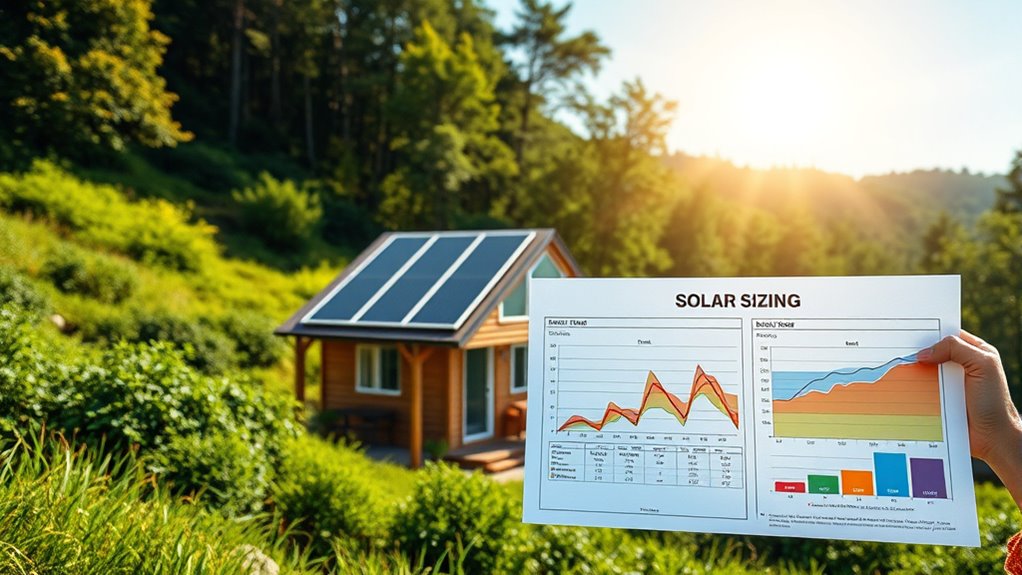
If you’re considering a tiny home and want to go off-grid or reduce your energy bills, understanding how to properly size your solar system is vital. The key to a reliable setup lies in calculating your energy needs accurately, which involves considering your daily power consumption, battery capacity, and inverter selection. Getting these right ensures your tiny home remains powered without over-investing or facing shortages.
First, determine your average daily energy consumption. Look at your appliances, lighting, and any other electrical devices you plan to use. Check their wattage and estimate how many hours each will operate daily. Multiply wattage by hours to get watt-hours, then add everything up for a total daily energy requirement in watt-hours. This figure guides you in selecting the right solar panel capacity, but it’s equally important to match your storage and conversion systems to this load.
Battery capacity is vital because it stores the energy you generate during the day for use at night or on cloudy days. To size your batteries, consider your total daily energy needs and how many days of autonomy you want—meaning, how long your system should operate without sunlight. For example, if your daily use is 3,000 watt-hours and you want two days of backup, you should aim for a battery capacity of at least 6,000 watt-hours. Keep in mind, you shouldn’t fully discharge your batteries regularly; most deep-cycle batteries recommend a 50% discharge limit, so you’ll need to double that capacity to avoid damaging your batteries. This means selecting batteries with a capacity of around 12,000 watt-hours for your scenario. Proper sizing here prevents energy shortfalls and prolongs your battery life.
Inverter selection is the next step. Your inverter converts the DC power stored in your batteries into AC power usable by your appliances. When choosing an inverter, make sure it can handle your peak load—meaning the highest power your devices will draw simultaneously. If you have several appliances running at once, add up their wattages and choose an inverter rated at least 20% higher than this combined load for safety and efficiency. A well-matched inverter prevents overloads and ensures your system runs smoothly. Remember, a mismatch here can limit your power availability or cause equipment damage. Proper sizing of all components is essential for a balanced and efficient off-grid solar setup.

ECO-WORTHY 25 Watts 12V Off Grid Solar Battery Charger Kit: Waterproof Solar Panel + Adjustable Mount Bracket + SAE Connection Cable +10A Charge Controller for Car RV Marine Boat 12V Battery
[Ideal for Keeping Batteries Charged] Designed to charge and maintain 12V rechargeable batteries such as LiFePO₄, Lithium Ion,…
As an affiliate, we earn on qualifying purchases.
As an affiliate, we earn on qualifying purchases.
Conclusion
By calculating your energy needs, selecting the right battery capacity, and choosing an inverter with a safety margin, you create a solar system that’s reliable, efficient, and tailored to your tiny home. Keep your system balanced, your components matched, and your safety margins in check. With this straightforward approach, you’ll enjoy consistent power, reduce unnecessary costs, and embrace sustainable living. Solar sizing becomes simple, effective, and perfectly suited to your tiny home lifestyle.

Weize Deep Cycle AGM 12 Volt 100Ah Battery, Maintenance-Free, 3% Self-Discharge Rate, 1150A Max Discharge Current, Perfect for RV, Solar, Trolling Motor, Wind, Marine, Camping and Off-Grid System
MAINTENANCE FREE: 12.99x 6.73x 8.43 inches. Weize 12v 100Ah sealed lead acid battery is manufactured with absorbent glass…
As an affiliate, we earn on qualifying purchases.
As an affiliate, we earn on qualifying purchases.

OLONETO 4000W 6000W Complete Solar Inverter Kit 12V to 110V 220V with 50A Controller and 100W Solar Panel for Home and Outdoor Power System(6000W,12V-110V)
4000W/6000W Power inverter:surge power: 4000W/6000W, the power inverter comes with free cigarette lighter and 2pcs battery clips, providing…
As an affiliate, we earn on qualifying purchases.
As an affiliate, we earn on qualifying purchases.

Portable Solar Generator, 300W Portable Power Station with Foldable 60W Solar Panel,110V Pure Sine Wave 280Wh Battery Power Pack with USB DC AC Outlet for Camping Smart Devices RV Van Outdoor-Orange
Portable Generator with 60W Solar Panel Included: with a big battery pack, ZeroKor 300W power stations Generator are…
As an affiliate, we earn on qualifying purchases.
As an affiliate, we earn on qualifying purchases.