
To build a solar battery bank for your tiny house, choose durable deep cycle batteries like lithium-ion or AGM, and connect them in series or parallel to meet your voltage and capacity needs. Keep terminals clean and check regularly for wear or corrosion. Use quality wiring, fuses, and a good charge controller to prevent overcharging. Proper configuration, maintenance, and system integration guarantee reliable performance—if you keep exploring, you’ll discover how to optimize your entire setup for long-term efficiency.
Key Takeaways
- Determine your energy needs to select appropriate battery capacity and system size.
- Choose durable deep cycle batteries, such as lithium-ion or AGM, suitable for repeated cycles.
- Connect batteries in series or parallel to achieve desired voltage and capacity.
- Install a charge controller to regulate input and prevent overcharging.
- Regularly inspect, maintain, and monitor the battery bank for optimal performance and longevity.
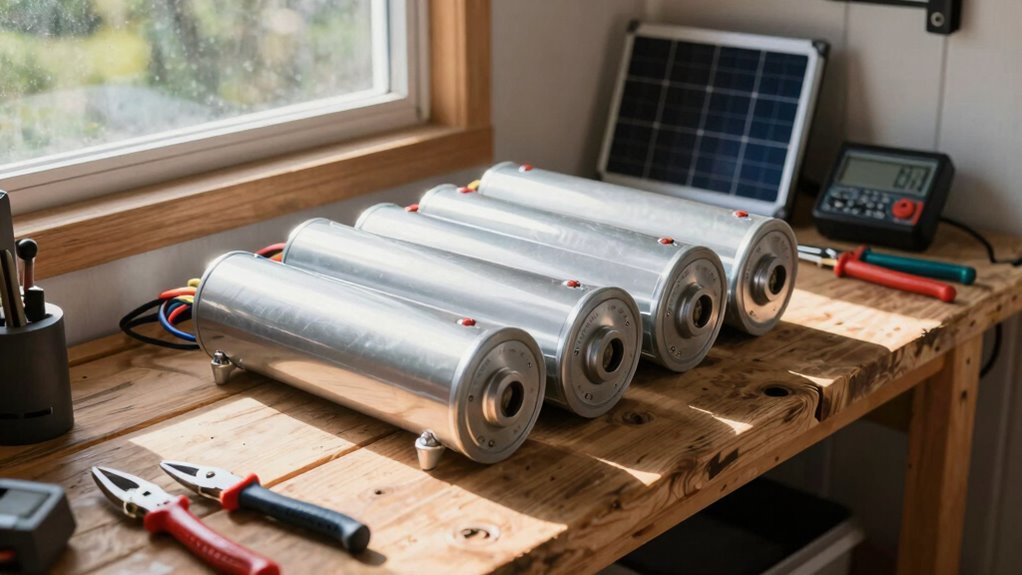
Thinking about powering your tiny house with solar energy? Building a reliable solar battery bank is a smart move, but it requires understanding some key factors. One of the most important is solar panel efficiency. The efficiency of your solar panels directly impacts how much energy you can generate each day. Higher efficiency panels capture more sunlight and convert it into usable electricity, which means you’ll need fewer panels to meet your energy needs. When planning your battery bank, consider investing in high-efficiency panels, especially if space is limited. This guarantees you maximize your solar potential without overcrowding your tiny house’s roof or yard.
Once you’ve selected the right panels, focus on setting up your battery bank properly. Battery maintenance plays a critical role in keeping your system running smoothly over time. Regularly checking your batteries for signs of wear, corrosion, or uneven charge levels helps prevent failures that can leave you without power. It’s important to keep terminals clean and tight, and to monitor your battery voltage and temperature, especially in extreme weather conditions. Proper ventilation is also essential, as batteries can generate heat during charge and discharge cycles. By maintaining your batteries well, you extend their lifespan and guarantee your energy storage remains reliable. Additionally, understanding solar panel efficiency can help you make smarter choices when designing your system, ensuring you get the most out of your panels and batteries. Regularly inspecting your system components and staying informed about battery technology advancements can further enhance your setup’s longevity and performance.
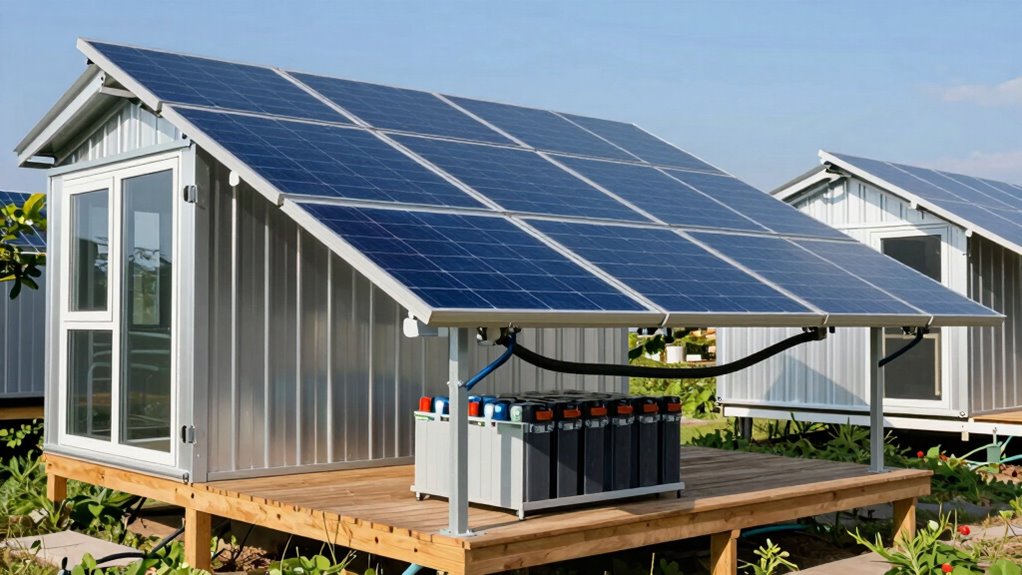
Building your solar battery bank begins with choosing the right type of batteries. Deep cycle batteries, such as lithium-ion or AGM, are popular choices for tiny house systems due to their durability and ability to handle repeated charge cycles. Once you’ve selected your batteries, you connect them in a configuration that matches your energy needs—either in series or parallel—to reach your desired voltage and capacity. Always use quality wiring and fuses to protect your system from electrical faults. Installing a charge controller is necessary to regulate the power going into your batteries, preventing overcharging and damage. Additionally, understanding component integration can help you optimize your system’s overall performance and efficiency, ensuring seamless operation. Continuing to monitor your solar panel efficiency and battery health using a good system monitor is crucial for early detection of potential issues, like a drop in panel output or declining battery capacity, so you can address them promptly. Remember, the better you care for your solar panel efficiency and battery maintenance, the more dependable your tiny house’s energy system becomes. With thoughtful planning and regular upkeep, your solar battery bank will serve as a robust, renewable power source, giving you independence and peace of mind on your tiny house journey.

Weize Deep Cycle AGM 12 Volt 100Ah Battery, Maintenance-Free, 3% Self-Discharge Rate, 1150A Max Discharge Current, Perfect for RV, Solar, Trolling Motor, Wind, Marine, Camping and Off-Grid System
- Maintenance-Free Design: Sealed AGM battery, no maintenance needed
- Compact Dimensions: 12.99 x 6.73 x 8.43 inches
- Corrosion-Resistant Terminals: Positive (+) and Negative (-) terminals
As an affiliate, we earn on qualifying purchases.
As an affiliate, we earn on qualifying purchases.
Frequently Asked Questions
How Long Do Solar Batteries Typically Last?
Solar batteries typically last between 5 to 15 years, depending on their quality and usage. You should expect a certain battery lifespan, but regular maintenance can extend its life. Keep in mind, replacement frequency varies based on how well you care for your batteries and their capacity to hold a charge over time. Monitoring their performance helps you plan for replacements, ensuring your tiny house’s solar system remains reliable.
What Is the Cost of Building a Solar Battery Bank?
Building a solar battery bank costs between $3,000 and $8,000, depending on your battery capacity needs. Did you know that a well-sized battery bank can cut your energy bills by up to 80%? Your cost estimation includes batteries, inverters, and wiring. The size and quality of batteries directly influence expenses; investing in high-quality cells guarantees longer-lasting performance and reliability for your tiny house energy system.
Can I Expand My Battery Bank Later?
Yes, you can expand your battery bank later. To do this effectively, consider your current battery capacity and the expansion options available with your existing setup. Make certain your inverter and charge controller can handle increased capacity, and choose compatible batteries for seamless integration. Planning for future expansion now ensures easier upgrades down the line, giving you flexibility as your energy needs grow.
How Do I Maintain My Solar Batteries?
You should regularly check your solar batteries to guarantee peak charging efficiency, which keeps them healthy. Keep the terminals clean and free of corrosion, and maintain a proper charge cycle. When batteries are no longer useful, consider battery recycling to dispose of them responsibly. Avoid deep discharges and overcharging, as these can reduce lifespan. Consistent maintenance helps maximize performance and extends the life of your solar battery bank.
Are Lithium Batteries Better Than Lead-Acid?
Lithium batteries outperform lead-acid in many ways, yet their battery chemistry demands careful handling and recycling processes. You benefit from higher energy density, longer lifespan, and faster charging, making lithium batteries ideal for tiny house solar setups. Although more expensive upfront, their durability and efficiency often outweigh costs over time. Lead-acid options are cheaper but require more maintenance and have shorter cycles, so consider your long-term needs when choosing.
Conclusion
Building your solar battery bank is like planting a sturdy oak tree—start small, nurture it with care, and watch your tiny house flourish with sustainable energy. With patience and a little know-how, you’ll create a reliable power source that echoes the resilience of nature itself. Soon, your tiny home will shine brightly, a beacon of independence and eco-friendly living in a world hungry for greener solutions. Your solar journey is just beginning—embrace the sunlight and let your energy grow.