
TL;DR

Get compact home essentials delivered free with Prime
- Fast, free delivery on millions of items
- Prime Video, Amazon Music and more included
- Member-only deals all year
An Ideal Home vacuum reviewer says robot vacuums can be useful in small houses, provided owners account for limited floor space, clutter and dock placement. The advice is based on the writer’s experience, not a comparative study; the article does not establish that every model or home will benefit equally.
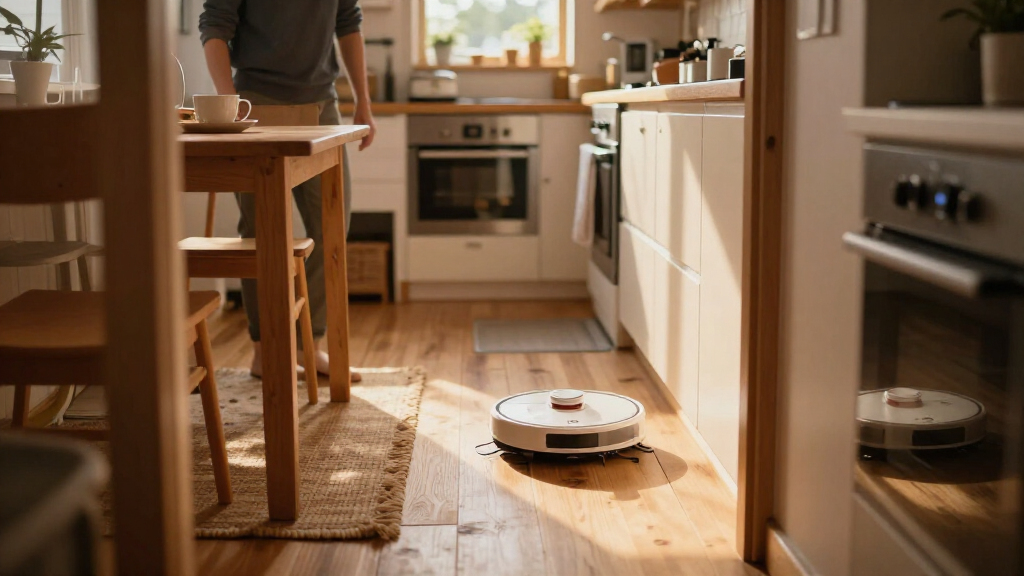
Robot vacuums can be worth buying for small homes, according to an Ideal Home vacuum reviewer, but their usefulness depends on how owners set them up and use them. In advice based on the writer’s experience living with and testing these cleaners, the main considerations are floor clutter, docking-station size, frequent cleaning and small-space-friendly settings.
The reviewer says small homes can suit robot vacuums even though open layouts with fewer obstacles may make cleaning simpler and provide more room to place a dock. The writer uses a robot vacuum daily in a small house and argues that limited floor area is not, by itself, a reason to rule one out. That is a personal assessment rather than a guarantee of results for every home or device.
The first practical issue is clutter on the floor. The article recommends picking up toys, shoes, cables and other objects before a cleaning run. It says obstacle-avoidance features may help a robot move around items, but cannot clean beneath them; clutter can also interrupt a run or tangle around the machine. The writer suggests spending about five minutes a day clearing floor space.
Dock dimensions and placement are another concern, particularly for vacuum-and-mop models with larger stations. The reviewer says some docks need about one metre of clearance from the nearest rug, which may be difficult to provide in a compact home. A smaller model without an auto-empty dock takes up less room but requires the owner to empty its canister and refill its water tank manually. Low-profile designs can also reach beneath some furniture.
The Space Cost of Hands-Free Cleaning
In a small home, a robot vacuum’s footprint is not limited to the cleaner itself. The dock occupies valuable floor space, and a machine that cannot be placed or operated conveniently may be less useful than its feature list suggests. Choosing between a large auto-empty station and a more compact, manually maintained model involves a trade-off between convenience and storage.
How often the machine runs also affects its value. The reviewer says dust and grime can become noticeable quickly in a smaller footprint because daily activities happen in a concentrated area. Their approach is to run the vacuum at least once a day, sometimes more often when floors are muddy, and to target selected rooms or high-traffic areas when a full-home run is unnecessary. This may reduce hands-on cleaning, but it still calls for planning and floor preparation.
For buyers, the practical takeaway is to judge a robot vacuum against the layout and household routine, not just its advertised suction or automation. A compact home with clear floors and a workable dock location may be a good fit; a crowded home with little clearance may require more manual intervention. The article provides experience-based buying guidance, not evidence that a robot vacuum saves a particular amount of time or money.
Products Worth Considering

Roborock Q7 M5+ Robot Vacuum and Mop with Self-Emptying Dock

Shark AI Ultra Robot Vacuum with Self-Empty Base

Shark Navigator Robot Vacuum with Self-Empty Base, Dark Grey (RV2120AE)
As an affiliate, we earn on qualifying purchases.
Five Factors in a Compact Home
The Ideal Home report is written by the publication’s resident vacuum expert, who says they test robot vacuum cleaners at home and also live in a small house. Its central point is that small-home owners may need to actively prepare the space for a robot rather than expect fully hands-free cleaning. The writer frames the recommendations as lessons from personal use.
Alongside decluttering and choosing a dock that fits, the article advises owners to run the machine regularly and make use of available settings. The reviewer says Quiet or Eco modes can reduce disruption while working from home, and that Do Not Disturb mode can prevent automatic emptying or noise at selected times. The supplied excerpt also mentions features such as room selection and high-traffic-area cleaning, which can focus runs where they are needed.
The report names several products as examples, including the Hoover HG2 Turbo Slim Hydro, which lacks an auto-empty docking station, and the SwitchBot K11+ as a compact option with a dock. It also describes the Eufy Robot Vacuum Omni E25 as a model the writer rated five stars. These are the publication’s product examples and review judgments; the material provided does not include independent test data comparing them for small homes.
““In my professional opinion, robot vacuum cleaners are worth it in a small house – but only if you take the time to realise that you’re going to need to actively set this hands-free hero up for success.””
— Ideal Home’s resident vacuum expert
What the Advice Does Not Establish
The report does not provide a controlled comparison of robot vacuums in small and large homes, nor does it quantify how much time a household saves. Its conclusions are drawn from the reviewer’s experience, so results may vary with the layout, flooring, furniture and amount of clutter. The supplied material also does not state the article’s publication date.
It is not clear whether any particular model will fit a reader’s available space without checking its dimensions and the manufacturer’s placement requirements. The article gives a one-metre rug-clearance guideline for docking stations, but the supplied excerpt does not identify that as a universal requirement for every model. It also does not compare the long-term cost of a robot vacuum with manual cleaning or provide independent evidence for the product performance figures it mentions.
Check the Layout Before Buying
The advice points prospective buyers toward a practical next step: measure the area available for both the robot and its dock, then check the model’s clearance and maintenance requirements. Buyers should consider whether they can keep cables and small objects off the floor, and whether they prefer an auto-empty station or are willing to empty a smaller machine themselves.
For households that proceed, the reviewer’s approach is to start with regular runs, adjust the schedule around work and household activity, and use room or zone selection where available. The report does not announce a product launch, policy change or follow-up test; the next development would be any further testing or updated product guidance from the publication.
Key Questions
Can a robot vacuum work in a small house?
According to Ideal Home’s reviewer, yes. The writer uses one daily in a small home, while stressing that clutter, dock placement and setup affect how well it works.
What should I check before buying one for a small home?
Measure the available space for the machine and its dock, check placement guidance for the specific model, and consider whether a large auto-empty station will fit. Also think about how much floor clutter needs to be cleared before runs.
Is an auto-empty dock necessary?
No. The report describes models without auto-empty docks as a space-saving option, but says owners will need to empty the dust canister and refill the water tank manually. The right choice depends on available space and preferred maintenance.
How often does the reviewer run a robot vacuum?
The Ideal Home writer says they run theirs at least once a day and sometimes add a second run when conditions are muddy. That is the writer’s routine, not a frequency established as necessary for every household.
Does the report prove a robot vacuum saves money or time?
No. It offers personal experience and practical advice, but the supplied material does not quantify time savings, financial returns or comparative performance across small homes.
Source: rss