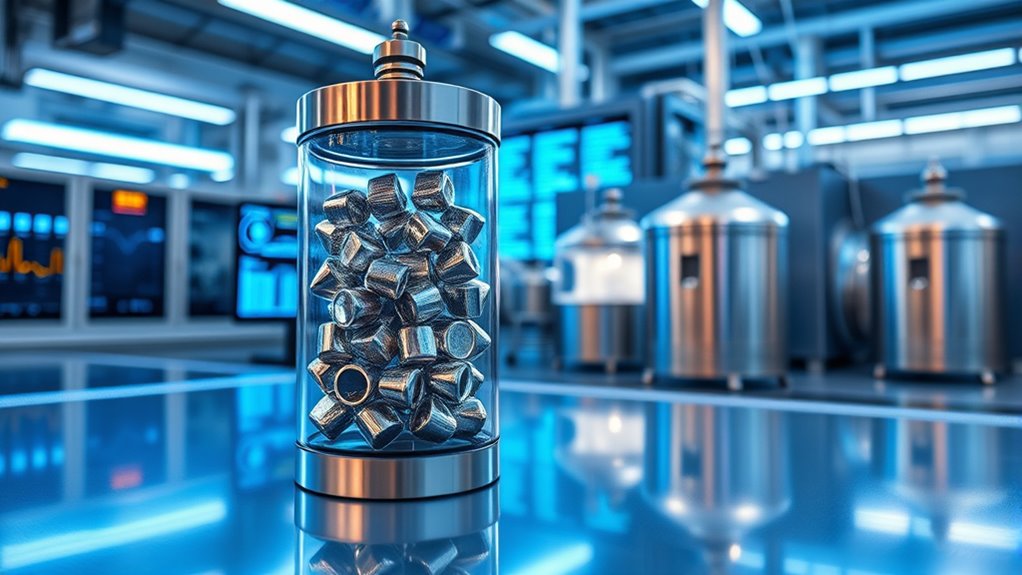

As someone interested in hydrogen energy, you’ll find that solid-state hydrogen storage has advanced markedly by 2025. New materials now offer better durability and higher efficiency, addressing previous challenges of capacity loss and safety concerns. These innovations could reshape how we think about storing and using hydrogen, but understanding their full implications requires exploring the latest developments and ongoing challenges in this rapidly evolving field.

Get compact home essentials delivered free with Prime
- Fast, free delivery on millions of items
- Prime Video, Amazon Music and more included
- Member-only deals all year
Key Takeaways
- Advances focus on developing durable materials that maintain performance over multiple hydrogen absorption/desorption cycles.
- Innovations aim to increase storage capacity and efficiency while ensuring long-term material stability.
- Emerging nanotechnology and composite solutions optimize the balance between durability and hydrogen density.
- Commercial efforts target cost-effective, safe, and scalable solid-state storage systems suitable for infrastructure integration.
- Research emphasizes enhancing material stability to ensure reliable, long-lasting hydrogen storage for diverse applications.

Solid‑state hydrogen storage offers a promising solution for safely and efficiently storing hydrogen without the need for high-pressure tanks or cryogenic temperatures. This technology relies on materials that can absorb, store, and release hydrogen through chemical or physical interactions, making it safer and more compact than traditional methods. As you explore this field, you’ll find that the durability of storage materials is essential to long-term performance. Material durability ensures that the storage medium maintains its integrity over multiple cycles, preventing degradation that could compromise safety or reduce storage capacity. High durability means fewer replacements and lower maintenance costs, which makes the technology more viable for large-scale applications.
Solid-state hydrogen storage’s durability is key to safe, long-term, large-scale energy solutions.
Storage efficiency is another critical aspect you need to understand. It measures how well the material can store hydrogen relative to its weight and volume. Achieving high storage efficiency means you can store more hydrogen in a smaller space, which is essential for applications like transportation where space and weight are limited. Researchers focus heavily on developing materials with high hydrogen uptake capacities while maintaining stability over repeated cycles. Metal hydrides, complex hydrides, and novel nanostructured materials are at the forefront of this effort. They promise increased storage densities and faster hydrogen release, making the system more practical for real-world use.
You should also recognize that balancing material durability and storage efficiency can be challenging. Some materials that offer high hydrogen capacity may degrade quickly or require high temperatures to release hydrogen, reducing their overall practicality. Conversely, highly durable materials might have lower storage densities. The ongoing research aims to optimize these trade-offs, developing materials that can withstand repeated cycling without losing capacity or integrity. Innovations in nanotechnology and composite materials are helping to improve both aspects simultaneously, pushing the boundaries of what’s possible in solid-state storage.
As you explore the latest updates for 2025, you’ll notice that advances are increasingly focused on creating materials that are both durable and highly efficient. These improvements not only extend the lifespan of storage systems but also enhance their commercial viability. The goal is to develop systems that are safe, cost-effective, and capable of integrating seamlessly into existing hydrogen infrastructure. Solid‑state hydrogen storage is evolving rapidly, and understanding these core factors—material durability and storage efficiency—will help you appreciate how close we are to widespread adoption and the potential impact on clean energy transportation and storage solutions. Additionally, ongoing research emphasizes the importance of material stability, which is essential for ensuring long-term performance and safety in practical applications.
solid-state hydrogen storage materials
As an affiliate, we earn on qualifying purchases.
As an affiliate, we earn on qualifying purchases.
Conclusion
As you embrace the future of hydrogen energy, remember that “a journey of a thousand miles begins with a single step.” Advances in solid-state storage in 2025 show we’re on the right path—developing durable, efficient, and safe materials. With continued innovation, you’ll help build a cleaner, sustainable world. Keep pushing forward; each breakthrough brings us closer to reliable, large-scale hydrogen solutions that can transform our energy landscape for generations to come.
Fall Picks
fall essentials
As an affiliate, we earn on qualifying purchases.